
Verwandte Artikel zu Lean Thinking: Banish Waste and Create Wealth in Your...
Inhaltsangabe
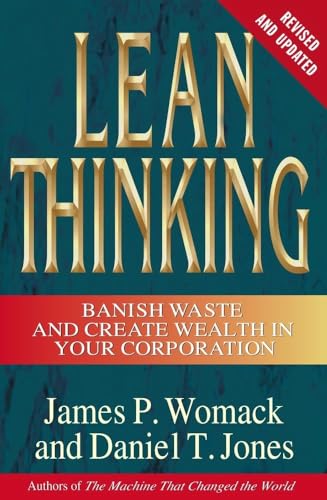
Expanded, updated, and more relevant than ever, this bestselling business classic by two internationally renowned management analysts describes a business system for the twenty-first century.
Expanded, updated, and more relevant than ever, this bestselling business classic by two internationally renowned management analysts describes a business system for the twenty-first century that supersedes the mass production system of Ford, the financial control system of Sloan, and the strategic system of Welch and GE. It is based on the Toyota (lean) model, which combines operational excellence with value-based strategies to produce steady growth through a wide range of economic conditions.
In contrast with the crash-and-burn performance of companies trumpeted by business gurus in the 1990s, the firms profiled in Lean Thinking -- from tiny Lantech to midsized Wiremold to niche producer Porsche to gigantic Pratt & Whitney -- have kept on keeping on, largely unnoticed, along a steady upward path through the market turbulence and crushed dreams of the early twenty-first century. Meanwhile, the leader in lean thinking -- Toyota -- has set its sights on leadership of the global motor vehicle industry in this decade.
Instead of constantly reinventing business models, lean thinkers go back to basics by asking what the customer really perceives as value. (It's often not at all what existing organizations and assets would suggest.) The next step is to line up value-creating activities for a specific product along a value stream while eliminating activities (usually the majority) that don't add value. Then the lean thinker creates a flow condition in which the design and the product advance smoothly and rapidly at the pull of the customer (rather than the push of the producer). Finally, as flow and pull are implemented, the lean thinker speeds up the cycle of improvement in pursuit of perfection. The first part of this book describes each of these concepts and makes them come alive with striking examples.
Lean Thinking clearly demonstrates that these simple ideas can breathe new life into any company in any industry in any country. But most managers need guidance on how to make the lean leap in their firm. Part II provides a step-by-step action plan, based on in-depth studies of more than fifty lean companies in a wide range of industries across the world.
Even those readers who believe they have embraced lean thinking will discover in Part III that another dramatic leap is possible by creating an extended lean enterprise for each of their product families that tightly links value-creating activities from raw materials to customer.
In Part IV, an epilogue to the original edition, the story of lean thinking is brought up-to-date with an enhanced action plan based on the experiences of a range of lean firms since the original publication of Lean Thinking.
Lean Thinking does not provide a new management "program" for the one-minute manager. Instead, it offers a new method of thinking, of being, and, above all, of doing for the serious long-term manager -- a method that is changing the world.
Die Inhaltsangabe kann sich auf eine andere Ausgabe dieses Titels beziehen.
Über die Autorinnen und Autoren
James P. Womack is the president and founder of the Lean Enterprise Institute (www.lean.org), a nonprofit education and research organization based in Brookline, Massachusetts.
Daniel T. Jones is the chairman and founder of the Lean Enterprise Academy (www.leanuk.org), a nonprofit education and research organization based in the UK.
Auszug. © Genehmigter Nachdruck. Alle Rechte vorbehalten.
Chapter 1
Value
A House or a Hassle-Free Experience?
Doyle Wilson of Austin, Texas, had been building homes for fifteen years before he got serious about quality. "In October of 1991 I just got disgusted. Such a large part of my business was waiting and rework, with expensive warranty claims and friction with customers, that I knew there must be a better way. Then I stumbled across the quality movement."
He read Carl Sewell's book on car dealing, Customers for Life, and decided to test his claims by buying a car at Sewell's Dallas dealership. ("I thought that if even a car dealer could make a customer feel good, it should be easy for a homebuilder!") His purchase was such a positive experience that he asked Sewell for advice on quality in home building and was told to read the works of W. Edwards Deming.
Doyle Wilson is the archetypical Texan and never does things halfway. By February of 1992 he had launched a wall-to-wall Total Quality Management campaign at Doyle Wilson Homebuilder. Over the next three years he personally taught his workforce the principles of TQM, began to collect and analyze enormous amounts of data on every aspect of his business, got rid of individual sales commissions ("which destroy quality consciousness"), eliminated the traditional "builder bonus" for his construction superintendents (who were qualifying for the "on-time completion" bonus by making side deals with customers on a "to-be-done-later" list), reduced his contractor corps by two thirds, and required the remaining contractors to attend (and pay for) his monthly quality seminars.
Customer surveys showed a steady rise in satisfaction with the homebuilding experience and sales grew steadily even in a fiat market as Wilson took sales from his competitors. In 1995, Doyle Wilson Homebuilder won the National Housing Quality Award (often called the Baldrige Award for quality of the construction industry), and Wilson set a goal of winning the Baldrige Award itself by 1998. Yet he was not satisfied.
"I knew I was making progress in competing with other builders for the new-home buyer, but a simple fact, once it lodged in my mind, wouldn't go away: 78 percent of the homes bought in central Texas each year are 'used' or older homes. I've been making progress in increasing my share of the 22 percent seeking a new home, but what about the 78 percent who bought older homes? Obviously, these buyers are the real market opportunity."
So instead of surveying people who were buying new homes, Wilson began to talk with people who were buying older homes. What he discovered was obvious in retrospect but has required a complete rethinking of his business. Specifically, he found that many buyers of older homes hated the "hassle factor" in negotiating for new construction, the long lead times to get the job done and move in, the inevitable "to-be-done" list after moving in, and the "phony choices" available from builders who promise custom homes but then load on as "standard equipment" many features of little interest to buyers.
Wilson soon realized that that was exactly what he had been asking his customers to go through. By contrast, older-home customers could clearly see what they were getting, buy only what they wanted, and, often, move in immediately. "No wonder I was losing 78 percent of my potential customers!"
To create a hassle-free experience to go with the house itself (these together constituting Wilson's "product"), it was necessary to rethink every step in the process. He has recently opened a one-stop sales center where the customer can see and decide on every option available in a house (for example, the forty different varieties of brick, the three thousand varieties of wallpaper, the four styles of built-in home office), customize a basic design with the help of an Auto-Cad computer system, select features beyond the standard level (for example, extra-thick carpet pads, additional outdoor lighting, and heavier-duty wiring), determine the exact price, work out the mortgage, arrange for insurance, and arrange for the title search. For customers truly in a hurry this can be done during one walk-through of the sales center.
To shrink the lead time from contract signing to moving in from six months to a target of thirty days, he has reorganized his contract-writing and job-release process and is developing a system of pull scheduling for contractors who are assigned new jobs as downstream jobs are completed.
He is also introducing standardized work statements, parts lists, and tool kits for every job. Eventually these steps will eliminate the "to-do" list because the new system does not allow the next task to start until the previous task is certified as complete with perfect quality.
Finally, Wilson has created a wide range of basic house designs with a minimum construction standard and asks the customer to specify all materials and systems upgrades (using the computer design system) to a selected base design so the customer only pays for exactly what she or he feels is really needed.
Doing all of this will not be easy, as we'll see when we return to this example in Chapter 3 on fiow, but Doyle Wilson has already made the key leap. Instead of concentrating on conventional markets and what he and his contractors were accustomed to making in a conventional way, he has looked hard at value as defined by his customers and set off down a new path.
Start by Challenging Traditional Definitions of "Value"
Why is it so hard to start at the right place, to correctly define value? Partly because most producers want to make what they are already making and partly because many customers only know how to ask for some variant of what they are already getting. They simply start in the wrong place and end up at the wrong destination. Then, when providers or customers do decide to rethink value, they often fall back on simple formulas -- lower cost, increased product variety through customization, instant delivery -- rather than jointly analyzing value and challenging old definitions to see what's really needed.
Steve Maynard, vice president for engineering and product development at the Wiremold Company in West Hartford, Connecticut, was trying to deal with these very problems when he reorganized Wiremold's product development system in 1992. For many years previously, Wiremold had developed new products -- consisting of wire guides for office and industrial users and surge protectors for PCs and other business electronics -- through a conventional departmentalized process. It started with marketing, which commissioned surveys comparing Wiremold's products with the offerings of competitors. When an "opportunity" was identified, usually a gap in the market or a reported weakness in a competitor's offering, a design was developed by product engineering, then tested by the prototype group. If it worked according to specification, the design proceeded to the engineers designing the machines to make the products and eventually went into production.
This system produced designs which lacked imagination and which customers often ignored. (The designs also took too much time and effort to develop and cost too much to make, but these are a different type of problem we'll discuss in Chapter 3.) Simply speeding up this process through simultaneous engineering and then broadening product variety would just have brought more bad designs to market faster. Pure muda.
Steve Maynard's solution was to form a team for each product to stick with that product during its entire production life. This team -- consisting of a marketer, a product engineer, and a tooling/process engineer -- proceeded to enter into a dialogue with leading customers (major contractors) in which all of the old products and solutions were ignored. Instead, the...
„Über diesen Titel“ kann sich auf eine andere Ausgabe dieses Titels beziehen.
Suchergebnisse für Lean Thinking: Banish Waste and Create Wealth in Your...

Beispielbild für diese ISBN
Lean Thinking, Second Edition:
Anbieter: World of Books (was SecondSale), Montgomery, IL, USA
Verkäuferbewertung 5 von 5 Sternen

Zustand: Very Good. Item in very good condition! Textbooks may not include supplemental items i.e. CDs, access codes etc. Artikel-Nr. 00107062584
Gebraucht kaufen
EUR 3,67
Versand gratis
Versand innerhalb von USA
Versand innerhalb von USA
Anzahl: 1 verfügbar
Beispielbild für diese ISBN
Lean Thinking, Second Edition:
Anbieter: World of Books (was SecondSale), Montgomery, IL, USA
Verkäuferbewertung 5 von 5 Sternen
Zustand: Acceptable. Item in acceptable condition! Textbooks may not include supplemental items i.e. CDs, access codes etc. Artikel-Nr. 00106727213
Gebraucht kaufen
EUR 3,67
Versand gratis
Versand innerhalb von USA
Versand innerhalb von USA
Anzahl: 4 verfügbar
Beispielbild für diese ISBN
Lean Thinking, Second Edition:
Anbieter: World of Books (was SecondSale), Montgomery, IL, USA
Verkäuferbewertung 5 von 5 Sternen
Zustand: Good. Item in good condition. Textbooks may not include supplemental items i.e. CDs, access codes etc. Artikel-Nr. 00094567270
Gebraucht kaufen
EUR 3,67
Versand gratis
Versand innerhalb von USA
Versand innerhalb von USA
Anzahl: Mehr als 20 verfügbar
Foto des Verkäufers
Lean Thinking: Banish Waste and Create Wealth in Your Corporation, Revised and Updated
Anbieter: Dream Books Co., Denver, CO, USA
Verkäuferbewertung 5 von 5 Sternen
Zustand: acceptable. This copy has clearly been enjoyedâ"expect noticeable shelf wear and some minor creases to the cover. Binding is strong, and all pages are legible. May contain previous library markings or stamps. Artikel-Nr. 4EKGU9007WBY_ns
Gebraucht kaufen
EUR 3,74
Versand gratis
Versand innerhalb von USA
Versand innerhalb von USA
Anzahl: 1 verfügbar
Foto des Verkäufers
Lean Thinking: Banish Waste and Create Wealth in Your Corporation, Revised and Updated
Anbieter: Dream Books Co., Denver, CO, USA
Verkäuferbewertung 5 von 5 Sternen
Zustand: very_good. Pages are clean with no markings. May show minor signs of wear or cosmetic defects marks, cuts, bends, or scuffs on the cover, spine, pages, or dust jacket. May have remainder marks on edges. Artikel-Nr. DBV.0743249275.VG
Gebraucht kaufen
EUR 3,75
Versand gratis
Versand innerhalb von USA
Versand innerhalb von USA
Anzahl: 1 verfügbar
Foto des Verkäufers
Lean Thinking: Banish Waste and Create Wealth in Your Corporation, Revised and Updated
Anbieter: Dream Books Co., Denver, CO, USA
Verkäuferbewertung 5 von 5 Sternen
Zustand: good. Gently used with minimal wear on the corners and cover. A few pages may contain light highlighting or writing, but the text remains fully legible. Dust jacket may be missing, and supplemental materials like CDs or codes may not be included. May be ex-library with library markings. Ships promptly! Artikel-Nr. 4EKGY3007YXJ_ns
Gebraucht kaufen
EUR 3,75
Versand gratis
Versand innerhalb von USA
Versand innerhalb von USA
Anzahl: 1 verfügbar
Beispielbild für diese ISBN
Lean Thinking: Banish Waste and Create Wealth in Your Corporation, Revised and Updated
Anbieter: ThriftBooks-Reno, Reno, NV, USA
Verkäuferbewertung 5 von 5 Sternen
Hardcover. Zustand: Very Good. No Jacket. May have limited writing in cover pages. Pages are unmarked. ~ ThriftBooks: Read More, Spend Less. Artikel-Nr. G0743249275I4N00
Gebraucht kaufen
EUR 5,73
Versand gratis
Versand innerhalb von USA
Versand innerhalb von USA
Anzahl: 4 verfügbar
Beispielbild für diese ISBN
Lean Thinking: Banish Waste and Create Wealth in Your Corporation, Revised and Updated
Anbieter: ThriftBooks-Phoenix, Phoenix, AZ, USA
Verkäuferbewertung 5 von 5 Sternen
Hardcover. Zustand: Very Good. No Jacket. May have limited writing in cover pages. Pages are unmarked. ~ ThriftBooks: Read More, Spend Less. Artikel-Nr. G0743249275I4N00
Gebraucht kaufen
EUR 5,73
Versand gratis
Versand innerhalb von USA
Versand innerhalb von USA
Anzahl: 4 verfügbar
Beispielbild für diese ISBN
Lean Thinking: Banish Waste and Create Wealth in Your Corporation, Revised and Updated
Anbieter: ThriftBooks-Atlanta, AUSTELL, GA, USA
Verkäuferbewertung 5 von 5 Sternen
Hardcover. Zustand: Very Good. No Jacket. Former library book; May have limited writing in cover pages. Pages are unmarked. ~ ThriftBooks: Read More, Spend Less. Artikel-Nr. G0743249275I4N10
Gebraucht kaufen
EUR 5,73
Versand gratis
Versand innerhalb von USA
Versand innerhalb von USA
Anzahl: 1 verfügbar
Beispielbild für diese ISBN
Lean Thinking: Banish Waste and Create Wealth in Your Corporation, Revised and Updated
Anbieter: ThriftBooks-Atlanta, AUSTELL, GA, USA
Verkäuferbewertung 5 von 5 Sternen
Hardcover. Zustand: Very Good. No Jacket. Missing dust jacket; May have limited writing in cover pages. Pages are unmarked. ~ ThriftBooks: Read More, Spend Less. Artikel-Nr. G0743249275I4N01
Gebraucht kaufen
EUR 5,73
Versand gratis
Versand innerhalb von USA
Versand innerhalb von USA
Anzahl: 1 verfügbar