
Verwandte Artikel zu Mark Twain: A Life (An American Literary History)
Inhaltsangabe
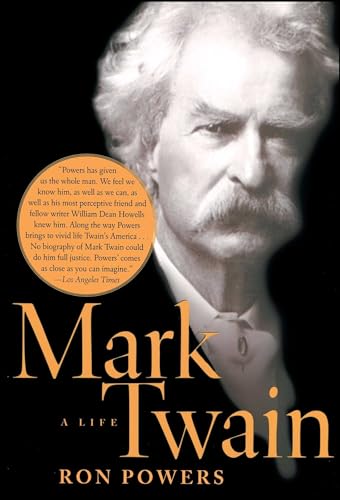
Ron Powers’s tour de force has been widely acclaimed as the best life and times, filled with Mark Twain’s voice, and as a great American story.
Samuel Clemens, the man known as Mark Twain, invented the American voice and became one of our greatest celebrities. His life mirrored his country's, as he grew from a Mississippi River boyhood in the days of the frontier, to a Wild-West journalist during the Gold Rush, to become the king of the eastern establishment and a global celebrity as America became an international power. Along the way, Mark Twain keenly observed the characters and voices that filled the growing country, and left us our first authentically American literature. Ron Powers's magnificent biography offers the definitive life of the founding father of our culture.
Die Inhaltsangabe kann sich auf eine andere Ausgabe dieses Titels beziehen.
Über die Autorin bzw. den Autor
Ron Powers, a Pulitzer Prize-winning and Emmy Award-winning writer and critic, has studied and written about Mark Twain for many years. He is the author of ten books, including Dangerous Water: A Biography of the Boy Who Became Mark Twain, and the coauthor of two, including the #1 New York Times bestseller Flags of Our Fathers. He lives in Middlebury, Vermont.
Auszug. © Genehmigter Nachdruck. Alle Rechte vorbehalten.
Mark Twain
A LifeBy Ron PowersFree Press
Copyright © 2006 Ron PowersAll right reserved.
ISBN: 0743249011
Prologue
On a chilly mid-November afternoon in 1869, a small man with a deranged mop of curly red hair and a wide-swept red mustache sauntered among the pedestrians in the 100 block of Tremont Street in Boston. He was desperately out of place amid these men in their muttonchops and tailored Scottish tweeds, and these women in their jeweled bonnets and brilliant brocade-lined shawls. Tremont bisected the epicenter of American cultural authority and power, announced by the Park Street Church across the thoroughfare and the sweep of the Boston Common behind it; the Georgian residential rooftops lining the far side of the Common; the wrought-iron balconies of Colonnade Row; the great domed neoclassical State House that commanded this elegant realm from the top of nearby Beacon Hill.
It was not just his clothing, black and drably functional, that marked him as an interloper (he owned a smart white collar and swallowtails, but they were reserved for other purposes). It was his gait, a curious rocking, rolling shamble, conspicuously unurbane -- the physical equivalent of a hinterland drawl, which he also possessed.
None of this seemed to faze him. At 124 Tremont Street, a dignified little four-story town house recently converted to an office building, he pushed open the door and let himself inside. He stepped past the heavy tome-scented shelves that filled the commercial shop at street level, the bookstore of Ticknor & Fields, and climbed the staircase leading to the second floor.
The stranger was -- well, that depended. Born Samuel Langhorne Clemens in "the almost invisible village of Florida, Monroe County, Missouri," he had taken to calling himself "Mark Twain" as a newspaperman in Nevada and California, after experimenting with such other pen names as Rambler, W. Epaminondas Adrastus Blab, Thomas Jefferson Snodgrass, and Josh. Lately he had been called "The Wild Humorist of the Pacific Slope" and "The Moralist of the Main," tags given him by his friend Charles Henry Webb.
Ambiguous as he was, he was penetrating an enclave quite certain of its own place in the universe. Only Harvard College itself could have fetched him closer to the core of the young nation's most important intellectual forces.
Ticknor & Fields comprised not only a bookseller but a prestigious publishing house whose authors, many of whom lived nearby, commanded the first ranks of America's emerging literature: the "Sage of Concord," Ralph Waldo Emerson; the originator of the "Brahmin" aesthetic, Oliver Wendell Holmes; Nathaniel Hawthorne; Henry Wadsworth Longfellow; Harriet Beecher Stowe; Henry David Thoreau.
The visitor's destination was an extension of this authoritative domain: the tiny editorial office of the Atlantic Monthly, a literary, cultural, and political magazine whose views, taste, and diction were supplied by the same New England literary aristocracy, and which was distributed to the nation (or at least to some thirty thousand of its citizens) as the highest cultural standard. The Atlantic had been founded twelve years earlier by a group of progressive-minded intellectuals, with the support of Emerson, Holmes, Longfellow, Stowe, and others. Harvard professor James Russell Lowell was appointed its first editor.
After knocking on the office door, the red-haired man was greeted by a robust figure enwreathed in flowing curls of hair and beard: the magazine's editor, James T. Fields, publishing partner of William D. Ticknor, and the Atlantic's editor since 1861. Fields was a self-educated businessman from New Hampshire with a genuine love of writers and ideas. He had guided the magazine through the Civil War years as the principled voice of abolitionist sentiment. But perhaps even more importantly, he had retained its emphasis on poetry, criticism, essays, and fiction -- an ongoing affirmation of civilization's values in those morbid and despairing times. Now Fields, who had a whimsical taste for eccentrics, swept a pile of handwritten manuscripts from a sofa opposite an open fireplace, and the two men chatted for a few moments.
But it was not Fields for whom Clemens had made this unannounced visit. He had come to meet Fields's young assistant, a moist, bookish fellow by the name of William Dean Howells. Howells had written a favorable, albeit unsigned, notice of Clemens's -- make that Mark Twain's -- new book for the Atlantic's current issue. The Atlantic did not usually deign to review books of this ilk: a humorous travelogue peddled door-to-door by common "subscription" salesmen, titled The Innocents Abroad, or The New Pilgrim's Progress. Now, a few days after reading the review, Clemens had arrived in Boston in the course of a lecture tour that, along with the book, was implanting his Western reputation in the formidable circles of the East, and not a moment too soon: he was a few days from turning thirty-four. Clemens knew that no other endorsement was as crucial as the Atlantic's: Howells had handed him an entrée into literary legitimacy. He couldn't help but be curious about who would do such a thing, and why. He'd ascertained the reviewer's identity a few days earlier in Pittsburgh, through a cousin of Howells's whom he'd met there. And now here he was in Boston to look this man in his face and shake his hand.
To the thirty-two-year-old Howells, rising to his height of 5 feet 4 inches from behind his desk, the visitor chatting with his boss was nothing less than -- well, what? Graphic? Bold? Shakespearean? ("Or, if his ghost will not suffer me the word," Howells later mused in print with typical fine-tuning, "then he was Baconian.") The fastidious Howells had seldom laid eyes on such a swashbuckler. Discreet dark woolens draped his own plump frame, punctuated by black bow ties. He wore his hair plastered down and parted at mid-scalp. His own mustache drooped softly over his upper lip, its long, tapering points adding to his aspect of sleepy introspection. His first impulse upon seeing this apparition labeled "Mark Twain," as he later recalled, was of alarm for the proprieties violated. Specifically, he shuddered at what "droll comment" might have been in the mind of his employer Mr. Fields as the two men of letters contemplated the disheveled, blazing-eyed figure in front of them. (And this was one of Clemens's good-grooming days. Others who had encountered him at this stage of his life remembered him as "disreputable-looking," "seedy," even "sinister," and equipped with "an evil-smelling cigar butt.")
The book that Howells had praised was a daring choice for an Atlantic review, given that it lampooned much of what the magazine stood for. Exuberantly un-Eastern, impious, and unconcerned with moral improvement, it amounted to a genial pie in the face of the European classicism that still regulated the tone and values of the American intellectuals while they struggled to liberate their nation from it. The Innocents Abroad was Mark Twain's eyewitness account of a transatlantic excursion by some sixty-five reverential American tourists, from New York harbor to Old Europe and the Holy Land -- the first successful organized "luxury cruise" in U.S. history. The idea for the voyage had been dreamed up by Henry Ward Beecher, the nationally renowned pastor of the Plymouth Congregational Church in Brooklyn. Beecher had conceived it as a way to finance his gathering of material for a biography of Jesus -- the idea being, presumably, that the Gospels...
„Über diesen Titel“ kann sich auf eine andere Ausgabe dieses Titels beziehen.
Suchergebnisse für Mark Twain: A Life (An American Literary History)

Beispielbild für diese ISBN
Mark Twain: A Life (An America
Anbieter: World of Books (was SecondSale), Montgomery, IL, USA
Verkäuferbewertung 5 von 5 Sternen

Zustand: Acceptable. Item in acceptable condition! Textbooks may not include supplemental items i.e. CDs, access codes etc. Artikel-Nr. 00102848464
Gebraucht kaufen
EUR 4,00
Versand gratis
Versand innerhalb von USA
Versand innerhalb von USA
Anzahl: 3 verfügbar
Beispielbild für diese ISBN
Mark Twain: A Life (An America
Anbieter: World of Books (was SecondSale), Montgomery, IL, USA
Verkäuferbewertung 5 von 5 Sternen
Zustand: Good. Item in good condition. Textbooks may not include supplemental items i.e. CDs, access codes etc. Artikel-Nr. 00099739659
Gebraucht kaufen
EUR 4,00
Versand gratis
Versand innerhalb von USA
Versand innerhalb von USA
Anzahl: 13 verfügbar
Beispielbild für diese ISBN
Mark Twain: A Life (An American Literary History)
Anbieter: World of Books (was SecondSale), Montgomery, IL, USA
Verkäuferbewertung 5 von 5 Sternen
Zustand: Good. Item in good condition and has highlighting/writing on text. Used texts may not contain supplemental items such as CDs, info-trac etc. Artikel-Nr. 00101132461
Gebraucht kaufen
EUR 5,29
Versand gratis
Versand innerhalb von USA
Versand innerhalb von USA
Anzahl: 1 verfügbar
Beispielbild für diese ISBN
Mark Twain: A Life (An American Literary History)
Verlag:
Free Press (edition Reprint), 2006
ISBN 10: 0743249011
ISBN 13: 9780743249010
Gebraucht
Paperback
Anbieter: BooksRun, Philadelphia, PA, USA
Verkäuferbewertung 5 von 5 Sternen
Paperback. Zustand: Very Good. Reprint. It's a well-cared-for item that has seen limited use. The item may show minor signs of wear. All the text is legible, with all pages included. It may have slight markings and/or highlighting. Artikel-Nr. 0743249011-11-1
Gebraucht kaufen
EUR 5,51
Versand gratis
Versand innerhalb von USA
Versand innerhalb von USA
Anzahl: 1 verfügbar
Beispielbild für diese ISBN
Mark Twain: A Life
Anbieter: ThriftBooks-Phoenix, Phoenix, AZ, USA
Verkäuferbewertung 5 von 5 Sternen
Paperback. Zustand: Good. No Jacket. Pages can have notes/highlighting. Spine may show signs of wear. ~ ThriftBooks: Read More, Spend Less. Artikel-Nr. G0743249011I3N00
Gebraucht kaufen
EUR 5,75
Versand gratis
Versand innerhalb von USA
Versand innerhalb von USA
Anzahl: 1 verfügbar
Beispielbild für diese ISBN
Mark Twain: A Life
Anbieter: ThriftBooks-Reno, Reno, NV, USA
Verkäuferbewertung 5 von 5 Sternen
Paperback. Zustand: Good. No Jacket. Pages can have notes/highlighting. Spine may show signs of wear. ~ ThriftBooks: Read More, Spend Less. Artikel-Nr. G0743249011I3N00
Gebraucht kaufen
EUR 5,75
Versand gratis
Versand innerhalb von USA
Versand innerhalb von USA
Anzahl: 1 verfügbar
Beispielbild für diese ISBN
Mark Twain: A Life
Anbieter: ThriftBooks-Dallas, Dallas, TX, USA
Verkäuferbewertung 5 von 5 Sternen
Paperback. Zustand: Very Good. No Jacket. May have limited writing in cover pages. Pages are unmarked. ~ ThriftBooks: Read More, Spend Less. Artikel-Nr. G0743249011I4N00
Gebraucht kaufen
EUR 5,75
Versand gratis
Versand innerhalb von USA
Versand innerhalb von USA
Anzahl: 1 verfügbar
Beispielbild für diese ISBN
Mark Twain: A Life
Anbieter: ThriftBooks-Atlanta, AUSTELL, GA, USA
Verkäuferbewertung 5 von 5 Sternen
Paperback. Zustand: Good. No Jacket. Pages can have notes/highlighting. Spine may show signs of wear. ~ ThriftBooks: Read More, Spend Less. Artikel-Nr. G0743249011I3N00
Gebraucht kaufen
EUR 5,75
Versand gratis
Versand innerhalb von USA
Versand innerhalb von USA
Anzahl: 2 verfügbar
Beispielbild für diese ISBN
Mark Twain: A Life
Anbieter: ThriftBooks-Dallas, Dallas, TX, USA
Verkäuferbewertung 5 von 5 Sternen
Paperback. Zustand: Good. No Jacket. Pages can have notes/highlighting. Spine may show signs of wear. ~ ThriftBooks: Read More, Spend Less. Artikel-Nr. G0743249011I3N00
Gebraucht kaufen
EUR 5,75
Versand gratis
Versand innerhalb von USA
Versand innerhalb von USA
Anzahl: 1 verfügbar
Beispielbild für diese ISBN
Mark Twain: A Life (An American Literary History)
Verlag:
Free Press (edition Reprint), 2006
ISBN 10: 0743249011
ISBN 13: 9780743249010
Gebraucht
Paperback
Anbieter: BooksRun, Philadelphia, PA, USA
Verkäuferbewertung 5 von 5 Sternen
Paperback. Zustand: Very Good. Reprint. It's a well-cared-for item that has seen limited use. The item may show minor signs of wear. All the text is legible, with all pages included. It may have slight markings and/or highlighting. Artikel-Nr. 0743249011-8-1
Gebraucht kaufen
EUR 5,89
Versand gratis
Versand innerhalb von USA
Versand innerhalb von USA
Anzahl: 1 verfügbar