
Verwandte Artikel zu Character Matters: How to Help Our Children Develop...
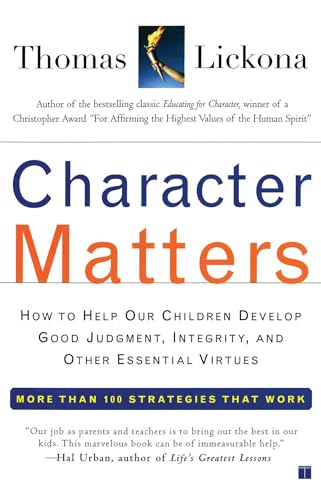
Character Matters: How to Help Our Children Develop Good Judgment, Integrity, and Other Essential Virtues - Softcover
Inhaltsangabe
Award-winning psychologist and educator Thomas Lickona offers more than one hundred practical strategies that parents and schools have used to help kids build strong personal character as the foundation for a purposeful, productive, and fulfilling life.
Succeeding in life takes character, and Lickona shows how irresponsible and destructive behavior can invariably be traced to the absence of good character and its ten essential qualities: wisdom, justice, fortitude, self-control, love, a positive attitude, hard work, integrity, gratitude, and humility.
The culmination of a lifetime’s work in character education from one the preeminent psychologists of our time, this landmark book gives us the tools we need to raise respectful and responsible children, create safe and effective schools, and build the caring and decent society in which we all want to live.
Die Inhaltsangabe kann sich auf eine andere Ausgabe dieses Titels beziehen.
Über die Autorin bzw. den Autor
Thomas Lickona is a developmental psychologist and professor of education at the State University of New York at Cortland, where he directs the Center for the 4th and 5th Rs (respect and responsibility). The recipient of the Sandy Lifetime Achievement Award from the Character Education Partnership, he is the author of Educating for Character, which has been called "the bible of the character education movement."
Von der hinteren Coverseite
Award-winning psychologist and educator Thomas Lickona offers more than one hundred practical strategies that parents and schools have used to help kids build strong personal character as the foundation for a purposeful, productive, and fulfilling life.
Succeeding in life takes character, and Lickona shows how irresponsible and destructive behavior can invariably be traced to the absence of good character and its ten essential qualities: wisdom, justice, fortitude, self-control, love, a positive attitude, hard work, integrity, gratitude, and humility.
The culmination of a lifetime’s work in character education from one the preeminent psychologists of our time, this landmark book gives us the tools we need to raise respectful and responsible children, create safe and effective schools, and build the caring and decent society in which we all want to live.
Auszug. © Genehmigter Nachdruck. Alle Rechte vorbehalten.
Introduction
Portraits of character touch something deep in the human heart. In the award-winning Civil War documentary by Ken Burns, one of the most commented on and moving moments was the reading of a letter written by a Union soldier, Major Sullivan Ballou, to his wife, Sarah, a week before his death at the Battle of Bull Run:
My very dear Sarah,
The indications are very strong that we shall move in a few days -- perhaps tomorrow. Lest I should not be able to write again, I feel impelled to write a few lines that may fall under your eye when I shall be no more.
I have no misgivings about, or lack of confidence in, the cause in which I am engaged, and my courage does not halt or falter. I know how strongly American Civilization now leans on the triumph of the Government, and how great a debt we owe to those who went before us through the blood and sufferings of the Revolution. And I am willing -- perfectly willing -- to lay down all my joys in this life to help maintain this Government, and to pay that debt....
Sarah, my love for you is deathless...and yet my love of Country comes over me like a strong wind and bears me irresistibly on to the battle field.
The memories of the blissful moments I have spent with you come creeping over me, and I feel most gratified to God and to you that I have enjoyed them so long....I have, I know, but few and small claims upon Divine Providence, but something whispers to me -- perhaps it is the wafted prayer of my little Edgar, that I shall return to my loved ones unharmed. If I do not, my dear Sarah, never forget how much I love you, and when my last breath escapes me on the battle field, it will whisper your name.
Here was a humble man, a courageous man, who loved his family and loved his country and, spurred on by high ideals, did his duty as he saw it without complaining. Tom Brokaw, interviewing veterans of World War II in his best-selling book The Greatest Generation was struck by many of the same qualities. September 11 produced abundant examples of unassuming heroism and sacrificial generosity.
We are moved by these stories of character because they show us human beings at their best. They reveal our capacity for goodness. They challenge us to be more than we might otherwise be. And they renew our faith in every child's potential to grow into a person of character.
As we begin a new century, we have a sharper sense of how much character matters. We need good character to lead purposeful, productive, and fulfilling lives. We need character to have strong and stable families. We need character to have safe, caring, and effective schools. We need character to build a civil, decent, and just society.
We are troubled, however, by the unraveling of the moral fabric of our society. In a recent national poll, nearly three of four American adults said that they believe that people in general lead less honest and moral lives than they used to.1 Says a high school teacher, "Kids today are more cynical than ever about the lack of honesty they see in the adult world."
We're troubled by all the ways societal moral decline is reflected, as it inevitably is, in the attitudes and behavior of our children. We're troubled by the precocious sexual behavior of the young. We're troubled by the bad language that comes out of the mouths of even elementary school children. We're troubled by the breakdown of the family and the growing numbers of parents who seem to let their children do and watch what they please. We're troubled by a ubiquitous media culture that grows more violent and vulgar by the day.
How can we renew our moral culture?
Children are 25 percent of the population but 100 percent of the future. If we wish to renew society, we must raise up a generation of children who have strong moral character. And if we wish to do that, we have two responsibilities: first, to model good character in our own lives, and second, to intentionally foster character development in our young.
Happily, an effort to do this is under way. For more than a decade, there has been a resurgence of character education in our nation's schools. It can be seen in a spate of character education books and curricular materials; in federal funding for character education and character education mandates in more than two-thirds of the states; in the emergence of national advocacy groups such as the Character Education Partnership and the Character Counts! Coalition; in the new Journal of Research in Character Education, the National Schools of Character awards competition, and reports on how to prepare future teachers to be character educators; and in an explosion of grassroots character education initiatives.
Character education is welcomed by parents who need support for the hard work of raising good children in a hostile moral environment; welcomed by teachers who went into teaching hoping to make a difference in the kind of person a child becomes and are demoralized to be in a school that gives up teaching right from wrong; and welcomed by all of us who are saddened by the decline in values as basic as common courtesy that we once took for granted. Effective character education in our schools is something all of us have a stake in, not just educators and parents, but everyone who cares about a decent society.
The premise of the character education movement is that the disturbing behaviors that bombard us daily -- violence, greed, corruption, incivility, drug abuse, sexual immorality, and a poor work ethic -- have a common core: the absence of good character. Educating for character, unlike piecemeal reforms, goes beneath the symptoms to the root of these problems. It therefore offers the best hope of improvement in all these areas.
Character education, of course, is not only the responsibility of schools. It is the shared duty of all those who touch the values and lives of the young, starting with families and extending to faith communities, youth organizations, business, government, and even the media. The hope for the future is that we can come together in common cause: to elevate the character of our children, our own character as adults, and ultimately the character of our culture.
At the heart of effective character education is a strong partnership between parents and schools. The family is the first school of virtue. It is where we learn about love. It is where we learn about commitment, sacrifice, and faith in something larger than ourselves. The family lays down the moral foundation on which all other social institutions build.
Parents, if they make the effort, can remain formative influences even during the challenging adolescent years. Building a Better Teenager, a 2002 research report based on hundreds of studies, concludes that the most academically motivated and morally responsible teens -- and the ones least likely to engage in risky behaviors -- are those who enjoy warm and involved relationships with their parents and whose parents set clear expectations and monitor their activities in age-appropriate ways.
For the past nine years, our Center for the 4th and 5th Rs (respect and responsibility) at the State University of New York at Cortland has worked with schools and parents to promote the development of good character. We publish a Fourth and Fifth Rs newsletter (www.cortland.edu/c4n5rs) spotlighting character education success stories and run the Summer Institute in Character Education, which trains teachers, counselors, administrators, and other educators from across the country.
Character education, we always emphasize, is not a new idea. Down through history, all over the world, education has had two great goals: to help students become smart and to help them become good. They need character for both. They need character strengths such as a...
„Über diesen Titel“ kann sich auf eine andere Ausgabe dieses Titels beziehen.
Suchergebnisse für Character Matters: How to Help Our Children Develop...

Beispielbild für diese ISBN
Character Matters: How to Help Our Children Develop Good Judgment, Integrity, and Other Essential Virtues
Anbieter: World of Books (was SecondSale), Montgomery, IL, USA
Verkäuferbewertung 5 von 5 Sternen

Paperback. Zustand: Good. Synopsis coming soon. Artikel-Nr. 00095382883
Gebraucht kaufen
EUR 4,04
Versand gratis
Versand innerhalb von USA
Versand innerhalb von USA
Anzahl: 14 verfügbar
Beispielbild für diese ISBN
Character Matters: How to Help Our Children Develop Good Judgment, Integrity, and Other Essential Virtues
Anbieter: World of Books (was SecondSale), Montgomery, IL, USA
Verkäuferbewertung 5 von 5 Sternen
Paperback. Zustand: Fair. Synopsis coming soon. Artikel-Nr. 00069203862
Gebraucht kaufen
EUR 4,04
Versand gratis
Versand innerhalb von USA
Versand innerhalb von USA
Anzahl: 7 verfügbar
Beispielbild für diese ISBN
Character Matters: How to Help Our Children Develop Good Judgment, Integrity, and Other Essential Virtues
Anbieter: World of Books (was SecondSale), Montgomery, IL, USA
Verkäuferbewertung 5 von 5 Sternen
Paperback. Zustand: Very Good. Synopsis coming soon. Artikel-Nr. 00094460190
Gebraucht kaufen
EUR 4,04
Versand gratis
Versand innerhalb von USA
Versand innerhalb von USA
Anzahl: 4 verfügbar
Beispielbild für diese ISBN
Character Matters: How to Help Our Children Develop Good Judgment, Integrity, and Other Essential Virtues
Verlag:
Atria Books (edition Original ed.), 2004
ISBN 10: 0743245075
ISBN 13: 9780743245074
Gebraucht
Paperback
Anbieter: BooksRun, Philadelphia, PA, USA
Verkäuferbewertung 5 von 5 Sternen
Paperback. Zustand: Very Good. Original ed. It's a well-cared-for item that has seen limited use. The item may show minor signs of wear. All the text is legible, with all pages included. It may have slight markings and/or highlighting. Artikel-Nr. 0743245075-11-1
Gebraucht kaufen
EUR 4,47
Versand gratis
Versand innerhalb von USA
Versand innerhalb von USA
Anzahl: 1 verfügbar
Beispielbild für diese ISBN
Character Matters: How to Help Our Children Develop Good Judgment, Integrity, and Other Essential Virtues
Anbieter: ThriftBooks-Reno, Reno, NV, USA
Verkäuferbewertung 5 von 5 Sternen
Paperback. Zustand: Very Good. No Jacket. May have limited writing in cover pages. Pages are unmarked. ~ ThriftBooks: Read More, Spend Less. Artikel-Nr. G0743245075I4N00
Gebraucht kaufen
EUR 5,96
Versand gratis
Versand innerhalb von USA
Versand innerhalb von USA
Anzahl: 1 verfügbar
Beispielbild für diese ISBN
Character Matters: How to Help Our Children Develop Good Judgment, Integrity, and Other Essential Virtues
Anbieter: ThriftBooks-Atlanta, AUSTELL, GA, USA
Verkäuferbewertung 5 von 5 Sternen
Paperback. Zustand: Very Good. No Jacket. May have limited writing in cover pages. Pages are unmarked. ~ ThriftBooks: Read More, Spend Less. Artikel-Nr. G0743245075I4N00
Gebraucht kaufen
EUR 5,96
Versand gratis
Versand innerhalb von USA
Versand innerhalb von USA
Anzahl: 1 verfügbar
Beispielbild für diese ISBN
Character Matters : How to Help Our Children Develop Good Judgment, Integrity, and Other Essential Virtues
Anbieter: Better World Books: West, Reno, NV, USA
Verkäuferbewertung 5 von 5 Sternen
Zustand: Very Good. Former library copy. Pages intact with possible writing/highlighting. Binding strong with minor wear. Dust jackets/supplements may not be included. Includes library markings. Stock photo provided. Product includes identifying sticker. Better World Books: Buy Books. Do Good. Artikel-Nr. 4076162-75
Gebraucht kaufen
EUR 6,19
Versand gratis
Versand innerhalb von USA
Versand innerhalb von USA
Anzahl: 1 verfügbar
Beispielbild für diese ISBN
Character Matters : How to Help Our Children Develop Good Judgment, Integrity, and Other Essential Virtues
Anbieter: Better World Books, Mishawaka, IN, USA
Verkäuferbewertung 5 von 5 Sternen
Zustand: Good. Pages intact with minimal writing/highlighting. The binding may be loose and creased. Dust jackets/supplements are not included. Stock photo provided. Product includes identifying sticker. Better World Books: Buy Books. Do Good. Artikel-Nr. 3430991-6
Gebraucht kaufen
EUR 6,19
Versand gratis
Versand innerhalb von USA
Versand innerhalb von USA
Anzahl: 2 verfügbar
Beispielbild für diese ISBN
Character Matters: How to Help Our Children Develop Good Judgment, Integrity, and Other Essential Virtues
Anbieter: Wonder Book, Frederick, MD, USA
Verkäuferbewertung 5 von 5 Sternen
Zustand: Good. Good condition. With remainder mark. A copy that has been read but remains intact. May contain markings such as bookplates, stamps, limited notes and highlighting, or a few light stains. Artikel-Nr. V02A-05127
Gebraucht kaufen
EUR 6,43
Versand gratis
Versand innerhalb von USA
Versand innerhalb von USA
Anzahl: 1 verfügbar
Beispielbild für diese ISBN
Character Matters: How to Help Our Children Develop Good Judgment, Integrity, and Other Essential Virtues
Anbieter: Books From California, Simi Valley, CA, USA
Verkäuferbewertung 4 von 5 Sternen

paperback. Zustand: Very Good. Cover and edges may have some wear. Artikel-Nr. mon0004104290
Gebraucht kaufen
EUR 4,60
EUR 4,45 Versand
Versand innerhalb von USA
Versand innerhalb von USA
Anzahl: 1 verfügbar