
Verwandte Artikel zu Nixonland: The Rise of a President and the Fracturing...
Inhaltsangabe
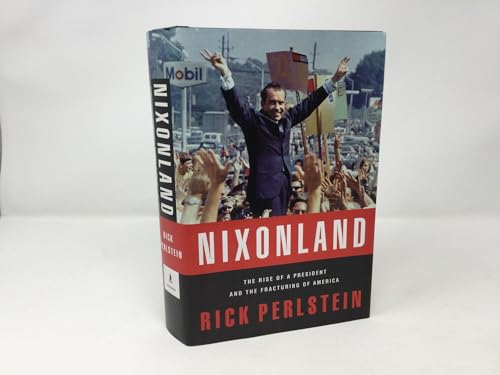
Told with urgency and sharp political insight, Nixonland recaptures America's turbulent 1960s and early 1970s and reveals how Richard Nixon rose from the political grave to seize and hold the presidency.
Perlstein's epic account begins in the blood and fire of the 1965 Watts riots, nine months after Lyndon Johnson's historic landslide victory over Barry Goldwater appeared to herald a permanent liberal consensus in the United States. Yet the next year, scores of liberals were tossed out of Congress, America was more divided than ever, and a disgraced politician was on his way to a shocking comeback: Richard Nixon.
Between 1965 and 1972, America experienced no less than a second civil war. Out of its ashes, the political world we know now was born. It was the era not only of Nixon, Johnson, Spiro Agnew, Hubert H. Humphrey, George McGovern, Richard J. Daley, and George Wallace but Abbie Hoffman, Ronald Reagan, Angela Davis, Ted Kennedy, Charles Manson, John Lindsay, and Jane Fonda. There are tantalizing glimpses of Jimmy Carter, George H. W. Bush, Jesse Jackson, John Kerry, and even of two ambitious young men named Karl Rove and William Clinton -- and a not so ambitious young man named George W. Bush.
Cataclysms tell the story of Nixonland:
Angry blacks burning down their neighborhoods in cities across the land as white suburbanites defend home and hearth with shotguns The student insurgency over the Vietnam War, the assassinations of Robert F. Kennedy and Martin Luther King, and the riots at the 1968 Democratic National Convention The fissuring of the Democratic Party into warring factions manipulated by the "dirty tricks" of Nixon and his Committee to Re-Elect the President Richard Nixon pledging a new dawn of national unity, governing more divisively than any president before him, then directing a criminal conspiracy, the Watergate cover-up, from the Oval Office
Then, in November 1972, Nixon, harvesting the bitterness and resentment born of America's turmoil, was reelected in a landslide even bigger than Johnson's 1964 victory, not only setting the stage for his dramatic 1974 resignation but defining the terms of the ideological divide that characterizes America today.
Filled with prodigious research and driven by a powerful narrative, Rick Perlstein's magisterial account of how America divided confirms his place as one of our country's most celebrated historians.
Die Inhaltsangabe kann sich auf eine andere Ausgabe dieses Titels beziehen.
Über die Autorin bzw. den Autor
Rick Perlstein is the author of Before the Storm: Barry Goldwater and the Unmaking of the American Consenus, which won the 2001 Los Angeles Times Book Award for history and appeared on the best books of the year lists of the New York Times, the Washington Post, and the Chicago Tribune. His essays and book reviews have been published in The New Yorker, the New York Times, the Washington Post, The Nation, The Village Voice, and Slate, among others. He has received a National Endowment for the Humanities grant for independent scholars. He lives with his wife in Chicago.
Auszug. © Genehmigter Nachdruck. Alle Rechte vorbehalten.
Preface
In 1964, the Democratic presidential candidate Lyndon B. Johnson won practically the biggest landslide in American history, with 61.05 percent of the popular vote and 486 of 538 electoral college votes. In 1972, the Republican presidential candidate Richard M. Nixon won a strikingly similar landslide -- 60.67 percent and 520 electoral college votes. In the eight years in between, the battle lines that define our culture and politics were forged in blood and fire. This is a book about how that happened, and why.
At the start of 1965, when those eight years began, blood and fire weren't supposed to be a part of American culture and politics. According to the pundits, America was more united and at peace with itself than ever. Five years later, a pretty young Quaker girl from Philadelphia, a winner of a Decency Award from the Kiwanis Club, was cross-examined in the trial of seven Americans charged with conspiring to start a riot at the 1968 Democratic National Convention.
"You practice shooting an M1 yourself, don't you?" the prosecutor asked her.
"Yes, I do," she responded.
"You also practice karate, don't you?"
"Yes, I do."
"That is for the revolution, isn't it?"
"After Chicago I changed from being a pacifist to the realization that we had to defend ourselves. A nonviolent revolution was impossible. I desperately wish it was possible."
And, several months after that, an ordinary Chicago ad salesman would be telling Time magazine, "I'm getting to feel like I'd actually enjoy going out and shooting some of these people. I'm just so goddamned mad. They're trying to destroy everything I've worked for -- for myself, my wife, and my children."
This American story is told in four sections, corresponding to four elections: in 1966, 1968, 1970, and 1972. Politicians, always reading the cultural winds, make their life's work convincing 50 percent plus one of their constituency that they understand their fears and hopes, can honor and redeem them, can make them safe and lead them toward their dreams. Studying the process by which a notably successful politician achieves that task, again and again, across changing cultural conditions, is a deep way into an understanding of those fears and dreams -- and especially, how those fears and dreams change.
The crucial figure in common to all these elections was Richard Nixon -- the brilliant and tormented man struggling to forge a public language that promised mastery of the strange new angers, anxieties, and resentments wracking the nation in the 1960s. His story is the engine of this narrative. Nixon's character -- his own overwhelming angers, anxieties, and resentments in the face of the 1960s chaos -- sparks the combustion. But there was nothing natural or inevitable about how he did it -- nothing inevitable in the idea that a president could come to power by using the angers, anxieties, and resentments produced by the cultural chaos of the 1960s. Indeed, he was slow to the realization. He reached it, through the 1966 election, studying others: notably, Ronald Reagan, who won the governorship of California by providing a political outlet for the outrages that, until he came along to articulate them, hadn't seemed like voting issues at all. If it hadn't been for the shocking defeats of a passel of LBJ liberals blindsided in 1966 by a conservative politics of "law and order," things might have turned out differently: Nixon might have run on a platform not too different from that of the LBJ liberals instead of one that cast them as American villains.
Nixon's win in 1968 was agonizingly close: he began his first term as a minority president. But the way he achieved that narrow victory seemed to point the way toward an entire new political alignment from the one that had been stable since FDR and the Depression. Next, Nixon bet his presidency, in the 1970 congressional elections, on the idea that an "emerging Republican majority" -- rooted in the conservative South and Southwest, seething with rage over the destabilizing movements challenging the Vietnam War, white political power, and virtually every traditional cultural norm -- could give him a governing majority in Congress. But when Republican candidates suffered humiliating defeats in 1970, Nixon blamed the chicanery of his enemies: America's enemies, he had learned to think of them. He grew yet more determined to destroy them, because of what he was convinced was their determination to destroy him.
Millions of Americans recognized the balance of forces in the exact same way -- that America was engulfed in a pitched battle between the forces of darkness and the forces of light. The only thing was: Americans disagreed radically over which side was which. By 1972, defining that order of battle as one between "people who identified with what Richard Nixon stood for" and "people who despised what Richard Nixon stood for" was as good a description as any other.
Richard Nixon, now, is long dead. But these sides have hardly changed. We now call them "red" or "blue" America, and whether one or the other wins the temporary allegiances of 50 percent plus one of the electorate -- or 40 percent of the electorate, or 60 percent of the electorate -- has been the narrative of every election since. It promises to be thus for another generation. But the size of the constituencies that sort into one or the other of the coalitions will always be temporary.
The main character in Nixonland is not Richard Nixon. Its protagonist, in fact, has no name -- but lives on every page. It is the voter who, in 1964, pulled the lever for the Democrat for president because to do anything else, at least that particular Tuesday in November, seemed to court civilizational chaos, and who, eight years later, pulled the lever for the Republican for exactly the same reason.
Copyright © 2008 by Rick Perlstein
„Über diesen Titel“ kann sich auf eine andere Ausgabe dieses Titels beziehen.
Weitere beliebte Ausgaben desselben Titels

Suchergebnisse für Nixonland: The Rise of a President and the Fracturing...

Beispielbild für diese ISBN
Nixonland The Rise of a Presid
Anbieter: World of Books (was SecondSale), Montgomery, IL, USA
Verkäuferbewertung 5 von 5 Sternen

Zustand: Good. Item in good condition and has highlighting/writing on text. Used texts may not contain supplemental items such as CDs, info-trac etc. Artikel-Nr. 00107730788
Gebraucht kaufen
EUR 7,62
Versand gratis
Versand innerhalb von USA
Versand innerhalb von USA
Anzahl: 1 verfügbar
Beispielbild für diese ISBN
Nixonland The Rise of a Presid
Anbieter: World of Books (was SecondSale), Montgomery, IL, USA
Verkäuferbewertung 5 von 5 Sternen
Zustand: Very Good. Item in very good condition! Textbooks may not include supplemental items i.e. CDs, access codes etc. Artikel-Nr. 00102776988
Gebraucht kaufen
EUR 7,62
Versand gratis
Versand innerhalb von USA
Versand innerhalb von USA
Anzahl: 3 verfügbar
Beispielbild für diese ISBN
Nixonland The Rise of a Presid
Anbieter: World of Books (was SecondSale), Montgomery, IL, USA
Verkäuferbewertung 5 von 5 Sternen
Zustand: Good. Item in good condition. Textbooks may not include supplemental items i.e. CDs, access codes etc. Artikel-Nr. 00100948279
Gebraucht kaufen
EUR 7,62
Versand gratis
Versand innerhalb von USA
Versand innerhalb von USA
Anzahl: 5 verfügbar
Beispielbild für diese ISBN
Nixonland: The Rise of a President and the Fracturing of America
Anbieter: ThriftBooks-Phoenix, Phoenix, AZ, USA
Verkäuferbewertung 5 von 5 Sternen
Hardcover. Zustand: Fair. No Jacket. Former library book; Readable copy. Pages may have considerable notes/highlighting. ~ ThriftBooks: Read More, Spend Less. Artikel-Nr. G0743243021I5N10
Gebraucht kaufen
EUR 7,73
Versand gratis
Versand innerhalb von USA
Versand innerhalb von USA
Anzahl: 1 verfügbar
Beispielbild für diese ISBN
Nixonland: The Rise of a President and the Fracturing of America
Anbieter: ThriftBooks-Dallas, Dallas, TX, USA
Verkäuferbewertung 5 von 5 Sternen
Hardcover. Zustand: Fair. No Jacket. Former library book; Readable copy. Pages may have considerable notes/highlighting. ~ ThriftBooks: Read More, Spend Less. Artikel-Nr. G0743243021I5N10
Gebraucht kaufen
EUR 7,78
Versand gratis
Versand innerhalb von USA
Versand innerhalb von USA
Anzahl: 1 verfügbar
Beispielbild für diese ISBN
Nixonland : The Rise of a President and the Fracturing of America
Anbieter: Better World Books, Mishawaka, IN, USA
Verkäuferbewertung 5 von 5 Sternen
Zustand: Good. Pages intact with minimal writing/highlighting. The binding may be loose and creased. Dust jackets/supplements are not included. Stock photo provided. Product includes identifying sticker. Better World Books: Buy Books. Do Good. Artikel-Nr. 4223803-6
Gebraucht kaufen
EUR 8,74
Versand gratis
Versand innerhalb von USA
Versand innerhalb von USA
Anzahl: 5 verfügbar
Beispielbild für diese ISBN
Nixonland : The Rise of a President and the Fracturing of America
Anbieter: Better World Books, Mishawaka, IN, USA
Verkäuferbewertung 5 von 5 Sternen
Zustand: Good. Former library copy. Pages intact with minimal writing/highlighting. The binding may be loose and creased. Dust jackets/supplements are not included. Includes library markings. Stock photo provided. Product includes identifying sticker. Better World Books: Buy Books. Do Good. Artikel-Nr. 4342529-6
Gebraucht kaufen
EUR 8,74
Versand gratis
Versand innerhalb von USA
Versand innerhalb von USA
Anzahl: 1 verfügbar
Beispielbild für diese ISBN
Nixonland : The Rise of a President and the Fracturing of America
Anbieter: Better World Books: West, Reno, NV, USA
Verkäuferbewertung 5 von 5 Sternen
Zustand: Very Good. Former library copy. Pages intact with possible writing/highlighting. Binding strong with minor wear. Dust jackets/supplements may not be included. Includes library markings. Stock photo provided. Product includes identifying sticker. Better World Books: Buy Books. Do Good. Artikel-Nr. GRP81381600
Gebraucht kaufen
EUR 8,74
Versand gratis
Versand innerhalb von USA
Versand innerhalb von USA
Anzahl: 1 verfügbar
Beispielbild für diese ISBN
Nixonland : The Rise of a President and the Fracturing of America
Anbieter: Better World Books: West, Reno, NV, USA
Verkäuferbewertung 5 von 5 Sternen
Zustand: Good. Pages intact with minimal writing/highlighting. The binding may be loose and creased. Dust jackets/supplements are not included. Stock photo provided. Product includes identifying sticker. Better World Books: Buy Books. Do Good. Artikel-Nr. 4223803-6
Gebraucht kaufen
EUR 8,74
Versand gratis
Versand innerhalb von USA
Versand innerhalb von USA
Anzahl: 2 verfügbar
Foto des Verkäufers
Nixonland: The Rise of a President and the Fracturing of America
Anbieter: WeBuyBooks, Rossendale, LANCS, Vereinigtes Königreich
Verkäuferbewertung 5 von 5 Sternen
Zustand: Good. Most items will be dispatched the same or the next working day. A copy that has been read but remains in clean condition. All of the pages are intact and the cover is intact and the spine may show signs of wear. The book may have minor markings which are not specifically mentioned. Artikel-Nr. rev3278254470
Gebraucht kaufen
EUR 5,39
EUR 12,86 Versand
Versand von Vereinigtes Königreich nach USA
Versand von Vereinigtes Königreich nach USA
Anzahl: 1 verfügbar