
Verwandte Artikel zu Mind Wide Open: Your Brain and the Neuroscience of...
Inhaltsangabe
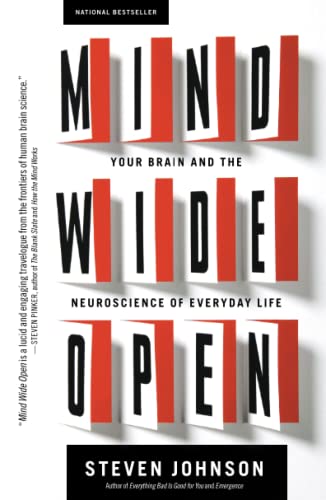
In this nationally bestselling, compulsively readable account of what makes brain science a vital component of people's quest to know themselves, acclaimed science writer Steven Johnson subjects his own brain to a battery of tests to find out what's really going on inside. He asks:
- How do we "read" other people?
- What is the neurochemistry behind love and sex?
- What does it mean that the brain is teeming with powerful chemicals closely related to recreational drugs?
- Why does music move us to tears?
- Where do breakthrough ideas come from?
Johnson answers these and many more questions arising from the events of our everyday lives. You do not have to be a neuroscientist to wonder, for example, why do you smile? And why do you sometimes smile inappropriately, even if you don't want to? How do others read your inappropriate smile? How does such interplay occur neurochemically, and what, if anything, can you do about it?
Fascinating and rewarding, Mind Wide Open speaks to brain buffs, self-obsessed neurotics, barstool psychologists, mystified parents, grumpy spouses, exasperated managers, and anyone who enjoys speculating and gossiping about the motivations and behaviors of other human beings. Steven Johnson shows us the transformative power of understanding brain science and offers new modes of introspection and tools for better parenting, better relationships, and better living.
Die Inhaltsangabe kann sich auf eine andere Ausgabe dieses Titels beziehen.
Über die Autorin bzw. den Autor
Steven Johnson is the bestselling author of Interface Culture, Emergence, and Everything Bad Is Good for You as well as a columnist for Discover and a contributing editor at Wired. He lives in New York City with his wife and two sons, and can be reached via the Web at www.stevenberlinjohnson.com.
Auszug. © Genehmigter Nachdruck. Alle Rechte vorbehalten.
Mind Wide Open
Your Brain and the Neuroscience of Everyday LifeBy Steven JohnsonScribner
Copyright © 2005 Steven JohnsonAll right reserved.
ISBN: 0743241665
Chapter One: Mind Sight
"He that has eyes to see and ears to hear may convince himself that no mortal can keep a secret. If his lips are silent, he chatters with his fingertips; betrayal oozes out of him at every pore."-- Freud
I'm gazing into a pair of eyes, scanning the arch of the brow, the hooded lids, trying to gauge whether they're signaling defiance or panic. Just a pair of eyes -- no mouth or torso, no hand gestures or vocal inflections. All I have to go on is a rectangular photo of two eyes staring at me from a computer screen. When I've made my judgment -- it's defiance, after all -- another set pops on the screen, and I start my examination all over again.
This reverse eye exam is part of an ingenious psychological test devised by the British psychologist Simon Baron-Cohen. The test presents you with thirty-six different sets of eyes, some crinkled in mirth, others gazing off to the horizon deep in thought. Below each image are four adjectives, such as:
- despondent
- preoccupied
- cautious
- regretful
Or:
- skeptical
- anticipating
- accusing
- contemplative
It's your job to choose the adjective that best fits the image. Is that raised eyebrow a sign of doubt? Or is it rebuke? The eyes themselves are a demographic mix: some weathered and ancient, others accented with mascara and eyeliner. The subtlety of the expressions is astonishing; as I scroll from image to image, I'm seeing the human eye with a fresh perspective, feeling a newfound amazement at its communicative range.
This test, though, is not ultimately about the eye's capacity to signal emotion. It's about something just as impressive, and just as easily overlooked: the brain's ability to read those signals, to peer into the inner landscape of another mind, while relying only on the most transient of cues. You won't find exam questions like these on the IQ test, or the SATs, but the mental skills being measured here are as eanotherssential as any in our cognitive toolbox. It turns out that one of the human brain's greatest evolutionary achievements is its ability to model the mental events occurring in other brains.
Chances are you've had an experience roughly like this: you're at a social gathering with colleagues or peers -- say it's an office holiday party -- and you run into a coworker with whom you have an unspoken rivalry. It's one of those relationships that is chummy on the surface, but right beneath there's a competitive energy that neither side acknowledges. When you first encounter your colleague, there's the usual pleasant banter, but before long he's confessed to you that something has gone wrong with his career trajectory: either he's lost a big account at work or the fellowship didn't come through or the last batch of short stories got rejected. Whatever it is, it's bad news. It's the sort of news that a friend should perhaps greet with a concerned, doleful expression, which is exactly the expression that you deliberately contort your face into as he delivers the news.
The trouble is, you're only a friend on the surface. Below the surface, you're a rival, and a rival wants to grin at this news, wants to relish the schadenfreude. And so for a split second, as you're hearing the fateful syllables roll off his tongue, his tone foreshadowing his disappointment before the sentence is even complete, you let out the slightest hint of a grin.
And then an intricate dance begins. As your face wraps itself up in dutiful concern, you detect a flash of something in his face, a momentary startle that says, "Were you just smiling right there?" Perhaps his eyes suddenly lock on to your pupils, or he pauses in midsentence as though something has distracted him. In your mind, an interior closed-captioning emerges: "Did he see that grin?" As you offer your condolences, you can't help wondering if your words sound cruel rather than comforting. "Is he thinking that I'm faking all this sympathy? Maybe I should tone it down a notch just in case."
The silent duet of those two internal monologues should be familiar to you, even if you're the sort of person who never, ever gloats at another's downfall. (Henry James made a literary career out of documenting these subtle interactions.) It needn't be a Cheshire cat grin that provokes the interior monologues: imagine a conversation between two potential lovers, in which one worries that a facial expression has betrayed his love before he has summoned the courage to make a formal declaration. Sometimes the closed-captioning can overshadow the main dialogue, which can make for stilted conversation, with each participant second-guessing the other's thoughts.
This silent conversation -- a passing grin, a sudden look of recognition, a lurking question about another's motivation -- comes so naturally to us that most of the time we're not even aware that we are locked into such a complex exchange. The internal duet comes naturally because it relies on parts of the brain that specialize in precisely this kind of social interaction. Neuroscientists refer to this phenomenon as "mindreading" -- not in the ESP sense, but rather in the more prosaic, but no less impressive, sense of building an educated guess about what someone else is thinking. Mindreading is literally part of our nature. We do it more effortlessly, and with more nuance, than any other species on the planet. We construct working hypotheses about what's going on in other people's heads almost as readily as we convert oxygen into carbon dioxide.
Because mindreading is part of our nature, we don't bother to teach it in schools or test our aptitude for it in placement exams. But it is a skill like any other, a skill that is unevenly distributed throughout the general population. Some people are deft mindreaders, picking up subtle intonational shifts and adjusting their response with imperceptible ease. Others mindread with the subtlety of a Mack truck, constantly second-guessing themselves or interrogating their conversational partners. Some are simply "mindblind," shut off entirely from other people's internal monologues.
Even though we don't teach this particular skill in school, and we barely have a vocabulary to describe it, our mindreading abilities play a key role in our work and relationship successes, our sense of humor, our social ease. But to understand these consequences, you have to stop taking the internal duet for granted. You have to slow it down, explore its underlying processes, recognize the duet for the marvel that it is.
Our growing appreciation for the art of mindreading was accelerated in the late 1990s by the discovery of "mirror neurons" in the brains of monkeys, neurons that fire both when a monkey does a particular task -- grabbing a branch, for example -- and when the monkey sees another monkey do that same task, suggesting that the brain is designed to draw analogies between our own mental and physical states and those of other individuals. At the same time, researchers explored the premise that autistic people suffer from a kind of mindblindness, preventing them from building hypotheses about others' internal monologues. In related studies, evolutionary psychologists began to think about the Darwinian rewards of mindreading in a social species, examining chimp populations for signs of comparable internal duets. Yet other scientists speculated on the...
„Über diesen Titel“ kann sich auf eine andere Ausgabe dieses Titels beziehen.
Suchergebnisse für Mind Wide Open: Your Brain and the Neuroscience of...

Beispielbild für diese ISBN
Mind Wide Open: Your Brain and the Neuroscience of Everyday Life
Anbieter: World of Books (was SecondSale), Montgomery, IL, USA
Verkäuferbewertung 5 von 5 Sternen

Paperback. Zustand: Good. In this nationally bestselling, compulsively readable account of what makes brain science a vital component of people's quest to know themselves, acclaimed science writer Steven Johnson subjects his own brain to a battery of tests to find out what's really going on inside. He asks: How do we read other people? What is the neurochemistry behind love and sex? What does it mean that the brain is teeming with powerful chemicals closely related to recreational drugs? Why does music move us to tears? Where do breakthrough ideas come from? Johnson answers these and many more questions arising from the events of our everyday lives. You do not have to be a neuroscientist to wonder, for example, why do you smile? And why do you sometimes smile inappropriately, even if you don't want to? How do others read your inappropriate smile? How does such interplay occur neurochemically, and what, if anything, can you do about it? Fascinating and rewarding, Mind Wide Open speaks to brain buffs, self-obsessed neurotics, barstool psychologists, mystified parents, grumpy spouses, exasperated managers, and anyone who enjoys speculating and gossiping about the motivations and behaviors of other human beings. Steven Johnson shows us the transformative power of understanding brain science and offers new modes of introspection and tools for better parenting, better relationships, and better living. Artikel-Nr. 00093593289
Gebraucht kaufen
EUR 3,91
Versand gratis
Versand innerhalb von USA
Versand innerhalb von USA
Anzahl: 17 verfügbar
Beispielbild für diese ISBN
Mind Wide Open: Your Brain and the Neuroscience of Everyday Life
Anbieter: World of Books (was SecondSale), Montgomery, IL, USA
Verkäuferbewertung 5 von 5 Sternen
Paperback. Zustand: Very Good. In this nationally bestselling, compulsively readable account of what makes brain science a vital component of people's quest to know themselves, acclaimed science writer Steven Johnson subjects his own brain to a battery of tests to find out what's really going on inside. He asks: How do we read other people? What is the neurochemistry behind love and sex? What does it mean that the brain is teeming with powerful chemicals closely related to recreational drugs? Why does music move us to tears? Where do breakthrough ideas come from? Johnson answers these and many more questions arising from the events of our everyday lives. You do not have to be a neuroscientist to wonder, for example, why do you smile? And why do you sometimes smile inappropriately, even if you don't want to? How do others read your inappropriate smile? How does such interplay occur neurochemically, and what, if anything, can you do about it? Fascinating and rewarding, Mind Wide Open speaks to brain buffs, self-obsessed neurotics, barstool psychologists, mystified parents, grumpy spouses, exasperated managers, and anyone who enjoys speculating and gossiping about the motivations and behaviors of other human beings. Steven Johnson shows us the transformative power of understanding brain science and offers new modes of introspection and tools for better parenting, better relationships, and better living. Artikel-Nr. 00097839050
Gebraucht kaufen
EUR 3,91
Versand gratis
Versand innerhalb von USA
Versand innerhalb von USA
Anzahl: 2 verfügbar
Beispielbild für diese ISBN
Mind Wide Open: Your Brain and the Neuroscience of Everyday Life
Anbieter: World of Books (was SecondSale), Montgomery, IL, USA
Verkäuferbewertung 5 von 5 Sternen
Paperback. Zustand: Fair. In this nationally bestselling, compulsively readable account of what makes brain science a vital component of people's quest to know themselves, acclaimed science writer Steven Johnson subjects his own brain to a battery of tests to find out what's really going on inside. He asks: How do we read other people? What is the neurochemistry behind love and sex? What does it mean that the brain is teeming with powerful chemicals closely related to recreational drugs? Why does music move us to tears? Where do breakthrough ideas come from? Johnson answers these and many more questions arising from the events of our everyday lives. You do not have to be a neuroscientist to wonder, for example, why do you smile? And why do you sometimes smile inappropriately, even if you don't want to? How do others read your inappropriate smile? How does such interplay occur neurochemically, and what, if anything, can you do about it? Fascinating and rewarding, Mind Wide Open speaks to brain buffs, self-obsessed neurotics, barstool psychologists, mystified parents, grumpy spouses, exasperated managers, and anyone who enjoys speculating and gossiping about the motivations and behaviors of other human beings. Steven Johnson shows us the transformative power of understanding brain science and offers new modes of introspection and tools for better parenting, better relationships, and better living. Artikel-Nr. 00072332998
Gebraucht kaufen
EUR 3,91
Versand gratis
Versand innerhalb von USA
Versand innerhalb von USA
Anzahl: 6 verfügbar
Beispielbild für diese ISBN
Mind Wide Open: Your Brain and the Neuroscience of Everyday Life
Verlag:
Scribner (edition Reprint), 2005
ISBN 10: 0743241665
ISBN 13: 9780743241663
Gebraucht
Paperback
Anbieter: BooksRun, Philadelphia, PA, USA
Verkäuferbewertung 5 von 5 Sternen
Paperback. Zustand: Very Good. Reprint. It's a well-cared-for item that has seen limited use. The item may show minor signs of wear. All the text is legible, with all pages included. It may have slight markings and/or highlighting. Artikel-Nr. 0743241665-11-6
Gebraucht kaufen
EUR 4,72
Versand gratis
Versand innerhalb von USA
Versand innerhalb von USA
Anzahl: 1 verfügbar
Beispielbild für diese ISBN
Mind Wide Open: Your Brain and the Neuroscience of Everyday Life
Anbieter: ThriftBooks-Atlanta, AUSTELL, GA, USA
Verkäuferbewertung 5 von 5 Sternen
Paperback. Zustand: As New. No Jacket. Pages are clean and are not marred by notes or folds of any kind. ~ ThriftBooks: Read More, Spend Less. Artikel-Nr. G0743241665I2N00
Gebraucht kaufen
EUR 6,00
Versand gratis
Versand innerhalb von USA
Versand innerhalb von USA
Anzahl: 1 verfügbar
Beispielbild für diese ISBN
Mind Wide Open: Your Brain and the Neuroscience of Everyday Life
Anbieter: ThriftBooks-Reno, Reno, NV, USA
Verkäuferbewertung 5 von 5 Sternen
Paperback. Zustand: Good. No Jacket. Pages can have notes/highlighting. Spine may show signs of wear. ~ ThriftBooks: Read More, Spend Less. Artikel-Nr. G0743241665I3N00
Gebraucht kaufen
EUR 6,00
Versand gratis
Versand innerhalb von USA
Versand innerhalb von USA
Anzahl: 1 verfügbar
Beispielbild für diese ISBN
Mind Wide Open: Your Brain and the Neuroscience of Everyday Life
Anbieter: ThriftBooks-Atlanta, AUSTELL, GA, USA
Verkäuferbewertung 5 von 5 Sternen
Paperback. Zustand: Good. No Jacket. Pages can have notes/highlighting. Spine may show signs of wear. ~ ThriftBooks: Read More, Spend Less. Artikel-Nr. G0743241665I3N00
Gebraucht kaufen
EUR 6,00
Versand gratis
Versand innerhalb von USA
Versand innerhalb von USA
Anzahl: 1 verfügbar
Beispielbild für diese ISBN
Mind Wide Open: Your Brain and the Neuroscience of Everyday Life
Anbieter: ThriftBooks-Phoenix, Phoenix, AZ, USA
Verkäuferbewertung 5 von 5 Sternen
Paperback. Zustand: Good. No Jacket. Pages can have notes/highlighting. Spine may show signs of wear. ~ ThriftBooks: Read More, Spend Less. Artikel-Nr. G0743241665I3N00
Gebraucht kaufen
EUR 6,00
Versand gratis
Versand innerhalb von USA
Versand innerhalb von USA
Anzahl: 1 verfügbar
Beispielbild für diese ISBN
Mind Wide Open: Your Brain and the Neuroscience of Everyday Life
Anbieter: ThriftBooks-Dallas, Dallas, TX, USA
Verkäuferbewertung 5 von 5 Sternen
Paperback. Zustand: Good. No Jacket. Pages can have notes/highlighting. Spine may show signs of wear. ~ ThriftBooks: Read More, Spend Less. Artikel-Nr. G0743241665I3N00
Gebraucht kaufen
EUR 6,00
Versand gratis
Versand innerhalb von USA
Versand innerhalb von USA
Anzahl: 1 verfügbar
Beispielbild für diese ISBN
Mind Wide Open: Your Brain and the Neuroscience of Everyday Life
Anbieter: Wonder Book, Frederick, MD, USA
Verkäuferbewertung 5 von 5 Sternen
Zustand: Good. Good condition. A copy that has been read but remains intact. May contain markings such as bookplates, stamps, limited notes and highlighting, or a few light stains. Bundled media such as CDs, DVDs, floppy disks or access codes may not be included. Artikel-Nr. O14K-00402
Gebraucht kaufen
EUR 6,45
Versand gratis
Versand innerhalb von USA
Versand innerhalb von USA
Anzahl: 1 verfügbar