
Verwandte Artikel zu Life's Greatest Lessons: 20 Things That Matter
Inhaltsangabe
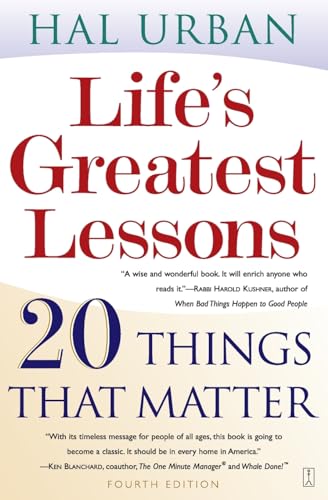
With more than a quarter million copies sold, award-winning teacher Hal Urban outlines twenty lessons that answer timeless questions about how to make the most of your life.
Life’s Greatest Lessons is a wise, wonderful book. In it, Hal Urban, a parent and an award-winning teacher, presents twenty principles that are as deeply rooted in common sense as they are in compassion. The topics, gathered from a lifetime of teaching both children and adults, span a wide range of readily understood concepts, including attitudes about money, understanding the real meaning of “success,” and the importance of having fun. The book will help you find the best—in the world, in others, and in yourself. Classic in its simplicity and enduring in its appeal, Life’s Greatest Lessons helps us all rediscover that the desire to live a good life is timeless.
Die Inhaltsangabe kann sich auf eine andere Ausgabe dieses Titels beziehen.
Über die Autorin bzw. den Autor
Hal Urban was a high school teacher for many years and also taught at the University of San Francisco. He is a well-known leader in the Character Education movement and is in constant demand as a speaker at national conferences and school and community events. He raised three sons as a single father and now lives in Redwood City, California, with his wife, Cathy.
Auszug. © Genehmigter Nachdruck. Alle Rechte vorbehalten.
Chapter 1
Success Is More
Than Making Money
Success means doing the best we can with what we have. Success is in the doing, not the getting -- in the trying, not the triumph.
Wynn Davis
Life's Most Important Discovery
I was thirty-nine when I first understood what it meant to be successful. What did I do? Become the CEO of a Fortune 500 company? Drive home in my first Mercedes? Win the lottery? Take home the grand prize on Who Wants to Be a Millionaire? None of the above. I just made a simple, yet profound, discovery. I discovered how life works and what its essentials are. After years of missing the point, I began to understand what it means to succeed in life and how to go about it. With this discovery came two things that had always eluded me: a sense of inner peace and a feeling of self-worth. And best of all, I began to enjoy life more than ever before.
So what was this great discovery? Is there really a formula for becoming successful? I'm convinced that there is. But you won't find it wrapped up in a nice, neat package and advertised on TV. It's not new, it's not a secret, and there's nothing magical about it. Therefore, it won't sell. It's too old, too simple, and too innocent. But it works.
After years of studying history, philosophy, and psychology, I realized that life and success can be reduced to some fundamental principles that have been around for thousands of years. After following several different paths in search of "the good life," I ended up back where I'd started, and with what I now call old-fashioned truths. As Edward Albee says in his play The Zoo Story, "...sometimes it's necessary to go a long distance out of the way in order to come back a short distance correctly."
Does this book contain the formula? Will you find it within the "20 Things"? I hope so. I honestly believe that if you apply these age-old principles consistently, you'll both understand and experience the true meaning of success. A Swedish proverb tells us that we get old too quick and smart too late. Maybe that doesn't have to happen. Maybe my book will help you get smart earlier than I did. And even if you're older, it's never too late to learn. The smartest people in the world are the ones who know how to be happy.
Success and Money
We can't seem to make up our minds whether money is good or bad. When someone is described as successful, it usually means he or she is wealthy. So it must be good. But they say money can't buy happiness. So it must be bad. Wealthy people contribute billions of dollars each year to worthy causes. So, it's good. But haven't we heard that money is the root of all evil? Now it's bad again. People who aren't rich criticize those who are, but would love to be rich themselves. So, which is it, good or bad?
It's neither. But because we live in a society which so often equates money with success, it needs to be examined. Some of the myths about it need to be clarified, and it needs to be placed in a proper perspective. There are two points I'd like to make about money:
1. Money is not bad
Does it really say in the Bible that money is the root of all evil? No. It says the love of money is the root of all evil. That's quite a difference. There's nothing wrong with money. There's nothing wrong with wanting it, and there's nothing wrong with having it, even in large amounts. The keys are how we earn it and what we do with it. Honestly acquired and well spent, money can be a resource for much good. Can it buy happiness? Whoever said that it can't probably didn't have enough. Actually, it'll buy a lot more happiness than poverty will. I think Pearl Bailey best described it when she said, "Honey, I been poor, and I been rich. And let me tell you, rich is better." It probably is better in most cases. There's nothing illegal or immoral about being rich, but it isn't everything.
2. Money isn't all there is to being successful
During the 1980s, we constantly read and heard about how many people were becoming millionaires...and how many millionaires were becoming billionaires. Some of the most celebrated among them went to prison. Ivan Boesky, one of the financial wizards of the day, even went so far as to say, "Greed is good." He said it a few months before being indicted by a federal grand jury. He was willing to say in public what many were feeling in private: success and wealth are synonymous.
Now we look back on the quest for wealth in the 1980s as being somewhat mild. That was just a warm-up for the dot-com and stock-market meteors of the 1990s. We learned on an almost daily basis who the new "instant billionaires" were, and countless people were risking their health, relationships, and resources to join the ranks. And all too often, ethics and some of our most cherished values took a backseat to wealth and the accompanying lifestyle.
The corporate scandals, still unfolding as I write -- at Enron, Arthur Andersen, Tyco, Xerox, WorldCom, and others -- are perfect examples. At Enron, for instance, the company and its executives were on top of the world. But they were toppled because of the way they got there. Their empire now lies in ruins. And because of what Newsweek magazine called "executive avarice" and the "greedy, go-for-broke ethos" of the corporate world, thousands of innocent employees and investors lost their jobs and much of their life savings.
This is what happens when we lose perspective on money. Life gets distorted. It wasn't just those who went to prison in the 1980s or went bankrupt in the 1990s and the early 2000s who lost themselves in the pursuit of the almighty dollar. Many of those who made large amounts of money legally and managed to hold on to it were still coming up empty. The Tom Peters Group conducted extensive interviews with thousands of business executives during this period. Almost half of them said that despite years spent striving to achieve their financial goals, their lives seemed "empty and meaningless." Sixty-eight percent of the senior executives interviewed said they had neglected their family lives to pursue professional goals.
These are people who had money, property, power, and status. Why weren't they happy? Because having those things is not the same as being successful. They'd lost sight of what was essential. They got addicted, becoming slaves to big money and the things that go with it. In the process, they damaged their own lives as well as the lives of others. Success is more than making money. To overemphasize its importance is to cheat ourselves out of the other things that make life so much more interesting, meaningful, and rewarding.
What Does It Mean to Be Successful?
The great philosopher Thomas Carlyle once wrote, "Let each become all that he was created capable of being." I can't think of a better definition of success. Life challenges us every day to develop our capabilities to the fullest. We're successful when we reach for the highest that's within us -- when we give the best we have.
The quote at the beginning of this chapter says that success is in the doing, not in the getting. I can't emphasize that point enough. Life doesn't require us to always come out on top. It asks only that we do our best at each level of experience. This is what successful people do in some of the most important areas of life:
• Successful people accept life as it is, with all its difficulties and challenges. They adapt to it rather than complain about it. They accept responsibility for their own lives instead of blaming or making excuses. They say YES to life in spite of its negative elements and make the most of it, no matter what the circumstances.
• Successful people develop and maintain a positive attitude toward life....
„Über diesen Titel“ kann sich auf eine andere Ausgabe dieses Titels beziehen.
Suchergebnisse für Life's Greatest Lessons: 20 Things That Matter

Beispielbild für diese ISBN
Life's Greatest Lessons: 20 Things That Matter
Anbieter: World of Books (was SecondSale), Montgomery, IL, USA
Verkäuferbewertung 5 von 5 Sternen

Paperback. Zustand: Good. LIFE'S GREATEST LESSONS is a wise, wonderful book. In it, Hal Urban, a parent and an award-winning teacher, presents twenty principles that are as deeply rooted in common sense as they are in compassion. The topics, gathered from a lifetime of teaching both children and adults, span a wide range of readily understood concepts, including attitudes about money, understanding the real meaning of 'success' and the importance of having fun. The book will help you find the best - in the world, in others, and in yourself. Classic in its simplicity and enduring in its appeal, LIFE'S GREATEST LESSONS helps us all rediscover that the desire to live a good life is timeless. Artikel-Nr. 00085946121
Gebraucht kaufen
EUR 3,72
Versand gratis
Versand innerhalb von USA
Versand innerhalb von USA
Anzahl: Mehr als 20 verfügbar
Beispielbild für diese ISBN
Life's Greatest Lessons: 20 Things That Matter
Anbieter: World of Books (was SecondSale), Montgomery, IL, USA
Verkäuferbewertung 5 von 5 Sternen
Paperback. Zustand: Very Good. LIFE'S GREATEST LESSONS is a wise, wonderful book. In it, Hal Urban, a parent and an award-winning teacher, presents twenty principles that are as deeply rooted in common sense as they are in compassion. The topics, gathered from a lifetime of teaching both children and adults, span a wide range of readily understood concepts, including attitudes about money, understanding the real meaning of 'success' and the importance of having fun. The book will help you find the best - in the world, in others, and in yourself. Classic in its simplicity and enduring in its appeal, LIFE'S GREATEST LESSONS helps us all rediscover that the desire to live a good life is timeless. Artikel-Nr. 00101938084
Gebraucht kaufen
EUR 3,72
Versand gratis
Versand innerhalb von USA
Versand innerhalb von USA
Anzahl: 11 verfügbar
Beispielbild für diese ISBN
Life's Greatest Lessons: 20 Th
Anbieter: World of Books (was SecondSale), Montgomery, IL, USA
Verkäuferbewertung 5 von 5 Sternen
Zustand: Acceptable. Item in acceptable condition! Textbooks may not include supplemental items i.e. CDs, access codes etc. Artikel-Nr. 00100356565
Gebraucht kaufen
EUR 3,72
Versand gratis
Versand innerhalb von USA
Versand innerhalb von USA
Anzahl: 10 verfügbar
Beispielbild für diese ISBN
Life's Greatest Lessons: 20 Things That Matter
Anbieter: BooksRun, Philadelphia, PA, USA
Verkäuferbewertung 5 von 5 Sternen
Paperback. Zustand: Fair. 4. The item might be beaten up but readable. May contain markings or highlighting, as well as stains, bent corners, or any other major defect, but the text is not obscured in any way. Artikel-Nr. 074323782X-7-1-13
Gebraucht kaufen
EUR 5,71
Versand gratis
Versand innerhalb von USA
Versand innerhalb von USA
Anzahl: 1 verfügbar
Beispielbild für diese ISBN
Life's Greatest Lessons: 20 Things That Matter
Anbieter: ThriftBooks-Atlanta, AUSTELL, GA, USA
Verkäuferbewertung 5 von 5 Sternen
Paperback. Zustand: As New. No Jacket. Pages are clean and are not marred by notes or folds of any kind. ~ ThriftBooks: Read More, Spend Less. Artikel-Nr. G074323782XI2N00
Gebraucht kaufen
EUR 5,96
Versand gratis
Versand innerhalb von USA
Versand innerhalb von USA
Anzahl: 1 verfügbar
Beispielbild für diese ISBN
Life's Greatest Lessons: 20 Things That Matter
Anbieter: ThriftBooks-Dallas, Dallas, TX, USA
Verkäuferbewertung 5 von 5 Sternen
Paperback. Zustand: Very Good. No Jacket. May have limited writing in cover pages. Pages are unmarked. ~ ThriftBooks: Read More, Spend Less. Artikel-Nr. G074323782XI4N00
Gebraucht kaufen
EUR 5,96
Versand gratis
Versand innerhalb von USA
Versand innerhalb von USA
Anzahl: 1 verfügbar
Beispielbild für diese ISBN
Life's Greatest Lessons: 20 Things That Matter
Anbieter: ThriftBooks-Atlanta, AUSTELL, GA, USA
Verkäuferbewertung 5 von 5 Sternen
Paperback. Zustand: Very Good. No Jacket. May have limited writing in cover pages. Pages are unmarked. ~ ThriftBooks: Read More, Spend Less. Artikel-Nr. G074323782XI4N00
Gebraucht kaufen
EUR 5,96
Versand gratis
Versand innerhalb von USA
Versand innerhalb von USA
Anzahl: 1 verfügbar
Beispielbild für diese ISBN
Life's Greatest Lessons: 20 Things That Matter
Anbieter: ThriftBooks-Reno, Reno, NV, USA
Verkäuferbewertung 5 von 5 Sternen
Paperback. Zustand: Very Good. No Jacket. May have limited writing in cover pages. Pages are unmarked. ~ ThriftBooks: Read More, Spend Less. Artikel-Nr. G074323782XI4N00
Gebraucht kaufen
EUR 5,96
Versand gratis
Versand innerhalb von USA
Versand innerhalb von USA
Anzahl: 1 verfügbar
Beispielbild für diese ISBN
Life's Greatest Lessons: 20 Things That Matter
Anbieter: ThriftBooks-Atlanta, AUSTELL, GA, USA
Verkäuferbewertung 5 von 5 Sternen
Paperback. Zustand: Very Good. No Jacket. Former library book; May have limited writing in cover pages. Pages are unmarked. ~ ThriftBooks: Read More, Spend Less. Artikel-Nr. G074323782XI4N10
Gebraucht kaufen
EUR 5,96
Versand gratis
Versand innerhalb von USA
Versand innerhalb von USA
Anzahl: 1 verfügbar
Beispielbild für diese ISBN
Life's Greatest Lessons: 20 Things That Matter
Anbieter: ThriftBooks-Phoenix, Phoenix, AZ, USA
Verkäuferbewertung 5 von 5 Sternen
Paperback. Zustand: Very Good. No Jacket. May have limited writing in cover pages. Pages are unmarked. ~ ThriftBooks: Read More, Spend Less. Artikel-Nr. G074323782XI4N00
Gebraucht kaufen
EUR 5,96
Versand gratis
Versand innerhalb von USA
Versand innerhalb von USA
Anzahl: 1 verfügbar