
Verwandte Artikel zu The 18 Immutable Laws of Corporate Reputation: Creating,...
The 18 Immutable Laws of Corporate Reputation: Creating, Protecting, and Repairing Your Most Valuable Asset (Wal Street Journal Book) - Hardcover
Buch 10 von 12: Wall Street Journal Book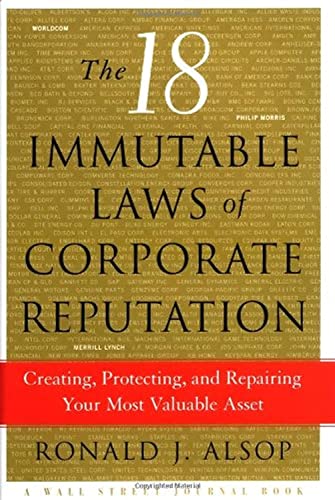
Inhaltsangabe
From Enron and WorldCom to the Catholic Church and Major League Baseball, reputation crises have never been more widespread. Now Ronald J. Alsop, a veteran Wall Street Journal authority on branding and reputation management, explains the dangers -- and gives organizations the eighteen crucial laws to follow in developing and protecting their reputations.
Consider this example of a simple decision made by a low-ranking employee: When rescue workers at the site of the World Trade Center disaster sought bottled water from a nearby Starbucks outlet, they complained that an employee charged them for it. In a matter of hours, the Internet had picked up the story and Starbucks' carefully cultivated worldwide reputation was quickly besmirched.
This is just one instance among many of how the business world, ever more global and competitive, has become increasingly difficult to navigate. Studies have demonstrated the powerful impact of reputation on profits and stock prices, and yet less than half of all companies have a formal system for measuring reputation. Clearly, companies in every industry -- from Dow Chemical to Disney to DaimlerChrystler -- have much more to learn.
It is still the rare company that realizes the full value of its reputation: how corporate reputation can enhance business in good times, become a protective halo in turbulent times, and be destroyed in an instant by people at the lowest or highest levels of the corporate ladder. Mr. Alsop provides eighteen thoroughly documented lessons based on years of experience covering every aspect of corporate reputation, with a clear distillation of the complex principles at the heart of a reputation. He explains:
• How to protect your reputation when the inevitable crisis hits
• How to cope with the many hazards in cyberspace
• How to create a reputation for vision and industry leadership
• How to establish a culture of ethical behavior
• How to measure and monitor your ever-changing public image
• How to make employees your reputation champions
• How to decide when it's time to change your name
The result is a book that is important not only for business executives, consultants, and advertising, public relations, and marketing professionals but also for anyone eager to learn more about the companies they work for, buy from, and invest in.
Die Inhaltsangabe kann sich auf eine andere Ausgabe dieses Titels beziehen.
Über die Autorin bzw. den Autor
Ronald J. Alsop, a news editor and senior writer at The Wall Street Journal, has many years of experience reporting on and supervising the coverage of corporate brands and reputations. He has served as the newspaper's marketing columnist and was editor of its Marketplace page. His previous books include The Wall Street Journal on Marketing and The Wall Street Journal Guide to the Top Business Schools. He is also a seasoned speaker at international conferences on corporate reputation and has worked closely with leading research firms that measure corporate reputation. He lives with his wife and son in Summit, New Jersey.
Auszug. © Genehmigter Nachdruck. Alle Rechte vorbehalten.
PREFACE
Associate yourself with men of good quality if you esteem your own reputation, for 'tis better to be alone than in bad company.
-- Maxim from George Washington's "Rules of Civility and Decent Behavior in Company and Conversation"
Corporate executives of good repute must feel rather lonely these days.
Scandals have brought down or tarnished company after company, as executives became obsessed with short-term profits and ever-rising stock prices and lost sight of reputation, their most valuable long-term asset. They lived for today and destroyed their corporate reputations.
All of the corporate malfeasance not only showed how precious and fleeting reputation is, but it also demonstrated how one company's misdeeds can taint an entire industry -- and even the whole of corporate America. The scandals and increased government oversight have created a corporate environment in which extra vigilance is required to protect reputations. Some businesses with superb reputations have found themselves unfairly lumped with the pack of fraudulent companies. A news report about an investigation into alleged problems at a Johnson & Johnson pharmaceutical plant in Puerto Rico put J&J into the company of the accounting-fraud scoundrels. The company requested a retraction.
Ron Sargent, the CEO of Staples, told me about having visited a high school in suburban Boston to talk with students and being appalled by a couple of their questions. "How much money do you make?" one teen asked, while another wondered, "Do you have a $6,000 shower curtain?" a reference to the extravagant purchases that Dennis Kozlowski, former CEO of Tyco International, allegedly used company funds to pay for. Unfortunately, many corporate officials have been unfairly tarred by the accounting fraud and executive greed.
The business world, ever more global and more competitive, has become even more difficult to navigate. In this new climate of suspicion and scrutiny, a good reputation is more important than ever and provides one of the few safety nets companies can count on.
It is my hope that this book will guide you in creating that good reputation. Toward that end, I have drawn upon my coverage of corporate reputation and branding over the past twenty years, as well as my experience as a marketing columnist and editor at The Wall Street Journal. The book is also based on my interviews with dozens of corporate executives, market researchers, communications experts, and academics over the past two years.
Whenever people learned that I was writing a book about managing corporate reputation, they automatically assumed it was a response to the Enron blowup and the corporate scandals that followed. That reaction is understandable, but in fact, I began planning in summer 2001, long before any of the corporate abuses came to light. My project was briefly interrupted by the September 11 attack on the World Trade Center, which forced the Wall Street Journal staff to evacuate its offices in the nearby World Financial Center, where all of my reputation files lay amid dust and debris. But my files were recovered, and the book proposal was completed and approved before Enron even filed for bankruptcy protection in December.
Long before the scandals broke, I had sensed that companies were beginning to understand how important -- but neglected -- their reputations were. Whenever I wrote an article about reputation for The Wall Street Journal, I received calls and e-mails from managers hungry to know more about the subject. They asked me questions about how to get their arms around the concept. They didn't understand how to define reputation, how to measure it, or, most important, how to manage it. "Your package of articles today regarding corporate reputations is excellent," the senior vice president and director of corporate communication at PNC Financial Services Group wrote me in an e-mail message. "I'm sharing it with all of my advertising and PR colleagues here as we wrestle with the factors that impact reputation and what to do about it."
Reputation management is more of an art than a science, but there are definite guiding principles that constitute the eighteen immutable laws. Divided into three parts, this book is a road map to maximizing the benefits of your most priceless asset. Through detailed examples, I demonstrate the benefits of a good reputation, the consequences of a bad reputation, and ways to protect good reputations and fix bad ones. I explain that every company must learn to measure its reputation, appoint senior executives to nurture it, and understand who among its many constituencies can do its reputation the most good -- or the most harm. I deal at length with some of the hot-button issues, such as ethics, corporate citizenship, and the Internet's impact on reputation. How, for example, can you both use the Internet as a tool to improve perceptions of your company and guard against its many dangers? How can you strike the best compromise between gratuitous publicity and getting the word out about your company's good deeds? These are just a couple of the tough issues that every company should be grappling with.
The book also includes a number of rankings of best and worst reputations, and it examines the companies making the headlines, such as how Merrill Lynch is struggling to mend its image and what lessons can be gleaned from the harm Martha Stewart inflicted on her company. The scandals, of course, offer many cautionary tales about reputation pitfalls. But the majority of the book is devoted to companies that weren't major players in the corporate chicanery. There is much more to learn from companies that have long valued their reputations and work hard every day to preserve them. I believe their stories clearly show the value of reputation management -- how Johnson & Johnson inculcates a sense of integrity throughout its global workforce, how DuPont vigilantly monitors its 200-year-old reputation, how IBM projects a consistent corporate image, and how Timberland and Levi Strauss make social responsibility the essence of their corporate cultures.
I do dwell on one company with a negative reputation -- Philip Morris -- but less because of its troubled image than because it is working so hard to improve it, from changing its name to writing a new ethics code. Whether or not you believe Philip Morris, now known as Altria Group, deserves a better reputation, the company still provides a unique and fascinating case study of a business trying to sell a legal but demonized product in a more responsible manner.
While I focus on corporate reputation in this book, many of the same lessons apply to any organization, whether or not it produces a profit. After all, poisoned reputations aren't restricted to corporate America these days. Just consider the recent damage to the reputations of the Roman Catholic Church, Major League Baseball, and even the Boy Scouts of America. The Catholic Church, for instance, violated Law 17 by being defensive rather than dealing with the problem of pedophile priests openly and honestly. The Boy Scouts of America could have learned from Law 3 that an organization needs to understand and try to cater to all of its many audiences. It didn't seem to realize how many of its loyal backers would be offended by its antigay membership policy and withdraw financial aid and other support. And Major League Baseball, whose image has suffered from the labor strife between the owners and players, could benefit from Law 10, Make Your Employees Your Reputation Champions, and Law 15, Fix It Right the First Time. The message of Law 15: Three strikes and you're out!
Read on and use these eighteen immutable laws to write your own playbook for managing your most valuable asset.
„Über diesen Titel“ kann sich auf eine andere Ausgabe dieses Titels beziehen.
Suchergebnisse für The 18 Immutable Laws of Corporate Reputation: Creating,...

Beispielbild für diese ISBN
The 18 Indispensable Laws of Corporate Reputation: Creating, Protecting, and Repairing Your Most Valuable Asset
Anbieter: World of Books (was SecondSale), Montgomery, IL, USA
Verkäuferbewertung 5 von 5 Sternen

Hardback. Zustand: Good. A veteran Wall Street Journal editor and authority on branding, marketing and reputation provides the 18 crucial rules for companies to follow in developing and protecting their reputation, which can be their most valuable asset or their worst nightmare. A must read book for senior executives, consultants, advertising, public relations, and marketing professionals. From Enron and WorldCom to the Catholic Church and Major League Baseball, reputation crises have never been more widespread. Now Ronald J. Alsop, a veteran Wall Street Journal authority on branding and reputation management, explains the dangers--and gives organizations the eighteen crucial laws to follow in developing and protecting their reputations. Consider this example of a simple decision made by a low-ranking employee: When rescue workers at the site of the World Trade Center disaster sought bottled water from a nearby Starbucks outlet, they complained that an employee charged them for it. In a matter of hours, the Internet had picked up the story and Starbucks' carefully cultivated worldwide reputation was quickly besmirched. This is just one instance among many of how the business world, ever more global and competitive, has become increasingly difficult to navigate. Studies have demonstrated the powerful impact of reputation on profits and stock prices, and yet less than half of all companies have a formal system for measuring reputation. Clearly, companies in every industry--from Dow Chemical to Disney to DaimlerChrystler--have much more to learn. It is still the rare company that realizes the full value of its reputation: how corporate reputation can enhance business in good times, become a protective halo in turbulent times, and be destroyed in an instant by people at the lowest or highest levels of the corporate ladder. Mr. Alsop provides eighteen thoroughly documented lessons based on years of experience covering every aspect of corporate reputation, with a clear distillation of the complex principles at the heart of a reputation. He explains: - How to protect your reputation when the inevitable crisis hits - How to cope with the many hazards in cyberspace - How to create a reputation for vision and industry leadership - How to establish a culture of ethical behavior - How to measure and monitor your ever-changing public image - How to make employees your reputation champions - How to decide when it's time to change your name The result is a book that is important not only for business executives, consultants, and advertising, public relations, and marketing professionals but also for anyone eager to learn more about the companies they work for, buy from, and invest in. Artikel-Nr. 00107602035
Gebraucht kaufen
EUR 4,48
Versand gratis
Versand innerhalb von USA
Versand innerhalb von USA
Anzahl: 1 verfügbar
Beispielbild für diese ISBN
The 18 Indispensable Laws of Corporate Reputation: Creating, Protecting, and Repairing Your Most Valuable Asset
Anbieter: World of Books (was SecondSale), Montgomery, IL, USA
Verkäuferbewertung 5 von 5 Sternen
Hardback. Zustand: Very Good. A veteran Wall Street Journal editor and authority on branding, marketing and reputation provides the 18 crucial rules for companies to follow in developing and protecting their reputation, which can be their most valuable asset or their worst nightmare. A must read book for senior executives, consultants, advertising, public relations, and marketing professionals. From Enron and WorldCom to the Catholic Church and Major League Baseball, reputation crises have never been more widespread. Now Ronald J. Alsop, a veteran Wall Street Journal authority on branding and reputation management, explains the dangers--and gives organizations the eighteen crucial laws to follow in developing and protecting their reputations. Consider this example of a simple decision made by a low-ranking employee: When rescue workers at the site of the World Trade Center disaster sought bottled water from a nearby Starbucks outlet, they complained that an employee charged them for it. In a matter of hours, the Internet had picked up the story and Starbucks' carefully cultivated worldwide reputation was quickly besmirched. This is just one instance among many of how the business world, ever more global and competitive, has become increasingly difficult to navigate. Studies have demonstrated the powerful impact of reputation on profits and stock prices, and yet less than half of all companies have a formal system for measuring reputation. Clearly, companies in every industry--from Dow Chemical to Disney to DaimlerChrystler--have much more to learn. It is still the rare company that realizes the full value of its reputation: how corporate reputation can enhance business in good times, become a protective halo in turbulent times, and be destroyed in an instant by people at the lowest or highest levels of the corporate ladder. Mr. Alsop provides eighteen thoroughly documented lessons based on years of experience covering every aspect of corporate reputation, with a clear distillation of the complex principles at the heart of a reputation. He explains: - How to protect your reputation when the inevitable crisis hits - How to cope with the many hazards in cyberspace - How to create a reputation for vision and industry leadership - How to establish a culture of ethical behavior - How to measure and monitor your ever-changing public image - How to make employees your reputation champions - How to decide when it's time to change your name The result is a book that is important not only for business executives, consultants, and advertising, public relations, and marketing professionals but also for anyone eager to learn more about the companies they work for, buy from, and invest in. Artikel-Nr. 00105138970
Gebraucht kaufen
EUR 4,48
Versand gratis
Versand innerhalb von USA
Versand innerhalb von USA
Anzahl: 1 verfügbar
Beispielbild für diese ISBN
The 18 Immutable Laws of Corporate Reputation: Creating, Protecting, and Repairing Your Most Valuable Asset (Wal Street Journal Book)
Anbieter: BooksRun, Philadelphia, PA, USA
Verkäuferbewertung 5 von 5 Sternen
Hardcover. Zustand: Very Good. With dust jacket. It's a well-cared-for item that has seen limited use. The item may show minor signs of wear. All the text is legible, with all pages included. It may have slight markings and/or highlighting. Artikel-Nr. 074323670X-11-1-29
Gebraucht kaufen
EUR 4,86
Versand gratis
Versand innerhalb von USA
Versand innerhalb von USA
Anzahl: 1 verfügbar
Beispielbild für diese ISBN
The 18 Immutable Laws of Corporate Reputation: Creating, Protecting, and Repairing Your Most Valuable Asset (Wal Street Journal Book)
Anbieter: Wonder Book, Frederick, MD, USA
Verkäuferbewertung 5 von 5 Sternen
Zustand: Very Good. Very Good condition. Like New dust jacket. A copy that may have a few cosmetic defects. May also contain light spine creasing or a few markings such as an owner's name, short gifter's inscription or light stamp. Artikel-Nr. P09R-00672
Gebraucht kaufen
EUR 6,43
Versand gratis
Versand innerhalb von USA
Versand innerhalb von USA
Anzahl: 1 verfügbar
Beispielbild für diese ISBN
The 18 Immutable Laws of Corporate Reputation: Creating, Protecting, and Repairing Your Most Valuable Asset (Wal Street Journal Book)
Anbieter: ThriftBooks-Phoenix, Phoenix, AZ, USA
Verkäuferbewertung 5 von 5 Sternen
Hardcover. Zustand: Very Good. No Jacket. May have limited writing in cover pages. Pages are unmarked. ~ ThriftBooks: Read More, Spend Less. Artikel-Nr. G074323670XI4N00
Gebraucht kaufen
EUR 6,85
Versand gratis
Versand innerhalb von USA
Versand innerhalb von USA
Anzahl: 1 verfügbar
Beispielbild für diese ISBN
The 18 Immutable Laws of Corporate Reputation: Creating, Protecting, and Repairing Your Most Valuable Asset (Wal Street Journal Book)
Anbieter: ThriftBooks-Atlanta, AUSTELL, GA, USA
Verkäuferbewertung 5 von 5 Sternen
Hardcover. Zustand: Very Good. No Jacket. May have limited writing in cover pages. Pages are unmarked. ~ ThriftBooks: Read More, Spend Less. Artikel-Nr. G074323670XI4N00
Gebraucht kaufen
EUR 6,85
Versand gratis
Versand innerhalb von USA
Versand innerhalb von USA
Anzahl: 1 verfügbar
Beispielbild für diese ISBN
The 18 Immutable Laws of Corporate Reputation: Creating, Protecting, and Repairing Your Most Valuable Asset (Wal Street Journal Book)
Anbieter: ThriftBooks-Dallas, Dallas, TX, USA
Verkäuferbewertung 5 von 5 Sternen
Hardcover. Zustand: Very Good. No Jacket. May have limited writing in cover pages. Pages are unmarked. ~ ThriftBooks: Read More, Spend Less. Artikel-Nr. G074323670XI4N00
Gebraucht kaufen
EUR 6,85
Versand gratis
Versand innerhalb von USA
Versand innerhalb von USA
Anzahl: 1 verfügbar
Beispielbild für diese ISBN
The 18 Immutable Laws of Corporate Reputation: Creating, Protecting, and Repairing Your Most Valuable Asset (Wal Street Journal Book)
Anbieter: ThriftBooks-Atlanta, AUSTELL, GA, USA
Verkäuferbewertung 5 von 5 Sternen
Hardcover. Zustand: As New. No Jacket. Pages are clean and are not marred by notes or folds of any kind. ~ ThriftBooks: Read More, Spend Less. Artikel-Nr. G074323670XI2N00
Gebraucht kaufen
EUR 6,85
Versand gratis
Versand innerhalb von USA
Versand innerhalb von USA
Anzahl: 1 verfügbar
Beispielbild für diese ISBN
The 18 Immutable Laws of Corporate Reputation: Creating, Protecting, and Repairing Your Most Valuable Asset (Wal Street Journal Book)
Anbieter: ThriftBooks-Atlanta, AUSTELL, GA, USA
Verkäuferbewertung 5 von 5 Sternen
Hardcover. Zustand: Very Good. No Jacket. Former library book; May have limited writing in cover pages. Pages are unmarked. ~ ThriftBooks: Read More, Spend Less. Artikel-Nr. G074323670XI4N10
Gebraucht kaufen
EUR 6,85
Versand gratis
Versand innerhalb von USA
Versand innerhalb von USA
Anzahl: 1 verfügbar
Beispielbild für diese ISBN
The 18 Immutable Laws of Corporate Reputation : Creating, Protecting, and Repairing Your Most Valuable Asset
Anbieter: Better World Books, Mishawaka, IN, USA
Verkäuferbewertung 5 von 5 Sternen
Zustand: Good. Pages intact with minimal writing/highlighting. The binding may be loose and creased. Dust jackets/supplements are not included. Stock photo provided. Product includes identifying sticker. Better World Books: Buy Books. Do Good. Artikel-Nr. 2447192-6
Gebraucht kaufen
EUR 8,58
Versand gratis
Versand innerhalb von USA
Versand innerhalb von USA
Anzahl: 2 verfügbar