
Verwandte Artikel zu Call of the Mall: The Geography of Shopping by the...
Inhaltsangabe
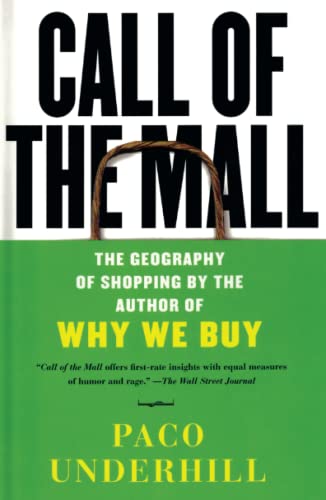
The author of the international bestseller Why We Buy—praised by The New York Times as “a book that gives this underrated skill the respect it deserves”—now takes us to the mall, a place every American has experienced and has an opinion about.
Paco Underhill, the Margaret Mead of shopping and author of the huge international bestseller Why We Buy, now takes us to the mall, a place every American has experienced and has an opinion about. The result is a bright, ironic, funny, and shrewd portrait of the mall—America’s gift to personal consumption, its most powerful icon of global commercial muscle, the once new and now aging national town square, the place where we convene in our leisure time.
It’s about the shopping mall as an exemplar of our commercial and social culture, the place where our young people have their first taste of social freedom and where the rest of us compare notes. Call of the Mall examines how we use the mall, what it means, why it works when it does, and why it sometimes doesn’t.
Die Inhaltsangabe kann sich auf eine andere Ausgabe dieses Titels beziehen.
Über die Autorin bzw. den Autor
Paco Underhill was the founder of Envirosell, Inc., a global research and consulting firm. His clients include more than a third of the Fortune 100 list, and he has worked on supermarket, convenience store, food, beverage, and restaurant issues in fifty countries. He is the bestselling author of Why We Buy, The Call of the Mall, What Women Want, and his newest book, How We Eat. He has also written articles for or been profiled in The New York Times, The Wall Street Journal, The Washington Post, The New Yorker, Smithsonian Magazine, and more. Paco divides his time between New York City and Madison, Connecticut.
Von der hinteren Coverseite
A bright, ironic, funny, and shrewd portrait of the mall--America's gift to personal consumption--is an example of commercial and social culture. This book examines how the mall is used, what it means, why it works when it does, and why it sometimes doesn't.
Auszug. © Genehmigter Nachdruck. Alle Rechte vorbehalten.
Chapter 1: America Shops
We're driving toward the mall.
I spend a lot of time in malls. Too much, I think. I daydream of life on a ranch out west where I'd go to Wal-Mart every two weeks for groceries, and that would be it for me and shopping.
It will never happen.
You are riding with a tall, bald, stuttering research wonk on the cusp of his fifty-third year. I am called a retail anthropologist, which makes me uncomfortable, especially around my colleagues still in academia who have many more degrees than I do. For whatever combination of reasons, I've spent my adult life studying people shopping. I watch how they move through stores and other commercial environments -- restaurants, banks, fast-food joints, movie theaters, car dealerships, the post office, concert halls. Even in church, I study people. It is an odd skill, not one I would have sought. Yet I am good at it, and it pays the bills. I can't imagine not doing it.
I am definitely not a shopper. I don't own lots of stuff. When I do buy, in spite of whatever professional knowledge I have, I perform like an ordinary guy.
I own a research and consulting business called Envirosell. We work with merchants, marketers, and retail bankers around the world. Our specialty is looking at the interaction between people and products, and people and spaces. We look at all the ways in which retailers, product manufacturers, bankers, restaurateurs, and commercial and other public spaces either meet (or fail to meet) their customers' needs. It is a niche business, but it's our niche. We've been doing it for almost twenty years.
Our home office is in a funky landmark building, a former hotel, in New York City, in the middle of what was the department store district at the turn of the nineteenth century. We have an old-fashioned manual elevator run by a guy named Billy. The company occupies the hotel's second-floor lobby. I sit in the old manager's office, which has a gas fireplace I have never used. My south-facing windows look out onto what was once a Lord & Taylor store. It's now a shop that sells fancy dishes. We also have offices in Milan, São Paolo, Mexico City, Tokyo, Moscow, and Istanbul.
We have done hundreds of research jobs in mall stores. There are only six states of the fifty where we haven't worked a mall (the Dakotas, Alaska, Montana, Wyoming, and Louisiana). I average 130 days a year away from home, nearly all of which are spent in retail settings. I have been inside about three hundred North American malls, and some in other countries -- Canada, Argentina, Brazil, Mexico, the United Arab Emirates, Italy, France, Spain, Holland, Germany, Sweden, Finland, Britain, Norway, Portugal, Turkey, Australia, Japan, Korea, Malaysia, Hong Kong; the list goes on and on. If someone mentions a mall somewhere in the United States -- the Galleria in Houston, say, or the Del Amo in L.A. -- I can picture the place, whether I want to or not. There are more than one hundred American malls to which I could give you accurate driving directions off the top of my head. I don't know whether to be proud or ashamed.
Okay, look around.
We're getting close to the mall, but you'd never know it. There are no directional signs anywhere on this highway, as there might be if we were headed toward Disney World or New York City or some other destination. The mall itself isn't a looming, dominating presence, even on this flat suburban landscape. We're just about to pass the only marker, a smallish road sign directing us to our exit, but beyond that there's nothing to steer us toward the mall, no attempt to inspire an impulse purchase, no billboard aimed at the road-weary traveler with an hour or two to kill. A mall is a huge commercial entity, but it tends to appeal strictly to the local shopper, the one who is already familiar with it and what it has to offer.
It's our mall. Maybe you have a mall, too.
You see a lot of a community's life in its mall. Families especially tend not to be on display in very many public spaces nowadays. You can find people in places of worship, but they tend to be on their best behavior, and they're mostly just standing or sitting. Increasingly, cities are becoming the province of the rich, the childless, or the poor. I love cities. But America hasn't lived there for a long time. The retail arena is still the best place I know for seeing what people wear and eat and look like, how they interact with their parents and friends and lovers and kids. If you really want to observe entire middle-class multigenerational American families, you have to go to the mall.
It's also not a bad place to shop.
A French historian I like named Daniel Roche wrote a book calledA History of Everyday Things. In it, he examines and reconstructs the lives not of kings, queens, and generals but of ordinary French people in the seventeenth and eighteenth centuries -- what they ate, what they wore, what they knew, and how they acquired what knowledge and possessions they had. In the spirit of Daniel Roche, this book is not about the official history of shopping malls and the tycoons who build and manage them. This is about malls, stores, and parking lots as experienced by us consumers.
Studying shopping provides the rhythm that governs my life -- pack, leave home, fly somewhere, pick up a rental car, check into a hotel, then drive to a mall or store. For myself and my colleagues, it's a life of science and research, except instead of going to an excavation site in Peru, we end up at Tyson's Corner, a mall outside Washington, D.C. It's an unusual way to make a living, and an even odder way of experiencing and understanding a time and place.
On the other hand, I never run out of socks.
The job has become a habit. If I have two hours to kill before a flight out of Dallas, I'll visit the Irving Mall or Outdoor World on my way to the airport. I don't know what I expect to find; but like any research geek, I'm constantly on the lookout for something I haven't seen before -- some innovation in digital signage, or a new sneaker style, or an interesting way to manage the line at the cash register. If I'm on vacation and get bored with the beach, I'll find the nearest mall and spend an afternoon there. It's not such a weird thing to do. If I said I enjoy a stroll along Madison Avenue in Manhattan, where Armani and Calvin and Donna Karan sit cheek by jowl, you'd understand. Doing it at the Beverly Center in Los Angeles or Bluewater outside London isn't so different.
I remember the first big research...
„Über diesen Titel“ kann sich auf eine andere Ausgabe dieses Titels beziehen.
Suchergebnisse für Call of the Mall: The Geography of Shopping by the...

Beispielbild für diese ISBN
Call of the Mall: The Geography of Shopping by the Author of Why We Buy
Anbieter: World of Books (was SecondSale), Montgomery, IL, USA
Verkäuferbewertung 5 von 5 Sternen

Zustand: Good. Item in good condition. Textbooks may not include supplemental items i.e. CDs, access codes etc. Artikel-Nr. 00087278230
Gebraucht kaufen
EUR 3,45
Versand gratis
Versand innerhalb von USA
Versand innerhalb von USA
Anzahl: 4 verfügbar
Beispielbild für diese ISBN
Call of the Mall: The Geography of Shopping by the Author of Why We Buy
Verlag:
Simon & Schuster (edition Reprint), 2005
ISBN 10: 0743235924
ISBN 13: 9780743235921
Gebraucht
Paperback
Anbieter: BooksRun, Philadelphia, PA, USA
Verkäuferbewertung 5 von 5 Sternen
Paperback. Zustand: Fair. Reprint. The item might be beaten up but readable. May contain markings or highlighting, as well as stains, bent corners, or any other major defect, but the text is not obscured in any way. Artikel-Nr. 0743235924-7-1
Gebraucht kaufen
EUR 4,76
Versand gratis
Versand innerhalb von USA
Versand innerhalb von USA
Anzahl: 1 verfügbar
Beispielbild für diese ISBN
Call of the Mall: The Geography of Shopping by the Author of Why We Buy
Anbieter: ThriftBooks-Atlanta, AUSTELL, GA, USA
Verkäuferbewertung 5 von 5 Sternen
Paperback. Zustand: Very Good. No Jacket. May have limited writing in cover pages. Pages are unmarked. ~ ThriftBooks: Read More, Spend Less. Artikel-Nr. G0743235924I4N00
Gebraucht kaufen
EUR 5,76
Versand gratis
Versand innerhalb von USA
Versand innerhalb von USA
Anzahl: 1 verfügbar
Beispielbild für diese ISBN
Call of the Mall: The Geography of Shopping by the Author of Why We Buy
Anbieter: ThriftBooks-Reno, Reno, NV, USA
Verkäuferbewertung 5 von 5 Sternen
Paperback. Zustand: Very Good. No Jacket. May have limited writing in cover pages. Pages are unmarked. ~ ThriftBooks: Read More, Spend Less. Artikel-Nr. G0743235924I4N00
Gebraucht kaufen
EUR 5,76
Versand gratis
Versand innerhalb von USA
Versand innerhalb von USA
Anzahl: 1 verfügbar
Beispielbild für diese ISBN
Call of the Mall: The Geography of Shopping by the Author of Why We Buy
Anbieter: ThriftBooks-Dallas, Dallas, TX, USA
Verkäuferbewertung 5 von 5 Sternen
Paperback. Zustand: Very Good. No Jacket. May have limited writing in cover pages. Pages are unmarked. ~ ThriftBooks: Read More, Spend Less. Artikel-Nr. G0743235924I4N00
Gebraucht kaufen
EUR 5,76
Versand gratis
Versand innerhalb von USA
Versand innerhalb von USA
Anzahl: 1 verfügbar
Beispielbild für diese ISBN
Call of the Mall : The Geography of Shopping by the Author of Why We Buy
Anbieter: Better World Books: West, Reno, NV, USA
Verkäuferbewertung 5 von 5 Sternen
Zustand: Good. Reprint. Pages intact with minimal writing/highlighting. The binding may be loose and creased. Dust jackets/supplements are not included. Stock photo provided. Product includes identifying sticker. Better World Books: Buy Books. Do Good. Artikel-Nr. 808202-6
Gebraucht kaufen
EUR 5,98
Versand gratis
Versand innerhalb von USA
Versand innerhalb von USA
Anzahl: 1 verfügbar
Beispielbild für diese ISBN
Call of the Mall : The Geography of Shopping by the Author of Why We Buy
Anbieter: Better World Books: West, Reno, NV, USA
Verkäuferbewertung 5 von 5 Sternen
Zustand: Very Good. Reprint. Pages intact with possible writing/highlighting. Binding strong with minor wear. Dust jackets/supplements may not be included. Stock photo provided. Product includes identifying sticker. Better World Books: Buy Books. Do Good. Artikel-Nr. 4391987-75
Gebraucht kaufen
EUR 5,98
Versand gratis
Versand innerhalb von USA
Versand innerhalb von USA
Anzahl: 2 verfügbar
Beispielbild für diese ISBN
Call of the Mall : The Geography of Shopping by the Author of Why We Buy
Anbieter: Better World Books, Mishawaka, IN, USA
Verkäuferbewertung 5 von 5 Sternen
Zustand: Good. Reprint. Pages intact with minimal writing/highlighting. The binding may be loose and creased. Dust jackets/supplements are not included. Stock photo provided. Product includes identifying sticker. Better World Books: Buy Books. Do Good. Artikel-Nr. 808202-6
Gebraucht kaufen
EUR 5,98
Versand gratis
Versand innerhalb von USA
Versand innerhalb von USA
Anzahl: 1 verfügbar
Beispielbild für diese ISBN
Call of the Mall: The Geography of Shopping by the Author of Why We Buy
Anbieter: WorldofBooks, Goring-By-Sea, WS, Vereinigtes Königreich
Verkäuferbewertung 5 von 5 Sternen
Paperback. Zustand: Very Good. The book has been read, but is in excellent condition. Pages are intact and not marred by notes or highlighting. The spine remains undamaged. Artikel-Nr. GOR003357981
Gebraucht kaufen
EUR 2,68
EUR 6,54 Versand
Versand von Vereinigtes Königreich nach USA
Versand von Vereinigtes Königreich nach USA
Anzahl: 1 verfügbar
Beispielbild für diese ISBN
Call of the Mall: The Geography of Shopping by the Author of Why We Buy
Anbieter: AwesomeBooks, Wallingford, Vereinigtes Königreich
Verkäuferbewertung 5 von 5 Sternen
Paperback. Zustand: Very Good. Call of the Mall: The Geography of Shopping by the Author of Why We Buy This book is in very good condition and will be shipped within 24 hours of ordering. The cover may have some limited signs of wear but the pages are clean, intact and the spine remains undamaged. This book has clearly been well maintained and looked after thus far. Money back guarantee if you are not satisfied. See all our books here, order more than 1 book and get discounted shipping. Artikel-Nr. 7719-9780743235921
Gebraucht kaufen
EUR 4,98
EUR 4,81 Versand
Versand von Vereinigtes Königreich nach USA
Versand von Vereinigtes Königreich nach USA
Anzahl: 2 verfügbar