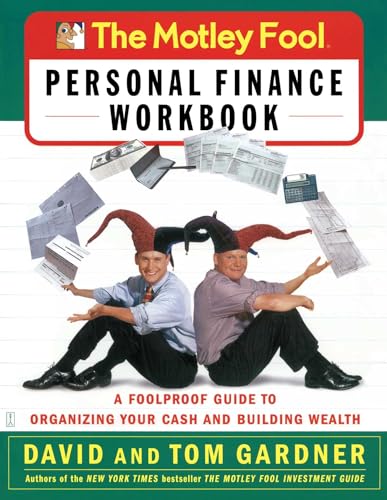
The Motley Fool Personal Finance Workbook: A Foolproof Guide to Organizing Your Cash and Building Wealth (Motley Fool Books) - Softcover
Inhaltsangabe
With easy-to-follow, quick-witted exercises, you'll discover all the ways that money touches your life -- from saving and spending to insurance to retirement.
Pencil your way to financial security!
What would it be like to know that you were making the very best decision for every dollar you spent or saved? Can you imagine balancing your budget by the beginning of next month? Wouldn't it be great to know whether a pro's advice is right for your situation? How valuable would it be to have a customized financial plan that would serve you for life?
What you hold in your hands is the first step to achieving all of the above. Whatever your income, lifestyle, or financial concerns may be, The Motley Fool Personal Finance Workbook will help you put more power into every dollar. Like a financial global positioning system, The Motley Fool Personal Finance Workbook will show you exactly where you stand right now and the most direct path to where you want to be.
The Motley Fool's legendary smarts and math-made-easy will show you:
-How to create a workable budget that gives you money and a life
-The smartest (and fastest) way out of debt
-How to set priorities to guide your financial decisions
-The savviest ways to finance big purchases like a home or an education
-Tactics for eliminating stress when saving for retirement
-And much more...
Hip, funny, and immediately useful, The Motley Fool Personal Finance Workbook is an indispensable hands-on guide for anyone looking to make the most of his or her money.
Die Inhaltsangabe kann sich auf eine andere Ausgabe dieses Titels beziehen.
Über die Autorinnen und Autoren
David Gardner learned from his father how to invest, and with his brother, Tom, started The Motley Fool in 1993 with a mission to educate, amuse, and enrich. Today, the Fool works to empower individual investors, reaching millions every month through its website, premium services, podcasts, radio show, newspaper column, and more. With Tom they have coauthored several books, including You Have More Than You Think, Rule Breakers, Rule Makers, and The Motley Fool Investment Guide for Teens.
Tom Gardner learned from his father how to invest, and with his brother, David, started The Motley Fool in 1993 with a mission to educate, amuse, and enrich. Today, the Fool works to empower individual investors, reaching millions every month through its website, premium services, podcasts, radio show, newspaper column, and more. With David they have coauthored several books, including You Have More Than You Think, Rule Breakers, Rule Makers, and The Motley Fool Investment Guide for Teens.
Auszug. © Genehmigter Nachdruck. Alle Rechte vorbehalten.
Chapter 1: Your Money and Your Life
SIXTY-SECOND GUIDE TO YOUR MONEY AND YOUR LIFE
Let's kick things off with a one-minute preview of Chapter 1. We have to admit that this first chapter may seem frivolous. But play along with us for a few pages before we get down to business. We need you to figure out who you are before you can really excel at this workbook.
Remember, the next sixty seconds is just an overview of the different projects we'll work on together in the chapter. So here's where we're headed.
0:60 Take time out for self-reflection.
In general, would you call yourself a saver? A spender? A procrastinator? A realist? An avoider? An Abstract Expressionist? Reflect on the past and how you handled financial matters (and how they were handled -- or mishandled -- by the role models in your life).
0:51 Define in concrete terms how your spending matches up with your priorities.
When you make a big purchase, are you able to enjoy the item, or do you feel guilty? Do you spend money on smaller, less meaningful things because you feel you'll never be able to afford the ones you really want?
0:44 Go on a spending spree...in your imagination, that is.
Put that credit card down. Instead, commit to paper your list of goals -- at least, those that will require capital. Don't dwell too much on the details; just write down a mega-master list of things you want to achieve (such as home ownership, a debt-free existence, a trip to China).
0:23 Pick the really important ones.
Scour your mega-master list of goals and pick out the top five that best match up with your priorities. Select only the ones that really count. That's what we'll be working toward in this book.
0:16 Make them real.
Put together a plan to figure what it'll take to achieve those five goals -- what each will cost, when you want them to be completed, and so on. Break each one up into monthly or weekly savings goals and commit them all to paper.
0:03 Celebrate you!
Now bask in the glow of self-knowledge and self-actualization. You've completed the chapter, voilà.
• • •
There's the synopsis. Now let's get started.
KNOW THYSELF
Who are you? And what does that say about the
way you use money? Think about it: Are you the sort who tirelessly searches out the four cents that won't let you balance your checkbook? Or do you believe, against all evidence, that there's money in your account just because there are still checks in your checkbook?
The Greek Oracle at Delphi read, "Know thyself." That's the first step in all good money management. We are all different. We all have unique talents and rare gifts. We all have flaws -- terribly sad but true. The challenge, the great challenge, is to know ourselves and then to adjust our lives accordingly.
As this short lesson pertains to money, we'll be laser-focused in this chapter on how your strengths and weaknesses affect your financial circumstance. Money might not be the root of all evil for you. But it may be a hot button in your relationships (a bubbling cauldron, in some cases). It may be a source of worry. It may be a cause for celebration. Or it may hold the clue to your high blood pressure. (If so, eat more leafy greens, shorten your breathing, get eight hours of rest a night, and get a sound financial plan into place.)
At the very least, the topic of money has probably given you pause during some uncomfortable experiences. Now remember these moments, briefly.
Then proceed.
YOUR INNER FINANCIAL CHILD
Some of you must be rolling your eyes. My inner child? Hey, we don't want this to sound like daytime talk television. But before we get to crunching the numbers of your financial future, take a step back, just for a moment, and consider your financial history. The legendary Bob Marley put it right: "Don't know your past, don't know your future."
To get you started, we asked a couple from The Motley Fool Online to share some dark secrets from their past. In their own words, here are four financial discoveries they've made over the years. Consider this a starter list for your own journey:
Discovery 1: The past matters.
Shannon and I grew up very differently. Unfortunately, it took us a while to realize how much this matters in our relationship -- especially when it comes to how we handle money as a couple. When you don't acknowledge the importance of where you come from, it comes back to haunt you in the form of agitation and misunderstanding.
Discovery 2: People react differently to their pasts.
My father worked at Walt Disney World his entire career, and my mom was a homemaker. I never worried that they couldn't pay the bills. Shannon's parents, on the other hand, divorced when he was seven, and his mom was the primary breadwinner. One result is that I'm much more of a short-term thinker in relation to money. I just have faith that everything will work out. Shannon is much more serious and interested in a long-term approach. Ah, how opposites attract.
Discovery 3: Your approach to money matters is as individual as you are.
One tangible result of our different backgrounds is the varying comfort levels we each have with debt and spending. We got married really young and moved to New York City. What does that spell? Trouble -- in the form of serious credit card debt. Because my parents didn't "believe" in debt, I totally freaked out about our credit card balances. I thought we were going to have to hit the streets. Shannon, on the other hand, seemed pretty comfortable with them. It took a while to develop a common language in this area.
Discovery 4: Knowing where you're coming from helps.
Shannon values having a secure retirement plan, whereas I value living our dream lives (the specifics of which change as we mature together). Again, developing a common language and really taking in what your partner needs is more than half the battle.
YOUR RUMINATIONS
Now it's time for your self-reflection. As a warm-up, we present ten questions about money management. Your answers will help set priorities later in this chapter. Be frank. It's okay if you're not the ideal chief financial officer yet.
1. Do you balance your checkbook? (Circle the appropriate answer.) Yes No
2. Are you a long-term planner? Yes No
3. When was the last time you really took a hard look at your finances (meaning more than glancing over your account statements)?
4. On a scale of 1 to 5 (5 being very much), how important are the following?
• Cutting coupons 1 2 3 4 5
• Going to the gas station with the cheapest gas 1 2 3 4 5
• Renting videos instead of going out to the movies 1 2 3 4 5
• Comparison shopping 1 2 3 4 5
5. How much is too much to spend on...
• Going out to dinner? $ _______
• A gift (for a friend, a significant other, children, a pet)? $ _______
• Vacation? $ _______
• A wireless sterling silver ab buster? $ _______
6. If you were to inherit $10,000, would it be most important to:
• Pay off debt
• Buy a new car
• Invest the money
• Take a vacation
• Throw an awesome party for your other relatives so that they, too, can see what an awesome and deserving daughter (granddaughter, nineteenth cousin twice removed) you are
• Other _________________
7. What are a few comforts you wouldn't want yourself or your loved ones to do without?
8. When do you expect to buy your next car? Will it be new or used?
9. What are your...
„Über diesen Titel“ kann sich auf eine andere Ausgabe dieses Titels beziehen.
Suchergebnisse für The Motley Fool Personal Finance Workbook: A Foolproof...

Beispielbild für diese ISBN
The Motley Fool Personal Finance Workbook: A Foolproof Guide to Organizing Your Cash and Building Wealth
Anbieter: Wonder Book, Frederick, MD, USA
Verkäuferbewertung 5 von 5 Sternen

Zustand: Very Good. Very Good condition. A copy that may have a few cosmetic defects. May also contain light spine creasing or a few markings such as an owner's name, short gifter's inscription or light stamp. Bundled media such as CDs, DVDs, floppy disks or access codes may not be included. Artikel-Nr. Y05I-00007
Gebraucht kaufen
EUR 5,35
Versand gratis
Versand innerhalb von USA
Versand innerhalb von USA
Anzahl: 2 verfügbar
Beispielbild für diese ISBN
The Motley Fool Personal Finance Workbook: A Foolproof Guide to Organizing Your Cash and Building Wealth
Anbieter: ThriftBooks-Atlanta, AUSTELL, GA, USA
Verkäuferbewertung 5 von 5 Sternen
Paperback. Zustand: Very Good. No Jacket. May have limited writing in cover pages. Pages are unmarked. ~ ThriftBooks: Read More, Spend Less. Artikel-Nr. G0743229975I4N00
Gebraucht kaufen
EUR 5,62
Versand gratis
Versand innerhalb von USA
Versand innerhalb von USA
Anzahl: 1 verfügbar
Beispielbild für diese ISBN
The Motley Fool Personal Finance Workbook: A Foolproof Guide to Organizing Your Cash and Building Wealth
Anbieter: ThriftBooks-Reno, Reno, NV, USA
Verkäuferbewertung 5 von 5 Sternen
Paperback. Zustand: Very Good. No Jacket. May have limited writing in cover pages. Pages are unmarked. ~ ThriftBooks: Read More, Spend Less. Artikel-Nr. G0743229975I4N00
Gebraucht kaufen
EUR 5,62
Versand gratis
Versand innerhalb von USA
Versand innerhalb von USA
Anzahl: 1 verfügbar
Beispielbild für diese ISBN
The Motley Fool Personal Finance Workbook: A Foolproof Guide to Organizing Your Cash and Building Wealth
Anbieter: ThriftBooks-Dallas, Dallas, TX, USA
Verkäuferbewertung 5 von 5 Sternen
Paperback. Zustand: Very Good. No Jacket. May have limited writing in cover pages. Pages are unmarked. ~ ThriftBooks: Read More, Spend Less. Artikel-Nr. G0743229975I4N00
Gebraucht kaufen
EUR 5,62
Versand gratis
Versand innerhalb von USA
Versand innerhalb von USA
Anzahl: 1 verfügbar
Beispielbild für diese ISBN
The Motley Fool Personal Finance Workbook: A Foolproof Guide to Organizing Your Cash and Building Wealth
Anbieter: ThriftBooks-Atlanta, AUSTELL, GA, USA
Verkäuferbewertung 5 von 5 Sternen
Paperback. Zustand: Very Good. No Jacket. Former library book; May have limited writing in cover pages. Pages are unmarked. ~ ThriftBooks: Read More, Spend Less. Artikel-Nr. G0743229975I4N10
Gebraucht kaufen
EUR 5,62
Versand gratis
Versand innerhalb von USA
Versand innerhalb von USA
Anzahl: 1 verfügbar
Beispielbild für diese ISBN
The Motley Fool Personal Finance Workbook : A Foolproof Guide to Organizing Your Cash and Building Wealth
Anbieter: Better World Books, Mishawaka, IN, USA
Verkäuferbewertung 5 von 5 Sternen
Zustand: Good. Workbook. Former library book; may include library markings. Used book that is in clean, average condition without any missing pages. Artikel-Nr. 6139677-6
Gebraucht kaufen
EUR 6,20
Versand gratis
Versand innerhalb von USA
Versand innerhalb von USA
Anzahl: 2 verfügbar
Beispielbild für diese ISBN
The Motley Fool Personal Finance Workbook : A Foolproof Guide to Organizing Your Cash and Building Wealth
Anbieter: Better World Books, Mishawaka, IN, USA
Verkäuferbewertung 5 von 5 Sternen
Zustand: Good. Workbook. Used book that is in clean, average condition without any missing pages. Artikel-Nr. 2447184-6
Gebraucht kaufen
EUR 6,20
Versand gratis
Versand innerhalb von USA
Versand innerhalb von USA
Anzahl: 1 verfügbar
Beispielbild für diese ISBN
The Motley Fool Personal Finance Workbook : A Foolproof Guide to Organizing Your Cash and Building Wealth
Anbieter: Better World Books, Mishawaka, IN, USA
Verkäuferbewertung 5 von 5 Sternen
Zustand: Very Good. Workbook. Used book that is in excellent condition. May show signs of wear or have minor defects. Artikel-Nr. GRP98761034
Gebraucht kaufen
EUR 6,20
Versand gratis
Versand innerhalb von USA
Versand innerhalb von USA
Anzahl: 1 verfügbar
Beispielbild für diese ISBN
The Motley Fool Personal Finance Workbook : A Foolproof Guide to Organizing Your Cash and Building Wealth
Anbieter: Better World Books: West, Reno, NV, USA
Verkäuferbewertung 5 von 5 Sternen
Zustand: Very Good. Workbook. Used book that is in excellent condition. May show signs of wear or have minor defects. Artikel-Nr. GRP98761034
Gebraucht kaufen
EUR 6,20
Versand gratis
Versand innerhalb von USA
Versand innerhalb von USA
Anzahl: 1 verfügbar
Beispielbild für diese ISBN
Motley Fool Personal Finance Workbo: A Foolproof Guide to Organizing Your Cash and Building Wealth (Motley Fool Books)
Anbieter: Kennys Bookstore, Olney, MD, USA
Verkäuferbewertung 4 von 5 Sternen

Zustand: New. Artikel-Nr. V9780743229975
Neu kaufen
EUR 28,07
EUR 8,96 shipping
Versand innerhalb von USA
Versand innerhalb von USA
Anzahl: Mehr als 20 verfügbar