
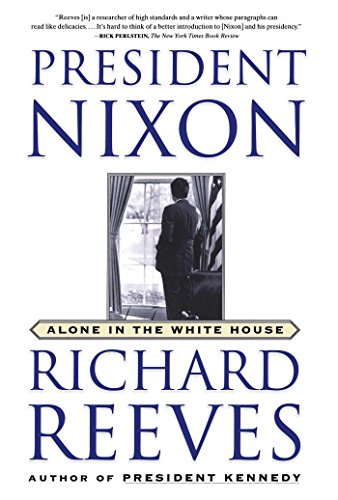
Verwandte Artikel zu President Nixon: Alone in the White House
Inhaltsangabe
Who was Richard Nixon? The most amazing thing about the man was not what he did as president, but that he became president at all. Using thousands of new interviews and recently discovered or declassified documents and tapes, Richard Reeves's President Nixon offers a surprising portrait of a brilliant and contradictory man.
Even as he dreamed of presidential greatness, Nixon could trust no one. His closest aides spied on him as he spied on them, while cabinet members, generals, and admirals spied on all of them -- rifling briefcases and desks, tapping each other's phones in a house where no one knew what was true anymore. Reeves shows a presidency doomed from the start by paranoia and corruption, beginning with Nixon and Kissinger using the CIA to cover up a murder by American soldiers in Vietnam that led to the theft and publication of the Pentagon Papers, then to secret counterintelligence units within the White House itself, and finally to the burglaries and cover-up that came to be known as Watergate. President Nixon is the astonishing story of a complex political animal who was as praised as he was reviled and who remains a subject of controversy to this day.
Die Inhaltsangabe kann sich auf eine andere Ausgabe dieses Titels beziehen.
Über die Autorin bzw. den Autor
Richard Reeves is the author of presidential bestsellers, including President Nixon and President Kennedy, acclaimed as the best nonfiction book of the year by Time magazine. A syndicated columnist and winner of the American Political Science Association's Carey McWilliams Award, he lives in New York and Los Angeles.
Auszug. © Genehmigter Nachdruck. Alle Rechte vorbehalten.
President Nixon
Alone in the White HouseBy Richard ReevesSimon & Schuster
Copyright © 2002 Richard ReevesAll right reserved.
ISBN: 0743227190
Prologue: August 9, 1974
At midnight on August 8, 1974, Stephen Bull, the personal assistant to the President of the United States, walked into the President's office, the Oval Office. It was quiet and dark in the West Wing of the White House. The television cameras were gone. The correspondents and the technicians had folded up their equipment and left after the thirty-seventh president, Richard Milhous Nixon, had announced, two hours before, that he would resign the office at noon on August 9. Bull decided not to turn on the lights. He could see enough in the dim light from the hallway. He went in, picked up Nixon's briefcase, put it near the doorway, and then began to pack away the things on the desk. The President was flying home to California the next day, and Bull decided to put everything on the desk there, just the way it was here, as if nothing had happened. He began with Nixon's reading glasses and a photograph of the President's two daughters, Tricia and Julie. As he picked up the appointment book, he bumped against the silver cigarette case the girls had given the President on the day he was inaugurated. The case was knocked off the desk onto the rug. It opened and the music box inside began to play its tinny tune, "Hail to the Chief."
Later, the President's secretary, Rose Mary Woods, who had spent twenty-three years with him in good times and bad, and an assistant named Marge Acker came in and began emptying the drawers into cardboard boxes. There were moving boxes in the hallways everywhere in the building. The place smelled of burnt paper, as some of the most powerful men in the country threw memos and files into their office fireplaces. The office of Nixon's last chief of staff, General Alexander M. Haig, was filled with giant clear plastic bags that held shredded documents. "Duplicates," he said. In the Oval Office the women packed up everything in the "Wilson desk," which Nixon used because he admired Woodrow Wilson. Then they moved on to his other two desks. The one President Dwight D. Eisenhower had used in the Oval Office, when Nixon was vice president, was in room 175 of the Executive Office Building, next to the White House; Nixon often worked alone there. The last one, which was smaller, was the "Lincoln desk" in the President's sitting room in the living quarters upstairs near his bedroom; Abraham Lincoln had used it in his summer retreat, a farmhouse only a mile away, north of Pennsylvania Avenue.
Miss Woods began with the center drawer of the Wilson desk. In it was a folder marked: "THE UNAUTHORIZED DISCLOSURE OF THE INFORMATION CONTAINED IN THE ATTACHED DOCUMENT(S) COULD BE PREJUDICIAL TO THE DEFENSE INTEREST OF THE UNITED STATES...Please put in the middle drawer of the President's desk." Inside were Nixon's funeral plans, six rose-colored pages, photographs, and an Avis Rent-a-Car map, with a description of Rose Hills cemetery in Whittier, California, the town where he grew up. "Rose Hills is renowned as Southern California's most spacious and naturally beautiful Memorial Park." There was a list of honorary pallbearers, as well as a list of six musical selections, from "God Bless America" to "California, Here I Come." Next to the California song, the poor boy from Whittier who had become president had written, "Played softly and slowly."
Into a box it went, along with letters, stacks of newspaper clippings and polling summaries, the plastic belts of dictating machines, even a Halloween mask from a party. Most of what went into the boxes were the President's memos to himself, hand-written over five years on long yellow legal pads or dictated late at night and transcribed the next day. "To do" lists and "to be" lists -- about what he wanted from history, what kind of president he wanted to be, what kind of man he wanted to be. American self-improvement lectures to himself -- the most important dialogue in the White House, an introvert's dialogue with himself.
One of the first of the lists, from the Eisenhower desk, was written late at night on February 6, 1969, Nixon's seventeenth day as president. He was preparing for an interview with Hugh Sidey, who wrote a column called "The Presidency" for both Time and Life magazines, and he wrote three pages of resolutions to himself:
Compassionate, Bold, New, Courageous...Zest for the job (not lonely but awesome). Goals -- reorganized govt. Idea magnet...Mrs. RN -- glamour, dignity...
Open Channels for Dissent...Progress -- Participation, Trustworthy, Open-minded.
Most powerful office. Each day a chance to do something memorable for someone. Need to be good to do good...The nation must be better in spirit at the end of term. Need for joy, serenity, confidence, inspiration.
One drawer in Ike's old desk in that hideaway was stuffed with letters Nixon had read and kept for some reason, along with the Dictaphone belts. The letters were the same kind any man kept, the important ones, or those that inspired or just flattered him. The oldest one in the desk turned out to be important. It was from Claude Kirk, the governor of Florida, who wrote on May 31, 1969: "In regard to the replacement of Justice Fortas, I want to bring to your attention a Federal judge in this district who meets what I believe is your criteria for experience, philosophy, and personal character. His name is Judge Harrold Carswell...To paraphrase the play entitled 'A Man For All Seasons,' I can tell you that Justice Carswell is a man for all 'regions.'..." There was flattery from Theodore H. White in June 1969, along with the first copy off the press of his book The Making of the President, 1968. True to form, the author's prose was rich: "This book whose hero is Richard M. Nixon...My previous reporting of Richard Nixon must I know have hurt. If I feel differently now it is not that there is a new Richard Nixon or a new Teddy White but that slowly truths force their way on all of us...this book tries to describe the campaign of a man of courage and conscience."
In the first days of January 1970, alone in EOB 175, Nixon gave himself a pep talk, writing:
Add element of lift to each appearance...Hard work -- Imagination -- Compassion -- Leadership -- Understanding of young -- Intellectual expansion...Cool -- Strong -- Organized -- Temperate -- Exciting...Excitement -- Joy in Life -- Sharing. Lift spirit of people -- Pithy, memorable phrases.
Some time after that, on an undated page found in the Oval Office, he wrote:
Foreign Policy = strength. 1. War is difficult -- But our successes are hidden -- and ending war will be denied us. 2. Must emphasize -- Courage, Stands alone...Knows more than anyone else. Towers above advisers. World leader.Restoration of Dignity. Family man -- Not a playboy -- respects office too much -- but fun.
Extraordinary intelligence -- memory -- Idealism -- Love of country -- Concern for old -- poor -- Refusal to exploit.
Yet must be personal and warm.
On November 15, 1970, he wrote himself two pages of notes that stayed in the desk in EOB 175 until they were packed away by Bull. They began: "2 years less one week or 6 years less one week," and went on:
I have learned about myself and the Presidency. From this experience I conclude:The primary contribution a President can make is on Spiritual lift -- not material solutions.
1. The staff -- particularly K & H -- with my active cooperation have taken...
„Über diesen Titel“ kann sich auf eine andere Ausgabe dieses Titels beziehen.
Suchergebnisse für President Nixon: Alone in the White House

Beispielbild für diese ISBN
President Nixon: Alone in the
Anbieter: World of Books (was SecondSale), Montgomery, IL, USA
Verkäuferbewertung 5 von 5 Sternen

Zustand: Acceptable. Item in acceptable condition! Textbooks may not include supplemental items i.e. CDs, access codes etc. Artikel-Nr. 00099172102
Gebraucht kaufen
EUR 3,64
Versand gratis
Versand innerhalb von USA
Versand innerhalb von USA
Anzahl: 2 verfügbar
Beispielbild für diese ISBN
President Nixon: Alone in the
Anbieter: World of Books (was SecondSale), Montgomery, IL, USA
Verkäuferbewertung 5 von 5 Sternen
Zustand: Good. Item in good condition. Textbooks may not include supplemental items i.e. CDs, access codes etc. Artikel-Nr. 00101523987
Gebraucht kaufen
EUR 3,64
Versand gratis
Versand innerhalb von USA
Versand innerhalb von USA
Anzahl: 5 verfügbar
Beispielbild für diese ISBN
President Nixon: Alone in the White House
Anbieter: World of Books (was SecondSale), Montgomery, IL, USA
Verkäuferbewertung 5 von 5 Sternen
Zustand: Good. Item in good condition and has highlighting/writing on text. Used texts may not contain supplemental items such as CDs, info-trac etc. Artikel-Nr. 00096736845
Gebraucht kaufen
EUR 4,19
Versand gratis
Versand innerhalb von USA
Versand innerhalb von USA
Anzahl: 1 verfügbar
Beispielbild für diese ISBN
President Nixon: Alone in the White House
Anbieter: ThriftBooks-Reno, Reno, NV, USA
Verkäuferbewertung 5 von 5 Sternen
Paperback. Zustand: Very Good. No Jacket. May have limited writing in cover pages. Pages are unmarked. ~ ThriftBooks: Read More, Spend Less. Artikel-Nr. G0743227190I4N00
Gebraucht kaufen
EUR 6,10
Versand gratis
Versand innerhalb von USA
Versand innerhalb von USA
Anzahl: 1 verfügbar
Beispielbild für diese ISBN
President Nixon: Alone in the White House
Anbieter: ThriftBooks-Atlanta, AUSTELL, GA, USA
Verkäuferbewertung 5 von 5 Sternen
Paperback. Zustand: Very Good. No Jacket. May have limited writing in cover pages. Pages are unmarked. ~ ThriftBooks: Read More, Spend Less. Artikel-Nr. G0743227190I4N00
Gebraucht kaufen
EUR 6,11
Versand gratis
Versand innerhalb von USA
Versand innerhalb von USA
Anzahl: 1 verfügbar
Beispielbild für diese ISBN
President Nixon: Alone in the White House
Anbieter: ThriftBooks-Dallas, Dallas, TX, USA
Verkäuferbewertung 5 von 5 Sternen
Paperback. Zustand: Very Good. No Jacket. May have limited writing in cover pages. Pages are unmarked. ~ ThriftBooks: Read More, Spend Less. Artikel-Nr. G0743227190I4N00
Gebraucht kaufen
EUR 6,11
Versand gratis
Versand innerhalb von USA
Versand innerhalb von USA
Anzahl: 1 verfügbar
Beispielbild für diese ISBN
President Nixon: Alone in the White House
Anbieter: Wonder Book, Frederick, MD, USA
Verkäuferbewertung 5 von 5 Sternen
Zustand: Very Good. Very Good condition. A copy that may have a few cosmetic defects. May also contain light spine creasing or a few markings such as an owner's name, short gifter's inscription or light stamp. Bundled media such as CDs, DVDs, floppy disks or access codes may not be included. Artikel-Nr. E12O-00269
Gebraucht kaufen
EUR 6,19
Versand gratis
Versand innerhalb von USA
Versand innerhalb von USA
Anzahl: 1 verfügbar
Beispielbild für diese ISBN
President Nixon: Alone in the White House
Anbieter: Wonder Book, Frederick, MD, USA
Verkäuferbewertung 5 von 5 Sternen
Zustand: Good. Good condition. With remainder mark. A copy that has been read but remains intact. May contain markings such as bookplates, stamps, limited notes and highlighting, or a few light stains. Artikel-Nr. X11E-01333
Gebraucht kaufen
EUR 6,19
Versand gratis
Versand innerhalb von USA
Versand innerhalb von USA
Anzahl: 2 verfügbar
Beispielbild für diese ISBN
President Nixon : Alone in the White House
Anbieter: Better World Books: West, Reno, NV, USA
Verkäuferbewertung 5 von 5 Sternen
Zustand: Very Good. Reprint. Pages intact with possible writing/highlighting. Binding strong with minor wear. Dust jackets/supplements may not be included. Stock photo provided. Product includes identifying sticker. Better World Books: Buy Books. Do Good. Artikel-Nr. 4569460-6
Gebraucht kaufen
EUR 6,27
Versand gratis
Versand innerhalb von USA
Versand innerhalb von USA
Anzahl: 1 verfügbar
Beispielbild für diese ISBN
President Nixon : Alone in the White House
Anbieter: Better World Books, Mishawaka, IN, USA
Verkäuferbewertung 5 von 5 Sternen
Zustand: Good. Reprint. Pages intact with minimal writing/highlighting. The binding may be loose and creased. Dust jackets/supplements are not included. Stock photo provided. Product includes identifying sticker. Better World Books: Buy Books. Do Good. Artikel-Nr. 2447506-6
Gebraucht kaufen
EUR 6,27
Versand gratis
Versand innerhalb von USA
Versand innerhalb von USA
Anzahl: 1 verfügbar