
Verwandte Artikel zu 1776
Inhaltsangabe
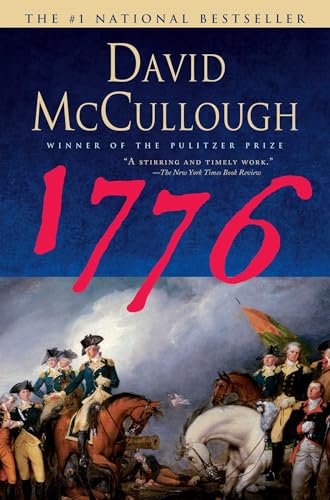
America’s beloved and distinguished historian presents, in a book of breathtaking excitement, drama, and narrative force, the stirring story of the year of our nation’s birth, 1776, interweaving, on both sides of the Atlantic, the actions and decisions that led Great Britain to undertake a war against her rebellious colonial subjects and that placed America’s survival in the hands of George Washington.
In this masterful book, David McCullough tells the intensely human story of those who marched with General George Washington in the year of the Declaration of Independence—when the whole American cause was riding on their success, without which all hope for independence would have been dashed and the noble ideals of the Declaration would have amounted to little more than words on paper.
Based on extensive research in both American and British archives, 1776 is a powerful drama written with extraordinary narrative vitality. It is the story of Americans in the ranks, men of every shape, size, and color, farmers, schoolteachers, shoemakers, no-accounts, and mere boys turned soldiers. And it is the story of the King’s men, the British commander, William Howe, and his highly disciplined redcoats who looked on their rebel foes with contempt and fought with a valor too little known.
Written as a companion work to his celebrated biography of John Adams, David McCullough’s 1776 is another landmark in the literature of American history.
Die Inhaltsangabe kann sich auf eine andere Ausgabe dieses Titels beziehen.
Über die Autorin bzw. den Autor
David McCullough (1933–2022) twice received the Pulitzer Prize, for Truman and John Adams, and twice received the National Book Award, for The Path Between the Seas and Mornings on Horseback. His other acclaimed books include The Johnstown Flood, The Great Bridge, Brave Companions, 1776, The Greater Journey, The American Spirit, The Wright Brothers, and The Pioneers. He was the recipient of numerous honors and awards, including the Presidential Medal of Freedom, the nation’s highest civilian award. Visit DavidMcCullough.com.
Von der hinteren Coverseite
America’s beloved and distinguished historian presents, in a book of breathtaking excitement, drama, and narrative force, the stirring story of the year of our nation’s birth, 1776, interweaving, on both sides of the Atlantic, the actions and decisions that led Great Britain to undertake a war against her rebellious colonial subjects and that placed America’s survival in the hands of George Washington.
In this masterful book, David McCullough tells the intensely human story of those who marched with General George Washington in the year of the Declaration of Independence―when the whole American cause was riding on their success, without which all hope for independence would have been dashed and the noble ideals of the Declaration would have amounted to little more than words on paper.
Based on extensive research in both American and British archives, 1776 is a powerful drama written with extraordinary narrative vitality. It is the story of Americans in the ranks, men of every shape, size, and color; farmers, schoolteachers, shoemakers, no-accounts, and mere boys turned soldiers. And it is the story of the King’s men, the British commander, William Howe, and his highly disciplined redcoats who looked on their rebel foes with contempt and fought with a valor too little known.
Written as a companion work to his celebrated biography of John Adams, David McCullough’s 1776 is another landmark in the literature of American history.
Auszug. © Genehmigter Nachdruck. Alle Rechte vorbehalten.
Chapter One: Sovereign Duty
God save Great George our King,Long live our noble King,
God save the King!
Send him victorious,
Happy and glorious,
Long to reign o'er us;
God save the King!
On the afternoon of Thursday, October 26, 1775, His Royal Majesty George III, King of England, rode in royal splendor from St. James's Palace to the Palace of Westminster, there to address the opening of Parliament on the increasingly distressing issue of war in America.
The day was cool, but clear skies and sunshine, a rarity in London, brightened everything, and the royal cavalcade, spruced and polished, shone to perfection. In an age that had given England such rousing patriotic songs as "God Save the King" and "Rule Britannia," in a nation that adored ritual and gorgeous pageantry, it was a scene hardly to be improved upon.
An estimated 60,000 people had turned out. They lined the whole route through St. James's Park. At Westminster people were packed solid, many having stood since morning, hoping for a glimpse of the King or some of the notables of Parliament. So great was the crush that latecomers had difficulty seeing much of anything.
One of the many Americans then in London, a Massachusetts Loyalist named Samuel Curwen, found the "mob" outside the door to the House of Lords too much to bear and returned to his lodgings. It was his second failed attempt to see the King. The time before, His Majesty had been passing by in a sedan chair near St. James's, but reading a newspaper so close to his face that only one hand was showing, "the whitest hand my eyes ever beheld with a very large rose diamond ring," Loyalist Curwen recorded.
The King's procession departed St. James's at two o'clock, proceeding at walking speed. By tradition, two Horse Grenadiers with swords drawn rode in the lead to clear the way, followed by gleaming coaches filled with nobility, then a clattering of Horse Guards, the Yeomen of the Guard in red and gold livery, and a rank of footmen, also in red and gold. Finally came the King in his colossal golden chariot pulled by eight magnificent cream-colored horses (Hanoverian Creams), a single postilion riding the left lead horse, and six footmen at the side.
No mortal on earth rode in such style as their King, the English knew. Twenty-four feet in length and thirteen feet high, the royal coach weighed nearly four tons, enough to make the ground tremble when under way. George III had had it built years before, insisting that it be "superb." Three gilded cherubs on top -- symbols of England, Scotland, and Ireland -- held high a gilded crown, while over the heavy spoked wheels, front and back, loomed four gilded sea gods, formidable reminders that Britannia ruled the waves. Allegorical scenes on the door panels celebrated the nation's heritage, and windows were of sufficient size to provide a full view of the crowned sovereign within.
It was as though the very grandeur, wealth, and weight of the British Empire were rolling past -- an empire that by now included Canada, that reached from the seaboard of Massachusetts and Virginia to the Mississippi and beyond, from the Caribbean to the shores of Bengal. London, its population at nearly a million souls, was the largest city in Europe and widely considered the capital of the world.
George III had been twenty-two when, in 1760, he succeeded to the throne, and to a remarkable degree he remained a man of simple tastes and few pretensions. He liked plain food and drank but little, and wine only. Defying fashion, he refused to wear a wig. That the palace at St. James's had become a bit dowdy bothered him not at all. He rather liked it that way. Socially awkward at Court occasions -- many found him disappointingly dull -- he preferred puttering about his farms at Windsor dressed in farmer's clothes. And in notable contrast to much of fashionable society and the Court, where mistresses and infidelities were not only an accepted part of life, but often flaunted, the King remained steadfastly faithful to his very plain Queen, the German princess Charlotte Sophia of Mecklenburg-Strelitz, with whom by now he had produced ten children. (Ultimately there would be fifteen.) Gossips claimed Farmer George's chief pleasures were a leg of mutton and his plain little wife.
But this was hardly fair. Nor was he the unattractive, dim-witted man critics claimed then and afterward. Tall and rather handsome, with clear blue eyes and a generally cheerful expression, George III had a genuine love of music and played both the violin and piano. (His favorite composer was Handel, but he adored also the music of Bach and in 1764 had taken tremendous delight in hearing the boy Mozart perform on the organ.) He loved architecture and did quite beautiful architectural drawings of his own. With a good eye for art, he had begun early to assemble his own collection, which by now included works by the contemporary Italian painter Canaletto, as well as watercolors and drawings by such old masters as Poussin and Raphael. He avidly collected books, to the point where he had assembled one of the finest libraries in the world. He adored clocks, ship models, took great interest in things practical, took great interest in astronomy, and founded the Royal Academy of Arts.
He also had a gift for putting people at their ease. Samuel Johnson, the era's reigning arbiter of all things of the mind, and no easy judge of men, responded warmly to the "unaffected good nature" of George III. They had met and conversed for the first time when Johnson visited the King's library, after which Johnson remarked to the librarian, "Sir, they may talk of the King as they will, but he is the finest gentleman I have ever seen."
Stories that he had been slow to learn, that by age eleven he still could not read, were unfounded. The strange behavior -- the so-called "madness" of King George III -- for which he would be long remembered, did not come until much later, more than twenty years later, and rather than mental illness, it appears to have been porphyria, a hereditary disease not diagnosed until the twentieth century.
Still youthful at thirty-seven, and still hardworking after fifteen years on the throne, he could be notably willful and often shortsighted, but he was sincerely patriotic and everlastingly duty-bound. "George, be a King," his mother had told him. As the crisis in America grew worse, and the opposition in Parliament more strident, he saw clearly that he must play the part of the patriot-king.
He had never been a soldier. He had never been to America, any more than he had set foot in Scotland or Ireland. But with absolute certainty he knew what must be done. He would trust to Providence and his high sense of duty. America must be made to obey.
"I have no doubt but the nation at large sees the conduct in America in its true light," he had written to his Prime Minister, Lord North, "and I am certain any other conduct but compelling obedience would be ruinous and...therefore no consideration could bring me to swerve from the present path which I think myself in duty-bound to follow."
In the House of Lords in March of 1775, when challenged on the chances of Britain ever winning a war in America, Lord Sandwich, First Lord of the Admiralty, had looked incredulous. "Suppose the colonies do abound in men, what does that signify?" he asked. "They are raw, undisciplined, cowardly men." And Lord Sandwich was by no means alone in that opinion. General James Grant, a member of the House of Commons, had boasted that with 5,000 British regulars he could march from one end of the American continent to the other, a claim that was widely quoted.
But in striking contrast, several of the most powerful speakers in Parliament, like the flamboyant Lord Mayor of London, John Wilkes, and...
„Über diesen Titel“ kann sich auf eine andere Ausgabe dieses Titels beziehen.
Suchergebnisse für 1776

Beispielbild für diese ISBN
1776
Anbieter: World of Books (was SecondSale), Montgomery, IL, USA
Verkäuferbewertung 5 von 5 Sternen

Paperback. Zustand: Good. America's beloved and distinguished historian presents, in a book of breathtaking excitement, drama, and narrative force, the stirring story of the year of our nation's birth, 1776, interweaving, on both sides of the Atlantic, the actions and decisions that led Great Britain to undertake a war against her rebellious colonial subjects and that placed America's survival in the hands of George Washington. In this masterful book, David McCullough tells the intensely human story of those who marched with General George Washington in the year of the Declaration of Independence--when the whole American cause was riding on their success, without which all hope for independence would have been dashed and the noble ideals of the Declaration would have amounted to little more than words on paper. Based on extensive research in both American and British archives, 1776 is a powerful drama written with extraordinary narrative vitality. It is the story of Americans in the ranks, men of every shape, size, and color; farmers, schoolteachers, shoemakers, no-accounts, and mere boys turned soldiers. And it is the story of the King's men, the British commander, William Howe, and his highly disciplined redcoats who looked on their rebel foes with contempt and fought with a valor too little known. Written as a companion work to his celebrated biography of John Adams, David McCullough's 1776 is another landmark in the literature of American history. Artikel-Nr. 00108091727
Gebraucht kaufen
EUR 3,83
Versand gratis
Versand innerhalb von USA
Versand innerhalb von USA
Anzahl: Mehr als 20 verfügbar
Beispielbild für diese ISBN
1776
Anbieter: World of Books (was SecondSale), Montgomery, IL, USA
Verkäuferbewertung 5 von 5 Sternen
Paperback. Zustand: Fair. America's beloved and distinguished historian presents, in a book of breathtaking excitement, drama, and narrative force, the stirring story of the year of our nation's birth, 1776, interweaving, on both sides of the Atlantic, the actions and decisions that led Great Britain to undertake a war against her rebellious colonial subjects and that placed America's survival in the hands of George Washington. In this masterful book, David McCullough tells the intensely human story of those who marched with General George Washington in the year of the Declaration of Independence--when the whole American cause was riding on their success, without which all hope for independence would have been dashed and the noble ideals of the Declaration would have amounted to little more than words on paper. Based on extensive research in both American and British archives, 1776 is a powerful drama written with extraordinary narrative vitality. It is the story of Americans in the ranks, men of every shape, size, and color; farmers, schoolteachers, shoemakers, no-accounts, and mere boys turned soldiers. And it is the story of the King's men, the British commander, William Howe, and his highly disciplined redcoats who looked on their rebel foes with contempt and fought with a valor too little known. Written as a companion work to his celebrated biography of John Adams, David McCullough's 1776 is another landmark in the literature of American history. Artikel-Nr. 00108387284
Gebraucht kaufen
EUR 3,83
Versand gratis
Versand innerhalb von USA
Versand innerhalb von USA
Anzahl: 17 verfügbar
Beispielbild für diese ISBN
1776
Anbieter: World of Books (was SecondSale), Montgomery, IL, USA
Verkäuferbewertung 5 von 5 Sternen
Paperback. Zustand: Very Good. America's beloved and distinguished historian presents, in a book of breathtaking excitement, drama, and narrative force, the stirring story of the year of our nation's birth, 1776, interweaving, on both sides of the Atlantic, the actions and decisions that led Great Britain to undertake a war against her rebellious colonial subjects and that placed America's survival in the hands of George Washington. In this masterful book, David McCullough tells the intensely human story of those who marched with General George Washington in the year of the Declaration of Independence--when the whole American cause was riding on their success, without which all hope for independence would have been dashed and the noble ideals of the Declaration would have amounted to little more than words on paper. Based on extensive research in both American and British archives, 1776 is a powerful drama written with extraordinary narrative vitality. It is the story of Americans in the ranks, men of every shape, size, and color; farmers, schoolteachers, shoemakers, no-accounts, and mere boys turned soldiers. And it is the story of the King's men, the British commander, William Howe, and his highly disciplined redcoats who looked on their rebel foes with contempt and fought with a valor too little known. Written as a companion work to his celebrated biography of John Adams, David McCullough's 1776 is another landmark in the literature of American history. Artikel-Nr. 00109030470
Gebraucht kaufen
EUR 3,83
Versand gratis
Versand innerhalb von USA
Versand innerhalb von USA
Anzahl: Mehr als 20 verfügbar
Foto des Verkäufers
1776
Anbieter: Dream Books Co., Denver, CO, USA
Verkäuferbewertung 5 von 5 Sternen
Zustand: acceptable. This copy has clearly been enjoyedâ"expect noticeable shelf wear and some minor creases to the cover. Binding is strong, and all pages are legible. May contain previous library markings or stamps. Artikel-Nr. DBV.0743226720.A
Gebraucht kaufen
EUR 3,83
Versand gratis
Versand innerhalb von USA
Versand innerhalb von USA
Anzahl: 9 verfügbar
Beispielbild für diese ISBN
1776
Verlag:
Simon & Schuster (edition First Edition), 2006
ISBN 10: 0743226720
ISBN 13: 9780743226721
Gebraucht
Paperback
Erstausgabe
Anbieter: BooksRun, Philadelphia, PA, USA
Verkäuferbewertung 5 von 5 Sternen
Paperback. Zustand: Fair. First Edition. The item might be beaten up but readable. May contain markings or highlighting, as well as stains, bent corners, or any other major defect, but the text is not obscured in any way. Markings in workbook. Artikel-Nr. 0743226720-7-1-117
Gebraucht kaufen
EUR 5,59
Versand gratis
Versand innerhalb von USA
Versand innerhalb von USA
Anzahl: 2 verfügbar
Beispielbild für diese ISBN
1776
Verlag:
Simon & Schuster (edition First Edition), 2006
ISBN 10: 0743226720
ISBN 13: 9780743226721
Gebraucht
Paperback
Erstausgabe
Anbieter: BooksRun, Philadelphia, PA, USA
Verkäuferbewertung 5 von 5 Sternen
Paperback. Zustand: Fair. First Edition. The item might be beaten up but readable. May contain markings or highlighting, as well as stains, bent corners, or any other major defect, but the text is not obscured in any way. Artikel-Nr. 0743226720-7-1-13
Gebraucht kaufen
EUR 5,69
Versand gratis
Versand innerhalb von USA
Versand innerhalb von USA
Anzahl: 3 verfügbar
Beispielbild für diese ISBN
1776
Verlag:
Simon & Schuster (edition First Edition), 2006
ISBN 10: 0743226720
ISBN 13: 9780743226721
Gebraucht
Paperback
Erstausgabe
Anbieter: BooksRun, Philadelphia, PA, USA
Verkäuferbewertung 5 von 5 Sternen
Paperback. Zustand: Fair. First Edition. The item might be beaten up but readable. May contain markings or highlighting, as well as stains, bent corners, or any other major defect, but the text is not obscured in any way. Artikel-Nr. 0743226720-7-1
Gebraucht kaufen
EUR 5,71
Versand gratis
Versand innerhalb von USA
Versand innerhalb von USA
Anzahl: 11 verfügbar
Beispielbild für diese ISBN
1776
Anbieter: ThriftBooks-Reno, Reno, NV, USA
Verkäuferbewertung 5 von 5 Sternen
Paperback. Zustand: Good. No Jacket. Former library book; Pages can have notes/highlighting. Spine may show signs of wear. ~ ThriftBooks: Read More, Spend Less. Artikel-Nr. G0743226720I3N10
Gebraucht kaufen
EUR 5,87
Versand gratis
Versand innerhalb von USA
Versand innerhalb von USA
Anzahl: 2 verfügbar
Beispielbild für diese ISBN
1776
Anbieter: ThriftBooks-Phoenix, Phoenix, AZ, USA
Verkäuferbewertung 5 von 5 Sternen
Paperback. Zustand: Good. No Jacket. Former library book; Pages can have notes/highlighting. Spine may show signs of wear. ~ ThriftBooks: Read More, Spend Less. Artikel-Nr. G0743226720I3N10
Gebraucht kaufen
EUR 5,87
Versand gratis
Versand innerhalb von USA
Versand innerhalb von USA
Anzahl: 2 verfügbar
Beispielbild für diese ISBN
1776
Anbieter: ThriftBooks-Dallas, Dallas, TX, USA
Verkäuferbewertung 5 von 5 Sternen
Paperback. Zustand: Good. No Jacket. Former library book; Pages can have notes/highlighting. Spine may show signs of wear. ~ ThriftBooks: Read More, Spend Less. Artikel-Nr. G0743226720I3N10
Gebraucht kaufen
EUR 5,87
Versand gratis
Versand innerhalb von USA
Versand innerhalb von USA
Anzahl: 2 verfügbar