
Verwandte Artikel zu Floating Off the Page: The Best Stories from The Wall...
Floating Off the Page: The Best Stories from The Wall Street Journal's "Middle Column" (Wall Street Journal Book) - Softcover
Buch 9 von 12: Wall Street Journal Book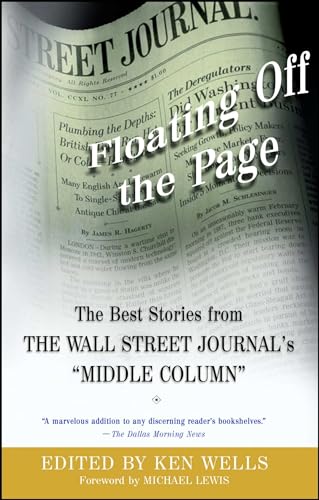
Inhaltsangabe
On any given day, millions of Wall Street Journal readers put aside the serious business and economic news of the day to focus first on the paper's middle column (a.k.a. the A-hed), a virtual sound-bubble for light literary fare -- a short story, a tall tale, an old yarn, a series of vignettes, and other unexpected delights that seem to "float off the page." In this first-ever compendium of middle-column pieces, you'll find an eclectic selection of writings, from the outlandish to the oddly enlightening. Read about:
• one man's attempt to translate the Bible into Klingon
• sheep orthodontics, pet-freezing, and toad-smoking
• being hip in Cairo, modeling at auto shows, piano-throwing
• the fate of mail destined for the World Trade Center after 9/11
• the plight of oiled otters in Prince William Sound
...and much, much more. Edited by 20-year Journal veteran Ken Wells, and with a foreword by Liar's Poker author Michael Lewis, Floating Off the Page is the perfect elixir for fans of innovative prose in all its forms and function.
Die Inhaltsangabe kann sich auf eine andere Ausgabe dieses Titels beziehen.
Über die Autorinnen und Autoren
Ken Wells is a novelist and journalist from the banks of Bayou Black in South Louisiana’s Cajun county. He is a Pulitzer Prize finalist, the editor of two Pulitzer Prize-wining projects, and a former senior editor for Conde Nast Portfolio. He is the author of two nonfiction books. He spends his time in Chicago, with summers in Maine, and is an avid photographer, hiker, and fisherman.
Michael Lewis, the bestselling author of The Undoing Project, Liar’s Poker, Moneyball, The Blind Side, and The Big Short, among other works, lives in Berkeley, California, with his wife and three children.
Auszug. © Genehmigter Nachdruck. Alle Rechte vorbehalten.
Introduction
"A-hed" -- Named because it is shaped roughly like a capital A, it is The Wall Street Journal's internal designation for a one-column, three-line, 18-point Caslon Italic headline, with an indented one-column, three-line, 12-point Scotch Roman deck, framed in a box formed by a quarter-point rule, and anchored on each side by dingbats. Alternatively, the feature story that sits under that headline in the "middle column" of the Journal's front page. When executed properly, with solid reporting, wit and fine writing, it is so light and engaging that it seems to float off the page.
What, you may ask, are feuding nudists, dueling translators of the Bible into Klingon, and the makers of high-quality prison underwear doing on the front page of The Wall Street Journal?
They have shared the umbrella of the "A-hed" and become part of its lore.
When the first A-hed appeared on Page One of this newspaper on Dec. 17, 1941, the kernel of a great idea had clearly been planted. World War II had been under way for ten days and the nation, according to the short piece that didn't carry a byline, was caught with a peculiar shortage for those suddenly patriotic times -- American flags.
For its time, that story amounted to a flight of sheer whimsy. The Journal back then was known exclusively for its single-minded coverage of business. That valuable piece of journalistic real estate known as the "middle column" was not yet fixed in its offerings; it had taken various styles of headlines and was given over to numerous matters core to the paper's purpose -- commodities charts, stock trends, business briefs. But the paper, already more than a half-century old, was in the throes of major change, and that first A-hed was a glimpse of its broader future.
Of course, the Journal is still predominantly and preeminently a business publication, but regular readers of our pages know that the modern paper, here and globally, energetically covers politics, social issues, societal trends and, in its Friday Weekend section, travel, leisure, arts and even sports. And five days a week, on its front page, the Journal delivers up an A-hed whose chief purpose is analogous to an aperitif or fine dessert -- it sweetens and pleases the palate of readers ready to tackle (or take a break from) stories about bonds, microchips and commodities futures. Not that an A-hed can't be serious; in its early days it usually was, and it still sparingly is -- witness, herein, former Journal staffer Charlie McCoy's moving tale about the efforts to save an oil-smeared sea otter during the 1989 Exxon Valdez oil spill, or Joshua Harris Prager's story on the personal trials of former major-league baseball player Bill Buckner long after his game-turning error in the 1986 World Series.
The credit for inventing the A-hed concept surely goes to Bernard "Barney" Kilgore, father of the modern Wall Street Journal, and Bill Kerby, the Journal's first Page One editor. Mr. Kilgore, a mild-mannered Midwesterner, joined the paper right out of DePauw University and became its managing editor in 1941 at the age of 30. More clearly than anyone before, he saw the Journal's future as a truly national newspaper, one that would keep itself rooted in Wall Street but, on its front page, deliver the wider world in a voice that tempered the urgency of a metropolitan newspaper with the analysis and stylish writing of a good magazine. His famous declaration -- "Don't write banking stories for bankers. Write for the banks' customers" -- cut the Journal loose from its stiff, almost technical writing style. He created a rewrite and editing staff for Page One and put Mr. Kerby in charge of it. Whole new forms were invented -- What's News, which delivered world, national and business news in punchy capsules; the Column 1 "leder," whose aim was and is to illuminate matters of social, cultural or political importance, or to demystify events in the news; and, not least, the A-hed.
Year after year, the middle column, according to Wall Street Journal readership surveys, continues to be among the paper's best-read features. It has been emulated by countless U.S. newspapers and some magazines; journalism professors across the nation routinely clip it and give it to students with the admonition: "If you wish to write well, learn to write like this." In 1971, a Fortune magazine feature on the Journal helped to cement the A-hed's place as an icon of contemporary journalism by describing it as a story often so engaging and light "as almost to float off the page" (hence the title of this book).
If Mr. Kilgore, who died in 1967, helped invent the A-hed, it's also true that the form was still very much a work in progress into the 1960s. On many days, the A-hed resembled that very first one -- a short business story with a quirk. (One example: a piece on how World War II was very good for the greeting-card industry.) Alternatively, it was often a news feature. When the Soviet Union's Nikita Khrushchev visited the United States in September 1959, his travels and doings occupied the A-hed spot for five days running -- an occurrence entwined with a bit of Barney Kilgore lore. Or, as Fred Taylor, a Journal managing editor who was aboard then, recalls: "The late, great Barney Kilgore was gadget happy and had just got one of the first car phones. So the reporters trailing Khrushchev used Barney's car, calling in their stories on the wonderful phone to the extent they ran down the car battery and got stuck somewhere in Iowa."
The success of the A-hed owes as much to the quality of ideas as it does to good writing, and the idea factory itself owes much to Journal culture. Page One has always been famously picky about A-hed ideas, yet famously egalitarian about who comes up with them. It is still very much a decentralized art. Any reporter at the paper can pitch and write an A-hed for Page One, as can (and have) news assistants and interns (with proper guidance and editing, of course). Once an idea is accepted, the paper gives the lucky scribe what most metro newspapers would consider a languid amount of time to report and write a story that is usually under 1,500 words in length. True, many A-heds are done in a day or two, but it isn't uncommon for A-heds to take a week to report and a week to write -- even longer. Consider that when Journal staffer Carrie Dolan alighted in the San Francisco bureau as a fresh-faced college graduate in 1982, she soon found herself in conference with Ken Slocum, the taciturn Texan who was bureau chief at the time. A clever features man, Mr. Slocum had a Texan's bias against what he considered fancy, overpriced, big-city hotels. He inexplicably shoved a note across the desk to Ms. Dolan that mused that it was probably possible for a person to travel across country for the price of a single night in the more expensive hotels in the Journal's headquarters city of New York.
Carrie was starting to wonder what that had to do with her when Ken drawled: "So Carrie, you better get goin'" -- and then broke into a chorus of the Willie Nelson song "On the Road Again."
And off she went, in an account that appears in this book, driving for a week coast-to-coast in a cheap rental car, trying to prove Mr. Slocum's theory in the A-hed column.
Ms. Dolan's story shows what comes of a quirky set piece, well executed. The A-hed's history is also filled with stories of opportunity -- reporters in exotic, remote, even dangerous locations putting their well-honed features eyes to the ground around them and coming up with gems. Barry Newman, unquestionably the current dean of Journal A-hed writers, was banging about the Australian Outback in the spring of 1978 when he realized that the Aussies had built a...
„Über diesen Titel“ kann sich auf eine andere Ausgabe dieses Titels beziehen.
Suchergebnisse für Floating Off the Page: The Best Stories from The Wall...

Beispielbild für diese ISBN
Floating off the Page
Anbieter: World of Books (was SecondSale), Montgomery, IL, USA
Verkäuferbewertung 5 von 5 Sternen

Paperback. Zustand: Good. Synopsis coming soon. Artikel-Nr. 00102783687
Gebraucht kaufen
EUR 4,56
Versand gratis
Versand innerhalb von USA
Versand innerhalb von USA
Anzahl: 5 verfügbar
Beispielbild für diese ISBN
Floating Off the Page: The Best Stories from The Wall Street Journal's "Middle Column"
Verlag:
Simon & Schuster (edition 50533rd), 2003
ISBN 10: 074322664X
ISBN 13: 9780743226646
Gebraucht
Paperback
Anbieter: BooksRun, Philadelphia, PA, USA
Verkäuferbewertung 5 von 5 Sternen
Paperback. Zustand: Fair. 50533rd. The item might be beaten up but readable. May contain markings or highlighting, as well as stains, bent corners, or any other major defect, but the text is not obscured in any way. Artikel-Nr. 074322664X-7-1-13
Gebraucht kaufen
EUR 4,64
Versand gratis
Versand innerhalb von USA
Versand innerhalb von USA
Anzahl: 1 verfügbar
Beispielbild für diese ISBN
Floating Off the Page: The Best Stories from the Wall Street Journal's Middle Column
Anbieter: ThriftBooks-Dallas, Dallas, TX, USA
Verkäuferbewertung 5 von 5 Sternen
Paperback. Zustand: Good. No Jacket. Pages can have notes/highlighting. Spine may show signs of wear. ~ ThriftBooks: Read More, Spend Less. Artikel-Nr. G074322664XI3N00
Gebraucht kaufen
EUR 6,07
Versand gratis
Versand innerhalb von USA
Versand innerhalb von USA
Anzahl: 1 verfügbar
Beispielbild für diese ISBN
Floating Off the Page: The Best Stories from the Wall Street Journal's Middle Column
Anbieter: ThriftBooks-Atlanta, AUSTELL, GA, USA
Verkäuferbewertung 5 von 5 Sternen
Paperback. Zustand: As New. No Jacket. Pages are clean and are not marred by notes or folds of any kind. ~ ThriftBooks: Read More, Spend Less. Artikel-Nr. G074322664XI2N00
Gebraucht kaufen
EUR 6,07
Versand gratis
Versand innerhalb von USA
Versand innerhalb von USA
Anzahl: 1 verfügbar
Beispielbild für diese ISBN
Floating Off the Page: The Best Stories from The Wall Street Journal's "Middle Column" (Wall Street Journal Book)
Anbieter: Wonder Book, Frederick, MD, USA
Verkäuferbewertung 5 von 5 Sternen
Zustand: Very Good. Very Good condition. A copy that may have a few cosmetic defects. May also contain light spine creasing or a few markings such as an owner's name, short gifter's inscription or light stamp. Artikel-Nr. T10M-01938
Gebraucht kaufen
EUR 6,45
Versand gratis
Versand innerhalb von USA
Versand innerhalb von USA
Anzahl: 1 verfügbar
Beispielbild für diese ISBN
Floating Off the Page: The Best Stories from The Wall Street Journal's "Middle Column" (Wall Street Journal Book)
Anbieter: Wonder Book, Frederick, MD, USA
Verkäuferbewertung 5 von 5 Sternen
Zustand: Good. Good condition. With remainder mark. A copy that has been read but remains intact. May contain markings such as bookplates, stamps, limited notes and highlighting, or a few light stains. Artikel-Nr. L07R-00605
Gebraucht kaufen
EUR 6,45
Versand gratis
Versand innerhalb von USA
Versand innerhalb von USA
Anzahl: 1 verfügbar
Beispielbild für diese ISBN
Floating off the Page : The Best Stories from the Wall Street Journal's "Middle Column"
Anbieter: Better World Books, Mishawaka, IN, USA
Verkäuferbewertung 5 von 5 Sternen
Zustand: Good. Reprint. Pages intact with minimal writing/highlighting. The binding may be loose and creased. Dust jackets/supplements are not included. Stock photo provided. Product includes identifying sticker. Better World Books: Buy Books. Do Good. Artikel-Nr. GRP75403458
Gebraucht kaufen
EUR 7,24
Versand gratis
Versand innerhalb von USA
Versand innerhalb von USA
Anzahl: 1 verfügbar
Beispielbild für diese ISBN
Floating off the Page : The Best Stories from the Wall Street Journal's "Middle Column"
Anbieter: Better World Books, Mishawaka, IN, USA
Verkäuferbewertung 5 von 5 Sternen
Zustand: Good. Reprint. Former library copy. Pages intact with minimal writing/highlighting. The binding may be loose and creased. Dust jackets/supplements are not included. Includes library markings. Stock photo provided. Product includes identifying sticker. Better World Books: Buy Books. Do Good. Artikel-Nr. 10211679-6
Gebraucht kaufen
EUR 8,38
Versand gratis
Versand innerhalb von USA
Versand innerhalb von USA
Anzahl: 1 verfügbar
Beispielbild für diese ISBN
Floating Off the Page: The Best Stories from The Wall Street Journal's "Middle Column" (Wall Street Journal Book)
Anbieter: WorldofBooks, Goring-By-Sea, WS, Vereinigtes Königreich
Verkäuferbewertung 5 von 5 Sternen
Paperback. Zustand: Very Good. The book has been read, but is in excellent condition. Pages are intact and not marred by notes or highlighting. The spine remains undamaged. Artikel-Nr. GOR005684076
Gebraucht kaufen
EUR 8,65
EUR 6,72 Versand
Versand von Vereinigtes Königreich nach USA
Versand von Vereinigtes Königreich nach USA
Anzahl: 1 verfügbar