
Verwandte Artikel zu The Breakout Principle: How to Activate the Natural...
The Breakout Principle: How to Activate the Natural Trigger That Maximizes Creativity, Athletic Performance, Productivity, and Personal Well-Being - Softcover
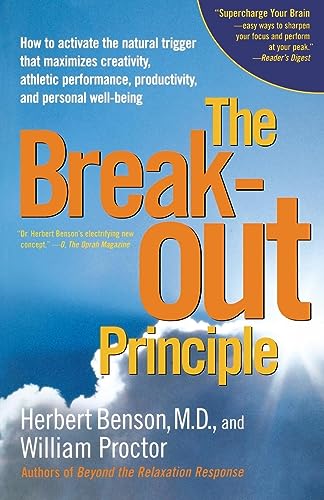
Inhaltsangabe
Would it surprise you to learn that to solve a seemingly unsolvable problem, you need to get up and leave the room? A walk in the woods will help you finish your novel? Humming can make you a better tennis player? Or completely giving up is the way to succeed?
In The Breakout Principle, the bestselling author of The Relaxation Response delivers the ultimate self-help principle -- simple instructions to activate a powerful biological trigger that converts conflict and confusion into clarity and extraordinary performance, a state athletes refer to as "the zone."
More than three decades ago, Dr. Herbert Benson of the Harvard Medical School began research into why some people are devastated by stress while others thrive, turning it into brilliant achievement. Now The Breakout Principle reports the discovery of an easy-to-access inner switch that increases mental function, enhances creativity and productivity, maximizes athletic performance, and enriches spiritual life. The same internal mechanism that improves a tennis serve or golf putt strengthens your speaking skills, makes you a better negotiator, and fosters inner peace and belief.
Dr. Benson and coauthor William Proctor explain the cutting-edge science behind the phenomenon in accessible language, clearly describe the four distinct phases of the Breakout, and provide simple, step-by-step instructions on how to activate the Breakout "trigger." Compelling case histories and information on how to incorporate Breakouts into daily life are woven throughout the book.
Dr. Benson's previous discoveries have helped millions reduce the harmful effects of stress. The Breakout Principle now reveals how to maximize your untapped abilities and powers.
Die Inhaltsangabe kann sich auf eine andere Ausgabe dieses Titels beziehen.
Über die Autorinnen und Autoren
Herbert Benson, MD, is the Mind Body Medical Institute Associate Professor of Medicine, Harvard Medical School. He is the author of the mega-bestselling book, The Relaxation Response, as well as ten other trade books. His groundbreaking work established the modern field of mind body medicine. Dr. Benson is the Director Emeritus of the Benson-Henry Institute for Mind Body Medicine at Massachusetts General Hospital.
William Proctor, JD, is a graduate of Harvard College and Harvard Law School and has written or co-written more than 80 books, including Beyond the Relaxation Response with Dr. Benson; The Templeton Touch with Sir John Templeton; and several international bestsellers with the “father of aerobics,” Dr. Kenneth H. Cooper.
Auszug. © Genehmigter Nachdruck. Alle Rechte vorbehalten.
Chapter One: Powering the Breakout
What Is a Breakout?
Have you ever noticed that self-improvement books, tapes, and programs often promise the moon, but then don't deliver?
• Perhaps no matter how hard you study and practice, they just don't help you at all.
• Or maybe they work, but only for a limited time. Either they -- or you -- lack staying power.
• Or you are wrestling with some deep fear, grief, or other trauma -- and the program doesn't take your concern into account.
• Or a particular self-help program may prove useful, but you still feel shortchanged because you need improvement in several areas -- such as playing golf, public speaking, and developing a consistent prayer life. Yet you lack the time or inclination to concentrate on more than one routine at a time.
Most people have had such feelings and have wistfully concluded that what's really needed is an ultimate self-help principle. In the best of all worlds, you might like to find a single, one-size-fits-all solution to your personal needs and aspirations -- a panacea that would combine every personal improvement concept into one all-encompassing, easily accessible formula. Also, ideally, this single concept would infuse you with the personal discipline to stick with the program year after year, as you transform your life for the better.
If you've ever found yourself longing for the self-help program to end all self-help programs, I have good news. After my more than thirty years of research at the Harvard Medical School, I've discovered that a fundamental self-transforming principle does indeed exist -- a principle that has been firmly established in exciting new studies on the molecular, biochemical, and neurological levels. What's more, the benefits -- which reach well beyond traditional notions of self-help and have the potential to revolutionize your entire life -- can be accessed through a simple but extremely powerful concept that I call the Breakout Principle.
So What Exactly Is the Breakout Principle?
In a nutshell, here is our basic working definition:
The Breakout Principle refers to a powerful mind-body impulse that severs prior mental patterns and -- even in times of great stress or emotional trauma -- opens an inner door to a host of personal benefits, including
• greater mental acuity
• enhanced creativity
• increased job productivity
• maximal athletic performance
• spiritual development
The most significant phrase in the above definition is "severs prior mental patterns." Many if not most of the problems we face in terms of blocked creativity and productivity, subpar athletic performance, flawed health, or even stunted spirituality can be traced back to unresolved destructive or negative thought patterns -- such as nagging anxieties, stress-related emotional baggage, or circular, obsessive "mental tapes."
But there's more. You can actually learn to turn on a natural inner switch to sever those past mental patterns and activate Breakouts that will transform your daily life. My investigations, which have been published in numerous peer-reviewed journals, have convinced me that this accessible, biological-medical "trigger" can be used to power up creativity, deep philosophical insights, stress-reduction responses, and top-notch professional performance.
Learning to activate this trigger can also provide you with what superior athletes call the physiology of zoning, or getting in the zone. In postcompetition interviews, world-class baseball sluggers "in the zone" have reported that 95-mile-per-hour fastballs seemed to be moving in slow motion. Professional tennis players have said that their opponent's bullet serves seemed the "size of basketballs." And top basketball players have reported that when they shoot, they somehow know they are unable to miss.
These almost mystical mind-sets -- which typically involve a sense of invulnerability or perfection, effortless activity, or extreme clarity of thought -- certainly aren't limited to superior sports achievement. Public speakers, writers, and other professionals who have entered into similar high-performance states have described their experiences in similar terms.
In many ways, then, the Breakout concept does promise to open the door to an ultimate self-help principle that spans the secular to the spiritual. But to understand how the abstract definition applies in a real-life situation, let's consider the rather unusual creative experience of a top management consultant whom we'll call Jason.
The Needlepoint School of Management Consulting
Jason was facing one of the toughest challenges of his career. A leading management consultant, he had been asked by a major U.S. corporation to take charge of the search for a new chief executive officer. But the problem was particularly difficult and multifaceted.
Several top executives in the company were vying for the CEO position, and two had let it be known that they expected to quit if they weren't selected. Opinions on the board of directors diverged radically. Stockholders had even divided into factions over the pending succession -- they knew that the value of their portfolios might be seriously damaged by the wrong choice.
Unfortunately, there was no clear front-runner. Even after exhaustive analyses by Jason and his firm, including numerous reports from a leading executive headhunter, the picture remained murky.
"To use a grammatical image, it's a compound-complex problem," Jason complained to a confidant. "Extensive research -- but no solution. No obvious heir apparent."
So what was required to move the consulting forward?
"I need a 'shazam,' " Jason said. "A brilliant way out of my pickle. All the analysis and detailed matrices -- all the research in the world isn't going to help now. Forget additional lists. No more pros and cons. The time's arrived for needlepoint."
Needlepoint was Jason's favorite way to escape the day's frustrations. Just as important, the pastime often helped him "think outside the box" -- and come up with million- or billion-dollar solutions.
So that day he left the office building, settled down in his hotel room, and pulled out his latest needlepoint canvas -- a cover for a pillow that he was doing in petit point. (Petit point, for the uninitiated, is needlepoint that requires relatively small stitches -- for Jason, usually about twenty-four per inch.)
During his career, Jason had learned that monumental amounts of research were necessary to move toward a solution. But after finishing all the hard, plodding research and analysis, Jason often hit an inner wall that intense work and thought couldn't penetrate. In many ways, his experience provided a classic illustration of the Yerkes-Dodson Law, which, as we'll see in Chapter 2, says that efficiency increases with stress up to a point. But if stress continues after that point, efficiency will begin to decline steadily.
Although Jason had heard that traditional relaxation techniques were supposed to help control stress, he knew he wasn't the "meditator type." Still, he had found that through needlepoint, he could control his stress and position himself to receive a "shazam."
As it happens, Jason was in good company. A feature in the Boston Globe (January 31, 2002, H1, H4), published long after he had embarked on his petit point, disclosed that the male knitting underground included such notables as Oscar-winning actor Russell Crowe; Ethan Zohn, winner of the CBS Survivor: Africa contest; fashion designer Bob Mackie; and network TV executive Stu Bloomberg.
One reason for the surge in...
„Über diesen Titel“ kann sich auf eine andere Ausgabe dieses Titels beziehen.
Suchergebnisse für The Breakout Principle: How to Activate the Natural...

Beispielbild für diese ISBN
The Breakout Principle: How to Activate the Natural Trigger That Maximizes Creativity, Athletic Performance, Productivity, and Personal Well-Being
Anbieter: World of Books (was SecondSale), Montgomery, IL, USA
Verkäuferbewertung 5 von 5 Sternen

Zustand: Good. Item in good condition. Textbooks may not include supplemental items i.e. CDs, access codes etc. Artikel-Nr. 00091703563
Gebraucht kaufen
EUR 4,06
Versand gratis
Versand innerhalb von USA
Versand innerhalb von USA
Anzahl: 2 verfügbar
Beispielbild für diese ISBN
The Breakout Principle : How to Activate the Natural Trigger That Maximizes Creativity, Athletic Performance, Productivity, and Personal Well-Being
Anbieter: Better World Books, Mishawaka, IN, USA
Verkäuferbewertung 5 von 5 Sternen
Zustand: Good. Reprint. Pages intact with minimal writing/highlighting. The binding may be loose and creased. Dust jackets/supplements are not included. Stock photo provided. Product includes identifying sticker. Better World Books: Buy Books. Do Good. Artikel-Nr. 4058167-6
Gebraucht kaufen
EUR 6,20
Versand gratis
Versand innerhalb von USA
Versand innerhalb von USA
Anzahl: 2 verfügbar
Beispielbild für diese ISBN
The Breakout Principle: How to Activate the Natural Trigger That Maximizes Creativity, Athletic Performance, Productivity and Personal Well-Being
Anbieter: ThriftBooks-Atlanta, AUSTELL, GA, USA
Verkäuferbewertung 5 von 5 Sternen
Paperback. Zustand: Very Good. No Jacket. May have limited writing in cover pages. Pages are unmarked. ~ ThriftBooks: Read More, Spend Less. Artikel-Nr. G0743223985I4N00
Gebraucht kaufen
EUR 7,82
Versand gratis
Versand innerhalb von USA
Versand innerhalb von USA
Anzahl: 1 verfügbar
Beispielbild für diese ISBN
The Breakout Principle: How to Activate the Natural Trigger That Maximizes Creativity, Athletic Performance, Productivity, and Personal Well-Being
Anbieter: WorldofBooks, Goring-By-Sea, WS, Vereinigtes Königreich
Verkäuferbewertung 5 von 5 Sternen
Paperback. Zustand: Very Good. The book has been read, but is in excellent condition. Pages are intact and not marred by notes or highlighting. The spine remains undamaged. Artikel-Nr. GOR001581069
Gebraucht kaufen
EUR 10,12
EUR 6,69 Versand
Versand von Vereinigtes Königreich nach USA
Versand von Vereinigtes Königreich nach USA
Anzahl: 2 verfügbar
Foto des Verkäufers
The Breakout Principle: How to Activate the Natural Trigger That Maximizes Creativity, Athletic Performance, Productivity, and Personal Well-Being
Anbieter: WeBuyBooks, Rossendale, LANCS, Vereinigtes Königreich
Verkäuferbewertung 5 von 5 Sternen
paperback. Zustand: Good. Most items will be dispatched the same or the next working day. A copy that has been read but remains in clean condition. All of the pages are intact and the cover is intact and the spine may show signs of wear. The book may have minor markings which are not specifically mentioned. Artikel-Nr. rev8149318687
Gebraucht kaufen
EUR 10,58
EUR 6,63 Versand
Versand von Vereinigtes Königreich nach USA
Versand von Vereinigtes Königreich nach USA
Anzahl: 2 verfügbar
Foto des Verkäufers
The Breakout Principle: How to Activate the Natural Trigger That Maximizes Creativity, Athletic Performance, Productivity, and Personal Well-Being
Anbieter: WeBuyBooks, Rossendale, LANCS, Vereinigtes Königreich
Verkäuferbewertung 5 von 5 Sternen
paperback. Zustand: Very Good. Most items will be dispatched the same or the next working day. A copy that has been read, but is in excellent condition. Pages are intact and not marred by notes or highlighting. The spine remains undamaged. Artikel-Nr. rev6392903396
Gebraucht kaufen
EUR 10,62
EUR 6,63 Versand
Versand von Vereinigtes Königreich nach USA
Versand von Vereinigtes Königreich nach USA
Anzahl: 1 verfügbar
Beispielbild für diese ISBN
The Breakout Principle: How to Activate the Natural Trigger That Maximizes Creativity, Athletic Performance, Productivity, and Personal Well-Being
Anbieter: Revaluation Books, Exeter, Vereinigtes Königreich
Verkäuferbewertung 5 von 5 Sternen
Paperback. Zustand: Brand New. reprint edition. 352 pages. 8.25x5.25x0.75 inches. In Stock. Artikel-Nr. x-0743223985
Neu kaufen
EUR 28,19
EUR 11,94 Versand
Versand von Vereinigtes Königreich nach USA
Versand von Vereinigtes Königreich nach USA
Anzahl: 2 verfügbar
Beispielbild für diese ISBN
The Breakout Principle
Anbieter: Majestic Books, Hounslow, Vereinigtes Königreich
Verkäuferbewertung 4 von 5 Sternen

Zustand: New. pp. 340 1:B&W 5.5 x 8.5 in or 216 x 140 mm (Demy 8vo) Perfect Bound on Creme w/Gloss Lam. Artikel-Nr. 8032577
Neu kaufen
EUR 43,00
EUR 7,76 Versand
Versand von Vereinigtes Königreich nach USA
Versand von Vereinigtes Königreich nach USA
Anzahl: 1 verfügbar