
Verwandte Artikel zu Parents Under Siege: Why You Are the Solution, Not...
Inhaltsangabe
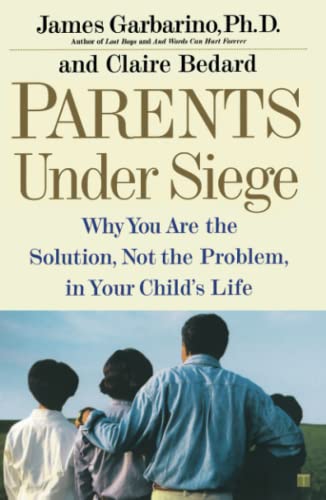
Is it always a parent's fault if a child grows up to become unruly, disruptive, or even destructive? Are parents always to blame for children “growing up wrong”? Is it possible that good parents can raise bad kids?
Is it always a parent's fault if a child grows up to become unruly, disruptive, or even destructive? Are parents always to blame for children “growing up wrong”? Is it possible that good parents can raise bad kids? Nationally recognized psychologist James Garbarino and child advocate Claire Bedard present tough-minded yet compassionate tactics for parents of children who don't make headlines-but who are exceptionally difficult and disruptive of normal family life.
Die Inhaltsangabe kann sich auf eine andere Ausgabe dieses Titels beziehen.
Über die Autorin bzw. den Autor
James Garbarino, PhD, is an author and professor at Loyola University Chicago. He has specialized in studying what causes violence in children, how they cope with it and how to rehabilitate them. Dr. Garbarino has served as consultant or adviser to a wide range of organizations, including the National Committee to Prevent Child Abuse, the National Institute for Mental Health, the American Medical Association, the National Black Child Development Institute, the National Science Foundation, the U.S. Advisory Board on Child Abuse and Neglect, and the FBI.
Auszug. © Genehmigter Nachdruck. Alle Rechte vorbehalten.
Chapter 1: When Bad Things Happen to Good Families
It all starts with compassion. You love your children. You want the best for them. You would give your life to save theirs. But sometimes love is not enough. Bad things happen to good families. Would you have compassion for a family in which a little girl died because she got into an unlocked medicine cabinet while her mom was on the phone? Would you feel compassion if a little boy were hit by a car while out riding his bike after his father had warned him many times not to ride in the street? To paraphrase Thich Nhat Hanh, the Zen master and peacemaker, compassion is not a principle, it is an energy in us waiting to manifest.
In the movie Seven Years in Tibet, there is an unforgettable scene in which Heinrich Harrer, played by Brad Pitt, is asked to build a movie house for the young Dalai Lama, at the Potala Palace, in Lhasa, Tibet. As the excavation begins, Heinrich arrives at the site and is greeted by a group of monks rushing toward him, looking absolutely frantic. They gesture toward the ground and implore the unsuspecting Heinrich to stop all digging; they explain that the worms hiding in the earth are being trampled and destroyed. Stunned by their concern for even these lives, Heinrich is left speechless.
He returns to see his friend, the young Dalai Lama, who explains to him that Tibetans believe that all living beings are to be protected against harm and suffering. This compassion is at the core of their spiritual practice and beliefs as Buddhists. When Heinrich protests that such compassion is impractical, the Dalai Lama reassures him, confident that he will find a creative solution to the problem.
The next scene reveals the solution. The monks kneel on the ground in two rows: one row of monks digs and places the mounds of dirt into bags, while the second row goes through the bags, gently removing each worm and placing it in a bowl for transportation to another environment where the worms can continue to live happily and fulfill their purpose. Why is this so important to us? Because it is a true story. This scene is not some movie fantasy, but rather a true portrait of Tibetan Buddhist belief and an accurate reflection of a people's nonviolence and respect for all living beings, great or small. For the Dalai Lama, it all starts with compassion.
Decades later, the adult Dalai Lama says of compassion: True compassion is not just an emotional response, but a firm commitment founded on reason. Therefore, a truly compassionate attitude toward others does not change, even if they behave negatively. Through universal altruism you develop a feeling of responsibility for others, the wish to actively help them overcome their problems.
In the summer of 2000 we spent a week listening to the 65-year-old Dalai Lama teach compassion. We were fortunate enough to have an audience with him, along with 200 other Americans, and we recommitted ourselves to living lives of compassion. The goal of this chapter -- indeed, of the whole book -- is to bring this commitment to parenting. So, following the counsel of the Dalai Lama, we begin with the process of understanding, which is the most reliable foundation for compassion. We want you to know why and how parents are under siege -- why maybe you are under siege -- and encourage you to use understanding to act with compassion, with your own children, with other parents, with yourself.
The challenges parents face exist on a spectrum. At one end are the day-to-day issues -- for example, getting infants to sleep through the night, toilet training toddlers, getting first-graders to pick up their toys, ensuring that sixth-graders do their homework, and making sure teenagers don't drink and drive. At the other end are the frightening problems that confront a minority of parents -- an infant with spina bifida, a child with cancer, a teenager who is paralyzed in a car accident. But certain difficulties require even more compassion than the child damaged physically through chance, some genetic defect or some lurking virus, or some random danger: Some children seem to volunteer for trouble, resisting everyone who tries to help and guide them toward a positive path.
Anything Can Happen
In Chicago, a mother walked her 7-year-old son, Dantrell, to school every morning. Their inner city neighborhood was a dangerous place to walk alone, and she always feared for his safety. One day in 1992, she accompanied Dantrell to school, and as the daily ritual goes, she let go of his hand to let him walk the last 75 feet to the front door, where teachers were standing on the steps to greet him. As usual, cops were sitting in a parked car at the corner. But this time, as he walked toward the school, a shot rang out and Dantrell fell dead, shot in the head by a gang member out to revenge himself against an opponent's little boy. It happened in broad daylight, in everyone's sight.
Seven years later, on April 20, 1999, a mother in the affluent Denver suburb of Littleton, Colorado, watched her beloved son get on the school bus to Columbine High School. Content in her knowledge that the day would unfold with the same predictability only such a small, affluent community enclave can provide these days, she went on with the rest of her day. Such peace of mind was, after all, why they had moved to this area. A security guard was stationed at the school, and surveillance cameras protected the building. A few hours later she learned from television reports that her son was dead, shot in the head by two of his classmates.
Anything can happen. This is the lesson American parents have taken with them into the twenty-first century, the one that resonates the loudest and ultimately leaves no parent unaffected. This is a parent's "Vietnam," the strange war that happens in faraway places and then suddenly hits home. It has profoundly affected the way parents think about other people's children and their own. Like the Vietnam lesson of the 1960s and 1970s, the anything-can-happen lesson of Littleton, Colorado, is part of our national consciousness. We want this terror to go away, yet it won't completely disappear.
For some of us it is a whispering voice inside; for others it is full-blown terror. Parents are uncomfortable with the status quo. The discomfort is hard to articulate for most, but undeniable. Not everyone's eyes are open, though when it is your child who is in trouble, you see it clearly. A mother tells us this. "My husband and I have given everything we have to being good parents, and our son is only getting into deeper trouble. We don't know where to turn anymore, and all we get is 'What are you doing wrong?' Not in so many words, but in the way some other parents look at us, or in the comments they make." Parents sleep better at night believing that if only they do things right, they are guaranteed good outcomes. Thus they resist compassion. They resist empathy. They yearn to believe they are immune. It's an understandable impulse. But the more you know, the more you know you must resist it.
In September 2000 we were participating in a program with Frank DeAngelis, the principal of Columbine High School. The moderator asked him what he had learned from all that had happened. He replied that if someone had asked him on April 19, 1999, if it was possible there were boys in his school so angry and troubled that they were planning to destroy the school, he would have said, "Impossible." But what he learned on April 20, 1999, was that it was possible, that it is possible anywhere in our country. Ask any American parent who has looked with open eyes, without the comfort of denial.
"If I work hard as a parent, my children will turn out okay." That is the unspoken guarantee of the American Dream of Parenting. We are told that you get back what you put in, a guiding...
„Über diesen Titel“ kann sich auf eine andere Ausgabe dieses Titels beziehen.
Suchergebnisse für Parents Under Siege: Why You Are the Solution, Not...

Beispielbild für diese ISBN
Parents Under Siege: Why You Are the Solution, Not the Problem in Your Child's Life
Anbieter: World of Books (was SecondSale), Montgomery, IL, USA
Verkäuferbewertung 5 von 5 Sternen

Zustand: Very Good. Item in very good condition! Textbooks may not include supplemental items i.e. CDs, access codes etc. Artikel-Nr. 00105892229
Gebraucht kaufen
EUR 4,53
Versand gratis
Versand innerhalb von USA
Versand innerhalb von USA
Anzahl: 1 verfügbar
Beispielbild für diese ISBN
Parents Under Siege: Why You Are the Solution, Not the Problem in Your Child's Life
Anbieter: BooksRun, Philadelphia, PA, USA
Verkäuferbewertung 5 von 5 Sternen
Paperback. Zustand: Fair. The item might be beaten up but readable. May contain markings or highlighting, as well as stains, bent corners, or any other major defect, but the text is not obscured in any way. Artikel-Nr. 0743223837-7-1
Gebraucht kaufen
EUR 4,78
Versand gratis
Versand innerhalb von USA
Versand innerhalb von USA
Anzahl: 1 verfügbar
Beispielbild für diese ISBN
Parents under Siege : Why You Are the Solution, Not the Problem in Your Child's Life
Anbieter: Better World Books, Mishawaka, IN, USA
Verkäuferbewertung 5 von 5 Sternen
Zustand: Very Good. Reprint. Former library copy. Pages intact with possible writing/highlighting. Binding strong with minor wear. Dust jackets/supplements may not be included. Includes library markings. Stock photo provided. Product includes identifying sticker. Better World Books: Buy Books. Do Good. Artikel-Nr. 18490924-75
Gebraucht kaufen
EUR 6,84
Versand gratis
Versand innerhalb von USA
Versand innerhalb von USA
Anzahl: 1 verfügbar
Beispielbild für diese ISBN
Parents under Siege : Why You Are the Solution, Not the Problem in Your Child's Life
Anbieter: Better World Books, Mishawaka, IN, USA
Verkäuferbewertung 5 von 5 Sternen
Zustand: Good. Reprint. Pages intact with minimal writing/highlighting. The binding may be loose and creased. Dust jackets/supplements are not included. Stock photo provided. Product includes identifying sticker. Better World Books: Buy Books. Do Good. Artikel-Nr. GRP64803416
Gebraucht kaufen
EUR 6,84
Versand gratis
Versand innerhalb von USA
Versand innerhalb von USA
Anzahl: 1 verfügbar
Beispielbild für diese ISBN
Parents Under Siege: Why You Are the Solution, Not the Problem in Your Child's Life
Anbieter: Revaluation Books, Exeter, Vereinigtes Königreich
Verkäuferbewertung 5 von 5 Sternen
Paperback. Zustand: Brand New. reprint edition. 272 pages. 8.25x5.50x0.50 inches. In Stock. Artikel-Nr. x-0743223837
Neu kaufen
EUR 20,37
EUR 11,66 Versand
Versand von Vereinigtes Königreich nach USA
Versand von Vereinigtes Königreich nach USA
Anzahl: 2 verfügbar
Beispielbild für diese ISBN
Parents Under Siege: Why You Are The Solution, Not The Problem In Your Child's Life
Anbieter: SZ Global, Toronto, ON, Kanada
Verkäuferbewertung 5 von 5 Sternen
Paperback. Zustand: New. Artikel-Nr. 9780743223836
Neu kaufen
EUR 30,78
EUR 32,40 Versand
Versand von Kanada nach USA
Versand von Kanada nach USA
Anzahl: 5 verfügbar