
Verwandte Artikel zu War in a Time of Peace: Bush, Clinton, and the Generals
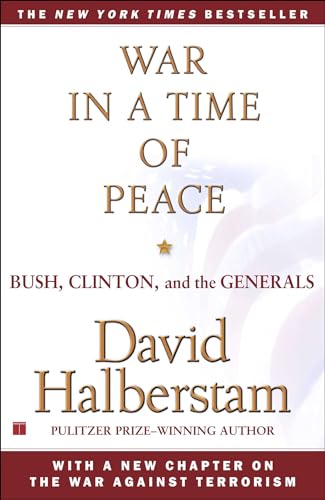
Inhaltsangabe
Pulitzer Prize-winning journalist David Halberstam chronicles Washington politics and foreign policy in post Cold War America.
Evoking the internal conflicts, unchecked egos, and power struggles within the White House, the State Department, and the military, Halberstam shows how the decisions of men who served in the Vietnam War, and those who did not, have shaped America's role in global events. He provides fascinating portraits of those in power—Clinton, Bush, Reagan, Kissinger, James Baker, Dick Cheney, Madeleine Albright, and others—to reveal a stunning view of modern political America.
Die Inhaltsangabe kann sich auf eine andere Ausgabe dieses Titels beziehen.
Über die Autorin bzw. den Autor
David Halberstam was one of America's most distinguished journalists and historians, a man whose newspaper reporting and books have helped define the era we live in. He graduated from Harvard in 1955, took his first job on the smallest daily in Mississippi, and then covered the early civil rights struggle for the Nashville Tennessean. He joined The New York Times in 1960, went overseas almost immediately, first to the Congo and then to Vietnam. His early pessimistic dispatches from Vietnam won him the Pulitzer in 1964 at the age of thirty. His last twelve books, starting with The Best and the Brightest and including The Powers That Be, The Reckoning, and The Fifties, have all been national bestsellers. Thirty-eight years after Mr. Halberstam won the Pulitzer Prize for his reporting in Vietnam, War in a Time of Peace was the runner-up for the Pulitzer Prize. He died in April 2007.
Auszug. © Genehmigter Nachdruck. Alle Rechte vorbehalten.
Chapter One
For a brief, glorious, almost Olympian moment it appeared that the presidency itself could serve as the campaign. Rarely had an American president seemed so sure of reelection. In the summer and fall of 1991, George Bush appeared to be politically invincible. His personal approval ratings in the aftermath of the Persian Gulf War had reached 90 percent, unheard of for any sitting president, and even more remarkable for someone like Bush, a competent political insider whose charisma and capacity to inspire had in the past escaped most of his fellow citizens. Of his essential decency and competence there had been little doubt, and the skill with which he had presided over the end of the Cold War had impressed not merely the inner club that monitored foreign policy decision-making, but much of the country as well. With exceptional sensitivity, he had juggled and balanced his own political needs with the greater political needs of his newest partner in this joint endeavor, Mikhail Gorbachev. For Bush was quite aware that Gorbachev's political equation was much more fragile than his own, and he had been careful to be the more generous member of this unlikely two-man team that was negotiating the end of almost forty-five years of terrifying bipolar tensions.
One moment had seemed to symbolize the supreme confidence of the Bush people during this remarkable chain of events. It came in mid-August of 1991, when some Russian right-wingers mounted a coup against Gorbachev and Bush held firm, trying at first to support Gorbachev and, unable to reach him, then using his influence to help the embattled Boris Yeltsin. The coup had failed. A few days later, Gorbachev, restored to power in part because of the leverage of Washington, had resigned from the Communist Party. To the Bush people that attempted coup had been a reminder that with the Cold War officially ended or not, the Berlin Wall up or down, the world was still a dangerous place, which meant that the country would surely need and want an experienced leader, preferably a Republican, at the helm. Aboard Air Force One at that time, flying with his father from Washington back to the Bush family's vacation home in Maine, was George W. Bush, the president's son. He was just coming of age as a political operative in his own right, and he was euphoric about the meaning of these latest events. "Do you think the American people are going to turn to a Democrat now?" he asked.
Bush himself believed he was invulnerable. He had presided over the end of the Cold War with considerable distinction. He had handled the delicate job of dealing with the complicated international events that had led to the end of European communism, thereby freeing the satellite nations of Eastern Europe, and perhaps most remarkably of all, gaining, with Russian approval, a unified Germany that was a member of NATO. But typically he had held back on participating in any kind of celebration to mark those stunning events.
When the Berlin Wall had come down, many in the right wing, and a number of people around Bush himself, wanted some kind of ceremony, for this was a historic moment and they believed it deserved a commemoration not unlike those that had attended V-E and V-J Days in World War II, the victories in Europe over Germany, and in the Pacific over Japan. The destruction of the wall represented not merely the West's triumph in a long, difficult struggle against a formidable adversary, but equally important, a triumph in their minds of good over evil, proof that we had been right and they had been wrong, and that our system was politically, economically, ethically, and spiritually superior to theirs. At the very least there should be, they believed, one momentous speech to recount the history of the Cold War and celebrate the victory of the forces of light over darkness.
But Bush was uncomfortable with the idea of a celebration, aware that he had little flare for the dramatic. "I'm not going to dance on the wall," he told his aides. Even as the wall was coming down, Marlin Fitzwater, his press officer, had invited a small group of reporters into the Oval Office to talk with the president, but they found his answers cautious, curiously without emotion, almost joyless. Bush was sparring with them. Why wasn't he more excited? a reporter asked. I'm not an emotional kind of guy, he answered. "Maybe," he said later by way of explaining his self-restraint, "I should have given them one of these," and he leapt in the air in a parody of a then popular Toyota commercial portraying a happy car owner jumping and clicking his heels together. On Saturday Night Live, a comic named Dana Carvey, who often parodied Bush, showed him watching scenes of Berliners celebrating the destruction of the wall but refusing to join in. "Wouldn't be prudent," he said. Then Carvey-as-Bush pointed at himself: "Place in history? Se-cure!"
So, much to the disappointment of many on the right, Bush was anxious to minimize the event as a symbolic occasion. It was against his nature. Taking personal credit for any kind of larger success, not all of which was his, conflicted with the way he had been brought up. He believed -- an attitude that was surely old-fashioned and quite optimistic in an age of ever more carefully orchestrated political spin, when the sizzle was more important than the steak -- that if you did the right things in the right way, people would know about it. You should never call attention to yourself or, worse, advertise your accomplishments. Besides, Bush put a primacy on personal relationships, and by then he had begun to forge one with Mikhail Gorbachev and was obviously unwilling to do anything that would make things more difficult for his new ally. The more Bush celebrated, the more vulnerable Gorbachev and the other more democratically inclined figures in the Soviet Union were likely to be. Celebrating was like gloating and Bush would not gloat. (A few months later, getting close to an election campaign, Bush was more emboldened, and when he delivered his January 1992 State of the Union speech, with an election year just beginning, he did give the United States credit for winning the Cold War. Gorbachev, by then ousted from power, was not amused and said that the end of the Cold War was "our common victory. We should give credit to all politicians who participated in that victory.")
It was probably just as well that Bush did not try to grab too much credit for the collapse of communism, for what had transpired was a triumphal victory for an idea rather than for any one man or political faction. The Soviet Union had turned out to be, however involuntarily, the perfect advertisement for the free society, suggesting in the end that harsh, authoritarian controls and systems did not merely limit political, intellectual, and spiritual freedom, but economic freedom and military development as well. They limited not just the freedom of the individual, something that many rulers in many parts of the world would gladly accommodate to, but in the end limited the sum strength and might of the state, which was a very different thing. Therefore, what the proponents of an open society had long argued, that freedom was indivisible, and that the freedom to speak openly and candidly about political matters was in the long run inseparable from the freedom to invent some new high-technology device, or to run a brilliant new company, was true. The rights of man included not merely the right to compose and send an angry letter to a newspaper complaining about the government, they included as well as the right to choose where he went to work, and his right to garner, if he so chose and worked hard enough and with enough originality, far greater material rewards than his neighbors. The Soviet system was a devastating argument for what the lack of choice did, and what happened...
„Über diesen Titel“ kann sich auf eine andere Ausgabe dieses Titels beziehen.
Suchergebnisse für War in a Time of Peace: Bush, Clinton, and the Generals

Beispielbild für diese ISBN
War in a Time of Peace: Bush, Clinton, and the Generals
Anbieter: World of Books (was SecondSale), Montgomery, IL, USA
Verkäuferbewertung 5 von 5 Sternen

Zustand: Good. Item in good condition. Textbooks may not include supplemental items i.e. CDs, access codes etc. Artikel-Nr. 00083635534
Gebraucht kaufen
EUR 3,44
Versand gratis
Versand innerhalb von USA
Versand innerhalb von USA
Anzahl: 14 verfügbar
Beispielbild für diese ISBN
War in a Time of Peace: Bush, Clinton, and the Generals
Anbieter: World of Books (was SecondSale), Montgomery, IL, USA
Verkäuferbewertung 5 von 5 Sternen
Zustand: Very Good. Item in very good condition! Textbooks may not include supplemental items i.e. CDs, access codes etc. Artikel-Nr. 00094773463
Gebraucht kaufen
EUR 3,44
Versand gratis
Versand innerhalb von USA
Versand innerhalb von USA
Anzahl: 3 verfügbar
Beispielbild für diese ISBN
War in a Time of Peace: Bush, Clinton, and the Generals
Verlag:
Scribner (edition Reprint), 2002
ISBN 10: 0743223233
ISBN 13: 9780743223232
Gebraucht
Paperback
Anbieter: BooksRun, Philadelphia, PA, USA
Verkäuferbewertung 5 von 5 Sternen
Paperback. Zustand: Fair. Reprint. The item might be beaten up but readable. May contain markings or highlighting, as well as stains, bent corners, or any other major defect, but the text is not obscured in any way. Artikel-Nr. 0743223233-7-1
Gebraucht kaufen
EUR 5,71
Versand gratis
Versand innerhalb von USA
Versand innerhalb von USA
Anzahl: 1 verfügbar
Beispielbild für diese ISBN
War in a Time of Peace: Bush, Clinton, and the Generals
Anbieter: ThriftBooks-Atlanta, AUSTELL, GA, USA
Verkäuferbewertung 5 von 5 Sternen
Paperback. Zustand: As New. No Jacket. Pages are clean and are not marred by notes or folds of any kind. ~ ThriftBooks: Read More, Spend Less. Artikel-Nr. G0743223233I2N00
Gebraucht kaufen
EUR 5,75
Versand gratis
Versand innerhalb von USA
Versand innerhalb von USA
Anzahl: 1 verfügbar
Beispielbild für diese ISBN
War in a Time of Peace: Bush, Clinton, and the Generals
Anbieter: ThriftBooks-Reno, Reno, NV, USA
Verkäuferbewertung 5 von 5 Sternen
Paperback. Zustand: As New. No Jacket. Pages are clean and are not marred by notes or folds of any kind. ~ ThriftBooks: Read More, Spend Less. Artikel-Nr. G0743223233I2N00
Gebraucht kaufen
EUR 5,75
Versand gratis
Versand innerhalb von USA
Versand innerhalb von USA
Anzahl: 1 verfügbar
Beispielbild für diese ISBN
War in a Time of Peace: Bush, Clinton, and the Generals
Anbieter: ThriftBooks-Dallas, Dallas, TX, USA
Verkäuferbewertung 5 von 5 Sternen
Paperback. Zustand: As New. No Jacket. Pages are clean and are not marred by notes or folds of any kind. ~ ThriftBooks: Read More, Spend Less. Artikel-Nr. G0743223233I2N00
Gebraucht kaufen
EUR 5,75
Versand gratis
Versand innerhalb von USA
Versand innerhalb von USA
Anzahl: 1 verfügbar
Beispielbild für diese ISBN
War in a Time of Peace: Bush, Clinton, and the Generals
Anbieter: ThriftBooks-Dallas, Dallas, TX, USA
Verkäuferbewertung 5 von 5 Sternen
Paperback. Zustand: Fair. No Jacket. Readable copy. Pages may have considerable notes/highlighting. ~ ThriftBooks: Read More, Spend Less. Artikel-Nr. G0743223233I5N00
Gebraucht kaufen
EUR 5,75
Versand gratis
Versand innerhalb von USA
Versand innerhalb von USA
Anzahl: 1 verfügbar
Beispielbild für diese ISBN
War in a Time of Peace: Bush, Clinton, and the Generals
Anbieter: Wonder Book, Frederick, MD, USA
Verkäuferbewertung 5 von 5 Sternen
Zustand: Good. Good condition. With remainder mark. A copy that has been read but remains intact. May contain markings such as bookplates, stamps, limited notes and highlighting, or a few light stains. Artikel-Nr. X01H-00302
Gebraucht kaufen
EUR 6,20
Versand gratis
Versand innerhalb von USA
Versand innerhalb von USA
Anzahl: 2 verfügbar
Beispielbild für diese ISBN
War in a Time of Peace: Bush, Clinton, and the Generals
Anbieter: Wonder Book, Frederick, MD, USA
Verkäuferbewertung 5 von 5 Sternen
Zustand: Very Good. Very Good condition. New Chapter edition. A copy that may have a few cosmetic defects. May also contain light spine creasing or a few markings such as an owner's name, short gifter's inscription or light stamp. Artikel-Nr. I14A-03213
Gebraucht kaufen
EUR 6,20
Versand gratis
Versand innerhalb von USA
Versand innerhalb von USA
Anzahl: 2 verfügbar
Beispielbild für diese ISBN
War in a Time of Peace : Bush, Clinton, and the Generals
Anbieter: Better World Books, Mishawaka, IN, USA
Verkäuferbewertung 5 von 5 Sternen
Zustand: Very Good. Reprint. Pages intact with possible writing/highlighting. Binding strong with minor wear. Dust jackets/supplements may not be included. Stock photo provided. Product includes identifying sticker. Better World Books: Buy Books. Do Good. Artikel-Nr. GRP69476693
Gebraucht kaufen
EUR 6,51
Versand gratis
Versand innerhalb von USA
Versand innerhalb von USA
Anzahl: 2 verfügbar