
Verwandte Artikel zu Band of Brothers (S & S Classic Edition) (Rough...
Inhaltsangabe
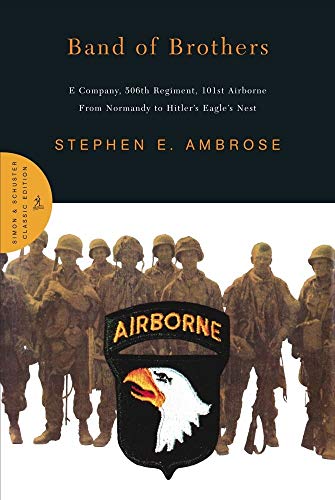
Stephen E. Ambrose’s iconic New York Times bestseller about the ordinary men who became the World War II’s most extraordinary soldiers: Easy Company, 506th Parachute Infantry Regiment, 101st Airborne Division, US Army.
They came together, citizen soldiers, in the summer of 1942, drawn to Airborne by the $50 monthly bonus and a desire to be better than the other guy. And at its peak—in Holland and the Ardennes—Easy Company was as good a rifle company as any in the world.
From the rigorous training in Georgia in 1942 to the disbanding in 1945, Stephen E. Ambrose tells the story of this remarkable company. In combat, the reward for a job well done is the next tough assignment, and as they advanced through Europe, the men of Easy kept getting the tough assignments.
They parachuted into France early D-Day morning and knocked out a battery of four 105 mm cannon looking down Utah Beach; they parachuted into Holland during the Arnhem campaign; they were the Battered Bastards of the Bastion of Bastogne, brought in to hold the line, although surrounded, in the Battle of the Bulge; and then they spearheaded the counteroffensive. Finally, they captured Hitler's Bavarian outpost, his Eagle's Nest at Berchtesgaden.
They were rough-and-ready guys, battered by the Depression, mistrustful and suspicious. They drank too much French wine, looted too many German cameras and watches, and fought too often with other GIs. But in training and combat they learned selflessness and found the closest brotherhood they ever knew. They discovered that in war, men who loved life would give their lives for them.
This is the story of the men who fought, of the martinet they hated who trained them well, and of the captain they loved who led them. E Company was a company of men who went hungry, froze, and died for each other, a company that took 150 percent casualties, a company where the Purple Heart was not a medal—it was a badge of office.
Die Inhaltsangabe kann sich auf eine andere Ausgabe dieses Titels beziehen.
Über die Autorin bzw. den Autor
Stephen E. Ambrose was a renowned historian and acclaimed author of more than thirty books. Among his New York Times bestsellers are Nothing Like It In the World, Citizen Soldiers, Band of Brothers, D-Day, and Undaunted Courage. Dr. Ambrose was a retired Boyd Professor of History at the University of New Orleans and a contributing editor for the Quarterly Journal of Military History.
Auszug. © Genehmigter Nachdruck. Alle Rechte vorbehalten.
Chapter 9: The Island
HOLLAND October 2 - November 25,1944
Easy Company, like all units in the American airborne divisions, had been trained as a light infantry assault outfit, with the emphasis on quick movement, daring maneuvers, and small arms fire. It had been utilized in that way in Normandy and during the first ten days in Holland. From the beginning of October until almost the end of November 1944, however, it would be involved in static, trench warfare, more reminiscent of World War I than World War II.
The area in which it fought was a 5-kilometer-wide "island" that lay between the Lower Rhine on the north and the Waal River on the south. The cities of Arnhem, on the Lower Rhine, and Nijmegen, on the Waal, marked the eastern limit of the 101st's lines; the small towns of Opheusden on the Lower Rhine and Dodewaard on the Waal were the western limit. The Germans held the territory north of the Lower Rhine and west of the Opheusden-Dodewaard line.
The Island was a flat agricultural area, below sea level. Dikes that were 7 meters high and wide enough at the top for two-lane roads held back the flood waters. The sides of the dikes were sometimes steep, more often sloping so gradually as to make the dikes 200 or even 300 feet wide at the base. Crisscrossing the area were innumerable drainage ditches. Hills rose on the north side of the Lower Rhine, giving the Germans a distinct advantage in artillery spotting. They had apparently unlimited ammunition (the German industrial heartland was only 50 kilometers or so up the Rhine River), enough at any rate to enable them to fire 88s at single individuals caught out in the open. All movement on the island was by night; during daylight hours, men stayed in their foxholes, observation posts, or houses and barns. The fall weather in northwest Europe was, as usual, miserable: cold, humid, rainy, a fit setting for a World War I movie.
There were whole regiments of British artillery on the Island, firing in support of the 101st. This meant that Island battles were artillery duels in which the main role of the infantry was to be prepared to hurl back any assault by the German ground troops and to serve as forward artillery observers. Patrols went out every night, to scout and to maintain contact with the enemy. For the most part, however, Easy and the other companies in the 101st sat there and took it, just as their fathers had done in 1918. A man's inability to do anything about the artillery fire added to the widespread, overwhelming feeling of frustration.
But of course it was not 1918. On the Island, the men of Easy first saw jet airplanes in action. They watched vapors from the V-2s, the world's first medium-range ballistic missile, as they passed overhead on the way to London. Still, as had been true of soldiers on the Western Front in 1914-1917, they fought without tank support, as a tank was much too conspicuous a target on the Island.
The rations added to the sense that Easy was in a World War I movie rather than a real 1944 battle. The company drew its rations from the British, and they were awful. The British 14-in-1s, according to Corporal Gordon, "will support life, but not morale." Bully beef and heavy Yorkshire pudding were particularly hated, as was the oxtail soup, characterized as "grease with bones floating in it." Most men took to throwing everything in the 14-in-1s into a single large pot, adding whatever vegetables they could scrounge from the countryside, and making a sort of stew out of it. Fortunately there was fresh fruit in abundance, mainly apples and pears. Cows that desperately needed milking were relieved of the contents of their bulging udders, and that helped, but there was no coffee and the men quickly tired of tea.
Worst of all were the English cigarettes. Cpl. Rod Bain described them as "a small portion of tobacco and an ungodly amount of straw." Best of all was the daily British rum ration. Next best was finding German rations. The hard biscuits were like concrete, but the canned meat and tubes of Limburger cheese were tasty and nutritious.
As had been true of the villages of France on both sides of the line on the Western Front 1914-1918, the civilian residents of the Island were evacuated (and Holland is the most densely populated country on earth). This gave the men almost unlimited opportunities for looting, opportunities that were quickly seized. Webster wrote, "Civilians dwell under the misapprehension that only Germans and Russians go through drawers, closets, and chicken coops, whereas every G.I. of my acquaintance made a habit of so doing." Watches, clocks, jewelry, small (and large) pieces of furniture, and of course liquor quickly disappeared -- that is, what was left, as the British had already stripped the area.
The Island was most like World War I in its stagnated front. Easy spent nearly two months there, in daily combat. It sent out almost 100 patrols. It repelled attacks. It fired an incredible amount of ammunition. It took casualties. But when it was finally relieved, it turned over to the relieving party front-line positions that had hardly moved one inch.
The company moved onto the Island on October 2, by truck, over the magnificent bridge at Nijmegen (still standing) that had been captured by the 82d on September 20 at 8:00 P.M. Once over the Waal, the trucks took the men some 15 kilometers, past dozens of camouflaged British artillery pieces, to the village of Zetten.
They arrived at night, to relieve the British 43d Division. The 506th regiment was taking over a stretch of front line that had been held by a full division. It was over 6 miles in length. The 2d Battalion of the 506th was on the right (east) end of the line, with Easy on the far right with the 501st PIR to its right. Easy had to cover almost 3 kilometers with only 130 men.
British soldiers met the company in Zetten and escorted the leading elements to their new positions. "What's it like up here?" Webster asked.
"It's a bloody rest position, mate," was the reply. The numerous craters from 105s and 88s looked fresh to Webster, who doubted that he was being given straight scoop. After a three-hour march, the patrol reached its destination, a clump of houses nestled beside a huge dike. The Lower Rhine was on the other side of the dike, with a kilometer or so of flat, soggy grazing land between it and the dike. The area was littered with dead animals, burned houses, and empty machine-gun belts and ammo boxes. This was no-man's-land.
To cover his assigned section of the front, Winters put the 2d and 3d platoons on the line, along the south side of the dike, with the 1 st platoon in reserve. He did not have sufficient troops to man the line properly, so he placed outposts along the dike at spots that he calculated were most likely enemy infiltration points. He kept in contact with the outposts by means of radio, wire, and contact patrols. He also sent three-man patrols to the river bank, to watch for enemy movement and to serve as forward artillery observers. He set up his CP at Randwijk.
At 0330, October 5, Winters sent Sgt. Art Yournan out on a patrol, with orders to occupy an outpost in a building near a windmill on the south bank of the dike. With Youman were Pvts. James Alley, Joe Lesniewski, Joe Liebgott, and Rod Strohl. The building was beside a north-south road that ran to a ferry crossing on the river to the north, back to the small village of Nijburg to the south.
When the patrol reached the road, Youman told Lesniewski to go to the top of the dike to look things over. When he reached the top, hugging the ground as he had been taught, Lesniewski saw an unexpected sight, the outline of a German machine-gun set up at the point where the road coming from the ferry crossed the dike. Behind it, in the dark, he could...
„Über diesen Titel“ kann sich auf eine andere Ausgabe dieses Titels beziehen.
Suchergebnisse für Band of Brothers (S & S Classic Edition) (Rough...

Foto des Verkäufers
Band of Brothers: E Company, 506th Regiment, 101st Airborne from Normandy to Hitler's Eagle's Nest
Anbieter: Dream Books Co., Denver, CO, USA
Verkäuferbewertung 5 von 5 Sternen

Zustand: good. Gently used with minimal wear on the corners and cover. A few pages may contain light highlighting or writing, but the text remains fully legible. Dust jacket may be missing, and supplemental materials like CDs or codes may not be included. May be ex-library with library markings. Ships promptly! Artikel-Nr. DBV.0743216385.G
Gebraucht kaufen
EUR 8,09
Versand gratis
Versand innerhalb von USA
Versand innerhalb von USA
Anzahl: 1 verfügbar
Beispielbild für diese ISBN
Band of Brothers
Anbieter: Wonder Book, Frederick, MD, USA
Verkäuferbewertung 5 von 5 Sternen
Zustand: Good. Good condition. Poor dust jacket. (korean war) A copy that has been read but remains intact. May contain markings such as bookplates, stamps, limited notes and highlighting, or a few light stains. Artikel-Nr. H10OS-00232
Gebraucht kaufen
EUR 21,74
Versand gratis
Versand innerhalb von USA
Versand innerhalb von USA
Anzahl: 1 verfügbar
Foto des Verkäufers
Band of Brothers: E Company, 506th Regiment, 101st Airborne from Normandy to Hitlers Eagles Nest
Anbieter: BoundlessBookstore, Wallingford, Vereinigtes Königreich
Verkäuferbewertung 5 von 5 Sternen
Hardcover. Zustand: Good. 5th printing. VG condition book with dust jacket. DJ is clean with a tear. Book has clean and bright contents. Artikel-Nr. 9999-999109741553
Gebraucht kaufen
EUR 19,65
EUR 8,32 Versand
Versand von Vereinigtes Königreich nach USA
Versand von Vereinigtes Königreich nach USA
Anzahl: 1 verfügbar
Beispielbild für diese ISBN
Band of Brothers: E Company, 506th Regiment, 101st Airborne from Normandy to Hitler's Eagle's Nest (Classic)
Verlag:
Simon & Schuster June 2001, 2001
ISBN 10: 0743216385
ISBN 13: 9780743216388
Gebraucht
Hardcover
Anbieter: Old Goat Books, Waterloo, ON, Kanada
Verkäuferbewertung 3 von 5 Sternen

Hardcover. Zustand: Near Fine. Zustand des Schutzumschlags: Near Fine. Jacket Condition: 'Near Fine' Condition: 'Near Fine' Notes: Binding is square and solid. Pages are unmarked, clean and unbent. Artikel-Nr. 9860824
Gebraucht kaufen
EUR 17,45
EUR 14,26 Versand
Versand von Kanada nach USA
Versand von Kanada nach USA
Anzahl: 1 verfügbar
Foto des Verkäufers
Band of Brothers: E Company, 506th Regiment, 101st Airborne from Normandy to Hitler's Eagle's Nest
Verlag:
Simon & Schuster, 2001
ISBN 10: 0743216385
ISBN 13: 9780743216388
Gebraucht
Hardcover
Erstausgabe
Anbieter: Southampton Books, Sag Harbor, NY, USA
Verkäuferbewertung 5 von 5 Sternen
Hardcover. Zustand: Very Good. First Edition. First Edition, First Printing. Published by Simon & Schuster, 2001. Octavo. Hardcover. Book is very good. Dust jacket is very good, price-clipped, with some shelf/edgewear. Spotting. Tear. Artikel-Nr. 524204
Gebraucht kaufen
EUR 32,14
EUR 4,45 Versand
Versand innerhalb von USA
Versand innerhalb von USA
Anzahl: 1 verfügbar
Beispielbild für diese ISBN
Band of Brothers: E Company, 506th Regiment, 101st Airborne from Normandy to Hitler's Eagle's Nest (S & S Classic Edition)
Anbieter: Kennys Bookstore, Olney, MD, USA
Verkäuferbewertung 5 von 5 Sternen
Zustand: New. 2001. Hardcover. . . . . . Books ship from the US and Ireland. Artikel-Nr. V9780743216388
Neu kaufen
EUR 38,03
EUR 9,36 Versand
Versand innerhalb von USA
Versand innerhalb von USA
Anzahl: 1 verfügbar
Beispielbild für diese ISBN
Band of Brothers: E Company, 506th Regiment, 101st Airborne from Normandy to Hitler's Eagle's Nest
Anbieter: Revaluation Books, Exeter, Vereinigtes Königreich
Verkäuferbewertung 5 von 5 Sternen
Hardcover. Zustand: Brand New. reissue edition. 333 pages. 10.00x6.50x1.25 inches. In Stock. Artikel-Nr. __0743216385
Neu kaufen
EUR 32,87
EUR 14,91 Versand
Versand von Vereinigtes Königreich nach USA
Versand von Vereinigtes Königreich nach USA
Anzahl: 1 verfügbar
Beispielbild für diese ISBN
Band of Brothers: E Company, 506th Regiment, 101st Airborne from Normandy to Hitler's Eagle's Nest
Anbieter: Revaluation Books, Exeter, Vereinigtes Königreich
Verkäuferbewertung 5 von 5 Sternen
Hardcover. Zustand: Brand New. reissue edition. 333 pages. 10.00x6.50x1.25 inches. In Stock. Artikel-Nr. xi0743216385
Neu kaufen
EUR 36,70
EUR 14,91 Versand
Versand von Vereinigtes Königreich nach USA
Versand von Vereinigtes Königreich nach USA
Anzahl: 2 verfügbar
Beispielbild für diese ISBN
Band of Brothers: E Company, 506th Regiment, 101st Airborne from Normandy to Hitler's Eagle's Nest
Anbieter: Revaluation Books, Exeter, Vereinigtes Königreich
Verkäuferbewertung 5 von 5 Sternen
Hardcover. Zustand: Brand New. reissue edition. 333 pages. 10.00x6.50x1.25 inches. In Stock. Artikel-Nr. xr0743216385
Neu kaufen
EUR 36,70
EUR 14,91 Versand
Versand von Vereinigtes Königreich nach USA
Versand von Vereinigtes Königreich nach USA
Anzahl: 2 verfügbar
Beispielbild für diese ISBN
Band of Brothers: E Company, 506th Regiment, 101st Airborne from Normandy to Hitler's Eagle's Nest
Anbieter: Majestic Books, Hounslow, Vereinigtes Königreich
Verkäuferbewertung 4 von 5 Sternen

Zustand: New. pp. 336 Illus., Maps. Artikel-Nr. 8032535
Neu kaufen
EUR 46,89
EUR 7,75 Versand
Versand von Vereinigtes Königreich nach USA
Versand von Vereinigtes Königreich nach USA
Anzahl: 1 verfügbar