
Verwandte Artikel zu The Perfect House: A Journey with Renaissance Master...
Inhaltsangabe
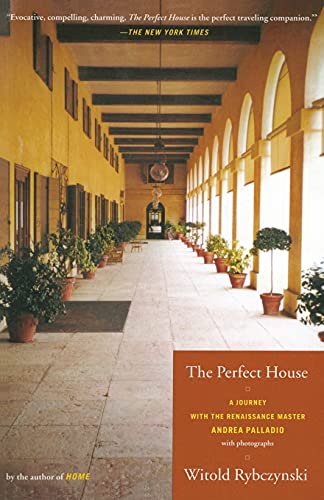
Palladio is the Bible, Thomas Jefferson once said. "You should get it and stick to it." With his simple, gracious, perfectly proportioned villas, Andrea Palladio elevated the architecture of the private house into an art form during the late sixteenth century -- and his influence is still evident in the ample porches, columned porticoes, grand ceilings, and front-door pediments of America today.
In The Perfect House, bestselling author Witold Rybczynski, whose previous books (Home, A Clearing in the Distance, Now I Sit Me Down) have transformed our understanding of domestic architecture, reveals how a handful of Palladio's houses in an obscure corner of the Venetian Republic should have made their presence felt hundreds of years later and halfway across the globe. More than just a study of one of history's seminal architectural figures, The Perfect House reflects Rybczynski's enormous admiration for his subject and provides a new way of looking at the special landscapes we call "home" in the modern world.
Die Inhaltsangabe kann sich auf eine andere Ausgabe dieses Titels beziehen.
Über die Autorin bzw. den Autor
Witold Rybczynski has written about architecture and urbanism for The New York Times, Time, The Atlantic, and The New Yorker. He is the author of the critically acclaimed book Home and the award-winning A Clearing in the Distance, as well as The Biography of a Building, The Mysteries of the Mall, and Now I Sit Me Down. The recipient of the National Building Museum’s 2007 Vincent Scully Prize, he lives with his wife in Philadelphia, where he is emeritus professor of architecture at the University of Pennsylvania.
Von der hinteren Coverseite
The award-winning author of A Clearing in the Distance focuses on the designs, constructions, and writings of the Italian Renaissance architect, noting the influence of his works on such structures as the White House.
Auszug. © Genehmigter Nachdruck. Alle Rechte vorbehalten.
I
Godi
Forty miles northwest of Venice, the flat plain that starts on the shore of the Adriatic runs abruptly into the base of the Dolomitic Alps. The foothills village of Lugo Vicentino overlooks the Astico River, whose broad valley must have been pretty once but is now an unsettled quilt of cultivated fields and large manufacturing sheds. The mixture of agriculture and industry is apparent in the La Casara restaurant, where I'm surrounded by a noisy crowd of farmers and factory workers enjoying their lunch hour.
After an excessive meal, which raises again the puzzle of how Italians get anything done in the afternoon, I take a stroll. The restaurant is on the outskirts of the village. The houses here are too new to be picturesque, but the neat buildings and well-kept gardens attest to the prosperity of the region. The suburban landscape is dotted with agricultural remnants: a renovated farmhouse, a stone barn, a fenced piece of pasture. At the edge of the built-up area the ground rises steeply and I can see the bare branches of an orchard. Farther up the hill, behind a forsythia hedge that is already blooming, a large rectangular building with a red-tile roof commands the scene. This is what I've come to see -- Palladio's Villa Godi. Although Renaissance country houses are commonly referred to as villas, this use of the term is modern. In the sixteenth century,la villa referred to the entire estate; the house itself was la casa padronale (the master's house), or more simplyla casa di villa.
I drive my rented car up the winding road. "Placed on a hill with a wonderful view and beside a river" is how Palladio described the house, and despite its industrial excrescence the Astico valley still presents a spectacular vista. The house sits on a man-made podium circumscribed by an imposing stone retaining wall. The curving, battered wall resembles a medieval bastion; the sturdy building, with its compact mass and severe symmetry, likewise has a military bearing. At first glance it could be an armory or a garrison post. As one gets closer, two features soften its severity: the plastered walls, which are painted a faded but cheerful buttery yellow and resemble old parchment, and an arcaded loggia, which is recessed into the center of the building and creates a shaded and welcoming entrance.
The caretaker lets me in through a large wrought-iron gate and I follow a path across the podium. The gravel crunches agreeably underfoot. The lawn is planted with conifers clipped into spheres and pyramids. A fountain, whose centerpiece is a statue of a nymph surrounded by cavorting cherubs, sprays water into a pool. I give her a sideward glance and hurry through the garden to the house.
The villa, which did not look large from a distance, turns out to be immense, almost as tall as a modern five-story building. The plain plastered walls are relieved by a regular pattern of windows with stone frames and slightly different details: a heavy bracketed sill for the lowest floor; a delicately modeled sill for the main level; and a plain surround for the attic. Square windows are pushed up against an elegant cornice just under the shallow eaves. The cornice is supported by a row of little repetitive blocks, a detail adapted from ancient Roman temple eaves decorations called modillions. These are the only classical references in this otherwise undecorated and austere façade.
"The master's rooms, which have floors thirteen feet above ground, are provided with ceilings," Palladio wrote, "above these are the granaries, and in the thirteen-foot-high basement are placed the cellars, the places for making wine, the kitchen, and other similar rooms." This pragmatic stacking of warehouse and domestic uses originated in Venice, where land was scarce. The tall Godi "basement" is entirely aboveground, so a long straight stair leads to the loggia. This spacious outdoor room faces west, which must give splendid views of sunsets over the peaks of thealtipiano but leaves the main façade of the house exposed to the hot afternoon sun. It is unclear why Palladio turned the building this way -- the preferred orientation was southern, and that view was equally fine. It may have had to do with how one originally arrived at the villa, since old maps show a long, straight approach road climbing the hill from the west. Or it may be explained by the fact that the villa is believed to incorporate parts of a medieval house that already existed on the site. The citizens of the Venetian Republic had a reputation for penny-pinching, if not outright parsimony, and new houses were frequently built on top of old ones in order to save money by reusing foundations and walls.
The intonaco, or plastered stucco, of the walls shows marks where it was once incised to simulate the joints of stone construction. The entry in my old edition of theEncyclopaedia Britannica claims that Palladio's buildings were originally "designed to be executed in stone." In fact, none of Palladio's country houses are built of stone; all are brick covered in plaster, which was the standard method of construction for rural buildings. The jointing pattern, which is faint today but was prominent when the house was built, was not meant to deceive. Like the wooden faux-stonework of George Washington's Mount Vernon, it produces a sense of scale as well as a pleasing decorative texture.
Not all the masonry is simulated. The most distinctive feature of the house is the three-arch loggia whose square piers, arches, and imposts from which the arches spring are all faced with stone. Two carved stone emblems adorn the wall above the loggia: an armorial shield with imperial eagles, symbols of the owner's nobility, and a rampant lion, thestemma, or coat of arms, of the Godi family. An inscription on the tablet below reads HIERONYMUS GODUS HENRICI ANTONII FILIUS FECIT ANNO MDXLII (Built by Girolamo Godi, son of Enrico Antonio, in the year 1542). The Godis, one of the most powerful and wealthy patrician families of Vicenza, owned large estates in the Vicentino. When the patriarch Enrico Antonio died in 1536, he bequeathed the lands in common to his three sons (the fourth was a priest). Girolamo took charge of the Lugo holdings, more than five hundred acres, which included the hilltop of Lonedo, where he started to build a villa the following year.
Small doors lead directly from the loggia to rooms on either side, but the large door in the center is obviously the main entrance. PROCUL ESTE PROFANI is carved into the stone frame. "Keep the unholy far away" may have been intended tongue in cheek, since the Godis were known to have had heretical tendencies. ET LIBERA NOS A MALO -- "And deliver us from evil" -- completes the sentiment on the inside. I read the interior inscription later, for when I open the door my attention is immediately arrested by the grand space -- as Palladio, no doubt, intended. The cavernous room rises up to the roof -- about twenty-five feet -- and extends all the...
„Über diesen Titel“ kann sich auf eine andere Ausgabe dieses Titels beziehen.
Suchergebnisse für The Perfect House: A Journey with Renaissance Master...

Beispielbild für diese ISBN
The Perfect House: A Journey with the Renaissance Master Andrea Palladio
Anbieter: World of Books (was SecondSale), Montgomery, IL, USA
Verkäuferbewertung 5 von 5 Sternen

Paperback. Zustand: Fair. The award-winning author of A Clearing in the Distance focuses on the designs, constructions, and writings of the Italian Renaissance architect, noting the influence of his works on such structures as the White House. Reprint. 25,000 first printing. Artikel-Nr. 00074766826
Gebraucht kaufen
EUR 4,05
Versand gratis
Versand innerhalb von USA
Versand innerhalb von USA
Anzahl: 1 verfügbar
Beispielbild für diese ISBN
The Perfect House: A Journey with the Renaissance Master Andrea Palladio
Anbieter: World of Books (was SecondSale), Montgomery, IL, USA
Verkäuferbewertung 5 von 5 Sternen
Paperback. Zustand: Very Good. The award-winning author of A Clearing in the Distance focuses on the designs, constructions, and writings of the Italian Renaissance architect, noting the influence of his works on such structures as the White House. Reprint. 25,000 first printing. Artikel-Nr. 00110563386
Gebraucht kaufen
EUR 4,05
Versand gratis
Versand innerhalb von USA
Versand innerhalb von USA
Anzahl: 1 verfügbar
Beispielbild für diese ISBN
The Perfect House: A Journey with the Renaissance Master Andrea Palladio
Anbieter: World of Books (was SecondSale), Montgomery, IL, USA
Verkäuferbewertung 5 von 5 Sternen
Paperback. Zustand: Good. The award-winning author of A Clearing in the Distance focuses on the designs, constructions, and writings of the Italian Renaissance architect, noting the influence of his works on such structures as the White House. Reprint. 25,000 first printing. Artikel-Nr. 00096521734
Gebraucht kaufen
EUR 4,05
Versand gratis
Versand innerhalb von USA
Versand innerhalb von USA
Anzahl: 3 verfügbar
Beispielbild für diese ISBN
The Perfect House: A Journey with Renaissance Master Andrea Palladio
Anbieter: Wonder Book, Frederick, MD, USA
Verkäuferbewertung 5 von 5 Sternen
Zustand: Very Good. Very Good condition. A copy that may have a few cosmetic defects. May also contain light spine creasing or a few markings such as an owner's name, short gifter's inscription or light stamp. Artikel-Nr. F13F-02720
Gebraucht kaufen
EUR 6,43
Versand gratis
Versand innerhalb von USA
Versand innerhalb von USA
Anzahl: 1 verfügbar
Beispielbild für diese ISBN
The Perfect House: A Journey with Renaissance Master Andrea Palladio
Anbieter: ThriftBooks-Dallas, Dallas, TX, USA
Verkäuferbewertung 5 von 5 Sternen
Paperback. Zustand: Good. No Jacket. Pages can have notes/highlighting. Spine may show signs of wear. ~ ThriftBooks: Read More, Spend Less. Artikel-Nr. G0743205871I3N00
Gebraucht kaufen
EUR 6,54
Versand gratis
Versand innerhalb von USA
Versand innerhalb von USA
Anzahl: 1 verfügbar
Beispielbild für diese ISBN
The Perfect House: A Journey with Renaissance Master Andrea Palladio
Anbieter: ThriftBooks-Dallas, Dallas, TX, USA
Verkäuferbewertung 5 von 5 Sternen
Paperback. Zustand: Very Good. No Jacket. May have limited writing in cover pages. Pages are unmarked. ~ ThriftBooks: Read More, Spend Less. Artikel-Nr. G0743205871I4N00
Gebraucht kaufen
EUR 6,54
Versand gratis
Versand innerhalb von USA
Versand innerhalb von USA
Anzahl: 1 verfügbar
Beispielbild für diese ISBN
The Perfect House : A Journey with Renaissance Master Andrea Palladio
Anbieter: Better World Books: West, Reno, NV, USA
Verkäuferbewertung 5 von 5 Sternen
Zustand: Very Good. Reprint. Pages intact with possible writing/highlighting. Binding strong with minor wear. Dust jackets/supplements may not be included. Stock photo provided. Product includes identifying sticker. Better World Books: Buy Books. Do Good. Artikel-Nr. 4793857-6
Gebraucht kaufen
EUR 6,57
Versand gratis
Versand innerhalb von USA
Versand innerhalb von USA
Anzahl: 1 verfügbar
Beispielbild für diese ISBN
The Perfect House : A Journey with Renaissance Master Andrea Palladio
Anbieter: Better World Books: West, Reno, NV, USA
Verkäuferbewertung 5 von 5 Sternen
Zustand: Very Good. Reprint. Former library copy. Pages intact with possible writing/highlighting. Binding strong with minor wear. Dust jackets/supplements may not be included. Includes library markings. Stock photo provided. Product includes identifying sticker. Better World Books: Buy Books. Do Good. Artikel-Nr. 807313-20
Gebraucht kaufen
EUR 6,57
Versand gratis
Versand innerhalb von USA
Versand innerhalb von USA
Anzahl: 1 verfügbar
Foto des Verkäufers
The Perfect House
Anbieter: Southampton Books, Sag Harbor, NY, USA
Verkäuferbewertung 5 von 5 Sternen
Paperback. Zustand: Like New. FIRST THUS. First Edition Thus, First Printing. Not price-clipped. Published by Scribner, 2003. Octavo. Paperback. Book is like new. 100% positive feedback. 30 day money back guarantee. NEXT DAY SHIPPING! Excellent customer service. Please email with any questions. All books packed carefully and ship with free delivery confirmation/tracking. All books come with free bookmarks. Ships from Sag Harbor, New York. Artikel-Nr. 459482
Gebraucht kaufen
EUR 18,39
EUR 4,45 Versand
Versand innerhalb von USA
Versand innerhalb von USA
Anzahl: 1 verfügbar
Foto des Verkäufers
The Perfect House: A Journey with Renaissance Master Andrea Palladio: A Journey with the Renaissance Master Andrea Palladio
Anbieter: M Godding Books Ltd, Devizes, WILTS, Vereinigtes Königreich
Verkäuferbewertung 5 von 5 Sternen
paperback. Zustand: Very Good. . Posted within 1 working day. 1st class tracked post to the UK, Airmail with tracking worldwide. Robust recyclable packaging. Picture is the actual item. Artikel-Nr. 287604
Gebraucht kaufen
EUR 8,51
EUR 14,74 Versand
Versand von Vereinigtes Königreich nach USA
Versand von Vereinigtes Königreich nach USA
Anzahl: 1 verfügbar