
Verwandte Artikel zu What's Love Got to Do With It?: Understanding and...
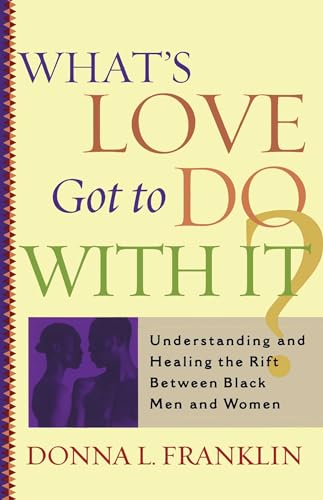
What's Love Got to Do With It?: Understanding and Healing the Rift Between Black Men and Women - Softcover
Inhaltsangabe
Relationships between black men and women in America are in crisis—it's time to figure out what's gone wrong and start the healing process.
The current divorce rates for black couples have quadrupled since 1960 and is now double that of the general population; rates of domestic violence in black marriages are skyrocketing; and nearly half of married black men admit to having been unfaithful. In What's Love Got to Do with It? Donna Franklin, one of the country's leading African American sociologists, speaks out on these painful, complex issues, providing an incisive and riveting analysis of the gender tensions that are the legacy of slavery and its aftermath.
Franklin breaks new ground in explaining why black men and women have trouble relating to each other, and examines their profoundly different starting points, which are influenced by generations of racism and injustice. She shows how black women's strength and self-sufficiency can be used to nurture relationships. Likewise, she teaches black men how to support one another and their relationships with women without excluding women, as has happened with the Million Man March.
The challenge of mending the rift between black men and women is formidable but can be made easier. Understanding is the first step on the path to healing.
Die Inhaltsangabe kann sich auf eine andere Ausgabe dieses Titels beziehen.
Über die Autorin bzw. den Autor
Donna L. Franklin is the author of Ensuring Inequality: The Structural Transformation of the African-American Family, which won the American Sociological Association's Goode Distinguished Book Award for "outstanding contribution to family scholarship," as well as What’s Love Got to Do With It?: Understanding and Healing the Rift Between Black Men and Women. She has held faculty appointments at the University of Chicago, Howard University, Smith College, and the University of Southern California. She lives in Los Angeles, California.
Auszug. © Genehmigter Nachdruck. Alle Rechte vorbehalten.
Chapter 1
Breaking the Silence
Black people are big on keeping race secrets. It's as if the bond of our skin color demands that we keep at least a façade of monolithic solidarity, even when doing so cripples and disenfranchises us....The men are always more important than the women, and, when it comes to issues particular to women, there's not much difference between a black or white patriarch.
Jill Nelson, Straight, No Chaser: How I Became a Grown-up Black Woman
Relationships between black men and women in America are in crisis. Black women and men know this well, for they experience it in their attempts to date, to forge relationships, to marry, and to stay together. More often than ever before, their attempts end in mutual misunderstandings and mutual recriminations.
Although forming satisfying and lasting bonds in today's society is a challenge for men and women of every racial background, the challenge is greatest for African Americans. Perhaps no group feels the problem more acutely than young, educated black women. A public school administrator with the District of Columbia has expressed the frustrations and disappointments shared by many black women:
Have you met this woman? She has a good job, works hard, earns a good salary. She went to college, got her master's degree; she is intelligent. She is personable, articulate, well read, interested in everybody and everything. Yet, she's single.
Or perhaps you recognize the community activist. She's a black lady -- or, as she prefers, an African-American woman -- on the move. She sports a short natural, sometimes cornrow braids, or even dreadlocks. She's an organizer, a motivator, a dynamo. Her work for her people speaks for itself -- organizing women for a self-help collective, raising funds for a community cause, educating others around a new issue in South Africa. Black folks look up to her, and white folks know she's a force to be reckoned with. Yet once again, the men leave her alone. What do these women have in common? They have so much; what is it they lack? Why is it they may be able to hook a man but can't hold him?
The women puzzle over this quandary themselves. They gather at professional clubs, at sorority meetings, or at the office over coffee and wonder what's wrong with black men. They hold special prayer vigils and fast and pray and beg Jesus to send the men back to church. They find the brothers attending political strategy sessions or participating in protests, but when it comes time to go home, the brothers go home to someone else. I know these women because I am all of these women.
The problem that black women like this one confront in finding black men to date and marry is exacerbated by the shrinking pool of available candidates. The ratio of black women to men is highly imbalanced and has been for generations. Although the gender ratios in the African-American community were balanced at the turn of the century, the ratios of men to women fell continuously and sharply until 1990 when the marital opportunities index fell below 65 -- meaning that there would be less than 65 men available to marry for every 100 women. For professional black women, the pool of eligible black men shrinks even further because so many black men face uncertain economic futures.
But attention to these demographic factors can obscure the deeper problem of the distressed state of gender relations in the African-American community. The data on relational patterns among African Americans are nothing short of alarming:
* The current divorce rate for blacks is four times the 1960 level and double that of the general population.
* Interracial marriages have risen from a reported 51,000 in 1960 to 311,000 in 1997. Even though marriageable black females out-number black males, twice as many black men as women marry outside the race. Among sexually active African Americans, 23 percent of the black men had had white partners, compared with only 6 percent of black women.
* Both black men and women are significantly less desirous of marriage than their white counterparts. Of all these groups, black men are the least desirous of marriage.
* The rates of violence between black men and women are higher than those for other races. Not only are black wives more likely to kill their husbands than wives of other races, but the majority of the women killed by husbands or boyfriends are also black. Paradoxically, white women have been more likely to push for tougher laws against domestic violence and for shelters for battered women.
* For couples in long-term marriages, 72 percent of the African-American husbands reported using a confrontational style of dealing with marital conflict, compared with 25 percent of Mexican-American husbands and 18 percent of white husbands.
* Forty-four percent of married black men admit to having been unfaithful to their wives, almost double the percentage for whites. In contrast, the differences between black women and white women were minuscule -- 18 percent and 15 percent respectively.
* If these patterns of infidelity are multigenerational, they could be one explanation for the findings of a nationwide survey of black women. This survey found that 77.1 percent of black mothers gave negative messages to their daughters about black men.
Why do the marriage and relationship experiences of African Americans differ so markedly from those of other Americans? How are we to explain the high levels of tension and conflict between black men and women? What are the root causes of their turbulent relationships?
In reflecting on her own experiences, the public school administrator points a finger squarely at herself and other black women:
After asking over and over again, "What's wrong with these men?" it finally dawned on me to ask the question, "What's wrong with us women?" What I have found, and what many of these women have yet to discover, is that the skills that make one successful in the church, community or workplace are not the skills that make one successful in a relationship.
Being acknowledged as the head of the household is an especially important thing for many black men, since their manhood is so often actively challenged everywhere else. Many modern women are so independent, so self-sufficient, so committed to the cause, to the church, to career -- or their narrow concepts of same -- that their entire personalities project an "I don't need a man" message. So they end up without one. An interested man may be attracted, but he soon discovers that this sister makes very little space for him in her life.
Going to graduate school is a good goal and an option that previous generations of blacks have not had. But sometimes the achieving woman will place her boyfriend so low on her list of priorities that his interest wanes. Between work, school and homework, she's seldom "there" for him, for the preliminaries that might develop a commitment to a woman. She's too busy to prepare him a home-cooked meal or to be a listening ear for his concerns because she is so occupied with her own.
Like many discussions of the dating challenges facing black women, this administrator's remarks place most of the responsibility on black women themselves. They echo the common idea that black women are simply too strong, too independent, and too self-sufficient for their own good or for the good of their relationships. As with male and female relationships, little attention is given to the attributes of black men that are problematic in relationships. When black men are discussed, it is usually within the context of how their manhood is constantly being challenged or how much more difficult life is for them than it is for black women. If a black woman is to have a harmonious relationship with a black man, she will have to...
„Über diesen Titel“ kann sich auf eine andere Ausgabe dieses Titels beziehen.
Suchergebnisse für What's Love Got to Do With It?: Understanding and...

Beispielbild für diese ISBN
What's Love Got to Do with It?: Understanding and Healing the Rift Between Black Men and Women
Anbieter: ThriftBooks-Dallas, Dallas, TX, USA
Verkäuferbewertung 5 von 5 Sternen

Paperback. Zustand: Very Good. No Jacket. May have limited writing in cover pages. Pages are unmarked. ~ ThriftBooks: Read More, Spend Less. Artikel-Nr. G0743203216I4N00
Gebraucht kaufen
EUR 12,06
Versand gratis
Versand innerhalb von USA
Versand innerhalb von USA
Anzahl: 1 verfügbar
Beispielbild für diese ISBN
What's Love Got to Do with It?: Understanding and Healing the Rift Between Black Men and Women
Anbieter: ThriftBooks-Atlanta, AUSTELL, GA, USA
Verkäuferbewertung 5 von 5 Sternen
Paperback. Zustand: Fair. No Jacket. Readable copy. Pages may have considerable notes/highlighting. ~ ThriftBooks: Read More, Spend Less. Artikel-Nr. G0743203216I5N00
Gebraucht kaufen
EUR 12,06
Versand gratis
Versand innerhalb von USA
Versand innerhalb von USA
Anzahl: 1 verfügbar
Foto des Verkäufers
What's Love Got to Do With It?: Understanding and Healing the Rift Between Black Men and Women
Anbieter: WeBuyBooks, Rossendale, LANCS, Vereinigtes Königreich
Verkäuferbewertung 5 von 5 Sternen
paperback. Zustand: Good. Most items will be dispatched the same or the next working day. A copy that has been read but remains in clean condition. All of the pages are intact and the cover is intact and the spine may show signs of wear. The book may have minor markings which are not specifically mentioned. Artikel-Nr. rev8487453422
Gebraucht kaufen
EUR 9,30
EUR 7,26 Versand
Versand von Vereinigtes Königreich nach USA
Versand von Vereinigtes Königreich nach USA
Anzahl: 1 verfügbar
Beispielbild für diese ISBN
What's Love Got to Do With It?: Understanding and Healing the Rift Between Black Men and Women
Anbieter: Robinson Street Books, IOBA, Binghamton, NY, USA
Verkäuferbewertung 4 von 5 Sternen

Paperback. Zustand: As New. Prompt Shipment, shipped in Boxes, Tracking PROVIDEDFine. First edition. Artikel-Nr. bing8048378
Gebraucht kaufen
EUR 12,42
EUR 8,48 Versand
Versand innerhalb von USA
Versand innerhalb von USA
Anzahl: 1 verfügbar
Beispielbild für diese ISBN
What's Love Got to Do With It?: Understanding and Healing the Rift Between Black Men and Women
Anbieter: Revaluation Books, Exeter, Vereinigtes Königreich
Verkäuferbewertung 5 von 5 Sternen
Paperback. Zustand: Brand New. 256 pages. 8.25x5.50x0.75 inches. In Stock. Artikel-Nr. x-0743203216
Neu kaufen
EUR 20,95
EUR 11,80 Versand
Versand von Vereinigtes Königreich nach USA
Versand von Vereinigtes Königreich nach USA
Anzahl: 2 verfügbar
Beispielbild für diese ISBN
What's Love Got To Do With It?
Anbieter: SZ Global, Toronto, ON, Kanada
Verkäuferbewertung 5 von 5 Sternen
Paperback. Zustand: New. Artikel-Nr. 9780743203210
Neu kaufen
EUR 31,60
EUR 33,22 Versand
Versand von Kanada nach USA
Versand von Kanada nach USA
Anzahl: 4 verfügbar