
Verwandte Artikel zu Nothing Like It In the World: The Men Who Built the...
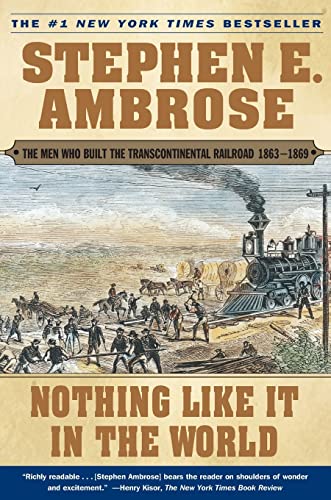
Nothing Like It In the World: The Men Who Built the Transcontinental Railroad 1863-1869 (Men Who Built the Transcontinental Railroad, 1865-69) - Softcover
Inhaltsangabe
Nothing Like It in the World gives the account of an unprecedented feat of engineering, vision, and courage. It is the story of the men who built the transcontinental railroad—the investors who risked their businesses and money; the enlightened politicians who understood its importance; the engineers and surveyors who risked, and sometimes lost, their lives; and the Irish and Chinese immigrants, the defeated Confederate soldiers, and the other laborers who did the backbreaking and dangerous work on the tracks.
The U.S. government pitted two companies—the Union Pacific and the Central Pacific Railroads—against each other in a race for funding, encouraging speed over caution. Locomotives, rails, and spikes were shipped from the East through Panama or around South America to the West or lugged across the country to the Plains. In Ambrose's hands, this enterprise, with its huge expenditure of brainpower, muscle, and sweat, comes vibrantly to life.
Die Inhaltsangabe kann sich auf eine andere Ausgabe dieses Titels beziehen.
Über die Autorin bzw. den Autor
Stephen E. Ambrose was a renowned historian and acclaimed author of more than thirty books. Among his New York Times bestsellers are Nothing Like It In the World, Citizen Soldiers, Band of Brothers, D-Day, and Undaunted Courage. Dr. Ambrose was a retired Boyd Professor of History at the University of New Orleans and a contributing editor for the Quarterly Journal of Military History.
Auszug. © Genehmigter Nachdruck. Alle Rechte vorbehalten.
Chapter One: Picking the Route 1830-1860
August 13, 1859, was a hot day in Council Bluffs, Iowa. The settlement was on the western boundary of the state, just across the Missouri River from the Nebraska village of Omaha. A politician from the neighboring state of Illinois, Abraham Lincoln, went to Concert Hall to make a speech. It attracted a big crowd because of Lincoln's prominence after the previous year's Lincoln-Douglas debates and the keen interest in the following year's presidential election. Lincoln was a full-time politician and a candidate for the Republican nomination for president. The local editor called Lincoln's speech -- never recorded -- one that "set forth the true principles of the Republican party."
In the audience was Grenville Mellen Dodge, a twenty-eight-year-old railroad engineer. The next day he joined a group of citizens who had gathered on the big porch of the Pacific House, a hotel, to hear Lincoln answer questions. When Lincoln had finished and the crowd dispersed, W.H.M. Pusey, with whom the speaker was staying, recognized young Dodge. He pointed out Dodge to Lincoln and said that the young engineer knew more about railroads than any "two men in the country."
That snapped Lincoln's head around. He studied Dodge intently for a moment and then said, "Let's go meet." He and Pusey strolled across the porch to a bench where Dodge was sitting. Pusey introduced them. Lincoln sat down beside Dodge, crossed his long legs, swung his foot for a moment, put his big hand on Dodge's forearm, and went straight to the point: "Dodge, what's the best route for a Pacific railroad to the West?"
Dodge instantly replied, "From this town out the Platte Valley."
Lincoln thought that over for a moment or two, then asked, "Why do you think so?"
Dodge replied that the route of the forty-second parallel was the "most practical and economic" for building the railroad, which made Council Bluffs the "logical point of beginning."
Why? Lincoln wanted to know.
"Because of the railroads building from Chicago to this point," Dodge answered, and because of the uniform grade along the Platte Valley all the way to the Rocky Mountains.
Lincoln went on with his questions, until he had gathered from Dodge all the information Dodge had reaped privately doing surveys for the Rock Island Railroad Company on the best route to the West. Or, as Dodge later put it, "He shelled my woods completely and got all the information I'd collected."
The transcontinental railroad had been talked about, promoted, encouraged, desired for three decades. This was true even though the railroads in their first decades of existence were rickety, ran on poorly laid tracks that gave a bone-crushing bump-bump-bump to the cars as they chugged along, and could only be stopped by a series of brakemen, one on top of each car. They had to turn a wheel connected to a device that put pressure on the wheels to slow and finally to stop. The cars were too hot in the summer, much too cold in the winter (unless one was at the end nearest the stove, which meant one was too hot). The seats were wooden benches set at ninety-degree angles that pained the back, the buttocks, and the knees. There was no food until the train stopped at a station, when one had fifteen or fewer minutes to buy something from a vendor. The boiler in the engine was fired by wood, which led to sparks, which sometimes -- often -- flew back into a car and set the whole thing on fire. Bridges could catch fire and burn. Accidents were common; sometimes they killed or wounded virtually all passengers. The locomotives put forth so much smoke that the downwind side of the tracks on the cars was less desirable and it generally was on the poorer side of town, thus the phrase "the wrong side of the tracks."
Nevertheless, people wanted a transcontinental railroad. This was because it was absolutely necessary to bind the country together. Further, it was possible, because train technology was improving daily. The locomotives were getting faster, safer, more powerful, as the cars became more comfortable. More than the steamboat, more than anything else, the railroads were the harbinger of the future, and the future was the Industrial Revolution.
In 1889, Thomas Curtis Clarke opened his essay on "The Building of a Railway" with these words: "The world of to-day differs from that of Napoleon more than his world differed from that of Julius Caesar; and this change has chiefly been made by railways."
That was true, and it had happened because of the American engineers, one of whom said, "Where a mule can go, I can make a locomotive go." The poetry of engineering, which required both imagination to conceive and skill to execute, was nowhere more in evidence than in America, where it was the most needed. In England and Europe, after George Stephenson launched the first locomotive in 1829, little of significance in design change took place for the next thirty years. In America nearly everything did, because of the contempt for authority among American engineers, who invented new ways to deal with old problems regardless of precedent.
America was riper than anywhere else for the railroad. It gave Americans "the confidence to expand and take in land far in excess of what any European nation or ancient civilization had been able successfully to control," as historian Sarah Gordon points out. The railroad promised Americans "that towns, cities, and industries could be put down anywhere as long as they were tied to the rest of the Union by rail."
Between 1830 and 1850, American engineers invented the swiveling truck. With it placed under the front end of a locomotive, the engine could run around curves of almost any radius. It was in use in 1831 on the Mohawk and Hudson Railroad. There was nothing like it in England. So too equalizing beams or levers, by means of which the weight of the engine was borne by three of the four driving-wheels, which kept the train on rough tracks. Or the four-wheeled swiveling trucks, one under each end of a car, which let the freight or passenger cars follow the locomotives around the sharpest curves. Another American invention was the switchback, making it possible for the locomotives to chug their way up steep inclines.
Something else distinguished the American railway from its English parent. In America it was common practice to get the road open for traffic in the cheapest manner possible, and in the least possible time. The attitude was, It can be fixed up and improved later, and paid for with the earnings.
The wooden bridge and wooden trestle were invented by Leonardo da Vinci in the sixteenth century and put to use for railways by American engineers beginning in 1840. The Howe truss, invented by an American, used bolts, washers, nuts, and rods so that the shrinkage of new timber could be taken up. It had its parts connected in such a way that they were able to bear the heavy, concentrated weight of locomotives without crushing. Had the Howe truss bridges not tended to decay or burn up, they would still be in use today.
The railways made America. Everyone knew that. But there was much left to do. Henry V. Poor, editor of the American Railroad Journal, wrote a year before the Lincoln-Dodge meeting, "In a railroad to the Pacific we have a great national work, transcending, in its magnitude, and in its results, anything yet attempted by man. By its execution, we are to accomplish our appropriate mission, and a greater one than any yet fulfilled by any nation." The mission was, he summed up, to establish "our empire on the Pacific, where our civilization can take possession of the New Continent and confront the Old."
Obviously Dodge wasn't the only engineer who did surveying on the west side of the Missouri River. But he envisioned and convinced Lincoln that the...
„Über diesen Titel“ kann sich auf eine andere Ausgabe dieses Titels beziehen.
Suchergebnisse für Nothing Like It In the World: The Men Who Built the...

Beispielbild für diese ISBN
Nothing Like It In the World: The Men Who Built the Transcontinental Railroad 1863-1869
Anbieter: World of Books (was SecondSale), Montgomery, IL, USA
Verkäuferbewertung 5 von 5 Sternen

Zustand: Acceptable. Item in good condition. Textbooks may not include supplemental items i.e. CDs, access codes etc. Artikel-Nr. 00062601595
Gebraucht kaufen
EUR 3,77
Versand gratis
Versand innerhalb von USA
Versand innerhalb von USA
Anzahl: 18 verfügbar
Beispielbild für diese ISBN
Nothing Like It In the World: The Men Who Built the Transcontinental Railroad 1863-1869
Anbieter: World of Books (was SecondSale), Montgomery, IL, USA
Verkäuferbewertung 5 von 5 Sternen
Zustand: Acceptable. Item in acceptable condition! Textbooks may not include supplemental items i.e. CDs, access codes etc. Artikel-Nr. 00084613117
Gebraucht kaufen
EUR 4,23
Versand gratis
Versand innerhalb von USA
Versand innerhalb von USA
Anzahl: Mehr als 20 verfügbar
Beispielbild für diese ISBN
Nothing Like It In the World: The Men Who Built the Transcontinental Railroad 1863-1869
Anbieter: World of Books (was SecondSale), Montgomery, IL, USA
Verkäuferbewertung 5 von 5 Sternen
Zustand: Very Good. Item in very good condition! Textbooks may not include supplemental items i.e. CDs, access codes etc. Artikel-Nr. 00107997928
Gebraucht kaufen
EUR 4,23
Versand gratis
Versand innerhalb von USA
Versand innerhalb von USA
Anzahl: 8 verfügbar
Beispielbild für diese ISBN
Nothing Like It In the World: The Men Who Built the Transcontinental Railroad 1863-1869
Anbieter: World of Books (was SecondSale), Montgomery, IL, USA
Verkäuferbewertung 5 von 5 Sternen
Zustand: Acceptable. Item in Acceptable condition. Textbooks may not include supplemental items i.e. CDs, access codes etc. Artikel-Nr. 00110343332
Gebraucht kaufen
EUR 4,23
Versand gratis
Versand innerhalb von USA
Versand innerhalb von USA
Anzahl: 1 verfügbar
Beispielbild für diese ISBN
Nothing Like It In the World: The Men Who Built the Transcontinental Railroad 1863-1869
Anbieter: World of Books (was SecondSale), Montgomery, IL, USA
Verkäuferbewertung 5 von 5 Sternen
Zustand: Good. Item in good condition. Textbooks may not include supplemental items i.e. CDs, access codes etc. Artikel-Nr. 00106524964
Gebraucht kaufen
EUR 4,23
Versand gratis
Versand innerhalb von USA
Versand innerhalb von USA
Anzahl: Mehr als 20 verfügbar
Beispielbild für diese ISBN
Nothing Like It In the World: The Men Who Built the Transcontinental Railroad 1863-1869
Verlag:
Simon & Schuster (edition First Edition), 2001
ISBN 10: 0743203178
ISBN 13: 9780743203173
Gebraucht
Paperback
Erstausgabe
Anbieter: BooksRun, Philadelphia, PA, USA
Verkäuferbewertung 5 von 5 Sternen
Paperback. Zustand: Fair. First Edition. The item might be beaten up but readable. May contain markings or highlighting, as well as stains, bent corners, or any other major defect, but the text is not obscured in any way. Artikel-Nr. 0743203178-7-1
Gebraucht kaufen
EUR 4,76
Versand gratis
Versand innerhalb von USA
Versand innerhalb von USA
Anzahl: 2 verfügbar
Beispielbild für diese ISBN
Nothing Like It In the World: The Men Who Built the Transcontinental Railroad 1863-1869
Anbieter: Wonder Book, Frederick, MD, USA
Verkäuferbewertung 5 von 5 Sternen
Zustand: Good. . Slightly dampstained. Owner's name on endpage. Artikel-Nr. I25A-00394
Gebraucht kaufen
EUR 4,99
Versand gratis
Versand innerhalb von USA
Versand innerhalb von USA
Anzahl: 1 verfügbar
Foto des Verkäufers
Nothing Like It In the World: The Men Who Built the Transcontinental Railroad 1863-1869
Anbieter: Dream Books Co., Denver, CO, USA
Verkäuferbewertung 5 von 5 Sternen
Zustand: acceptable. This copy has clearly been enjoyedâ"expect noticeable shelf wear and some minor creases to the cover. Binding is strong, and all pages are legible. May contain previous library markings or stamps. Artikel-Nr. DBV.0743203178.A
Gebraucht kaufen
EUR 5,02
Versand gratis
Versand innerhalb von USA
Versand innerhalb von USA
Anzahl: 2 verfügbar
Foto des Verkäufers
Nothing Like It In the World: The Men Who Built the Transcontinental Railroad 1863-1869
Anbieter: Dream Books Co., Denver, CO, USA
Verkäuferbewertung 5 von 5 Sternen
Zustand: good. Gently used with minimal wear on the corners and cover. A few pages may contain light highlighting or writing, but the text remains fully legible. Dust jacket may be missing, and supplemental materials like CDs or codes may not be included. May be ex-library with library markings. Ships promptly! Artikel-Nr. DBV.0743203178.G
Gebraucht kaufen
EUR 5,02
Versand gratis
Versand innerhalb von USA
Versand innerhalb von USA
Anzahl: 1 verfügbar
Beispielbild für diese ISBN
Nothing Like It In the World: The Men Who Built the Transcontinental Railroad 1863-1869
Verlag:
Simon & Schuster (edition First Edition), 2001
ISBN 10: 0743203178
ISBN 13: 9780743203173
Gebraucht
Paperback
Erstausgabe
Anbieter: BooksRun, Philadelphia, PA, USA
Verkäuferbewertung 5 von 5 Sternen
Paperback. Zustand: Very Good. First Edition. It's a well-cared-for item that has seen limited use. The item may show minor signs of wear. All the text is legible, with all pages included. It may have slight markings and/or highlighting. Artikel-Nr. 0743203178-11-1
Gebraucht kaufen
EUR 5,06
Versand gratis
Versand innerhalb von USA
Versand innerhalb von USA
Anzahl: 2 verfügbar