
Verwandte Artikel zu Prairie Nocturne: A Novel (No Series)
Inhaltsangabe
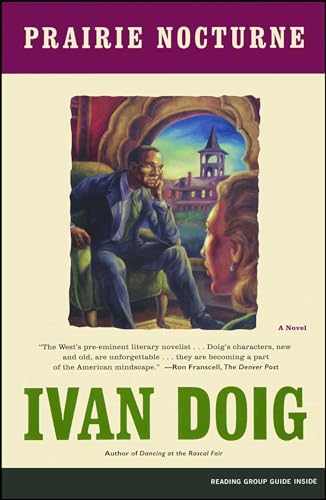
From one of the greatest novelists of the American West comes a surprising and riveting story set in Montana and New York during the Harlem Renaissance, drawing together an unlikely set of thwarted performers in one last inspired grasp at life’s set of gold rings: love and renown.
Susan Duff—the bossy, indomitable schoolgirl with a silver voice from the pages of Doig’s most popular work, Dancing at the Rascal Fair—has reached middle age alone, teaching voice lessons to the progeny of Helena’s high society.
Wesley Williamson—business scion of a cattle-empire family—has fallen from the heights of gubernatorial aspirations, forced out of a public career by political foes who uncovered his love affair with Susan.
Years later, former lovers Wes and Susan have reunited to share in an extraordinary goal: launching the singing career of Monty Rathbun—a man on the wrong side of the racial divide. In this triumph of sure-footed storytelling, motives and fates dangerously entangle.
Set in Montana, France, Scotland, and New York during the Harlem Renaissance of the 1920s, Prairie Nocturne is a soul-searching and deeply longitudinal novel that raises everlasting questions of allegiance, the grip of the past, and the costs of career and passion.
Die Inhaltsangabe kann sich auf eine andere Ausgabe dieses Titels beziehen.
Über die Autorin bzw. den Autor
Ivan Doig (1939–2015) was a third-generation Montanan and the author of sixteen books, including the classic memoir This House of Sky and most recently Last Bus to Wisdom. He was a National Book Award finalist and received the Wallace Stegner Award, among many other honors. Doig lived in Seattle with his wife, Carol. Visit IvanDoig.com.
Von der hinteren Coverseite
Teaching voice lessons to the privileged members of society during the height of the Harlem Renaissance, Susan Duff is hired by a man who once harbored political ambitions to teach his African-American chauffeur how to sing and perform.
Auszug. © Genehmigter Nachdruck. Alle Rechte vorbehalten.
Chapter One: Amended Star
1924
"The evening, the evening,
The evening brings all home."
The last ringleted girl had finished off the ballad on a hopeful note -- she would have given her ears for a praising word from Miss Duff -- and night and quiet came again to the house on Highland Street. Regular as the curtain of nightfall was Susan Duff's routine in closing away her teaching day. Shoulders back, her tall frame straightening expectantly even though there was no one in the house to meet for the evening but herself, she shuffled sheet music into its rightful order, tallied the hours of lessons in the secondhand mercantile ledger she kept handy atop the piano, and cast an eye over the schedule of impending pupils, then the balky old doors of the music parlor were slid shut. Next a freshening of her face with a rinse of cold water; one adjusting glance into the mirror, never two; hairpins taken out, and her chestnut hair shaken down. Onward to her stovetop supper, which she raced through as though still making up for her father's interminable graces over expiring food. Now, with a pat to the kitchen and a cursory locking of doors and windows, she was ready to ascend.
As fixed as a star, the telltale glow of her gable window appeared over Helena at the last of dusk and burned on past respectable bedtime. You might think a woman of her early climb in life, singled out by her father's God for a soaring voice to lift His hymns and then casting away choirsong for the anthems of a harsh young century, would find it a hard comedown to be faced with a nightly audience of only herself. You'd be as wrong as you could be, Susan would have you know in a finger snap.
This night, however, no sooner was she upstairs than she whipped to a halt in front of the alcove of window, her gaze drawn down the hillside to the state capitol dome, resting as it did on the center of the government of Montana like a giant's copper helmet. The dome still was alight with the festoon of bulbs that had greeted 1924 three months ago, which seemed to her uncalled for.
"Blaze," Susan addressed the civic constellation in the coarse-ground Fife burr she was born to, "see if I care."
She gave a throaty chuckle at herself and wended her way toward her desk. Pausing to choose a lozenge from the cut-glass jar there, she tasted it thoughtfully with the tip of her tongue, then swirled it in her mouth as if it would clear away beginner lessons and quavery approximations of high C; poor Flossie, last pupil of the day and absolute farthest from a worthwhile voice.No recital there, she reflected, except what I'll hear from her mother.
Still caught in thought, Susan automatically cast a glance around to judge the state of her housekeeping up here and reached her usual conclusion that she needed the availability of these spacious hours beyond dark more than the place demanded housecleaning. The attic-like room extended the full length of the house -- loft quarters for a married pair of servants, this must have originally been -- and she treated the expanse like a rambler cottage perched above the formal quarters of downstairs. The rolltop desk, a divan, a Victrola, what had been her father's Morris chair and footstool, onyx-topped side tables, a blue-and-black knitted comforter on the sill seat of the strategically aimed gable window, swayback sets of bookshelves, a spinet piano, a typewriter sitting composedly on a rolling secretarial table, a highly unreliable new thing called a radio set standing on a sturdy side cabinet, the whopping Duff family Bible on a commemorative reading stand of its own, all populated what was in actual fact her bedroom.
This mob of comforts drew her up out of public day as if lifting her into a lifeboat, and Susan tallied the necessity of this each time, too. Liberal with the night, resourceful as she probably ever was going to be in what that Bible would have deemed her fortieth year under heaven, she held to the belief that she was most her reconstituted self in these upstairs hours, at this elevation where the minute hand did not count. The time of footlights and the song-led marches for the right of women to vote were tucked into the past as firmly as could be, and as to the tongues of the town down there beyond the base of the stairs, she could do nothing about those. But up here, what she could do was to get busy at life's amended version of Susan Duff. There were encouraging letters to be written to favorite former pupils. (Tonight's, which took lip-biting concentration, to the breathy young soprano whose recentlieder recital in Milwaukee had not found favor there; many a time Susan wished she could deal solely with the voices, shapes of sound standing free in the air, without the human wrappings.) This political city's newspapers to be devoured, Anaconda Copper's one for spite and the independent one for sustenance. Books in plenitude; currently she was trying to make her way through E. M. Forster and the murky doings in the Marabar Caves. Music, of course: her half-finished operettaPrairie Tide always awaited, always unnavigable; and the radio set sometimes brought in serenades from unimaginable distances and sometimes madly cackled out static; but the Victrola sang the songs of others perfectly on command, restorative in itself to a teacher of voice. Then too she still was secretary of the state chapter of the Over There Memorial Committee, which took her to a drafty meeting hall once a month and obliged her to see to official correspondence, clerical enough to cross the eyes, in between. Tonight, as always, she shifted workspots every so often, her tall solo figure suddenly on the move as if she were a living chess piece. Time did not lag here in her industrious garret; it was not permitted to.
When it was nearing midnight and she had just begun to salt away another day between diary covers, she faintly heard the turn of a key in the front door and then the rhythm of him coming up the stairs to her for the first time in four years.
•••
"Susan? You might have changed the lock."
He arrived on the wings of that commanding smile. The very model of a modern genteel major, a line of hers teased somewhere back in that diary. The blue of his blood and the red silver of bayonet steel, those paradoxical flying colors by which he came through the war. Behind Wes, it was said, men would have charged Hell; in fact, men had.
Susan sat back hard in her chair at the desk, surprised no end to be confronted with him again after all this time. Even so she could not help but marvel at the presence with which Wes did most anything, as though the shadow under him were the thrust of a stage. Her emotions were more mixed about how little...
„Über diesen Titel“ kann sich auf eine andere Ausgabe dieses Titels beziehen.
Suchergebnisse für Prairie Nocturne: A Novel (No Series)

Beispielbild für diese ISBN
Prairie Nocturne: A Novel
Anbieter: World of Books (was SecondSale), Montgomery, IL, USA
Verkäuferbewertung 5 von 5 Sternen

Paperback. Zustand: Very Good. Teaching voice lessons to the privileged members of society during the height of the Harlem Renaissance, Susan Duff is hired by a man who once harbored political ambitions to teach his African-American chauffeur how to sing and perform. Artikel-Nr. 00092624874
Gebraucht kaufen
EUR 3,99
Versand gratis
Versand innerhalb von USA
Versand innerhalb von USA
Anzahl: 1 verfügbar
Beispielbild für diese ISBN
Prairie Nocturne: A Novel
Anbieter: World of Books (was SecondSale), Montgomery, IL, USA
Verkäuferbewertung 5 von 5 Sternen
Paperback. Zustand: Fair. Teaching voice lessons to the privileged members of society during the height of the Harlem Renaissance, Susan Duff is hired by a man who once harbored political ambitions to teach his African-American chauffeur how to sing and perform. Artikel-Nr. 00081235698
Gebraucht kaufen
EUR 3,99
Versand gratis
Versand innerhalb von USA
Versand innerhalb von USA
Anzahl: 4 verfügbar
Beispielbild für diese ISBN
Prairie Nocturne: A Novel
Anbieter: World of Books (was SecondSale), Montgomery, IL, USA
Verkäuferbewertung 5 von 5 Sternen
Paperback. Zustand: Good. Teaching voice lessons to the privileged members of society during the height of the Harlem Renaissance, Susan Duff is hired by a man who once harbored political ambitions to teach his African-American chauffeur how to sing and perform. Artikel-Nr. 00109504085
Gebraucht kaufen
EUR 3,99
Versand gratis
Versand innerhalb von USA
Versand innerhalb von USA
Anzahl: 2 verfügbar
Beispielbild für diese ISBN
Prairie Nocturne: A Novel
Verlag:
Scribner (edition Reprint), 2005
ISBN 10: 0743201361
ISBN 13: 9780743201360
Gebraucht
Paperback
Anbieter: BooksRun, Philadelphia, PA, USA
Verkäuferbewertung 5 von 5 Sternen
Paperback. Zustand: Very Good. Reprint. It's a well-cared-for item that has seen limited use. The item may show minor signs of wear. All the text is legible, with all pages included. It may have slight markings and/or highlighting. Artikel-Nr. 0743201361-11-1
Gebraucht kaufen
EUR 4,63
Versand gratis
Versand innerhalb von USA
Versand innerhalb von USA
Anzahl: 1 verfügbar
Beispielbild für diese ISBN
Prairie Nocturne: A Novel
Anbieter: Wonder Book, Frederick, MD, USA
Verkäuferbewertung 5 von 5 Sternen
Zustand: Good. Good condition. A copy that has been read but remains intact. May contain markings such as bookplates, stamps, limited notes and highlighting, or a few light stains. Artikel-Nr. V18A-05675
Gebraucht kaufen
EUR 6,33
Versand gratis
Versand innerhalb von USA
Versand innerhalb von USA
Anzahl: 1 verfügbar
Beispielbild für diese ISBN
Prairie Nocturne : A Novel
Anbieter: Better World Books, Mishawaka, IN, USA
Verkäuferbewertung 5 von 5 Sternen
Zustand: Good. Reprint. Former library copy. Pages intact with minimal writing/highlighting. The binding may be loose and creased. Dust jackets/supplements are not included. Includes library markings. Stock photo provided. Product includes identifying sticker. Better World Books: Buy Books. Do Good. Artikel-Nr. 5664677-75
Gebraucht kaufen
EUR 6,47
Versand gratis
Versand innerhalb von USA
Versand innerhalb von USA
Anzahl: 1 verfügbar
Beispielbild für diese ISBN
Prairie Nocturne : A Novel
Anbieter: Better World Books, Mishawaka, IN, USA
Verkäuferbewertung 5 von 5 Sternen
Zustand: Good. Reprint. Pages intact with minimal writing/highlighting. The binding may be loose and creased. Dust jackets/supplements are not included. Stock photo provided. Product includes identifying sticker. Better World Books: Buy Books. Do Good. Artikel-Nr. 6017625-6
Gebraucht kaufen
EUR 6,47
Versand gratis
Versand innerhalb von USA
Versand innerhalb von USA
Anzahl: 1 verfügbar
Beispielbild für diese ISBN
Prairie Nocturne
Anbieter: ThriftBooks-Atlanta, AUSTELL, GA, USA
Verkäuferbewertung 5 von 5 Sternen
Paperback. Zustand: Good. No Jacket. Pages can have notes/highlighting. Spine may show signs of wear. ~ ThriftBooks: Read More, Spend Less. Artikel-Nr. G0743201361I3N00
Gebraucht kaufen
EUR 6,59
Versand gratis
Versand innerhalb von USA
Versand innerhalb von USA
Anzahl: 1 verfügbar
Beispielbild für diese ISBN
Prairie Nocturne
Anbieter: ThriftBooks-Dallas, Dallas, TX, USA
Verkäuferbewertung 5 von 5 Sternen
Paperback. Zustand: Very Good. No Jacket. Former library book; May have limited writing in cover pages. Pages are unmarked. ~ ThriftBooks: Read More, Spend Less. Artikel-Nr. G0743201361I4N10
Gebraucht kaufen
EUR 6,59
Versand gratis
Versand innerhalb von USA
Versand innerhalb von USA
Anzahl: 1 verfügbar
Beispielbild für diese ISBN
Prairie Nocturne : A Novel
Anbieter: Robinson Street Books, IOBA, Binghamton, NY, USA
Verkäuferbewertung 4 von 5 Sternen

Paperback. Zustand: Used: Good Copy. Prompt Shipment, shipped in Boxes, Tracking PROVIDEDContemporary FictionGood copy with clean pages, some creasing on pages. Artikel-Nr. ware696JW053
Gebraucht kaufen
EUR 12,23
EUR 8,35 Versand
Versand innerhalb von USA
Versand innerhalb von USA
Anzahl: 1 verfügbar