
Inhaltsangabe
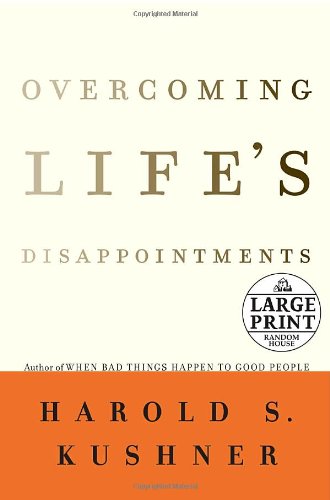
From Harold S. Kushner, the author of When Bad Things Happen to Good People, a book that shows us how to be our best selves even when things don't turn out as we had hoped--that is, how we can overcome life's disappointments.
Kushner turns to the experience of Moses to find the requisite lessons of strength and faith. Moses towers over all others in the Old Testament: he is the man on the mountaintop to whom God speaks with unparalleled intimacy, and he leads his people out of bondage. But he is also deeply human, someone whose soaring triumphs are offset by frustration and longing: his people ignore his teachings, he is denied entrance to the Promised Land, his family suffers. But he overcomes.
Through the example of Moses' remarkable resilience, we learn how to weather the disillusionment of dreams unfulfilled, the pain of a lost job or promotion, a child's failures, divorce or abandonment, and illness. We learn how to meet all disappointments with faith in ourselves and the future, and how to respond to heartbreak with understanding rather than bitterness and despair.
This is a book of spiritual wisdom--as practical as it is inspiring.
Die Inhaltsangabe kann sich auf eine andere Ausgabe dieses Titels beziehen.
Über die Autorin bzw. den Autor
Harold S. Kushner is Rabbi Laureate of Temple Israel in Natick, Massachusetts, where he resides. He has been honored by the Christophers, a Roman Catholic organization, as one of the fifty people who have made the world a better place in the last half century, and by Religion in American Life as the clergyman of the year in 1999. He is the author of When Bad Things Happen to Good People and eight other books.
Auszug. © Genehmigter Nachdruck. Alle Rechte vorbehalten.
1
The Man Who Dared to Dream
What happens to a dream deferred?
Does it dry up like a raisin in the sun?
Langston Hughes, “Harlem”
In these lines, the poet Langston Hughes wonders what happens to dreams that don’t come true. I wonder what happens to the dreamer. How do people cope with the realization that important dimensions of their lives will not turn out as they hoped they would? A person’s marriage isn’t all he or she anticipated. Someone doesn’t get the promotion or the recognition he had set his heart on. Many of us look at the world and see two groups of people, winners and losers: those who get what they want out of life and those who don’t. But in reality life is more complicated than that. Nobody gets everything he or she yearns for. I look at the world and see three sorts of people: those who dream boldly even as they realize that a lot of their dreams will not come true; those who dream more modestly and fear that even their modest dreams may not be realized; and those who are afraid to dream at all, lest they be disappointed. I would wish for more people who dreamed boldly and trusted their powers of resilience to see them through the inevitable disappointments.
History is written by winners, so most history books are about people who win. Most biographies, excluding works of pure scholarship, are meant to inspire as much as to inform, so they focus on a person’s successes. But in real life, even the most successful people see some of their efforts fail and even the greatest of people learn to deal with failure, rejection, bereavement, and serious illness.
The lessons of this book will come in large part from examining the life of one of the most influential people who ever lived, Moses, the hero of the Bible, the man who brought God’s word down to earth from the mountaintop. When we think of Moses, we think of his triumphs: leading the Israelites out of slavery, splitting the Red Sea, ascending Mount Sinai to receive the tablets of the law. But Moses was a man who knew frustration and failure in his public and personal life at least as often and as deeply as he knew fulfillment, and we, whose lives are also a mix of fulfillment and disappointment, can learn from his experiences. If he could overcome his monumental disappointments, we can learn to overcome ours.
What can we learn from Moses’ story to help my congregant who is overlooked for a promotion or the elderly man or woman whose children and grandchildren ignore him or her? What can I learn from Moses to share with all the wives and husbands who find it hard to feel affectionate toward a mate who takes them for granted? Let us turn to the story of Moses, the man who dared to dream, to see what lessons it reveals.
Nobel Prize winner Elie Wiesel has written in Messengers of God that Moses was “the most solitary and the most powerful hero in biblical history . . . the man who changed the course of history by himself. After him, nothing was the same again.” He goes on: “His passion for social justice, his struggle for national liberation, his triumphs and disappointments, his poetic inspiration, his gifts as a strategist and his organizational genius, his complex relationship with God and God’s people . . . his efforts to reconcile the law with compassion, authority with integrity—no individual ever, anywhere accomplished so much for so many people in so many domains. His influence is boundless.” The teachings of Jesus and Paul in the New Testament would be unintelligible unless read against the background of the Torah, the Five Books of Moses. The revelation to Muhammad at the inception of Islam assumes that the earlier revelation to Moses contained the authentic words of God. Even such secular prophets as Karl Marx and Sigmund Freud drew their passion for justice and freedom from the life and teachings of Moses.
We may think that we know about Moses, if not from Sunday school classes, then perhaps from one of the movies about his life. If we do, chances are that we relegate that knowledge to the dusty corner of our consciousness reserved for old Sunday school lessons, entertaining and probably edifying but not that relevant to our daily lives. But let me give you a fuller view of him, not only the man on the mountaintop, the man to whom God spoke with unparalleled intimacy, but Moses the human being, a man whose soaring triumphs were offset by crushing defeats in some of the things that mattered most to him, a man who came to realize the price his family paid for his successes. In the end, I trust we will still see him as a hero to admire and learn from, maybe even more heroic when the all-too-human qualities of longing, frustration, regret, and resiliency have been added to the portrait. Let me review his story, as told in the book of Exodus and the narrative portions of Leviticus, Numbers, and Deuteronomy.
Jacob, the third of the biblical patriarchs, son of Isaac and grandson of Abraham, moved his large family from Canaan to Egypt during one of the droughts that often afflicted that part of the world. There they were welcomed warmly in a country where Jacob’s son Joseph, by a series of fortuitous events, had become an important government official and had arranged for Egypt to be the only country with abundant food during hard times. The clan of Israel (as Jacob was sometimes called) settled there and flourished.
A generation or two later, “there arose a new king in Egypt who knew not Joseph” (Exodus 1:8). The reference may be to a native Egyptian Pharaoh who resented the prominence of some of the non-Egyptians in his kingdom. He may have seen them as a threat to his rule and reduced them to slavery, setting them to the task of building the royal fortifications and storehouses.
Before long, the Pharaoh’s contempt for the Hebrew slaves turned into irrational hatred. He commanded that all male Israelite babies be killed at birth, thrown into the Nile to drown (not a good way to maintain his slave labor force, but such is the power of irrational hate). The midwives who served the Hebrew population foiled his plan by sparing the babies and lying to Pharaoh, telling him that Israelite women were like animals, dropping their babies before the midwives could attend to them. Pharaoh believed their story because he needed to see the Israelites as less human than Egyptians in order to justify his treatment of them.
It was into this world that Moses was born. The narrative of his early years is typical of the hero narrative, the stories typically told about a child who will grow up to be someone special. The child is born to worthy parents, either after years of childlessness or at a time of great peril. He is separated from his parents and grows up ignorant of his heritage. We hear little of his early years, until he comes of age and is summoned to do great things.
To save the newborn child’s life, Moses’ mother places him in a basket, sets him afloat in the Nile, and sends his older sister, Miriam, to watch and see what happens to him. Pharaoh’s daughter, having gone down to bathe in the Nile, finds him and adopts him. Why was Pharaoh’s daughter bathing in the Nile when she had a houseful of servants available to draw her bath in the palace? One Talmudic sage suggests that she opposed her father’s treatment of the Israelites (I picture her as an idealistic adolescent). She was going to immerse herself in the Nile to identify with the Hebrew slaves at the place of their greatest suffering and to cleanse herself of the shame of being Pharaoh’s daughter.
Moses, having been adopted by Pharaoh, is...
„Über diesen Titel“ kann sich auf eine andere Ausgabe dieses Titels beziehen.
Weitere beliebte Ausgaben desselben Titels

Suchergebnisse für Overcoming Life's Disappointments (Random House...

Beispielbild für diese ISBN
Overcoming Life's Disappointments
Verlag:
Random House Large Print, 2006
ISBN 10: 0739326503
ISBN 13: 9780739326503
Gebraucht
Hardcover
Anbieter: Better World Books, Mishawaka, IN, USA
Verkäuferbewertung 5 von 5 Sternen

Zustand: Good. Pages intact with minimal writing/highlighting. The binding may be loose and creased. Dust jackets/supplements are not included. Stock photo provided. Product includes identifying sticker. Better World Books: Buy Books. Do Good. Artikel-Nr. 2444392-6
Gebraucht kaufen
EUR 6,47
Versand gratis
Versand innerhalb von USA
Versand innerhalb von USA
Anzahl: 1 verfügbar
Beispielbild für diese ISBN
Overcoming Life's Disappointments
Verlag:
Random House Large Print, 2006
ISBN 10: 0739326503
ISBN 13: 9780739326503
Gebraucht
Hardcover
Anbieter: Better World Books, Mishawaka, IN, USA
Verkäuferbewertung 5 von 5 Sternen
Zustand: Good. Former library copy. Pages intact with minimal writing/highlighting. The binding may be loose and creased. Dust jackets/supplements are not included. Includes library markings. Stock photo provided. Product includes identifying sticker. Better World Books: Buy Books. Do Good. Artikel-Nr. 4429502-75
Gebraucht kaufen
EUR 6,47
Versand gratis
Versand innerhalb von USA
Versand innerhalb von USA
Anzahl: 2 verfügbar
Beispielbild für diese ISBN
Overcoming Life's Disappointments
Verlag:
Random House Large Print, 2006
ISBN 10: 0739326503
ISBN 13: 9780739326503
Gebraucht
Hardcover
Anbieter: ThriftBooks-Dallas, Dallas, TX, USA
Verkäuferbewertung 5 von 5 Sternen
Hardcover. Zustand: Good. No Jacket. Former library book; Pages can have notes/highlighting. Spine may show signs of wear. ~ ThriftBooks: Read More, Spend Less. Artikel-Nr. G0739326503I3N10
Gebraucht kaufen
EUR 6,64
Versand gratis
Versand innerhalb von USA
Versand innerhalb von USA
Anzahl: 1 verfügbar
Beispielbild für diese ISBN
Overcoming Life's Disappointments
Verlag:
Random House Large Print, 2006
ISBN 10: 0739326503
ISBN 13: 9780739326503
Gebraucht
Hardcover
Anbieter: ThriftBooks-Atlanta, AUSTELL, GA, USA
Verkäuferbewertung 5 von 5 Sternen
Hardcover. Zustand: Very Good. No Jacket. May have limited writing in cover pages. Pages are unmarked. ~ ThriftBooks: Read More, Spend Less. Artikel-Nr. G0739326503I4N00
Gebraucht kaufen
EUR 6,64
Versand gratis
Versand innerhalb von USA
Versand innerhalb von USA
Anzahl: 1 verfügbar
Beispielbild für diese ISBN
Overcoming Life's Disappointments
Verlag:
Random House Large Print, 2006
ISBN 10: 0739326503
ISBN 13: 9780739326503
Gebraucht
Hardcover
Anbieter: Robinson Street Books, IOBA, Binghamton, NY, USA
Verkäuferbewertung 4 von 5 Sternen

Hardcover wit. Zustand: Very Good. Prompt Shipment, shipped in Boxes, Tracking PROVIDEDNonfiction: Very Good hardcover with dust jacket, clean deckled pages, prompt shipping with tracking. minor creases to dust jacket. Artikel-Nr. Bing103JM090
Gebraucht kaufen
EUR 40,56
EUR 8,31 Versand
Versand innerhalb von USA
Versand innerhalb von USA
Anzahl: 1 verfügbar
Beispielbild für diese ISBN
Overcoming Life's Disappointments (Random House Large Print)
Anbieter: Revaluation Books, Exeter, Vereinigtes Königreich
Verkäuferbewertung 5 von 5 Sternen
Hardcover. Zustand: Brand New. large print edition. 287 pages. 9.00x6.00x1.25 inches. In Stock. Artikel-Nr. 0739326503
Neu kaufen
EUR 48,74
EUR 11,77 Versand
Versand von Vereinigtes Königreich nach USA
Versand von Vereinigtes Königreich nach USA
Anzahl: 1 verfügbar