
Verwandte Artikel zu Solar Arcs: Astrology's Most Successful Predictive...
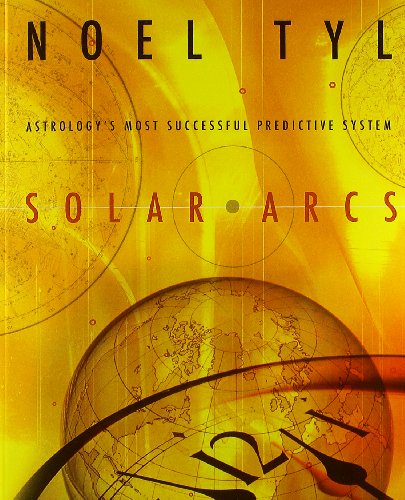
Solar Arcs: Astrology's Most Successful Predictive System: Astrology's Most Successful Predictive System Including Midpoints, Tertiary Progressions, ... the 100-Year "Guick-Glance" Ephemeris and 1,1 - Softcover
Inhaltsangabe
In this indispensable astrology book, Noel Tyl presents the definitive study of astrology's most accurate prediction system. The first major presentation of Solar Arc theory and practice in the English language, this book offers the entire application spectrum of Solar Arcs, dramatized in numerous case studies. Tyl explains the theory behind Solar Arcs from their inception in ancient times to their present-day articulation in rich, psychodynamic natal analyses. He also focuses on their quintessential importance to modern rectification methodology, the divining of unknown birth times. Finally, he shows you how to maximize computer software support to produce definitive results.
- Learn the developmental history of the Solar Arc method
- Identify important development times in anyone's life, at a glance
- Explore the timing power of Tertiary Progressions
- Follow step-by-step rectification methods
- Use the 100-year Quick Glance Ephemeris
- Acquire knowledge of 1,130 possible Natal and Solar Arc Midpoint pictures
Solar Arcs reveals the immense power of today's fastest growing astrological method. Written for the advancing student and the professional astrologer, Noel Tyl's work will transform the way you practice astrology.
Die Inhaltsangabe kann sich auf eine andere Ausgabe dieses Titels beziehen.
Über die Autorin bzw. den Autor
Noel Tyl was one of the foremost astrologers in the world. His twenty textbooks have guided astrologers for two generations, and his lecture activities reached out through sixteen countries and some 200,000 miles a year.
Tyl wrote the definitive professional manual in the astrology counseling field, the 1,000-page Synthesis & Counseling In Astrology is consulted regularly by individuals and corporations throughout the world. He also directed the Master's Degree Correspondence Course for Certification of professional astrologers from his office in the Phoenix, Arizona area.
Tyl, a Harvard University graduate, was the Presiding Officer of AFAN ( The Association for Astrological Networking), astrology's world organization.
Auszug. © Genehmigter Nachdruck. Alle Rechte vorbehalten.
1
Timing the Circle
The Development of Solar Arc Theory
The Circle. How does this shape, this spatial form, enter consciousness; how does it take on meaning; how does it come to be divided into 360 units; and how is it used as a measurement standard to capture the time of our lives? Timing the Circle
The Development of Solar Arc Theory
Initially, man must have learned to identify the circle from the pupils of maternal eyes, and then from reading the eyes of others. Above, overseeing all, there were the moving disks of the godly Sun and the Moon. There were the intricate centers of so many flowers. Even when worked by a stick into the sand or earth, the circle had uniqueness among forms: with a cross, there was the sense of division (the beginning of the concept of 2); but with the fashioning of a circle, there was the sense of unity, of wholeness, of inviolable symmetry.
We can speculate that, in development, man then began to grasp the concept of magnitude: there were different sizes of trees, rocks, animals, squares, and circles. Thought-tools were developed to express the relationships between things in terms of size, to capture comparisons and set standards. (This phase of evolution is often cited as the dawn of mathematics.)
With the development of language, thoughts became communication. The sense of possession—what defines you and what defines me—was linked with the relativity of magnitude. Counting systems and measurements were then required to describe things accurately, to define location and property, to plan building. And through continuous long-time measurement experimentation, rules emerged—certain measurement practices and relationships that were always valid. The square was understood: all sides were equal! Then, the observation that a square divided by a line drawn diagonally between opposite corners yielded two identical triangles led to understanding triangles; then to the rectangle and other polygons (configured by squares and triangles, a geometry accomplished through subdivision and rearrangement), but with the circle, rules were harder to discover.
The observations about the circle that must have been dominant are, first, that there is no beginning or end to the circle (the concept of constant development, of eternal continuity) and, second, that the wider the circle is, the longer the distance is around it (the concept of containment, of boundary).1
Mathematician-engineer Petr Beckmann gives us an extremely clear suggestion of the development of the properties of the circle, as shown on page 3.
So we find a fairly flat patch of wet sand along the Nile, drive in a stake, attach a piece of rope to it by loop and knot, tie the other end to another stake with a sharp point, and keeping the rope taut, we draw a circle in the sand. We pull out the central stake, leaving a hole O (see drawing below). Now we take a longer piece of rope, choose any point A on the circle and stretch the rope from A across the hole O until it intersects the circle at B. We mark the length AB on the rope (with charcoal); this is the diameter of the circle and our unit of length. Now we take the rope and lay it into the circular groove (inscribed) in the sand, starting at A. The charcoal mark is at C; we have laid off the diameter along the circumference once. Then we lay it off a second time from C to D, and a third time from D to E, so that the diameter goes into the circumference three (plus a little bit) times.2
We discover that the circumference of the circle (the distance around its boundary) is equal to 3 times the diameter, plus a little bit. Experimentation shows that this is always the case no matter what the diameter of the circle is. This coefficient (characteristic relationship) is called a constant, and for the circle it is labeled Pi, shown by the Greek letter .3
Research shows that, some 5,000 years ago, the coefficient of the circle was known in these close terms, in terms accurate enough to allow reliable measurement of the circle: the circumference of a circle was determined by 3+ times the diameter (C=Pi D or, more customarily, C=2 Pi r, where r is the radius, one-half the diameter of the circle).4
The Egyptians and Babylonians pursed the “+”, that little bit over 3, the distance EA in the drawing on page 3. We presume that they tried to define EA in terms of the diameter AB, as a fractional part of that key unit distance. If we mark EA on a rope and lay it off as many times as it will go on (into) the diameter distance AB of any circle, it will go down between 7 and 8 times, i.e., EA is something between 1/7 (0.142857) and 1/8 (0.125) of the unit distance AB. The modern study of Pi does not get much closer; the decimals never end. The basic standard coefficient now used is 3.14159265 (i.e., 3 + .1416).
Learning to calculate the area of a circle (the space within the circumference) was another problem, a complex one indeed.
Determining the area of a square was easy: subdividing the space bounded by the perimeter gave us a measurement of the space in terms of one side multiplied by the other side, a x b (see diagram, p. 5). With two units per side (2 feet, for example), we get an area of 4 square feet. When the square is increased to a rectangle (oblong), the same rule applies: 3 units on one side and 2 units on the other side gives us an area of six “square” units.
When we subdivide a rectangle or square by a diagonal, we get two triangles, i.e., the area of the triangle in this case is measured as one-half the product of the two sides of the imagined rectangle, ab/2.
The ancients knew that the square had sides that related to each other by a certain measure, 90 units (degrees). They learned that an equilateral triangle (sides of equal length) had the sides meeting each other at 60 units (degrees). In other words, a theorem emerged that the sum of the three angles of a triangle always equaled 180 units (degrees).
But with the circle, there were no sides, there was no beginning or end, no edge, no angle. We postulate that the measurement of the area of a circle was arrived at through increasingly more sophisticated filling-up of the space within the circle, filling the space up with figures whose area could be known. You can almost fill up a circle with a system of equilateral triangles, as we shall see in a moment.
The Babylonians (seeded by the preceding Sumerian culture, in the third millennium b.c.) knew area computation, and it is to them that credit is given for the initial, approximate determination of the area of the circle.5 It is this method of measurement for the area of a circle to which we can trace the origin of circular subdivision into 360 units—those units we now call degrees.
Now: the Sumerian and Babylonian number system was sexagesimal in orientation (based upon 6; ours is decimal, based on 10).6 The three 60-unit angles of the equilateral triangle fit into a neat conceptualization that did indeed come close to defining the area of the circle. Here’s how:
If we inscribe six equilateral triangles within any circle—using up almost all of the circle’s area with areas we can measure—using the circle’s radius as the base of the triangle(s), a hexagon (six-sided figure) is formed, and six 60-unit angles define the center of the figure. Six times 60 gives 360 units. We call them degrees.
The area of the circle became A=Pi r2.7
Indeed, when we use the initial displacement arrangement of the hexagon (six equilateral triangles), there is space left over, as there was with the discovery and derivation of Pi. With exacting Greek thought that followed in time historically, the inscription of more sophisticated polygons within the circle led to more and more precise measurement.8
The Circle and the Year
Throughout...
„Über diesen Titel“ kann sich auf eine andere Ausgabe dieses Titels beziehen.
Suchergebnisse für Solar Arcs: Astrology's Most Successful Predictive...

Beispielbild für diese ISBN
Solar Arcs: Astrology's Most Successful Predictive System
Anbieter: World of Books (was SecondSale), Montgomery, IL, USA
Verkäuferbewertung 5 von 5 Sternen

Zustand: Acceptable. Item in acceptable condition! Textbooks may not include supplemental items i.e. CDs, access codes etc. Artikel-Nr. 00108266314
Gebraucht kaufen
EUR 32,54
Versand gratis
Versand innerhalb von USA
Versand innerhalb von USA
Anzahl: 1 verfügbar
Beispielbild für diese ISBN
Solar Arcs: Astrology's Most Successful Predictive System
Verlag:
Llewellyn Publications,U.S., 2001
ISBN 10: 0738700541
ISBN 13: 9780738700540
Gebraucht
Paperback
Anbieter: World of Books (was SecondSale), Montgomery, IL, USA
Verkäuferbewertung 5 von 5 Sternen
Paperback. Zustand: Very Good. This simple astrological prediction system harnesses the individualized symbolism of the sun in the mechanics of future times. The text provides case studies and analytical synthesis of each of the 1130 possible solar arc and solar arc mid-point pictures. Artikel-Nr. 00108506666
Gebraucht kaufen
EUR 32,94
Versand gratis
Versand innerhalb von USA
Versand innerhalb von USA
Anzahl: 1 verfügbar