
Verwandte Artikel zu The Reality Bubble: How Science Reveals the Hidden...
Inhaltsangabe
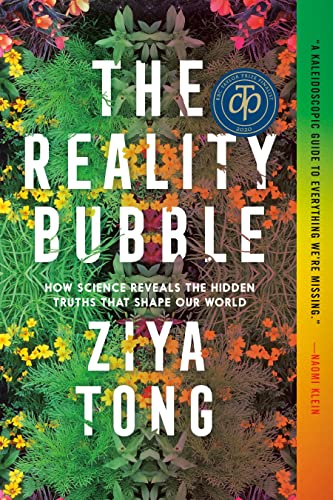
From one of the world's most engaging science journalists, a groundbreaking and wonder-filled look at the hidden things that shape our lives in unexpected and sometimes dangerous ways.
Our naked eyes see only a thin sliver of reality.
     We are blind in comparison to the X-rays that peer through skin, the mass spectrometers that detect the dead inside the living, or the high-tech surveillance systems that see with artificial intelligence. And we are blind compared to the animals that can see in infrared, or ultraviolet, or in 360-degree vision. These animals live in the same world we do, but they see something quite different when they look around.
     With all of the curiosity and flair that drives her broadcasting, Ziya Tong illuminates this hidden world, and takes us on a journey to examine ten of humanity's biggest blind spots. Tong also takes us through the technology that reveals the astonishing world that lives beyond our senses, reminding us that sometimes, we choose not to see what's there even when we can.
     This vitally important book shows how science, and the curiosity that drives it, can help civilization flourish by opening our eyes to the landscape laid out before us. Fast-paced, utterly fascinating, and deeply humane, The Reality Bubble gives voice to the sense we've all had--that there is more to the world than meets the eye.
Die Inhaltsangabe kann sich auf eine andere Ausgabe dieses Titels beziehen.
Über die Autorinnen und Autoren
Award-winning broadcaster, ZIYA TONG anchored Daily Planet, Discovery Channel's flagship science program until its final season in 2018. Tong also hosted the CBC's Emmy-nominated series ZeD, PBS's national prime-time series, Wired Science, and worked as a correspondent for NOVA scienceNOW alongside Neil deGrasse Tyson on PBS.
Award-winning broadcaster, ZIYA TONG anchored Daily Planet, Discovery Channel's flagship science program until its final season in 2018. Tong also hosted the CBC's Emmy-nominated series ZeD, PBS's national prime-time series, Wired Science, and worked as a correspondent for NOVA scienceNOW alongside Neil deGrasse Tyson on PBS. She served as the Vice Chair of WWF Canada until 2019, and was elected to the WWF International Board in 2020.
Auszug. © Genehmigter Nachdruck. Alle Rechte vorbehalten.
The philosopher Ludwig Wittgenstein once said that “the aspects of things that are most important for us are hidden because of their simplicity and familiarity.” Put another way, we often can’t see what’s right in front of our noses. We’ve all experienced it: looking everywhere for your keys when they are staring right at you from the kitchen counter.
Individually, we can be blind to the obvious, but collectively, as a society, we can be blind as well. Here’s a curious fact to consider: in the twenty-first century, there are cameras everywhere, except where our food comes from, where our energy comes from, and where our waste goes. How is it, then, that the most powerful species on the planet is blind to how it survives?
You might say that modern humans interface with nature as though we live in a bubble. It’s the reason why, in the United Kingdom, one in three young adults don’t know that eggs come from chickens, a third of children believe that cheese comes from plants, and a whopping 40 percent of youth have no idea that milk comes from cows. For these kids, food comes from where you’d think it comes from: “Duh,” the supermarket.
Now, it’s not the case that young people aren’t smart; it’s just that their focus has shifted. The average child in the United States spends forty-five hours a week looking at electronic media and only half an hour of unregulated time outdoors. That being the case, we shouldn’t be surprised that the cultural world fogs over the natural one. Immersed in this environment, the average American kid is able to recognize one thousand corporate logos but can’t name ten plants or animals native to the area in which they live.
Adults don’t fare much better. From inside the bubble, the origin of our greatest source of energy—the fuel that powers our global economy—is also a big unknown. If you take a moment to ask around, you’ll soon discover that the average person has no idea what oil is. The liquid we pump into our gas tanks to get to work doesn’t come from the pulp of dinosaurs, but every tank of gas is powered by a thousand tons of ancient life. So which dead species fuel our daily commute? And what caused those giant graveyards that pressure-cooked into the rich black oil fields we drill for energy?
Finally, we are exceptionally blind to what we waste. From excrement to trash to toxic waste, we live with the illusion that refuse can be made to disappear or, with the push of a button, be magically flushed away. That our waste goes somewhere, that our own pollution finds its way right back into the food we eat, the water we drink, and the air we breathe, is one of the reasons the human race is in such deep shit today.
The kicker is our ignorance as a species would be a lot easier to write off if we weren’t also so intelligent. After all, we are the smartest animals on Earth. We are the primates with superpowers. We can fly at the speed of sound and communicate across the planet at the speed of light. Our species has figured out how to hack DNA and change the very codes that govern life.
But the problem is that life is disappearing.
Scientists tell us we are currently in the midst of the sixth great extinction. On land, from armadillos to zebras, animal populations are plummeting. In the sea, fish stocks are crashing and coral reefs are bleaching. Glaciers are melting. Droughts are increasing. Wildfires are raging. The population is exploding and the climate is changing. The creep of catastrophe nears day by day, and yet when we reach out our arms . . . it is only to take another selfie.
That somewhere in the back of our minds we know civilization is teetering on the brink explains our cultural obsession with the zombie apocalypse. These dark fantasies don’t come from nowhere. We all know that things are going very wrong, but living in a bubble means that, for now, we get to ignore it. Instead, we playfully channel our collective unease, mocking our own fear of a seemingly imminent societal crash. From TV shows to survival guides, we “joke” about building bunkers and stockpiling weapons and food supplies. In cities around the world, tens of thousands gather in “zombie walks” dressed in ghoulish makeup and rags, limping along in a low-rumble chant for one, singular desire.
And what is it that the zombies want? The zombies want braaaains.
It’s worth asking whether we could fend for ourselves if there were no societal means for survival. Because when you think about it, our system of society works precisely because we conform to it, like brainless zombies. The human population is almost eight billion strong, marching to a capitalist drumbeat of eat, work, shop, and sleep. Now, it might be one thing if we loved it, but we don’t. I mean, seriously, have you ever met anyone in your life who loves the rat race?
So, given that humanity faces dire consequences and that most of us don’t even like what we do, the question is: Why do we do it?
The big myth, I will argue, is that we are brought up believing there is no other way. We are simply told that this is how the system works. But what if there is another way? What if this “real world” we’re so invested in isn’t that real at all? What if we could scrub away the fog of humanity’s biggest blind spots so we can see more clearly and begin to uncover what is beyond our reality bubble?
Proust famously said, “The real voyage of discovery consists not in seeking new landscapes but in having new eyes.” And so our journey must begin right where we are: by seeing the ordinary, everyday world we live in, in an extraordinary new way.
In John Carpenter’s 1988 cult classic sci-fi movie They Live, a drifter named John Nada gets hold of a pair of special sunglasses that reveal “truths” that ordinary citizens can’t see. Putting them on and looking at magazine ads, billboards, or the TV, he sees their real messages: to obey, consume, conform, and stay asleep.
As a modern parable, the film struck a chord. Its influence can be seen in films, video games, and street art, like Shepard Fairey’s Obey series, and in Hal Hefner’s political posters and web memes. The film’s secret conceit is this: if only a pair of glasses like this existed, people might begin to question why reality is not what it seems.
Luckily, something like that does exist.
In this book, we will venture into the unseen world around us, but instead of fictional sunglasses we will be using scientific lenses to bring hidden views to light. That’s because scientific instruments are, in a very real way, our new eyes, giving us superhuman abilities to see and hear well beyond what our senses perceive.
On true crime shows, we often catch a glimpse of what modern science can reveal. A nice, tidy living room might appear perfectly ordinary to the naked eye, but once investigators have sprayed luminol—a chemical that reacts with iron in hemoglobin—and flicked off the lights, the chemical’s neon-blue glow illuminates blood splatters on the wall, revealing a grisly crime scene.
We have a tendency to think that seeing is believing, but there is so much that we don’t see unaided. The same is true for the world around us. Our vision is feeble compared with the most advanced scientific tools. Telescopes allow us to see galaxies over thirteen billion light...
„Über diesen Titel“ kann sich auf eine andere Ausgabe dieses Titels beziehen.
Suchergebnisse für The Reality Bubble: How Science Reveals the Hidden...

Beispielbild für diese ISBN
The Reality Bubble: How Science Reveals the Hidden Truths that Shape Our World
Anbieter: World of Books (was SecondSale), Montgomery, IL, USA
Verkäuferbewertung 5 von 5 Sternen

Paperback. Zustand: Very Good. WINNER OF THE 2020 LANE ANDERSON AWARD SHORTLISTED FOR THE 2020 RBC TAYLOR PRIZE From one of the world's most engaging science journalists, a groundbreaking and wonder-filled look at the hidden things that shape our lives in unexpected and sometimes dangerous ways. Our naked eyes see only a thin sliver of reality. We are blind in comparison to the X-rays that peer through skin, the mass spectrometers that detect the dead inside the living, or the high-tech surveillance systems that see with artificial intelligence. And we are blind compared to the animals that can see in infrared, or ultraviolet, or in 360-degree vision. These animals live in the same world we do, but they see something quite different when they look around. With all of the curiosity and flair that drives her broadcasting, Ziya Tong illuminates this hidden world, and takes us on a journey to examine ten of humanity's biggest blind spots. First, we are introduced to the blind spots we are all born with, to see how technology reveals an astonishing world that exists beyond our human senses. It is with these new ways of seeing that today's scientists can image everything from an atom to a black hole. In Section Two, our collective blind spots are exposed. It's not that we can't see, Tong reminds us. It's that we don't. In the 21st century, there are cameras everywhere, except where our food comes from, where our energy comes from, and where our waste goes. Being in the dark when it comes to how we survive makes it impossible to navigate our future. Lastly, the scope widens to our civilizational blind spots. Here, the blurred lens of history reveals how we inherit ways of thinking about the world that seem natural or inevitable but are in fact little more than traditions, ways of seeing the world that have come to harm it. This vitally important new book shows how science, and the curiosity that drives it, can help civilization flourish by opening our eyes to the landscape laid out before us. Fast-paced, utterly fascinating, and deeply humane, The Reality Bubble gives voice to the sense we've all had -- that there is more to the world than meets the eye. Artikel-Nr. 00104448830
Gebraucht kaufen
EUR 4,04
Versand gratis
Versand innerhalb von USA
Versand innerhalb von USA
Anzahl: 1 verfügbar
Beispielbild für diese ISBN
The Reality Bubble: How Science Reveals the Hidden Truths that Shape Our World
Verlag:
Penguin Canada (edition ), 2021
ISBN 10: 0735235589
ISBN 13: 9780735235588
Gebraucht
Paperback
Anbieter: BooksRun, Philadelphia, PA, USA
Verkäuferbewertung 5 von 5 Sternen
Paperback. Zustand: Very Good. It's a well-cared-for item that has seen limited use. The item may show minor signs of wear. All the text is legible, with all pages included. It may have slight markings and/or highlighting. Artikel-Nr. 0735235589-11-1
Gebraucht kaufen
EUR 5,37
Versand gratis
Versand innerhalb von USA
Versand innerhalb von USA
Anzahl: 1 verfügbar
Beispielbild für diese ISBN
The Reality Bubble: How Science Reveals the Hidden Truths that Shape Our World
Anbieter: Wonder Book, Frederick, MD, USA
Verkäuferbewertung 5 von 5 Sternen
Zustand: As New. Like New condition. A near perfect copy that may have very minor cosmetic defects. Artikel-Nr. X02H-00251
Gebraucht kaufen
EUR 6,41
Versand gratis
Versand innerhalb von USA
Versand innerhalb von USA
Anzahl: 1 verfügbar
Beispielbild für diese ISBN
The Reality Bubble : How Science Reveals the Hidden Truths That Shape Our World
Anbieter: Better World Books, Mishawaka, IN, USA
Verkäuferbewertung 5 von 5 Sternen
Zustand: Good. Former library copy. Pages intact with minimal writing/highlighting. The binding may be loose and creased. Dust jackets/supplements are not included. Includes library markings. Stock photo provided. Product includes identifying sticker. Better World Books: Buy Books. Do Good. Artikel-Nr. 50314092-6
Gebraucht kaufen
EUR 6,55
Versand gratis
Versand innerhalb von USA
Versand innerhalb von USA
Anzahl: 1 verfügbar
Beispielbild für diese ISBN
The Reality Bubble : How Science Reveals the Hidden Truths That Shape Our World
Anbieter: Better World Books: West, Reno, NV, USA
Verkäuferbewertung 5 von 5 Sternen
Zustand: Good. Pages intact with minimal writing/highlighting. The binding may be loose and creased. Dust jackets/supplements are not included. Stock photo provided. Product includes identifying sticker. Better World Books: Buy Books. Do Good. Artikel-Nr. 50311549-6
Gebraucht kaufen
EUR 6,55
Versand gratis
Versand innerhalb von USA
Versand innerhalb von USA
Anzahl: 1 verfügbar
Beispielbild für diese ISBN
The Reality Bubble : How Science Reveals the Hidden Truths That Shape Our World
Anbieter: Better World Books: West, Reno, NV, USA
Verkäuferbewertung 5 von 5 Sternen
Zustand: Good. Former library copy. Pages intact with minimal writing/highlighting. The binding may be loose and creased. Dust jackets/supplements are not included. Includes library markings. Stock photo provided. Product includes identifying sticker. Better World Books: Buy Books. Do Good. Artikel-Nr. 50314092-6
Gebraucht kaufen
EUR 6,55
Versand gratis
Versand innerhalb von USA
Versand innerhalb von USA
Anzahl: 1 verfügbar
Beispielbild für diese ISBN
The Reality Bubble: How Science Reveals the Hidden Truths That Shape Our World
Anbieter: ThriftBooks-Reno, Reno, NV, USA
Verkäuferbewertung 5 von 5 Sternen
Paperback. Zustand: Very Good. No Jacket. May have limited writing in cover pages. Pages are unmarked. ~ ThriftBooks: Read More, Spend Less. Artikel-Nr. G0735235589I4N00
Gebraucht kaufen
EUR 7,00
Versand gratis
Versand innerhalb von USA
Versand innerhalb von USA
Anzahl: 1 verfügbar
Beispielbild für diese ISBN
The Reality Bubble: How Science Reveals the Hidden Truths That Shape Our World
Anbieter: ThriftBooks-Dallas, Dallas, TX, USA
Verkäuferbewertung 5 von 5 Sternen
Paperback. Zustand: Very Good. No Jacket. May have limited writing in cover pages. Pages are unmarked. ~ ThriftBooks: Read More, Spend Less. Artikel-Nr. G0735235589I4N00
Gebraucht kaufen
EUR 7,02
Versand gratis
Versand innerhalb von USA
Versand innerhalb von USA
Anzahl: 1 verfügbar
Beispielbild für diese ISBN
The Reality Bubble: How Science Reveals the Hidden Truths That Shape Our World
Anbieter: ThriftBooks-Atlanta, AUSTELL, GA, USA
Verkäuferbewertung 5 von 5 Sternen
Paperback. Zustand: Fair. No Jacket. Readable copy. Pages may have considerable notes/highlighting. ~ ThriftBooks: Read More, Spend Less. Artikel-Nr. G0735235589I5N00
Gebraucht kaufen
EUR 7,02
Versand gratis
Versand innerhalb von USA
Versand innerhalb von USA
Anzahl: 1 verfügbar
Beispielbild für diese ISBN
The Reality Bubble: How Science Reveals the Hidden Truths That Shape Our World
Anbieter: ThriftBooks-Atlanta, AUSTELL, GA, USA
Verkäuferbewertung 5 von 5 Sternen
Paperback. Zustand: Very Good. No Jacket. May have limited writing in cover pages. Pages are unmarked. ~ ThriftBooks: Read More, Spend Less. Artikel-Nr. G0735235589I4N00
Gebraucht kaufen
EUR 7,02
Versand gratis
Versand innerhalb von USA
Versand innerhalb von USA
Anzahl: 1 verfügbar