
Verwandte Artikel zu A Pilgrimage to Eternity: From Canterbury to Rome in...
Inhaltsangabe
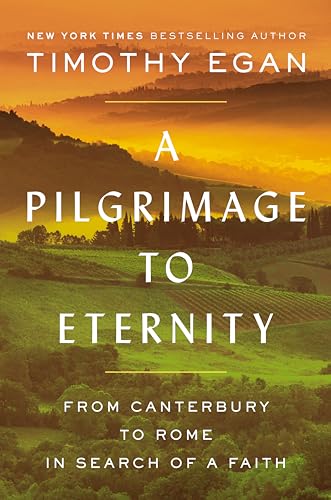
From "the world's greatest tour guide," a deeply-researched, captivating journey through the rich history of Christianity and the winding paths of the French and Italian countryside that will feed mind, body, and soul (New York Times).
"What a wondrous work! This beautifully written and totally clear-eyed account of his pilgrimage will have you wondering whether we should all embark on such a journey, either of the body, the soul or, as in Egan's case, both." --Cokie Roberts
"Egan draws us in, making us feel frozen in the snow-covered Alps, joyful in valleys of trees with low-hanging fruit, skeptical of the relics of embalmed saints and hopeful for the healing of his encrusted toes, so worn and weathered from their walk."--The Washington Post
Moved by his mother's death and his Irish Catholic family's complicated history with the church, Timothy Egan decided to follow in the footsteps of centuries of seekers to force a reckoning with his own beliefs. He embarked on a thousand-mile pilgrimage through the theological cradle of Christianity to explore the religion in the world that it created. Egan sets out along the Via Francigena, once the major medieval trail leading the devout to Rome, and travels overland via the alpine peaks and small mountain towns of France, Switzerland and Italy, accompanied by a quirky cast of fellow pilgrims and by some of the towering figures of the faith--Joan of Arc, Henry VIII, Martin Luther. The goal: walking to St. Peter's Square, in hopes of meeting the galvanizing pope who is struggling to hold together the church through the worst crisis in half a millennium.
A thrilling journey, a family story, and a revealing history, A Pilgrimage to Eternity looks for our future in its search for God.
Die Inhaltsangabe kann sich auf eine andere Ausgabe dieses Titels beziehen.
Über die Autorin bzw. den Autor
Timothy Egan is a Pulitzer Prize-winning reporter and the author of eight other books, most recently The Immortal Irishman, a New York Times bestseller. His book on the Dust Bowl, The Worst Hard Time, won a National Book Award for nonfiction. His account of photographer Edward Curtis, Short Nights of the Shadow Catcher, won the Carnegie Medal for nonfiction. He writes a biweekly opinion column for The New York Times.
Auszug. © Genehmigter Nachdruck. Alle Rechte vorbehalten.
One
London Falling
The passage to eternity begins on the Piccadilly Line to Cockfosters. Contain the snickering, you tell yourself during the gentle forward rocking through London's Tube. By now, you should be purged of the trivial and juvenile. You should be in pilgrim mode. You've prepared for a journey of more than a thousand miles by walking hills and stairs, by breaking in shoes and building calf muscles, by shedding weight and inconvenient thoughts. You've tried to knead doubt into a lump of manageable anxiety. Getting in spiritual shape was much harder. You tidied up your affairs, made a donation to charity. Atoned. You ended a thirty-year feud with a man you've known since college. Although, when you told him all was forgiven, he responded with a quizzical look and said, "Were we in a feud?" You hope the soul has not gone dark. You've given it a scrub, cleaned out the grime from long-held grievances, petty jealousies, and spells of intolerance. The goal is to be fresh, open to possibility.
At Heathrow earlier today, after a nine-hour flight from my home in Seattle, I felt inexplicably cheerful in the grim fluorescence of an international customs barrier, ready to roam.
"Are you alone?" the British officer asked. I wanted to say "Aren't we all," but a sign warned that this was a gate of utter seriousness; it was a crime to joke.
"Why are you alone?"
I explained that I was starting a pilgrimage from Canterbury to Rome, the Via Francigena.
"The what?"
Well, surely you've heard of the Camino de Santiago in Spain, I told him. More than a quarter million people walk some part of that dusty path to the tomb of the Apostle Saint James every year. I will follow a less-known trail, once the major medieval route from Canterbury to Rome, the Via Francigena. The name means, roughly, the Way Through France, and is pronounced frahn-chee-jeh-na. More of a braid than a single road, it traces a course described by Sigeric the Serious, archbishop of Canterbury, when he walked through Europe to see the pope in the year 990. My plan is to travel the entire route of the Via, about twelve hundred miles on foot, on two wheels, four wheels, or train-so long as I stay on the ground. The Via Francigena crosses the English Channel to Calais, wends through dark towns still shadowed by King Clovis, Napoleon, and war, to hilltop cathedrals said to hold calcified scraps of saints and proof of miracles. It leaves the cold interiors of northern France for the revitalizing air of the mountains and the Reformation, deep into Switzerland. Up, up, up into the Alps after that. Down, down, down through the Sound of Music hamlets of the Val d'Aosta. Then south into the radiance of Tuscan villages first inhabited in the Etruscan era twenty-five hundred years ago. In the end, it's a straight line to St. Peter's Square over the fabled Roman road, in hopes of meeting a pope with one working lung who is struggling to hold together the world's 1.3 billion Roman Catholics through the worst crisis in half a millennium.
Now here is my first stop, St. Pancras station in central London. It's another curious name, sounding like an homage to an internal organ. The tourist information booth has nothing on the origin. "Some kind of saint." Pancras, it turns out, was a teenage martyr, killed by the Romans in ad 304 for refusing to worship one of their gods. The boy was beheaded. He has a special place in England because some of his relics-body parts and the like-were carried to these shores in the first systematic attempt to bring Christianity to the island, in the sixth century.
The morning is lovely, May sunlight pouring through the big glass walls of the station. I pick up a couple of papers and magazines, happy to be in a city where print journalism is alive and shouting. It's tempting to overstate things in the daily grind of events, but the news of the day seems monumental on all fronts. Britain is cracking up-an existential fight. Having shaped so much history for so many centuries, a fractious former imperial power struggles to find its place in the world, and with how much of that world to open its doors to. No nation is an island-even one that is an island-entire of itself. A shared national narrative, difficult in the best of times, is far out of reach for "this precious stone set in the silver sea," in Shakespeare's perfect tribute.
And something else is running through the national disquiet: the kingdom is fast losing its belief in God. For the first time, more than half of all British say they have no religion at all. Some are looking for answers in the five-thousand-year-old Neolithic mystery of Newgrange in Ireland, a circular mound of tomb passages older than the Great Pyramids at Giza-a fascination of the neo-pagans. Others are dogmatically atheistic, if that isn't oxymoronic. In between are people who haven't given up on the Big Questions, but are checking out of organized religion in droves. The collapse has hit the Church of England hard, with just 15 percent of UK residents now calling themselves Anglican, the faith founded by Henry VIII. To this day, the head of the church, ninety-three-year-old Queen Elizabeth II, is also head of state. For centuries, in order to hold office or even attend college, you had to take an oath of supremacy, swearing to the monarch's absolute power at the top of this nation's established church.
One story predicts the end of British Christianity within fifty years, when the religion brought here with the bones of Saint Pancras will become "statistically invisible." Across the pond, a much slower-moving but similar trend is taking hold in America. There, the fastest-growing segment of belief is no particular belief-the Nones, as they're called. Nearly seven in ten Americans are still Christian. But if White Anglo-Saxon Protestants were indeed the rootstock of the United States, then the mother ground is nearly barren. What's happening is a mass exodus, particularly among the young: 71 percent of people aged eighteen to twenty-four say they have no religion. Since 1980, the Church of England has shuttered a thousand places of worship-great stone heaps, finely masoned and arched to high purpose, now demolished, sold at auction and repurposed, or left to rot.
This news sharpens my purpose. At times, we have trouble seeing history as it slow pivots. But here now is a moment that's been building for a century. Britain-and much of Europe, the theological cradle of Christianity-has never been so removed from belief in God. It's likely that a higher percentage of people once worshipped Odin or Jupiter than those who now regularly pray to the carpenter's son from Nazareth. Elsewhere, the world is becoming more religious, and Christianity is growing, robustly so in China and Africa. With 2.2 billion followers, the faith that began as a small Jewish sect is by far the planet's most popular and diverse religion. But in Europe, where the rules of the spiritual here and hereafter were shaped over centuries of bloodshed, it's all a shrug.
One reason I want to follow the Via Francigena is to experience layers of time on consecrated ground. There's barely a village along the way that has not played host to some life-changing event, a cathedral stairway that has not been trod by martyrs, madmen, or monarchs. Would there come a day when all those shrines and reliquaries would be nothing but Michelin-starred curiosities-left behind, like the great rock faces of Easter Island or Stonehenge? What was that all about, we may ask, looking at haloed humans fronting an oversized edifice in marble. In that sense, this adventure is an attempt to find God in Europe before God is gone.
But I have another motive to get moving over this sanctified pathway. For the enfeebled Church of England, the figure of Jesus is almost an afterthought; he is "sometimes compelling," as the...
„Über diesen Titel“ kann sich auf eine andere Ausgabe dieses Titels beziehen.
Suchergebnisse für A Pilgrimage to Eternity: From Canterbury to Rome in...

Beispielbild für diese ISBN
A Pilgrimage to Eternity: From Canterbury to Rome in Search of a Faith
Anbieter: World of Books (was SecondSale), Montgomery, IL, USA
Verkäuferbewertung 5 von 5 Sternen

Hardback. Zustand: Good. Following an ancient pilgrimage route a thousand miles from Canterbury to Rome, the bestselling and award-winning writer weaves history and culture into an exploration of why Christianity is struggling in the world it created. He is accompanied by fellow pilgrims and by the towering figures of the faith: Joan of Arc, Henry VIII, Martin Luther. The goal: walking to Saint Peter's Square over the old Roman road, in hopes of meeting the pope who is struggling to hold together the world's 1.3 billion Roman Catholics. Artikel-Nr. 00097871310
Gebraucht kaufen
EUR 3,84
Versand gratis
Versand innerhalb von USA
Versand innerhalb von USA
Anzahl: Mehr als 20 verfügbar
Beispielbild für diese ISBN
A Pilgrimage to Eternity: From Canterbury to Rome in Search of a Faith
Anbieter: World of Books (was SecondSale), Montgomery, IL, USA
Verkäuferbewertung 5 von 5 Sternen
Hardback. Zustand: Very Good. Following an ancient pilgrimage route a thousand miles from Canterbury to Rome, the bestselling and award-winning writer weaves history and culture into an exploration of why Christianity is struggling in the world it created. He is accompanied by fellow pilgrims and by the towering figures of the faith: Joan of Arc, Henry VIII, Martin Luther. The goal: walking to Saint Peter's Square over the old Roman road, in hopes of meeting the pope who is struggling to hold together the world's 1.3 billion Roman Catholics. Artikel-Nr. 00107370270
Gebraucht kaufen
EUR 3,84
Versand gratis
Versand innerhalb von USA
Versand innerhalb von USA
Anzahl: 2 verfügbar
Foto des Verkäufers
A Pilgrimage to Eternity: From Canterbury to Rome in Search of a Faith
Anbieter: Dream Books Co., Denver, CO, USA
Verkäuferbewertung 5 von 5 Sternen
Zustand: good. Gently used with minimal wear on the corners and cover. A few pages may contain light highlighting or writing, but the text remains fully legible. Dust jacket may be missing, and supplemental materials like CDs or codes may not be included. May be ex-library with library markings. Ships promptly! Artikel-Nr. 4EKGY3007YGV_ns
Gebraucht kaufen
EUR 3,89
Versand gratis
Versand innerhalb von USA
Versand innerhalb von USA
Anzahl: 1 verfügbar
Beispielbild für diese ISBN
A Pilgrimage to Eternity: From Canterbury to Rome in Search of a Faith
Anbieter: ThriftBooks-Dallas, Dallas, TX, USA
Verkäuferbewertung 5 von 5 Sternen
Hardcover. Zustand: As New. No Jacket. Pages are clean and are not marred by notes or folds of any kind. ~ ThriftBooks: Read More, Spend Less. Artikel-Nr. G0735225230I2N00
Gebraucht kaufen
EUR 5,96
Versand gratis
Versand innerhalb von USA
Versand innerhalb von USA
Anzahl: 1 verfügbar
Beispielbild für diese ISBN
A Pilgrimage to Eternity: From Canterbury to Rome in Search of a Faith
Anbieter: ThriftBooks-Reno, Reno, NV, USA
Verkäuferbewertung 5 von 5 Sternen
Hardcover. Zustand: Very Good. No Jacket. May have limited writing in cover pages. Pages are unmarked. ~ ThriftBooks: Read More, Spend Less. Artikel-Nr. G0735225230I4N00
Gebraucht kaufen
EUR 5,96
Versand gratis
Versand innerhalb von USA
Versand innerhalb von USA
Anzahl: 2 verfügbar
Beispielbild für diese ISBN
A Pilgrimage to Eternity: From Canterbury to Rome in Search of a Faith
Anbieter: ThriftBooks-Atlanta, AUSTELL, GA, USA
Verkäuferbewertung 5 von 5 Sternen
Hardcover. Zustand: Very Good. No Jacket. May have limited writing in cover pages. Pages are unmarked. ~ ThriftBooks: Read More, Spend Less. Artikel-Nr. G0735225230I4N00
Gebraucht kaufen
EUR 5,96
Versand gratis
Versand innerhalb von USA
Versand innerhalb von USA
Anzahl: 2 verfügbar
Beispielbild für diese ISBN
A Pilgrimage to Eternity: From Canterbury to Rome in Search of a Faith
Anbieter: ThriftBooks-Atlanta, AUSTELL, GA, USA
Verkäuferbewertung 5 von 5 Sternen
Hardcover. Zustand: Good. No Jacket. Former library book; Pages can have notes/highlighting. Spine may show signs of wear. ~ ThriftBooks: Read More, Spend Less. Artikel-Nr. G0735225230I3N10
Gebraucht kaufen
EUR 5,96
Versand gratis
Versand innerhalb von USA
Versand innerhalb von USA
Anzahl: 1 verfügbar
Beispielbild für diese ISBN
A Pilgrimage to Eternity: From Canterbury to Rome in Search of a Faith
Anbieter: ThriftBooks-Atlanta, AUSTELL, GA, USA
Verkäuferbewertung 5 von 5 Sternen
Hardcover. Zustand: Very Good. No Jacket. Former library book; May have limited writing in cover pages. Pages are unmarked. ~ ThriftBooks: Read More, Spend Less. Artikel-Nr. G0735225230I4N10
Gebraucht kaufen
EUR 5,96
Versand gratis
Versand innerhalb von USA
Versand innerhalb von USA
Anzahl: 1 verfügbar
Beispielbild für diese ISBN
A Pilgrimage to Eternity: From Canterbury to Rome in Search of a Faith
Anbieter: ThriftBooks-Dallas, Dallas, TX, USA
Verkäuferbewertung 5 von 5 Sternen
Hardcover. Zustand: Very Good. No Jacket. May have limited writing in cover pages. Pages are unmarked. ~ ThriftBooks: Read More, Spend Less. Artikel-Nr. G0735225230I4N00
Gebraucht kaufen
EUR 5,96
Versand gratis
Versand innerhalb von USA
Versand innerhalb von USA
Anzahl: 2 verfügbar
Beispielbild für diese ISBN
A Pilgrimage to Eternity: From Canterbury to Rome in Search of a Faith
Anbieter: ThriftBooks-Phoenix, Phoenix, AZ, USA
Verkäuferbewertung 5 von 5 Sternen
Hardcover. Zustand: Very Good. No Jacket. May have limited writing in cover pages. Pages are unmarked. ~ ThriftBooks: Read More, Spend Less. Artikel-Nr. G0735225230I4N00
Gebraucht kaufen
EUR 5,96
Versand gratis
Versand innerhalb von USA
Versand innerhalb von USA
Anzahl: 1 verfügbar