
Verwandte Artikel zu The Coddling of the American Mind: How Good Intentions...
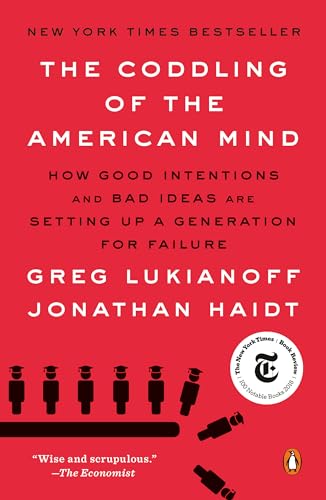
The Coddling of the American Mind: How Good Intentions and Bad Ideas Are Setting Up a Generation for Failure - Softcover
Inhaltsangabe
New York Times Bestseller • Finalist for the 2018 National Book Critics Circle Award in Nonfiction • A New York Times Notable Book • Bloomberg Best Book of 2018 • One of Bill Gates’s Top Five Books of All Time
“Their distinctive contribution to the higher-education debate is to meet safetyism on its own, psychological turf . . . Lukianoff and Haidt tell us that safetyism undermines the freedom of inquiry and speech that are indispensable to universities.” —Jonathan Marks, Commentary
“The remedies the book outlines should be considered on college campuses, among parents of current and future students, and by anyone longing for a more sane society.” —Pittsburgh Post-Gazette
Something has been going wrong on many college campuses in the last few years. Speakers are shouted down. Students and professors say they are walking on eggshells and are afraid to speak honestly. Rates of anxiety, depression, and suicide are rising—on campus as well as nationally. How did this happen?
First Amendment expert Greg Lukianoff and social psychologist Jonathan Haidt, author of The Anxious Generation, show how the new problems on campus have their origins in three terrible ideas that have become increasingly woven into American childhood and education: What doesn’t kill you makes you weaker; always trust your feelings; and life is a battle between good people and evil people. These three Great Untruths contradict basic psychological principles about well-being and ancient wisdom from many cultures. Embracing these untruths—and the resulting culture of safetyism—interferes with young people’s social, emotional, and intellectual development. It makes it harder for them to become autonomous adults who are able to navigate the bumpy road of life.
Lukianoff and Haidt investigate the many social trends that have intersected to promote the spread of these untruths. They explore changes in childhood such as the rise of fearful parenting, the decline of unsupervised, child-directed play, and the new world of social media that has engulfed teenagers in the last decade. They examine changes on campus, including the corporatization of universities and the emergence of new ideas about identity and justice. They situate the conflicts on campus within the context of America’s rapidly rising political polarization and dysfunction.
This is a book for anyone who is confused by what is happening on college campuses today, or has children, or is concerned about the growing inability of Americans to live, work, and cooperate across party lines.
Die Inhaltsangabe kann sich auf eine andere Ausgabe dieses Titels beziehen.
Über die Autorin bzw. den Autor
Greg Lukianoff is the president and CEO of the Foundation for Individual Rights in Education (FIRE). Lukianoff is a graduate of American University and Stanford Law School. He specializes in free speech and First Amendment issues in higher education. He is the author of Unlearning Liberty: Campus Censorship and the End of American Debate and Freedom From Speech.
Jonathan Haidt is the Thomas Cooley Professor of Ethical Leadership at New York University’s Stern School of Business. He obtained his PhD in social psychology from the University of Pennsylvania in 1992 and taught at the University of Virginia for sixteen years. His research focuses on moral and political psychology, as described in his book The Righteous Mind. His latest book, The Anxious Generation, is a direct continuation of the themes explored in The Coddling of the American Mind. He writes the After Babel Substack.
Auszug. © Genehmigter Nachdruck. Alle Rechte vorbehalten.
Chapter 1
The Untruth of Fragility: What Doesn't Kill You Makes You Weaker
When heaven is about to confer a great responsibility on any man, it will exercise his mind with suffering, subject his sinews and bones to hard work, expose his body to hunger, put him to poverty, place obstacles in the paths of his deeds, so as to stimulate his mind,
harden his nature, and improve wherever he is incompetent.
meng tzu (mencius), fourth century BCE
In August 2009, Max Haidt, age three, had his first day of preschool in Charlottesville, Virginia. But before he was allowed to take the first step on his eighteen-year journey to a college degree, his parents, Jon and Jayne, had to attend a mandatory orientation session where the rules and procedures were explained by Max's teacher. The most important rule, judging by the time spent discussing it, was: no nuts. Because of the risk to children with peanut allergies, there was an absolute prohibition on bringing anything containing nuts into the building. Of course, peanuts are legumes, not nuts, but some kids have allergies to tree nuts, too, so along with peanuts and peanut butter, all nuts and nut products were banned. And to be extra safe, the school also banned anything produced in a factory that processes nuts, so many kinds of dried fruits and other snacks were prohibited, too.
As the list of prohibited substances grew, and as the clock ticked on, Jon asked the assembled group of parents what he thought was a helpful question: "Does anyone here have a child with any kind of nut allergy? If we know about the kids' actual allergies, I'm sure we'll all do everything we can to avoid risk. But if there's no kid in the class with such an allergy, then maybe we can lighten up a bit and instead of banning all those things, just ban peanuts?"
The teacher was visibly annoyed by Jon's question, and she moved rapidly to stop any parent from responding. Don't put anyone on the spot, she said. Don't make any parent feel uncomfortable. Regardless of whether anyone in the class is affected, these are the school's rules.
You can't blame the school for being so cautious. Peanut allergies were rare among American children up until the mid-1990s, when one study found that only four out of a thousand children under the age of eight had such an allergy (meaning probably nobody in Max's entire preschool of about one hundred kids). But by 2008, according to the same survey, using the same measures, the rate had more than tripled, to fourteen out of a thousand (meaning probably one or two kids in Max's school). Nobody knew why American children were suddenly becoming more allergic to peanuts, but the logical and compassionate response was obvious: Kids are vulnerable. Protect them from peanuts, peanut products, and anything that has been in contact with nuts of any kind. Why not? What's the harm, other than some inconvenience to parents preparing lunches?
But it turns out that the harm was severe. It was later discovered that peanut allergies were surging precisely because parents and teachers had started protecting children from exposure to peanuts back in the 1990s. In February 2015, an authoritative study was published. The LEAP (Learning Early About Peanut Allergy) study was based on the hypothesis that "regular eating of peanut-containing products, when started during infancy, will elicit a protective immune response instead of an allergic immune reaction." The researchers recruited the parents of 640 infants (four to eleven months old) who were at high risk of developing a peanut allergy because they had severe eczema or had tested positive for another allergy. The researchers told half the parents to follow the standard advice for high-risk kids, which was to avoid all exposure to peanuts and peanut products. The other half were given a supply of a snack made from peanut butter and puffed corn and were told to give some to their child at least three times a week. The researchers followed all the families carefully, and when the children turned five years old, they were tested for an allergic reaction to peanuts.
The results were stunning. Among the children who had been "protected" from peanuts, 17% had developed a peanut allergy. In the group that had been deliberately exposed to peanut products, only 3% had developed an allergy. As one of the researchers said in an interview, "For decades allergists have been recommending that young infants avoid consuming allergenic foods such as peanut to prevent food allergies. Our findings suggest that this advice was incorrect and may have contributed to the rise in the peanut and other food allergies."
It makes perfect sense. The immune system is a miracle of evolutionary engineering. It can't possibly anticipate all the pathogens and parasites a child will encounter-especially in a mobile and omnivorous species such as ours-so it is "designed" (by natural selection) to learn rapidly from early experience. The immune system is a complex adaptive system, which can be defined as a dynamic system that is able to adapt in and evolve with a changing environment. It requires exposure to a range of foods, bacteria, and even parasitic worms in order to develop its ability to mount an immune response to real threats (such as the bacterium that causes strep throat) while ignoring nonthreats (such as peanut proteins). Vaccination uses the same logic. Childhood vaccines make us healthier not by reducing threats in the world ("Ban germs in schools!") but by exposing children to those threats in small doses, thereby giving children's immune systems the opportunity to learn how to fend off similar threats in the future.
This is the underlying rationale for what is called the hygiene hypothesis, the leading explanation for why allergy rates generally go up as countries get wealthier and cleaner-another example of a problem of progress. Developmental psychologist Alison Gopnik explains the hypothesis succinctly and does us the favor of linking it to our mission in this book:
Thanks to hygiene, antibiotics and too little outdoor play, children don't get exposed to microbes as they once did. This may lead them to develop immune systems that overreact to substances that aren't actually threatening-causing allergies. In the same way, by shielding children from every possible risk, we may lead them to react with exaggerated fear to situations that aren't risky at all and isolate them from the adult skills that they will one day have to master [emphasis added].
This brings us to the oracle's first Great Untruth, the Untruth of Fragility: What doesn't kill you makes you weaker. Of course, Nietzsche's original aphorism-"What doesn't kill me makes me stronger"-is not entirely correct if taken literally; some things that don't kill you can still leave you permanently damaged and diminished. But teaching kids that failures, insults, and painful experiences will do lasting damage is harmful in and of itself. Human beings need physical and mental challenges and stressors or we deteriorate. For example, muscles and joints need stressors to develop properly. Too much rest causes muscles to atrophy, joints to lose range of motion, heart and lung function to decline, and blood clots to form. Without the challenges imposed by gravity, astronauts develop muscle weakness and joint degeneration.
Antifragility
No one has done a better job of explaining the harm of avoiding stressors, risks, and small doses of pain than Nassim Nicholas Taleb, the Lebanese-born statistician, stock trader, and polymath who is now a professor of risk engineering at New York University. In his 2007 best seller, The Black Swan, Taleb argued that most of us think about risk in the wrong way. In complex systems, it is virtually inevitable that unforeseen problems will arise, yet we persist in trying to calculate risk based on past...
„Über diesen Titel“ kann sich auf eine andere Ausgabe dieses Titels beziehen.
Suchergebnisse für The Coddling of the American Mind: How Good Intentions...

Beispielbild für diese ISBN
The Coddling of the American Mind: How Good Intentions and Bad Ideas Are Setting Up a Generation for Failure
Anbieter: World of Books (was SecondSale), Montgomery, IL, USA
Verkäuferbewertung 5 von 5 Sternen

Paperback. Zustand: Very Good. New York Times Bestseller * Finalist for the 2018 National Book Critics Circle Award in Nonfiction * A New York Times Notable Book * Bloomberg Best Book of 2018 * One of Bill Gates's Top Five Books of All Time "Their distinctive contribution to the higher-education debate is to meet safetyism on its own, psychological turf . . . Lukianoff and Haidt tell us that safetyism undermines the freedom of inquiry and speech that are indispensable to universities." --Jonathan Marks, Commentary "The remedies the book outlines should be considered on college campuses, among parents of current and future students, and by anyone longing for a more sane society." --Pittsburgh Post-Gazette Something has been going wrong on many college campuses in the last few years. Speakers are shouted down. Students and professors say they are walking on eggshells and are afraid to speak honestly. Rates of anxiety, depression, and suicide are rising--on campus as well as nationally. How did this happen? First Amendment expert Greg Lukianoff and social psychologist Jonathan Haidt, author of The Anxious Generation, show how the new problems on campus have their origins in three terrible ideas that have become increasingly woven into American childhood and education: What doesn't kill you makes you weaker; always trust your feelings; and life is a battle between good people and evil people. These three Great Untruths contradict basic psychological principles about well-being and ancient wisdom from many cultures. Embracing these untruths--and the resulting culture of safetyism--interferes with young people's social, emotional, and intellectual development. It makes it harder for them to become autonomous adults who are able to navigate the bumpy road of life. Lukianoff and Haidt investigate the many social trends that have intersected to promote the spread of these untruths. They explore changes in childhood such as the rise of fearful parenting, the decline of unsupervised, child-directed play, and the new world of social media that has engulfed teenagers in the last decade. They examine changes on campus, including the corporatization of universities and the emergence of new ideas about identity and justice. They situate the conflicts on campus within the context of America's rapidly rising political polarization and dysfunction. This is a book for anyone who is confused by what is happening on college campuses today, or has children, or is concerned about the growing inability of Americans to live, work, and cooperate across party lines. Artikel-Nr. 00110407764
Gebraucht kaufen
EUR 3,91
Versand gratis
Versand innerhalb von USA
Versand innerhalb von USA
Anzahl: 1 verfügbar
Beispielbild für diese ISBN
The Coddling of the American Mind: How Good Intentions and Bad Ideas Are Setting Up a Generation for Failure
Anbieter: World of Books (was SecondSale), Montgomery, IL, USA
Verkäuferbewertung 5 von 5 Sternen
Paperback. Zustand: Good. New York Times Bestseller * Finalist for the 2018 National Book Critics Circle Award in Nonfiction * A New York Times Notable Book * Bloomberg Best Book of 2018 * One of Bill Gates's Top Five Books of All Time "Their distinctive contribution to the higher-education debate is to meet safetyism on its own, psychological turf . . . Lukianoff and Haidt tell us that safetyism undermines the freedom of inquiry and speech that are indispensable to universities." --Jonathan Marks, Commentary "The remedies the book outlines should be considered on college campuses, among parents of current and future students, and by anyone longing for a more sane society." --Pittsburgh Post-Gazette Something has been going wrong on many college campuses in the last few years. Speakers are shouted down. Students and professors say they are walking on eggshells and are afraid to speak honestly. Rates of anxiety, depression, and suicide are rising--on campus as well as nationally. How did this happen? First Amendment expert Greg Lukianoff and social psychologist Jonathan Haidt, author of The Anxious Generation, show how the new problems on campus have their origins in three terrible ideas that have become increasingly woven into American childhood and education: What doesn't kill you makes you weaker; always trust your feelings; and life is a battle between good people and evil people. These three Great Untruths contradict basic psychological principles about well-being and ancient wisdom from many cultures. Embracing these untruths--and the resulting culture of safetyism--interferes with young people's social, emotional, and intellectual development. It makes it harder for them to become autonomous adults who are able to navigate the bumpy road of life. Lukianoff and Haidt investigate the many social trends that have intersected to promote the spread of these untruths. They explore changes in childhood such as the rise of fearful parenting, the decline of unsupervised, child-directed play, and the new world of social media that has engulfed teenagers in the last decade. They examine changes on campus, including the corporatization of universities and the emergence of new ideas about identity and justice. They situate the conflicts on campus within the context of America's rapidly rising political polarization and dysfunction. This is a book for anyone who is confused by what is happening on college campuses today, or has children, or is concerned about the growing inability of Americans to live, work, and cooperate across party lines. Artikel-Nr. 00105542394
Gebraucht kaufen
EUR 3,91
Versand gratis
Versand innerhalb von USA
Versand innerhalb von USA
Anzahl: Mehr als 20 verfügbar
Foto des Verkäufers
The Coddling of the American Mind: How Good Intentions and Bad Ideas Are Setting Up a Generation for Failure
Anbieter: Dream Books Co., Denver, CO, USA
Verkäuferbewertung 5 von 5 Sternen
Zustand: acceptable. This copy has clearly been enjoyedâ"expect noticeable shelf wear and some minor creases to the cover. Binding is strong, and all pages are legible. May contain previous library markings or stamps. Artikel-Nr. DBV.0735224919.A
Gebraucht kaufen
EUR 3,92
Versand gratis
Versand innerhalb von USA
Versand innerhalb von USA
Anzahl: 2 verfügbar
Foto des Verkäufers
The Coddling of the American Mind: How Good Intentions and Bad Ideas Are Setting Up a Generation for Failure
Anbieter: Aspen Book Co., Denver, CO, USA
Verkäuferbewertung 5 von 5 Sternen
Zustand: good. A well-loved companion. Corners and cover might show a little wear, and you could find some notes or highlights. The dust jacket might be MIA, it might have been a library book and extras aren't guaranteedâ"but the story's all there! Artikel-Nr. PKV.0735224919.G
Gebraucht kaufen
EUR 5,26
Versand gratis
Versand innerhalb von USA
Versand innerhalb von USA
Anzahl: 2 verfügbar
Beispielbild für diese ISBN
The Coddling of the American Mind: How Good Intentions and Bad Ideas Are Setting Up a Generation for Failure
Anbieter: ThriftBooks-Phoenix, Phoenix, AZ, USA
Verkäuferbewertung 5 von 5 Sternen
Paperback. Zustand: Good. No Jacket. Pages can have notes/highlighting. Spine may show signs of wear. ~ ThriftBooks: Read More, Spend Less. Artikel-Nr. G0735224919I3N00
Gebraucht kaufen
EUR 5,98
Versand gratis
Versand innerhalb von USA
Versand innerhalb von USA
Anzahl: 17 verfügbar
Beispielbild für diese ISBN
The Coddling of the American Mind: How Good Intentions and Bad Ideas Are Setting Up a Generation for Failure
Anbieter: ThriftBooks-Reno, Reno, NV, USA
Verkäuferbewertung 5 von 5 Sternen
Paperback. Zustand: Fair. No Jacket. Readable copy. Pages may have considerable notes/highlighting. ~ ThriftBooks: Read More, Spend Less. Artikel-Nr. G0735224919I5N00
Gebraucht kaufen
EUR 5,98
Versand gratis
Versand innerhalb von USA
Versand innerhalb von USA
Anzahl: 10 verfügbar
Beispielbild für diese ISBN
The Coddling of the American Mind: How Good Intentions and Bad Ideas Are Setting Up a Generation for Failure
Anbieter: ThriftBooks-Atlanta, AUSTELL, GA, USA
Verkäuferbewertung 5 von 5 Sternen
Paperback. Zustand: Fair. No Jacket. Readable copy. Pages may have considerable notes/highlighting. ~ ThriftBooks: Read More, Spend Less. Artikel-Nr. G0735224919I5N00
Gebraucht kaufen
EUR 5,98
Versand gratis
Versand innerhalb von USA
Versand innerhalb von USA
Anzahl: 11 verfügbar
Beispielbild für diese ISBN
The Coddling of the American Mind: How Good Intentions and Bad Ideas Are Setting Up a Generation for Failure
Anbieter: ThriftBooks-Reno, Reno, NV, USA
Verkäuferbewertung 5 von 5 Sternen
Paperback. Zustand: Good. No Jacket. Former library book; Pages can have notes/highlighting. Spine may show signs of wear. ~ ThriftBooks: Read More, Spend Less. Artikel-Nr. G0735224919I3N10
Gebraucht kaufen
EUR 5,98
Versand gratis
Versand innerhalb von USA
Versand innerhalb von USA
Anzahl: 1 verfügbar
Beispielbild für diese ISBN
The Coddling of the American Mind: How Good Intentions and Bad Ideas Are Setting Up a Generation for Failure
Anbieter: ThriftBooks-Atlanta, AUSTELL, GA, USA
Verkäuferbewertung 5 von 5 Sternen
Paperback. Zustand: Good. No Jacket. Missing dust jacket; Pages can have notes/highlighting. Spine may show signs of wear. ~ ThriftBooks: Read More, Spend Less. Artikel-Nr. G0735224919I3N01
Gebraucht kaufen
EUR 5,98
Versand gratis
Versand innerhalb von USA
Versand innerhalb von USA
Anzahl: 1 verfügbar
Beispielbild für diese ISBN
The Coddling of the American Mind: How Good Intentions and Bad Ideas Are Setting Up a Generation for Failure
Anbieter: ThriftBooks-Dallas, Dallas, TX, USA
Verkäuferbewertung 5 von 5 Sternen
Paperback. Zustand: Good. No Jacket. Former library book; Pages can have notes/highlighting. Spine may show signs of wear. ~ ThriftBooks: Read More, Spend Less. Artikel-Nr. G0735224919I3N10
Gebraucht kaufen
EUR 5,98
Versand gratis
Versand innerhalb von USA
Versand innerhalb von USA
Anzahl: 1 verfügbar