
Verwandte Artikel zu Aftermath: Seven Secrets of Wealth Preservation in...
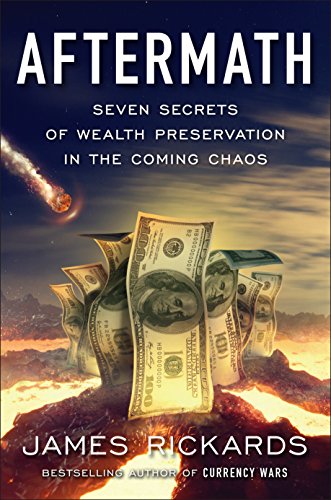
Inhaltsangabe
A Wall Street Journal bestseller
Financial expert, investment advisor and New York Times bestselling author James Rickards shows why and how global financial markets are being artificially inflated--and what smart investors can do to protect their assets
What goes up, must come down. As any student of financial history knows, the dizzying heights of the stock market can't continue indefinitely--especially since asset prices have been artificially inflated by investor optimism around the Trump administration, ruinously low interest rates, and the infiltration of behavioral economics into our financial lives. The elites are prepared, but what's the average investor to do?
James Rickards, the author of the prescient books Currency Wars, The Death of Money, and The Road to Ruin, lays out the true risks to our financial system, and offers invaluable advice on how best to weather the storm. You'll learn, for instance:
* How behavioral economists prop up the market: Funds that administer 401(k)s use all kinds of tricks to make you invest more, inflating asset prices to unsustainable levels.
* Why digital currencies like Bitcoin and Ethereum are best avoided.
* Why passive investing has been overhyped: The average investor has been scolded into passively managed index funds. But active investors will soon have a big advantage.
* What the financial landscape will look like after the next crisis: it will not be an apocalypse, but it will be radically different. Those who forsee this landscape can prepare now to preserve wealth.
Provocative, stirring, and full of counterintuitive advice, Aftermath is the book every smart investor will want to get their hands on--as soon as possible.
Die Inhaltsangabe kann sich auf eine andere Ausgabe dieses Titels beziehen.
Über die Autorin bzw. den Autor
James Rickards is the Editor of Strategic Intelligence a financial newsletter. He is The New York Times bestselling author of The New Great Depression (2020), Aftermath (2019), The Road to Ruin (2016), The New Case for Gold (2016), The Death of Money (2014), and Currency Wars (2011) from Penguin Random House. He is an investment advisor, lawyer, inventor, and economist, and has held senior positions at Citibank, Long-Term Capital Management, and Caxton Associates. In 1998, he was the principal negotiator of the rescue of LTCM sponsored by the Federal Reserve. His clients include institutional investors and government directorates. He is an op-ed contributor to the Financial Times, Evening Standard, The Telegraph, New York Times, and Washington Post, and has been interviewed by BBC, CNN, NPR, CSPAN, CNBC, Bloomberg, Fox, and The Wall Street Journal. Mr. Rickards is a guest lecturer in globalization and finance at The Johns Hopkins University, Georgetown University, Trinity College Dublin, The Kellogg School at Northwestern, the U.S. Army War College and the School of Advanced International Studies. He has presented papers on risk at Singularity University, the Applied Physics Laboratory, and the Los Alamos National Laboratory. He is an advisor on capital markets to the U.S. intelligence community, and the Office of the Secretary of Defense, and is on the Advisory Board of the FDD Center on Economic and Financial Power in Washington DC. Mr. Rickards holds an LL.M. (Taxation) from the NYU School of Law; a J.D. from the University of Pennsylvania Law School; an M.A. in international economics from SAIS, and a B.A. (with honors) from Johns Hopkins. He lives in New Hampshire.
Follow him on Twitter @JamesGRickards
Auszug. © Genehmigter Nachdruck. Alle Rechte vorbehalten.
Chapter One
Scattergoods
From November 1918 down to the present day, no frontal challenge to state power has ever succeeded in any Western state.
—Adam Tooze, The Deluge (2014)
History is the first casualty of media’s microsecond attention span. An army of pseudo-savants saturate the airways to explain that tariffs are bad, trade wars hurt growth, and mercantilism (the art of accumulating reserves) is a throwback to the seventeenth century. These sentiments come from mainstream liberals and conservatives and tagalong journalists trained in the orthodoxy of so-called free trade and the false if comforting belief that trade deficits are the flip side of capital surpluses. So what’s the problem?
The problem is that perpetual trade deficits have put the United States on a path to a crisis of confidence in the dollar. Capital surplus is a euphemism for excessive debt issuance by corporations and the Treasury. Zero tariffs are an invitation to outsource manufacturing and destroy high-paying U.S. jobs. Mercantilism makes China the fastest-growing major economy, while free trade leaves the United States to languish with depression-level growth. The cherished verities of liberal economics are mostly junk science; a thinly veiled stalking horse for the real goal of global governance and taxation in the name of globalization.
A visit to the history section of a library reveals liberal hero Alexander Hamilton was a staunch protectionist who nurtured U.S. industry with bounties, tariffs, and other obstacles to free trade. Progressive icon Teddy Roosevelt supported the gold standard and a strong dollar. Our first globalist president, Woodrow Wilson, wanted globalism not based on integrated supply chains, but on U.S. hegemony over authoritarian Germany and Russia and imperialist France, Japan, and the U.K. Wilson’s way of achieving this was not with arms but with gold, dollars, and Wall Street credit. Conservative champion Ronald Reagan imposed such high tariffs on Japanese cars that they moved their factories to Tennessee and South Carolina, where the factories remain today. In fact, America’s greatest periods of prosperity were associated with tariffs and mercantilism until the 1990s, when debt and war became all-purpose substitutes for investment in U.S. factories. Now the debt boom is dying, a day of reckoning approaches, and false economic nostrums won’t save us.
This conundrum between what works in practice (protection and mercantilism) and modern miseducation (free trade and globalism) must be solved to secure the future strength and stability of the United States. There is ample room for smoothing the rough edges off mercantilism, but only if clear-eyed and historically trained negotiators are assigned to the task. Soft-power globalists are happy to see the United States in relative decline as long as “the world” is better off. The problem is that most of the world is violent, authoritarian, unethical, and inimical to U.S. values. Enriching China at U.S. expense is not just a weak globalist trade-off; it finances concentration camps and industrial slavery. Globalist champions such as Jeffrey Sachs and Mike Bloomberg are in deep denial on this, yet it’s true.
Resolving this conundrum requires talents that range far beyond economics. The quandary can be addressed only by combining experts in geopolitics, history, sociology, law, and complex dynamics. This kind of high-level expert integration with a view to national security is an unsung strength of the Central Intelligence Agency. In this fashion, we turn to the CIA for an inside look at how the United States is using centuries-old tools to meet the twenty-first-century threat from globalization.
A House in Langley Woods
CIA headquarters is a secure compound, with admittance tightly restricted. Yet the location is not secret. The main entrance is on Virginia Route 123, also called Dolley Madison Boulevard, about a mile off the George Washington Parkway, not far from the Potomac River’s south bank.
As if to confound the casual inquirer, most guideposts around headquarters seem to have three names. Dolley Madison Boulevard is shown on some maps as Chain Bridge Road. Reporters frequently refer to CIA headquarters as “Langley,” yet there’s no such town in that part of Virginia; headquarters is located in the town of McLean. The initials “CIA” do not appear in the official headquarters name, the George Bush Center for Intelligence. These double and triple namings seem in keeping with the CIA’s main mission of deception.
Any driver can turn off Dolley Madison Boulevard onto the CIA headquarters access road, yet you won’t make it far without an official badge in hand or a visitor’s badge waiting for you at the security building near the main gate. If a visitor, you’ll be heavily screened before you even get to the gatehouse to pick up your badge.
Once inside, the CIA campus has an open, airy feel not unlike a lot of large corporate campuses located in suburban bands around major cities. The architecture is decidedly midtwentieth century; not at all like the twenty-first-century dome and starship designs adopted by Amazon in Seattle and Apple in Silicon Valley. The two main buildings, Original Headquarters Building, OHB, and New Headquarters Building, NHB, are connected at ground level by glass corridors that frame a small park contained between them.
Beginning in 2003, I was on the front lines of global financial warfare working at CIA headquarters and in the field. My projects involved insider trading in advance of terror attacks, predictive analytics using market data, and national security implications of foreign investment in the United States, among others. One of the pleasures at headquarters was to wander through the CIA Museum on the main floor of OHB. This could be relaxing during snowstorms when scores of staff were no-shows. As a long-time New Englander, I never considered snow a reason to miss work, yet a lot of Virginia colleagues were paralyzed. Senior management sympathized with the locals and routinely granted snow days just like in elementary school. These days meant canceled meetings, which gave me downtime to explore the hidden treasures in headquarters that most staffers rushed by on their way from one vault to another. Former CIA director Mike Hayden called the CIA Museum, “the best museum you’ll probably never see,” a reference to the fact that it’s not open to the public.
The museum is a collation of contributions from private collections, captured items from foreign intelligence services, and the CIA’s own resources. One highlight is an ENIGMA machine invented by a German engineer and used by the Nazi regime in the Second World War to send encrypted message traffic to the German military. Polish, French, and U.K. cryptographers eventually cracked the ENIGMA codes, a feat memorably portrayed in the 2014 Oscar-winning film The Imitation Game. Few of the original machines survive; one of the scarce ENIGMA machines in private hands was sold at auction by Christie’s for over five hundred thousand dollars. I have been fortunate to see two of the originals, one at CIA headquarters and one at the Imperial War Museum in London.
My favorite display in the CIA Museum is a lipstick gun, also called the Kiss of Death. It’s a small-caliber, single-shot pistol disguised as a tube of lipstick. A woman spy in a tight spot could casually reach into her purse, remove the tube of lipstick, and kill her target at close range.
Near one end of the museum is an exhibit that doubles as a lesson in tradecraft. It’s a large...
„Über diesen Titel“ kann sich auf eine andere Ausgabe dieses Titels beziehen.
Suchergebnisse für Aftermath: Seven Secrets of Wealth Preservation in...

Beispielbild für diese ISBN
Aftermath Seven Secrets of Wea
Anbieter: World of Books (was SecondSale), Montgomery, IL, USA
Verkäuferbewertung 5 von 5 Sternen

Zustand: Very Good. Item in very good condition! Textbooks may not include supplemental items i.e. CDs, access codes etc. Artikel-Nr. 00109734183
Gebraucht kaufen
EUR 3,74
Versand gratis
Versand innerhalb von USA
Versand innerhalb von USA
Anzahl: 1 verfügbar
Beispielbild für diese ISBN
Aftermath Seven Secrets of Wea
Anbieter: World of Books (was SecondSale), Montgomery, IL, USA
Verkäuferbewertung 5 von 5 Sternen
Zustand: Good. Good condition ex-library book with usual library markings and stickers. Artikel-Nr. 00109363383
Gebraucht kaufen
EUR 3,74
Versand gratis
Versand innerhalb von USA
Versand innerhalb von USA
Anzahl: 2 verfügbar
Beispielbild für diese ISBN
Aftermath Seven Secrets of Wea
Anbieter: World of Books (was SecondSale), Montgomery, IL, USA
Verkäuferbewertung 5 von 5 Sternen
Zustand: Good. Item in good condition. Textbooks may not include supplemental items i.e. CDs, access codes etc. Artikel-Nr. 00102342885
Gebraucht kaufen
EUR 3,74
Versand gratis
Versand innerhalb von USA
Versand innerhalb von USA
Anzahl: 8 verfügbar
Foto des Verkäufers
Aftermath: Seven Secrets of Wealth Preservation in the Coming Chaos
Anbieter: Dream Books Co., Denver, CO, USA
Verkäuferbewertung 5 von 5 Sternen
Zustand: acceptable. This copy has clearly been enjoyedâ"expect noticeable shelf wear and some minor creases to the cover. Binding is strong, and all pages are legible. May contain previous library markings or stamps. Artikel-Nr. DBV.0735216959.A
Gebraucht kaufen
EUR 3,75
Versand gratis
Versand innerhalb von USA
Versand innerhalb von USA
Anzahl: 1 verfügbar
Foto des Verkäufers
Aftermath: Seven Secrets of Wealth Preservation in the Coming Chaos
Anbieter: Dream Books Co., Denver, CO, USA
Verkäuferbewertung 5 von 5 Sternen
Zustand: very_good. Pages are clean with no markings. May show minor signs of wear or cosmetic defects marks, cuts, bends, or scuffs on the cover, spine, pages, or dust jacket. May have remainder marks on edges. Artikel-Nr. DBV.0735216959.VG
Gebraucht kaufen
EUR 3,76
Versand gratis
Versand innerhalb von USA
Versand innerhalb von USA
Anzahl: 1 verfügbar
Foto des Verkäufers
Aftermath: Seven Secrets of Wealth Preservation in the Coming Chaos
Anbieter: Dream Books Co., Denver, CO, USA
Verkäuferbewertung 5 von 5 Sternen
Zustand: good. Gently used with minimal wear on the corners and cover. A few pages may contain light highlighting or writing, but the text remains fully legible. Dust jacket may be missing, and supplemental materials like CDs or codes may not be included. May be ex-library with library markings. Ships promptly! Artikel-Nr. 4EKGRJ008CWM_ns
Gebraucht kaufen
EUR 4,20
Versand gratis
Versand innerhalb von USA
Versand innerhalb von USA
Anzahl: 1 verfügbar
Beispielbild für diese ISBN
Aftermath: Seven Secrets of Wealth Preservation in the Coming Chaos
Anbieter: BooksRun, Philadelphia, PA, USA
Verkäuferbewertung 5 von 5 Sternen
Hardcover. Zustand: Very Good. With dust jacket. It's a well-cared-for item that has seen limited use. The item may show minor signs of wear. All the text is legible, with all pages included. It may have slight markings and/or highlighting. Artikel-Nr. 0735216959-11-1-29
Gebraucht kaufen
EUR 5,52
Versand gratis
Versand innerhalb von USA
Versand innerhalb von USA
Anzahl: 1 verfügbar
Beispielbild für diese ISBN
Aftermath: Seven Secrets of Wealth Preservation in the Coming Chaos
Anbieter: ThriftBooks-Reno, Reno, NV, USA
Verkäuferbewertung 5 von 5 Sternen
Hardcover. Zustand: Good. No Jacket. Missing dust jacket; Pages can have notes/highlighting. Spine may show signs of wear. ~ ThriftBooks: Read More, Spend Less. Artikel-Nr. G0735216959I3N01
Gebraucht kaufen
EUR 5,74
Versand gratis
Versand innerhalb von USA
Versand innerhalb von USA
Anzahl: 1 verfügbar
Beispielbild für diese ISBN
Aftermath: Seven Secrets of Wealth Preservation in the Coming Chaos
Anbieter: ThriftBooks-Reno, Reno, NV, USA
Verkäuferbewertung 5 von 5 Sternen
Hardcover. Zustand: Very Good. No Jacket. Former library book; May have limited writing in cover pages. Pages are unmarked. ~ ThriftBooks: Read More, Spend Less. Artikel-Nr. G0735216959I4N10
Gebraucht kaufen
EUR 5,74
Versand gratis
Versand innerhalb von USA
Versand innerhalb von USA
Anzahl: 1 verfügbar
Beispielbild für diese ISBN
Aftermath: Seven Secrets of Wealth Preservation in the Coming Chaos
Anbieter: ThriftBooks-Atlanta, AUSTELL, GA, USA
Verkäuferbewertung 5 von 5 Sternen
Hardcover. Zustand: Good. No Jacket. Pages can have notes/highlighting. Spine may show signs of wear. ~ ThriftBooks: Read More, Spend Less. Artikel-Nr. G0735216959I3N00
Gebraucht kaufen
EUR 5,74
Versand gratis
Versand innerhalb von USA
Versand innerhalb von USA
Anzahl: 1 verfügbar