
Verwandte Artikel zu This Side of Night
Inhaltsangabe
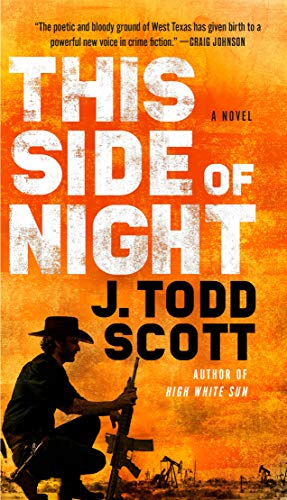
The vicious Mexican cartel war boils over into the Big Bend in the explosive novel from the author of The Far Empty and High White Sun.
In the Mexican borderlands, a busload of student protesters is gunned down in broad daylight, a violent act blamed on the Nemesio cartel. But its aging leader, Fox Uno, sees the attack for what it is: another salvo in the long-running battle for control of Nemesio itself; perhaps by a rival cartel, or maybe someone closer to home...
Across the Rio Grande, Sheriff Chris Cherry and his deputies America Reynosa and Danny Ford find themselves caught in Fox Uno's escalating war with the recent discovery of five dead men at the river's edge. But when El Paso DEA agent Joe Garrison's own Nemesio investigation leads him into the heart of the Big Bend, he's not ready to accept the cartel leader's retreat or defeat. Not only does he suspect a high-profile drug task force in a neighboring county is corrupt, he can't shake lingering doubts about the loyalty and motives of the young deputy, Ame Reynosa. And he won't let Sheriff Cherry ignore them either.
In this pitiless land it's kill or be killed, where everyone will make one final bloody stand to decide the fate of Nemesio, the law in the Big Bend, and most of all, the future of America Reynosa.
Die Inhaltsangabe kann sich auf eine andere Ausgabe dieses Titels beziehen.
Über die Autorin bzw. den Autor
J. Todd Scott has been a federal agent with the DEA for more than twenty years, working cases investigating international maritime smuggling and domestic meth labs, and led a multiagency strike force dedicated to attacking Mexican cartel smuggling routes. He has a law degree from George Mason University and is a father of three. A Kentucky native, he now resides in the southwest, which provided the backdrop for his novels of the Big Bend.
Auszug. © Genehmigter Nachdruck. Alle Rechte vorbehalten.
i
Chayo & Neva
When they shot Castel in the face, Chayo knew they were going to kill them all.
Castel had just pulled off his dirty T-shirt and was waving it over his shaved head, screaming they were students, normalistas, all unarmed, when the shot rang out. It was a high sound, clear and cutting, nothing like Chayo had ever heard before.
A church bell ringing.
Castel looked surprised, staring upward into the softening sky, when he fell.
Moments before, he'd stepped off the bus right into the burning bright headlights of the municipal police truck that had blocked their way. Chayo had marveled at how pale Castel was in those lights, his skin smooth and perfect and shiny like a new peso. How small and thin he looked, too, though he was three years older and ready to graduate. His glasses had sat crooked on his face as he yelled, big old ones his abuelo might have worn, and they were just as shiny as his skin, reflecting everything and nothing at all, since beyond that circled glow the intersection-the whole of the world-was nothing but shadows. Shadows so deep that the men surrounding them were only the barest hints of secret movement.
It was like the night itself was sweating, breathing hard: black lungs and an open, swallowing mouth.
Chayo knew that some of those men circling them in the dark wore uniforms, their faces covered in bandannas or old shirts in shame and fear, and that unlike the normalistas, all of them were armed.
Everyone was then yelling at each other, warnings and names that made no sense. All these polic’a or men pretending to be so, and the students they threatened.
At the next intersection, so far away it was like looking up to the moon, a red streetlight blinked on and off.
On and off.
A heart beating.
Despite the calming words of their own driver, when the other truck had first appeared, Chayo and Castel and some of the older students-Ernesto, Iker, Juan Pablo-had been angry and eager to pile out of the bus and confront it, make it get out of their way. But it was Neva who'd held him back, her small hand trembling yet holding his tight. Whispering, "No, please," begging him with her eyes to stay, so that when he looked down into those eyes that for weeks had been making his heart trip and stumble-always tying his tongue-he'd hesitated.
He'd sat back down. For her . . . for them both.
And he wasn't the only one, not after Iker-with his round, pockmarked face pressed against the window-had called out that the truck was empty anyway. Abandonado. Its driver having quickly vanished into the dark to join the swiftly circling shadows, the truck left idling in the intersection.
Only its lights alive, pointed at them like cold, staring eyes. Seeing nothing.
Ojos de los muertos.
Holding Neva's hand, feeling her heartbeat in his fingers, Chayo had thought he could hear the empty truck's radio still chattering to itself, ghostly voices from far away. A mouthful of static. Fantasmas whispering in the hot night and the empty air, murmuring about them: two busloads of young students, trapped in the street.
So, it was Castel alone who'd stepped down from the bus to face the truck, calling out to the rest of them still huddled on the bus-all those like Chayo who'd sat back down, afraid:
". . . It's nothing, we'll push it out of the way. Have heart!"
ÁTener coraz—n!
Castel, who was going to teach in Chiquero later in the year, who liked navelina oranges more than anyone Chayo had ever known.
Castel, from Meoqui, who also wanted to be a poet, someday.
Castel, who had never listened to anyone about anything and made everything an argument, smiling as he did so, the gap between his two front teeth far too wide.
Castel, who took off his shirt to wave wildly in front of him.
Un peque–o torero.
Only Castel . . . whose voice was far too big for that small, exposed body.
Surrounded by light.
Naked.
"We are unarmed. Who do you think you are? The night cannot hide you! We see all of you."
ÁLos vemos a todos ustedes!
But Chayo couldn't see anything, not really. The night was too dark. It had become this living thing, with its black lungs and beating red streetlight heart and hot, open mouth.
And . . .
Ojos de los muertos.
The night had come alive to swallow them whole and make them disappear.
Or Chayo hadn't wanted to see, as Neva buried her face in his arm, turning them both away . . .
. . . when the shooting began.
Leaving Castel alone in that pooled light, looking up into the night sky, searching for that mysterious church bell they'd all heard and Chayo would never forget.
Castel, still calling out, "It's okay. No fear, my friends. They're shooting in the air."
But they weren't.
TheyÕd taken the buses two hours earlier outside Ojinaga, bargaining with the drivers until theyÕd agreed to take the thirty-five students of the Escuela Normal Rural Librado Rivera to Chihuahua City. It was the way of things, a practice that had been going on for as long as the rural schools had existed. With no funding from the government, the normalistas-all teachers-in-training for MexicoÕs most remote farming areas-had become accustomed to making deals with local bus and van drivers, borrowing and begging and offering them food and lodging and what little money they had in exchange for help. Sometimes it was easy, sometimes not, but they took the buses all the time to visit the remote schools they would eventually be responsible for or to pick up supplies . . . and of course, to go to protests. On this occasion they were going to Chihuahua City to join other normalistas in a great rally against government corruption. Next fall theyÕd need them again to make their way to Mexico City itself, to commemorate the 1968 massacre of students and civilians by government security forces in Tlatelolco, in the great Plaza de las Tres Culturas. TheyÕd sing and draw chalk outlines of the dead and bleed fake blood on scribbled doves.
Carry signs and chant.
"ÁYo no estaba all’, pero no voy a olvidar!" I wasn't there, but I won't forget!
Again, it was the way of things. All the normalistas were going to be teachers, but most were activists, too, at heart. They loved their country and wanted better for it.
Chayo, a first-year, along with Castel and Juan Pablo and Batista, were responsible for getting the buses for the trip to Chihuahua. They found the first at Calle Segunda, near Federal Highway 16. The bus had been empty and the driver had been lighthearted. A big man, round and ruddy as the navelinas Castel liked so much (so Chayo called him "Naranja"), drinking two warm Cokes and eating an empanada his wife had made; laughing easily at Juan Pablo's jokes. He told dirty stories of his own youth and they all liked him. They found the second on Calle del Pac’fico, but this one had been less enthusiastic. He already had paying passengers, a handful of old abuelas and teenagers no older than the normalistas themselves, and only agreed to their request if he could first drop them at the bus station and then talk with his dispatch.
He had to make arrangements for the rest of his shift and have the tires checked for such a long trip.
He didn't tell jokes or laugh. He was as thin as the other driver was fat, with a pinched and sour face (so he became "Lim—n"), and sparse hair too small for his head. It looked painted on, badly colored like a child's drawing. Juan Pablo made a joke about it, and although Chayo had tried hard not to laugh, he joined in with the others until the driver stared at them all, glaring, as if counting or memorizing their faces.
At the...
„Über diesen Titel“ kann sich auf eine andere Ausgabe dieses Titels beziehen.
Suchergebnisse für This Side of Night

Beispielbild für diese ISBN
This Side of Night
Anbieter: World of Books (was SecondSale), Montgomery, IL, USA
Verkäuferbewertung 5 von 5 Sternen

Paperback. Zustand: Good. In the Mexican borderlands, a busload of student protesters is gunned down in a violent act blamed on the Nemesio cartel. But its aging leader, Fox Uno, sees the attack for what it is: another salvo in the battle for control of Nemesio itself; by a rival cartel, or maybe someone closer to home. Across the Rio Grande, Sheriff Chris Cherry and his deputies find themselves caught in Fox Uno's escalating war with the discovery of five dead men. But when El Paso DEA agent Joe Garrison's own Nemesio investigation leads him into the heart of the Big Bend, he s not ready to accept the cartel leader's retreat or defeat. Artikel-Nr. CIN0735212937G
Gebraucht kaufen
EUR 4,17
Versand gratis
Versand innerhalb von USA
Versand innerhalb von USA
Anzahl: 1 verfügbar
Beispielbild für diese ISBN
This Side of Night
Verlag:
G.P. Putnam's Sons (edition Reprint), 2020
ISBN 10: 0735212937
ISBN 13: 9780735212930
Gebraucht
Paperback
Anbieter: BooksRun, Philadelphia, PA, USA
Verkäuferbewertung 5 von 5 Sternen
Paperback. Zustand: Very Good. Reprint. It's a well-cared-for item that has seen limited use. The item may show minor signs of wear. All the text is legible, with all pages included. It may have slight markings and/or highlighting. Artikel-Nr. 0735212937-11-1
Gebraucht kaufen
EUR 7,81
Versand gratis
Versand innerhalb von USA
Versand innerhalb von USA
Anzahl: 1 verfügbar
Beispielbild für diese ISBN
This Side of Night
Anbieter: WorldofBooks, Goring-By-Sea, WS, Vereinigtes Königreich
Verkäuferbewertung 5 von 5 Sternen
Paperback. Zustand: Very Good. The book has been read, but is in excellent condition. Pages are intact and not marred by notes or highlighting. The spine remains undamaged. Artikel-Nr. GOR011425311
Gebraucht kaufen
EUR 2,55
EUR 6,61 Versand
Versand von Vereinigtes Königreich nach USA
Versand von Vereinigtes Königreich nach USA
Anzahl: 1 verfügbar
Beispielbild für diese ISBN
This Side of Night
Verlag:
Penguin Publishing Group, 2020
ISBN 10: 0735212937
ISBN 13: 9780735212930
Gebraucht
Softcover
Anbieter: Better World Books, Mishawaka, IN, USA
Verkäuferbewertung 5 von 5 Sternen
Zustand: Very Good. Former library copy. Pages intact with possible writing/highlighting. Binding strong with minor wear. Dust jackets/supplements may not be included. Includes library markings. Stock photo provided. Product includes identifying sticker. Better World Books: Buy Books. Do Good. Artikel-Nr. 38409802-6
Gebraucht kaufen
EUR 10,70
Versand gratis
Versand innerhalb von USA
Versand innerhalb von USA
Anzahl: 1 verfügbar