
Verwandte Artikel zu Shadowbahn
Inhaltsangabe
A LA TIMES' BEST BOOK OF 2017 (FICTION)
“Gorgeous, compassionate, weird, unpredictable, alarmingly prescient . . . an answer to and sanctuary from the American Century to come."
—Fiona Maazel, New York Times Book Review
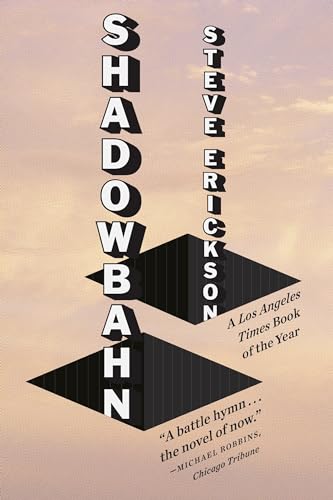
When the Twin Towers suddenly reappear in the Badlands of South Dakota two decades after their fall, nobody can explain their return. To the tens of thousands drawn to the “American Stonehenge” — including Parker and Zema, siblings driving from L.A. to Michigan — the Towers seem to sing, even as everybody hears a different song. And on the ninety-third floor of the South Tower, Jesse Presley, the stillborn twin of the most famous singer who ever lived, suddenly awakes. Over the days and months and years to come, he’s driven mad by a voice in his head that sounds like his but isn’t, and by the memory of a country where he survived in his brother’s place.
So begins Shadowbahn, a kaleidoscopic, musical road-trip across the dreamscape of American destiny. Original and fearless in vision and form, Steve Erickson’s novel speaks to our current times, and to a nation “defiling its own great idea . . . the moment that idea was born.”
“A beautiful, moving, strange examination of apocalypse and rebirth.”
—Neil Gaiman, author of American Gods
“Jaw-dropping. A tour-de-forcer’s tour de force.”
—Jonathan Lethem, Granta
Die Inhaltsangabe kann sich auf eine andere Ausgabe dieses Titels beziehen.
Über die Autorin bzw. den Autor
Steve Erickson is the author of nine other novels (including Zeroville, Our Ecstatic Days, and These Dreams of You) and two nonfiction books that have been published in ten languages. His work has appeared in numerous periodicals, such as Esquire, Rolling Stone, Smithsonian, American Prospect, and Los Angeles, for which he writes regularly about film, music, and television. Erickson is the recipient of a Guggenheim Fellowship, the American Academy of Arts and Letters Award in Literature, and the Lannan Lifetime Achievement Award. Currently he teaches at the University of California, Riverside.
Auszug. © Genehmigter Nachdruck. Alle Rechte vorbehalten.
Copyright © 2017 Steve Erickson
One
Shenandoah
Things don’t just appear into thin--
. . . but she hangs up on him before he finishes. “What the . . . ?” he says, staring at his cell phone in dismay and trying to remember if she ever hung up on him before. As he finishes filling the tank of his truck and replaces the pump’s nozzle, Aaron ponders how this became the kind of argument where his wife hangs up on him. He hauls himself back up into the driver’s seat thinking maybe this is really the kind of argument that’s about something other than what it’s about.
Starting the ignition, turning down the oldies station on the radio, he sits a minute irritably checking the rearview mirror. An- other truck waits for him to pull away from the pump. Aaron remembers that he meant to get a donut and Red Bull from the gas station’s convenience market, some concentrated discharge of sugar and caffeine to take him the rest of the way to Rapid City.
The unnamed song
He looks at his cell to see if she’s texted. “Fuck if I’m apologizing!” he says out loud to nobody and nothing; without his donut and Red Bull, he glides back out onto Interstate 90 in his red truck with its gold racing stripes and the bumper sticker that reads save america from itself. When he first put on the sticker, he thought he knew what it meant. The more he’s thought about it since, the less sure he is.
Aaron considers the one time he fell asleep at the wheel. It couldn’t have been longer than a couple of seconds, but enough to start veering off the road until another truck’s horn blared him into consciousness. His heart didn’t stop pounding till he finished the route: If you want to wake yourself up good for the rest of a drive, try falling asleep at the wheel for a moment. On the radio a man and woman sing to each other, not with each other, having their own argument maybe. She hung up on me, he’s thinking, “I’m not apologizing, fuck that.” But he’s had fights with Cilla Ann before and knows, as his indignation subsides, that if she hasn’t texted by the other side of the bridge at Chamberlain crossing the Missouri River, he’ll wind up calling.
Summer wine
Is something else wrong? he wonders. Is there something else going on with her? Can this fight actually be about something as trivial as his wallet gone missing, vanished from his jacket? even if now he’s a driver without an identity. The man and woman singing to each other on the radio aren’t exactly arguing. It’s kind of a cow- boy song but not exactly, half a century old, trippy with spy-movie horn riffs—although Aaron, not caring about music, doesn’t break it down like that. Instead he catches out of the corner of his ear the story that the cowboy sings in the deepest voice anyone’s heard . . .
. . . of the woman seducing him with wine made of strawberries, cherries, and an angel’s kiss in spring, so she can steal his silver spurs while he sleeps. If I’m being honest, Aaron admits to himself ruefully about the conversation with Cilla Ann, I know it’s not true that things don’t just disappear into thin air. If I’m honest and I’ve learned anything in this life, it’s that things disappear into thin air all the time.
The woman singing on the radio reminds Aaron that these are the last days of summer, nine days before the fall.
Cross the wide Missouri
The music that he pays little mind is only something in the background to keep him company and awake. “A song finishes,” he says out loud, “ask me what I just heard, I have no idea.” Sometimes instead he’ll listen to the talk radio until it becomes too nuts, or the CB radio that’s broken at the moment, Aaron having tried futilely back in Mitchell to get it fixed. In his early forties, he drives Interstate 90 at least three times a week counting both to and from, sometimes four or five if he can hustle up the commerce. Sometimes when the traffic of other trucks is at a maxi- mum, or just because he feels like it, he cuts down to Highway 44 running through the plains beyond Buffalo Gap.
From the cabin of his truck, he aims himself at anything west- ward that he can see a hundred miles away, at the swathe of blue crushing a horizon invaded by the slightest vapor of white—not so much clouds, since there hasn’t been a cloud in the sky, let alone rain, in forever. Highway 44 is draped with the flags of Dis- union that grow in number the farther west Aaron gets. Later he’ll wonder how it is that on this morning of the argument about the wallet disappearing into thin air, he could have missed there on the flat plain before him the two skyscrapers each a quarter mile high: the breath of Aaron’s country, exhaled from the nostrils of Aaron’s century
All our trials
Soon, the change in the landscape announces itself as always. Dashed lava and the blasted detritus of dying asteroids, slashes of geologic red and gold rendering his truck a chameleon. A song finishes, I have no idea what I just heard, but he still remembers what was playing on the radio the time he fell asleep behind the wheel, a mash-up of spirituals and national folk tunes sung by the most famous singer who ever lived: old times there are not forgotten, look away and His truth is marching on and a third, all my trials will soon be over.
In the two seconds when Aaron fell asleep that time, he had a dream that lasted hours, in which the song appeared as a black tunnel on the highway before him. Of course he has no idea now where the tunnel led, or whether it led anywhere or had any ending, because he woke with a great start to that warning of the other truck’s horn and the open highway, no tunnel in sight.
Emergence
By midafternoon—the tail end of the five-hour drive to Rapid City from Sioux Falls—Aaron has neither called his wife nor heard from her. He’s buzzy and bleary at the same time, in the crossfire of fatigue and two Starbucks espressos self-administered in Chamberlain. But when he slams on the brakes of the truck, without bothering to check in the rearview mirror whether any- one is behind him, he knows he’s not in the tunnel of any song. He’s not dreaming the thing that suddenly has appeared before him and can no longer be missed as he rounds a corner and emerges from a pass into the Dakota Badlands, with its rocks shaped like interstellar mushrooms and ridges like the spine of a mutated iguana.
He doesn’t bother pulling his truck over to the side of the high- way. Stopping in the middle, he gawks for a full minute, opening and closing his eyes and then opening them again. His truck abandoned mid-highway, Aaron strides to the roadside as though the few extra feet will somehow make what he sees comprehensible; a moment later, he returns to the truck’s cabin. Unsure what he would say on it anyway, he remembers the CB is dead. He pulls his cell phone from his pocket. “Hey,” he says when she answers.
The unheard song
“Hey,” he hears her say back, hesitant and quiet.
“Uh . . .”
“Look, I’m sorry. . . .” A pause, and when he doesn’t reciprocate she says, “Okay then,” annoyed; then another pause. “Aaron?” When he still doesn’t answer, she’s both irritated and...
„Über diesen Titel“ kann sich auf eine andere Ausgabe dieses Titels beziehen.
Suchergebnisse für Shadowbahn

Beispielbild für diese ISBN
Shadowbahn
Anbieter: World of Books (was SecondSale), Montgomery, IL, USA
Verkäuferbewertung 5 von 5 Sternen

Zustand: Good. Item in good condition. Textbooks may not include supplemental items i.e. CDs, access codes etc. Artikel-Nr. 00110200433
Gebraucht kaufen
EUR 5,32
Versand gratis
Versand innerhalb von USA
Versand innerhalb von USA
Anzahl: 1 verfügbar
Beispielbild für diese ISBN
Shadowbahn
Anbieter: Revaluation Books, Exeter, Vereinigtes Königreich
Verkäuferbewertung 5 von 5 Sternen
Paperback. Zustand: Brand New. reprint edition. 320 pages. 8.25x5.50x0.63 inches. In Stock. Artikel-Nr. x-0735212023
Neu kaufen
EUR 25,54
EUR 11,66 Versand
Versand von Vereinigtes Königreich nach USA
Versand von Vereinigtes Königreich nach USA
Anzahl: 2 verfügbar
Foto des Verkäufers
Shadowbahn
Anbieter: AHA-BUCH GmbH, Einbeck, Deutschland
Verkäuferbewertung 5 von 5 Sternen
Paperback. Zustand: Neu. Neu Neuware, Importqualität, auf Lager - A LA TIMES' BEST BOOK OF 2017 (FICTION) Gorgeous, compassionate, weird, unpredictable, alarmingly prescient . . . an answer to and sanctuary from the American Century to come.' Fiona Maazel, New York Times Book Review When the Twin Towers suddenly reappear in the Badlands of South Dakota two decades after their fall, nobody can explain their return. To the tens of thousands drawn to the American Stonehenge including Parker and Zema, siblings driving from L.A. to Michigan the Towers seem to sing, even as everybody hears a different song. And on the ninety-third floor of the South Tower, Jesse Presley, the stillborn twin of the most famous singer who ever lived, suddenly awakes. Over the days and months and years to come, he s driven mad by a voice in his head that sounds like his but isn t, and by the memory of a country where he survived in his brother s place. So begins Shadowbahn, a kaleidoscopic, musical road-trip across the dreamscape of American destiny. Original and fearless in vision and form, Steve Erickson s novel speaks to our current times, and to a nation defiling its own great idea . . . the moment that idea was born. A beautiful, moving, strange examination of apocalypse and rebirth. Neil Gaiman, author of American Gods Jaw-dropping. A tour-de-forcer s tour de force. Jonathan Lethem, Granta. Artikel-Nr. INF1000760304
Neu kaufen
EUR 26,00
EUR 62,22 Versand
Versand von Deutschland nach USA
Versand von Deutschland nach USA
Anzahl: 1 verfügbar
Foto des Verkäufers
Shadowbahn
Anbieter: AHA-BUCH GmbH, Einbeck, Deutschland
Verkäuferbewertung 5 von 5 Sternen
Paperback. Zustand: Neu. Neu Neuware, Importqualität, auf Lager - A LA TIMES' BEST BOOK OF 2017 (FICTION) Gorgeous, compassionate, weird, unpredictable, alarmingly prescient . . . an answer to and sanctuary from the American Century to come.' Fiona Maazel, New York Times Book Review When the Twin Towers suddenly reappear in the Badlands of South Dakota two decades after their fall, nobody can explain their return. To the tens of thousands drawn to the American Stonehenge including Parker and Zema, siblings driving from L.A. to Michigan the Towers seem to sing, even as everybody hears a different song. And on the ninety-third floor of the South Tower, Jesse Presley, the stillborn twin of the most famous singer who ever lived, suddenly awakes. Over the days and months and years to come, he s driven mad by a voice in his head that sounds like his but isn t, and by the memory of a country where he survived in his brother s place. So begins Shadowbahn, a kaleidoscopic, musical road-trip across the dreamscape of American destiny. Original and fearless in vision and form, Steve Erickson s novel speaks to our current times, and to a nation defiling its own great idea . . . the moment that idea was born. A beautiful, moving, strange examination of apocalypse and rebirth. Neil Gaiman, author of American Gods Jaw-dropping. A tour-de-forcer s tour de force. Jonathan Lethem, Granta. Artikel-Nr. INF1000760663
Neu kaufen
EUR 29,99
EUR 62,22 Versand
Versand von Deutschland nach USA
Versand von Deutschland nach USA
Anzahl: 4 verfügbar