
Verwandte Artikel zu Pretty Paper: A Christmas Tale
Inhaltsangabe
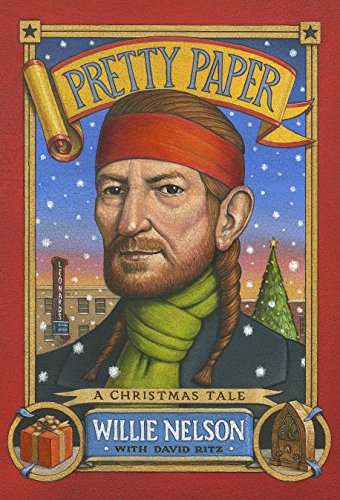
A perfect Christmas gift for music lovers, Pretty Paper is Willie Nelson’s inspiring Christmas fable, based on his holiday classic “Pretty Paper.”
More than fifty years ago, Willie Nelson’s beloved Christmas song “Pretty Paper” first hit the airwaves. And for all these years, Willie has wondered about the real-life Texas street vendor, selling wrappings and ribbons, who inspired his song. Who was this poor soul? What did his painful trials say about our loves, our hopes, our dreams in this holiday season—and in the rest of our lives?
It’s the early sixties and Willie Nelson is down and out, barely eking out a living as a singer-songwriter. The week before Christmas, he spots a legless man on a cart, selling wares in front of Leonard’s Department Store in Fort Worth, Texas. The humble figure, by the name of Vernon Clay, piques Willie’s curiosity, but Vernon is stubbornly private and—despite Willie’s charming queries—has no interest in telling his story. Willie is tenacious, though, and he eventually learns that Vernon is a fellow musician, a fine guitarist and singer.
When Vernon disappears, he leaves behind only a diary, which tells an epic tale of life-altering tragedies, broken hearts, and crooked record men, not to mention backroad honky-tonks, down-home cooking, and country songwriting genius. Deeply moved and spurred on by Vernon’s pages, Willie aims to give the man one last shot at redemption and a chance to embody the holiday spirit.
Die Inhaltsangabe kann sich auf eine andere Ausgabe dieses Titels beziehen.
Über die Autorin bzw. den Autor
Willie Nelson is an American country music singer-songwriter, as well as a poet, actor, and activist. He is also the author of six previous books. Nelson was inducted into the Country Music Hall of Fame in 1993.
David Ritz coauthored Nelson’s memoir, It’s a Long Story, and has collaborated with everyone from Ray Charles to Don Rickles.
Auszug. © Genehmigter Nachdruck. Alle Rechte vorbehalten.
***This excerpt is from an advance uncorrected copy proof***
Copyright © 2016 Willie Nelson
HAPPY HOLIDAYS
It was a rough Christmas in a rough town. Back in the early 1960s, Fort Worth was still the Wild West. There was no shortage of honky-tonks. The city was a haven for hustlers who’d mastered the art of living outside the law. Gangsters controlled the bookie joints, the brothels and most of the nightspots. In the midst of all this, I was struggling to get my career off the ground. Actually “career” is too fancy a word. I was a just a broke-ass picker looking to make a living making music. Running every which way—haunting the beer joints that hid in the shadows of the stockyards, soliciting the club owners who ran the buckets of blood out on Jacksboro Highway—I was getting no- where fast. I did manage to get a gig deejaying on KCNC, but that didn’t last. Neither did my half-baked attempts to peddle Kirby vacuum cleaners and Encyclopedia Americanas. Proud to say, I was no good at convincing people—especially hard-working people— to buy stuff they didn’t need. What I needed was a break.
And a break meant a hit song. I didn’t care if I sang it or someone else did. If I found a bandleader who liked what I’d written, I’d sell my tune for the price of dinner. That’s how desperate I was. Yet in the midst of my desperation, I also saw that others were more desperate than me. Which is where this story begins.
A week before Christmas, I was determined to get into the holiday spirit. Wasn’t easy because my wife was singing the blues about bills we couldn’t pay. We were living in a cramped two-room apartment with our three little ones. Most nights I was gone, looking for places to play my music, and by the time I got home, the kids were up and my wife was off to her waitress job. On this particular morning, two days before Christmas, my mother-in-law was good enough to watch the children while I drove downtown for some last-minute shopping. But, as luck would have it, my beat-up Ford Fairlane wouldn’t start, the battery dead as a doornail. So I caught the bus.
I was freezing. The heater on the bus was busted, and my plaid wool jacket, which had seen better days, couldn’t keep me warm. But what the hell. I was happy because last night I’d found a barroom—Big Bill’s on Main Street near the slaughterhouses—where I could sing some of my songs. Folks liked what they heard and I wound up with twenty-five dollars’ worth of tips in my pocket, a minor miracle. It was just the sort of encouragement that I needed to keep going. So today I wasn’t bothered by the gray sky. Last night’s tips told me that beyond the gray, the sun was shining. Besides, cold can be exhilarating. Best of all, snow was in the forecast, meaning that my kids might get to enjoy their first white Christmas.
I got off at Houston Street in the middle of down- town. The sidewalks were crowded with shoppers, men in fedoras and long overcoats, women in furs, kids bundled up with scarves and mittens. The store windows were decorated with wreaths and poinsettias. I could see my breath in the frosty air. Already a few flakes had begun to fall. Everyone’s expectations were high. Everyone’s heart was full. A beautiful Christmas was just around the corner—a Christmas when,at least for a day, we could forget our troubles and enjoy simple fellowship with family and friends.
Up ahead was Leonard’s, the mammoth depart- ment store that took up six city blocks, the establish- ment that advertised ONE-STOP SHOPPING WITH MORE MERCHANDISE FOR LESS MONEY. During the holidays, Leonard’s was also famous for installing a Santa Claus monorail and an elaborate Toyland department. When it came to Christmas cheer, Leonard’s was the spot.
But then, all of a sudden, a few steps down from the store’s main entrance, I saw someone who stopped me in my tracks: A man, whose legs had been amputated above his knees, supporting himself on a large wooden board resting on four wheels. The board not only held the man, but an array of neatly arranged products that he was selling—wrapping paper, pencils and ribbons. In addition to the traditional Christmas colors of green and red, his merchandise also came in blue, orange, purple and yellow. He easily moved around the board, supporting himself with his long strong arms.
“Pretty paper!” he sang out in a strong and emotional voice, “pretty ribbons of blue . . . wrap your presents to your darling from you . . . pretty pencils to write ‘I love you.’”
He sang like he meant it. In fact, he sang like a singer. He sang in tune. Sadly, he also seemed to be singing in vain. I didn’t see a single person stop to buy his wares. And yet that didn’t stop his singing. I sensed that he sang to lift his spirits and stay warm. I stood about nine or ten feet away from him, off to one side, so he wouldn’t see me studying him.
What I saw was a man who looked to be roughly my age—in his early thirties—a handsome man with chestnut brown eyes and a brown beard covering his square-jawed face. He had a broad nose and thick eyebrows. He wore a black turtleneck sweater with big gaping holes. His blue jeans, that covered the stumps of his legs, were tattered. Despite his handicap, he projected a sense of confidence and rugged masculinity. As he sang his song peddling his wares, his eyes looked upward—above the crowds passing by, above Leonard’s Department Store, above the streetlights—into a sky filled with snowflakes growing fluffier by the minute. Some of the flakes landed on the man’s eyes, melting on his lids and giving the impression that he was crying.
Was he crying? Was he distraught that no one found the time to stop and inquire about him or his colorful merchandise? I wanted to stop. I wanted to ask how he came to be doing what he was doing. How had he lost his legs? His deep brown eyes, wet with snow, suggested some story. But like the others, I did not stop. The Christmas rush was on, and even though I was in no rush at all, I picked up the rhythm of the downtown shoppers. I hurried along. I left the man on the rolling wooden board and rushed into the store.
I bought perfume for my wife, candy for my mother-in-law, a model train for my son and dolls for my girls. When the sales clerk asked if I wanted them giftwrapped, without thinking I said, “Yes, please.” But then I changed my mind. I thought of the man selling pretty paper. I wasn’t much of a wrapper, but I could figure it out. This guy deserved a break, and buying his goods seemed like the right thing to do. After all, it was Christmas.
So with my unwrapped gifts, I left Leonard’s. Now the snow was coming down hard—a rare event in this part of Texas. The wind was kicking up a storm. The temperature had dipped down into single digits. It was hard to see, hard to walk against the howling wind. Folks were hanging on to light poles and the sides of buildings. Looking around, I couldn’t see my man. Where had he gone? Maybe he’d moved on. Battling the wind, I circled all the way around Leonard’s enormous complex. I went up and down the block two, three four times. Something told me I had to find him. But by now I was walking through a virtual blizzard.
I couldn’t look forever. He’d probably found shelter in some nearby coffee shop. Or maybe he actually went inside Leonard’s to wait out the storm. So I reentered the store where, for the next twenty minutes, I looked from one end to the other. But he was nowhere to be found. I gave up the search. Feeling a little guilty, I...
„Über diesen Titel“ kann sich auf eine andere Ausgabe dieses Titels beziehen.
Suchergebnisse für Pretty Paper: A Christmas Tale

Beispielbild für diese ISBN
Pretty Paper: A Christmas Tale
Anbieter: World of Books (was SecondSale), Montgomery, IL, USA
Verkäuferbewertung 5 von 5 Sternen

Hardback. Zustand: Good. It's the early Sixties and Willie is down and out, barely eking out a living as a singer songwriter. The week before Christmas, he spots a legless man on a cart, selling wares in front of Leonard's Department Store. The humble figure, known as Vernon Clay, incites Willie's curiosity, but Vernon is private and - despite Willie's charming queries - has no interest in telling his story. Willie is tenacious, though, and he eventually learns that Vernon is a fellow musician, a fine guitarist and singer. Artikel-Nr. 00097669949
Gebraucht kaufen
EUR 4,43
Versand gratis
Versand innerhalb von USA
Versand innerhalb von USA
Anzahl: 11 verfügbar
Beispielbild für diese ISBN
Pretty Paper
Verlag:
Blue Rider Press (edition Illustrated), 2016
ISBN 10: 073521154X
ISBN 13: 9780735211544
Gebraucht
Hardcover
Anbieter: BooksRun, Philadelphia, PA, USA
Verkäuferbewertung 5 von 5 Sternen
Hardcover. Zustand: Very Good. Illustrated. With dust jacket. It's a well-cared-for item that has seen limited use. The item may show minor signs of wear. All the text is legible, with all pages included. It may have slight markings and/or highlighting. Artikel-Nr. 073521154X-11-1-29
Gebraucht kaufen
EUR 5,38
Versand gratis
Versand innerhalb von USA
Versand innerhalb von USA
Anzahl: 1 verfügbar
Beispielbild für diese ISBN
Pretty Paper
Anbieter: Wonder Book, Frederick, MD, USA
Verkäuferbewertung 5 von 5 Sternen
Zustand: As New. Like New condition. Like New dust jacket. With remainder mark. A near perfect copy that may have very minor cosmetic defects. Artikel-Nr. V14A-04619
Gebraucht kaufen
EUR 6,33
Versand gratis
Versand innerhalb von USA
Versand innerhalb von USA
Anzahl: 1 verfügbar
Beispielbild für diese ISBN
Pretty Paper
Verlag:
Penguin Publishing Group, 2016
ISBN 10: 073521154X
ISBN 13: 9780735211544
Gebraucht
Hardcover
Erstausgabe
Anbieter: Better World Books, Mishawaka, IN, USA
Verkäuferbewertung 5 von 5 Sternen
Zustand: Good. 1st. Former library copy. Pages intact with minimal writing/highlighting. The binding may be loose and creased. Dust jackets/supplements are not included. Includes library markings. Stock photo provided. Product includes identifying sticker. Better World Books: Buy Books. Do Good. Artikel-Nr. 10918374-6
Gebraucht kaufen
EUR 6,91
Versand gratis
Versand innerhalb von USA
Versand innerhalb von USA
Anzahl: 2 verfügbar
Beispielbild für diese ISBN
Pretty Paper
Anbieter: ThriftBooks-Atlanta, AUSTELL, GA, USA
Verkäuferbewertung 5 von 5 Sternen
Hardcover. Zustand: As New. No Jacket. Pages are clean and are not marred by notes or folds of any kind. ~ ThriftBooks: Read More, Spend Less. Artikel-Nr. G073521154XI2N00
Gebraucht kaufen
EUR 7,03
Versand gratis
Versand innerhalb von USA
Versand innerhalb von USA
Anzahl: 1 verfügbar
Beispielbild für diese ISBN
Pretty Paper
Anbieter: ThriftBooks-Dallas, Dallas, TX, USA
Verkäuferbewertung 5 von 5 Sternen
Hardcover. Zustand: Very Good. No Jacket. Former library book; May have limited writing in cover pages. Pages are unmarked. ~ ThriftBooks: Read More, Spend Less. Artikel-Nr. G073521154XI4N10
Gebraucht kaufen
EUR 7,03
Versand gratis
Versand innerhalb von USA
Versand innerhalb von USA
Anzahl: 1 verfügbar
Beispielbild für diese ISBN
Pretty Paper
Anbieter: ThriftBooks-Atlanta, AUSTELL, GA, USA
Verkäuferbewertung 5 von 5 Sternen
Hardcover. Zustand: Very Good. No Jacket. May have limited writing in cover pages. Pages are unmarked. ~ ThriftBooks: Read More, Spend Less. Artikel-Nr. G073521154XI4N00
Gebraucht kaufen
EUR 7,03
Versand gratis
Versand innerhalb von USA
Versand innerhalb von USA
Anzahl: 1 verfügbar
Beispielbild für diese ISBN
Pretty Paper
Anbieter: ThriftBooks-Dallas, Dallas, TX, USA
Verkäuferbewertung 5 von 5 Sternen
Hardcover. Zustand: Very Good. No Jacket. May have limited writing in cover pages. Pages are unmarked. ~ ThriftBooks: Read More, Spend Less. Artikel-Nr. G073521154XI4N00
Gebraucht kaufen
EUR 7,03
Versand gratis
Versand innerhalb von USA
Versand innerhalb von USA
Anzahl: 1 verfügbar
Beispielbild für diese ISBN
Pretty Paper
Anbieter: ThriftBooks-Reno, Reno, NV, USA
Verkäuferbewertung 5 von 5 Sternen
Hardcover. Zustand: Very Good. No Jacket. May have limited writing in cover pages. Pages are unmarked. ~ ThriftBooks: Read More, Spend Less. Artikel-Nr. G073521154XI4N00
Gebraucht kaufen
EUR 7,03
Versand gratis
Versand innerhalb von USA
Versand innerhalb von USA
Anzahl: 1 verfügbar
Foto des Verkäufers
Pretty Paper: A Christmas Tale
Anbieter: WeBuyBooks, Rossendale, LANCS, Vereinigtes Königreich
Verkäuferbewertung 5 von 5 Sternen
hardcover. Zustand: Very Good. Most items will be dispatched the same or the next working day. A copy that has been read, but is in excellent condition. Pages are intact and not marred by notes or highlighting. The spine remains undamaged. Artikel-Nr. rev4543984654
Gebraucht kaufen
EUR 5,39
EUR 7,86 Versand
Versand von Vereinigtes Königreich nach USA
Versand von Vereinigtes Königreich nach USA
Anzahl: 1 verfügbar