
Verwandte Artikel zu When: The Scientific Secrets of Perfect Timing
Inhaltsangabe
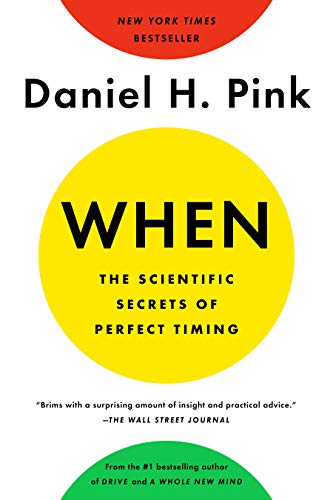
The instant New York Times Bestseller
#1 Wall Street Journal Business Bestseller
Instant Washington Post Bestseller
"Brims with a surprising amount of insight and practical advice." --The Wall Street Journal
Daniel H. Pink, the #1 bestselling author of Drive and To Sell Is Human, unlocks the scientific secrets to good timing to help you flourish at work, at school, and at home.
Everyone knows that timing is everything. But we don't know much about timing itself. Our lives are a never-ending stream of "when" decisions: when to start a business, schedule a class, get serious about a person. Yet we make those decisions based on intuition and guesswork.
Timing, it's often assumed, is an art. In When: The Scientific Secrets of Perfect Timing, Pink shows that timing is really a science.
Drawing on a rich trove of research from psychology, biology, and economics, Pink reveals how best to live, work, and succeed. How can we use the hidden patterns of the day to build the ideal schedule? Why do certain breaks dramatically improve student test scores? How can we turn a stumbling beginning into a fresh start? Why should we avoid going to the hospital in the afternoon? Why is singing in time with other people as good for you as exercise? And what is the ideal time to quit a job, switch careers, or get married?
In When, Pink distills cutting-edge research and data on timing and synthesizes them into a fascinating, readable narrative packed with irresistible stories and practical takeaways that give readers compelling insights into how we can live richer, more engaged lives.
Die Inhaltsangabe kann sich auf eine andere Ausgabe dieses Titels beziehen.
Über die Autorin bzw. den Autor
Daniel H. Pink is the author of several books including the New York Times bestsellers When, Drive, To Sell is Human, and A Whole New Mind. His books have won multiple awards and have been translated into 39 languages. He lives with his family in Washington, DC.
Auszug. © Genehmigter Nachdruck. Alle Rechte vorbehalten.
1.
The Hidden Pattern of Everyday Life
What men daily do, not knowing what they do!
—William Shakespeare, Much Ado About Nothing
If you want to measure the world’s emotional state, to find a mood ring large enough to encircle the globe, you could do worse than Twitter. Nearly one billion human beings have accounts, and they post roughly 6,000 tweets every second. The sheer volume of these minimessages—what people say and how they say it—has produced an ocean of data that social scientists can swim through to understand human behavior.
A few years ago, two Cornell University sociologists, Michael Macy and Scott Golder, studied more than 500 million tweets that 2.4 million users in eighty-four countries posted over a two-year period. They hoped to use this trove to measure people’s emotions—in particular, how “positive affect” (emotions such as enthusiasm, confidence, and alertness) and “negative affect” (emotions such as anger, lethargy, and guilt) varied over time. The researchers didn’t read those half a billion tweets one by one, of course. Instead, they fed the posts into a powerful and widely used computerized text-analysis program called LIWC (Linguistic Inquiry and Word Count) that evaluated each word for the emotion it conveyed.
What Macy and Golder found, and published in the eminent journal Science, was a remarkably consistent pattern across people’s waking hours. Positive affect—language revealing that tweeters felt active, engaged, and hopeful—generally rose in the morning, plummeted in the afternoon, and climbed back up again in the early evening. Whether a tweeter was North American or Asian, Muslim or atheist, black or white or brown, didn’t matter. “The temporal affective pattern is similarly shaped across disparate cultures and geographic locations,” they write. Nor did it matter whether people were tweeting on a Monday or a Thursday. Each weekday was basically the same. Weekend results differed slightly. Positive affect was generally a bit higher on Saturdays and Sundays—and the morning peak began about two hours later than on weekdays—but the overall shape stayed the same. Whether measured in a large, diverse country like the United States or a smaller, more homogenous country like the United Arab Emirates, the daily pattern remained weirdly similar.
Across continents and time zones, as predictable as the ocean tides, was the same daily oscillation—a peak, a trough, and a rebound. Beneath the surface of our everyday life is a hidden pattern: crucial, unexpected, and revealing.
Understanding this pattern—where it comes from and what it means—begins with a potted plant, a Mimosa pudica, to be exact, that perched on the windowsill of an office in eighteenth-century France. Both the office and the plant belonged to Jean-Jacques d’Ortous de Mairan, a prominent astronomer of his time. Early one summer evening in 1729, de Mairan sat at his desk doing what both eighteenth-century French astronomers and twenty-first-century American writers do when they have serious work to complete: He was staring out the window. As twilight approached, de Mairan noticed that the leaves of the plant sitting on his windowsill had closed up. Earlier in the day, when sunlight streamed through the window, the leaves were spread open. This pattern—leaves unfurled during the sunny morning and furled as darkness loomed—spurred questions. How did the plant sense its surroundings? And what would happen if that pattern of light and dark was disrupted?
So in what would become an act of historically productive procrastination, de Mairan removed the plant from the windowsill, stuck it in a cabinet, and shut the door to seal off light. The following morning, he opened the cabinet to check on the plant and—mon Dieu!—the leaves had unfurled despite being in complete darkness. He continued his investigation for a few more weeks, draping black curtains over his windows to prevent even a sliver of light from penetrating the office. The pattern remained. The Mimosa pudica’s leaves opened in the morning, closed in the evening. The plant wasn’t reacting to external light. It was abiding by its own internal clock.
Since de Mairan’s discovery nearly three centuries ago, scientists have established that nearly all living things—from single-cell organisms that lurk in ponds to multicellular organisms that drive minivans—have biological clocks. These internal timekeepers play an essential role in proper functioning. They govern a collection of what are called circadian rhythms (from the Latin circa [around] and diem [day]) that set the daily backbeat of every creature’s life. (Indeed, from de Mairan’s potted plant eventually bloomed an entirely new science of biological rhythms known as chronobiology.)
For you and me, the biological Big Ben is the suprachiasmatic nucleus, or SCN, a cluster of some 20,000 cells the size of a grain of rice in the hypothalamus, which sits in the lower center of the brain. The SCN controls the rise and fall of our body temperature, regulates our hormones, and helps us fall asleep at night and awaken in the morning. The SCN’s daily timer runs a bit longer than it takes for the Earth to make one full rotation—about twenty-four hours and eleven minutes. So our built-in clock uses social cues (office schedules and bus timetables) and environmental signals (sunrise and sunset) to make small adjustments that bring the internal and external cycles more or less in synch, a process called “entrainment.”
The result is that, like the plant on de Mairan’s windowsill, human beings metaphorically “open” and “close” at regular times during each day. The patterns aren’t identical for every person—just as my blood pressure and pulse aren’t exactly the same as yours or even the same as mine were twenty years ago or will be twenty years hence. But the broad contours are remarkably similar. And where they’re not, they differ in predictable ways.
Chronobiologists and other researchers began by examining physiological functions such as melatonin production and metabolic response, but the work has now widened to include emotions and behavior. Their research is unlocking some surprising time-based patterns in how we feel and how we perform—which, in turn, yields guidance on how we can configure our own daily lives.
Mood Swings and Stock Swings
For all their volume, hundreds of millions of tweets cannot provide a perfect window into our daily souls. While other studies using Twitter to measure mood have found much the same patterns that Macy and Golder discovered, both the medium and the methodology have limits. People often use social media to present an ideal face to the world that might mask their true, and perhaps less ideal, emotions. In addition, the industrial-strength analytic tools necessary to interpret so much data can’t always detect irony, sarcasm, and other subtle human tricks.
Fortunately, behavioral scientists have other methods to understand what we are thinking and feeling, and one is especially good for charting hour-to-hour changes in how we feel. It’s called the Day Reconstruction Method (DRM), the creation of a quintet of researchers that included Daniel Kahneman, winner of the Nobel Prize in Economics, and Alan Krueger, who served as chairman of the White House Council of Economic Advisers under Barack Obama. With the DRM, participants reconstruct the previous day—chronicling everything...
„Über diesen Titel“ kann sich auf eine andere Ausgabe dieses Titels beziehen.
Suchergebnisse für When: The Scientific Secrets of Perfect Timing

Beispielbild für diese ISBN
When: The Scientific Secrets of Perfect Timing
Anbieter: World of Books (was SecondSale), Montgomery, IL, USA
Verkäuferbewertung 5 von 5 Sternen

Paperback. Zustand: Fair. The instant New York Times Bestseller #1 Wall Street Journal Business Bestseller Instant Washington Post Bestseller "Brims with a surprising amount of insight and practical advice." --The Wall Street Journal Daniel H. Pink, the #1 bestselling author of Drive and To Sell Is Human, unlocks the scientific secrets to good timing to help you flourish at work, at school, and at home. Everyone knows that timing is everything. But we don't know much about timing itself. Our lives are a never-ending stream of "when" decisions: when to start a business, schedule a class, get serious about a person. Yet we make those decisions based on intuition and guesswork. Timing, it's often assumed, is an art. In When: The Scientific Secrets of Perfect Timing, Pink shows that timing is really a science. Drawing on a rich trove of research from psychology, biology, and economics, Pink reveals how best to live, work, and succeed. How can we use the hidden patterns of the day to build the ideal schedule? Why do certain breaks dramatically improve student test scores? How can we turn a stumbling beginning into a fresh start? Why should we avoid going to the hospital in the afternoon? Why is singing in time with other people as good for you as exercise? And what is the ideal time to quit a job, switch careers, or get married? In When, Pink distills cutting-edge research and data on timing and synthesizes them into a fascinating, readable narrative packed with irresistible stories and practical takeaways that give readers compelling insights into how we can live richer, more engaged lives. Artikel-Nr. 00082632378
Gebraucht kaufen
EUR 3,68
Versand gratis
Versand innerhalb von USA
Versand innerhalb von USA
Anzahl: 6 verfügbar
Beispielbild für diese ISBN
When The Scientific Secrets of
Anbieter: World of Books (was SecondSale), Montgomery, IL, USA
Verkäuferbewertung 5 von 5 Sternen
Zustand: Very Good. Item in very good condition! Textbooks may not include supplemental items i.e. CDs, access codes etc. Artikel-Nr. 00108538468
Gebraucht kaufen
EUR 3,68
Versand gratis
Versand innerhalb von USA
Versand innerhalb von USA
Anzahl: 4 verfügbar
Beispielbild für diese ISBN
When: The Scientific Secrets of Perfect Timing
Anbieter: World of Books (was SecondSale), Montgomery, IL, USA
Verkäuferbewertung 5 von 5 Sternen
Paperback. Zustand: Good. The instant New York Times Bestseller #1 Wall Street Journal Business Bestseller Instant Washington Post Bestseller "Brims with a surprising amount of insight and practical advice." --The Wall Street Journal Daniel H. Pink, the #1 bestselling author of Drive and To Sell Is Human, unlocks the scientific secrets to good timing to help you flourish at work, at school, and at home. Everyone knows that timing is everything. But we don't know much about timing itself. Our lives are a never-ending stream of "when" decisions: when to start a business, schedule a class, get serious about a person. Yet we make those decisions based on intuition and guesswork. Timing, it's often assumed, is an art. In When: The Scientific Secrets of Perfect Timing, Pink shows that timing is really a science. Drawing on a rich trove of research from psychology, biology, and economics, Pink reveals how best to live, work, and succeed. How can we use the hidden patterns of the day to build the ideal schedule? Why do certain breaks dramatically improve student test scores? How can we turn a stumbling beginning into a fresh start? Why should we avoid going to the hospital in the afternoon? Why is singing in time with other people as good for you as exercise? And what is the ideal time to quit a job, switch careers, or get married? In When, Pink distills cutting-edge research and data on timing and synthesizes them into a fascinating, readable narrative packed with irresistible stories and practical takeaways that give readers compelling insights into how we can live richer, more engaged lives. Artikel-Nr. 00087625183
Gebraucht kaufen
EUR 3,68
Versand gratis
Versand innerhalb von USA
Versand innerhalb von USA
Anzahl: Mehr als 20 verfügbar
Beispielbild für diese ISBN
When: The Scientific Secrets of Perfect Timing
Anbieter: ThriftBooks-Reno, Reno, NV, USA
Verkäuferbewertung 5 von 5 Sternen
Paperback. Zustand: Very Good. No Jacket. May have limited writing in cover pages. Pages are unmarked. ~ ThriftBooks: Read More, Spend Less. Artikel-Nr. G0735210632I4N00
Gebraucht kaufen
EUR 5,95
Versand gratis
Versand innerhalb von USA
Versand innerhalb von USA
Anzahl: 1 verfügbar
Beispielbild für diese ISBN
When: The Scientific Secrets of Perfect Timing
Anbieter: ThriftBooks-Phoenix, Phoenix, AZ, USA
Verkäuferbewertung 5 von 5 Sternen
Paperback. Zustand: Very Good. No Jacket. May have limited writing in cover pages. Pages are unmarked. ~ ThriftBooks: Read More, Spend Less. Artikel-Nr. G0735210632I4N00
Gebraucht kaufen
EUR 5,95
Versand gratis
Versand innerhalb von USA
Versand innerhalb von USA
Anzahl: 1 verfügbar
Beispielbild für diese ISBN
When: The Scientific Secrets of Perfect Timing
Anbieter: ThriftBooks-Dallas, Dallas, TX, USA
Verkäuferbewertung 5 von 5 Sternen
Paperback. Zustand: Very Good. No Jacket. Former library book; May have limited writing in cover pages. Pages are unmarked. ~ ThriftBooks: Read More, Spend Less. Artikel-Nr. G0735210632I4N10
Gebraucht kaufen
EUR 5,97
Versand gratis
Versand innerhalb von USA
Versand innerhalb von USA
Anzahl: 1 verfügbar
Beispielbild für diese ISBN
When: The Scientific Secrets of Perfect Timing
Anbieter: ThriftBooks-Atlanta, AUSTELL, GA, USA
Verkäuferbewertung 5 von 5 Sternen
Paperback. Zustand: Very Good. No Jacket. May have limited writing in cover pages. Pages are unmarked. ~ ThriftBooks: Read More, Spend Less. Artikel-Nr. G0735210632I4N00
Gebraucht kaufen
EUR 5,97
Versand gratis
Versand innerhalb von USA
Versand innerhalb von USA
Anzahl: 2 verfügbar
Beispielbild für diese ISBN
When: The Scientific Secrets of Perfect Timing
Anbieter: ThriftBooks-Dallas, Dallas, TX, USA
Verkäuferbewertung 5 von 5 Sternen
Paperback. Zustand: Very Good. No Jacket. May have limited writing in cover pages. Pages are unmarked. ~ ThriftBooks: Read More, Spend Less. Artikel-Nr. G0735210632I4N00
Gebraucht kaufen
EUR 5,97
Versand gratis
Versand innerhalb von USA
Versand innerhalb von USA
Anzahl: 2 verfügbar
Beispielbild für diese ISBN
When: The Scientific Secrets of Perfect Timing
Verlag:
Penguin Publishing Group, 2019
ISBN 10: 0735210632
ISBN 13: 9780735210639
Gebraucht
Softcover
Anbieter: Better World Books, Mishawaka, IN, USA
Verkäuferbewertung 5 von 5 Sternen
Zustand: Good. Reprint. Pages intact with minimal writing/highlighting. The binding may be loose and creased. Dust jackets/supplements are not included. Stock photo provided. Product includes identifying sticker. Better World Books: Buy Books. Do Good. Artikel-Nr. 18489163-6
Gebraucht kaufen
EUR 6,11
Versand gratis
Versand innerhalb von USA
Versand innerhalb von USA
Anzahl: 12 verfügbar
Beispielbild für diese ISBN
When: The Scientific Secrets of Perfect Timing
Verlag:
Penguin Publishing Group, 2019
ISBN 10: 0735210632
ISBN 13: 9780735210639
Gebraucht
Softcover
Anbieter: Better World Books: West, Reno, NV, USA
Verkäuferbewertung 5 von 5 Sternen
Zustand: Good. Reprint. Former library copy. Pages intact with minimal writing/highlighting. The binding may be loose and creased. Dust jackets/supplements are not included. Includes library markings. Stock photo provided. Product includes identifying sticker. Better World Books: Buy Books. Do Good. Artikel-Nr. 17234603-75
Gebraucht kaufen
EUR 6,11
Versand gratis
Versand innerhalb von USA
Versand innerhalb von USA
Anzahl: 2 verfügbar