
Verwandte Artikel zu How to Ace Calculus: The Streetwise Guide (How to Ace...
Inhaltsangabe
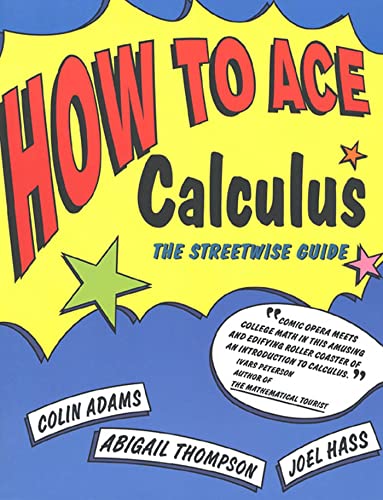
"Comic opera meets college math in this amusing and edifying roller coaster of an introduction to calculus."
-Ivars Peterson, author of The Mathematical Tourist
Written by three gifted-and funny-teachers, How to Ace Calculus provides humorous and readable explanations of the key topics of calculus without the technical details and fine print that would be found in a more formal text. Capturing the tone of students exchanging ideas among themselves, this unique guide also explains how calculus is taught, how to get the best teachers, what to study, and what is likely to be on exams-all the tricks of the trade that will make learning the material of first-semester calculus a piece of cake. Funny, irreverent, and flexible, How to Ace Calculus shows why learning calculus can be not only a mind-expanding experience but also fantastic fun.
Die Inhaltsangabe kann sich auf eine andere Ausgabe dieses Titels beziehen.
Über die Autorin bzw. den Autor
Colin Adams is the Thomas T. Read Professor of Mathematics at Williams College, where he has taught since 1985. He has produced a number of books that make mathematics more accessible and relatable, including How to Ace Calculus and its sequel, How to Ace the Rest of Calculus; Riot at the Calc Exam and other Mathematically Bent Stories; and Zombies & Calculus. Colin co-wrote and appears in the videos "The Great Pi vs. E Debate" and "Derivative vs. Integral: the Final Smackdown."
Adams received his undergraduate degree from MIT and his Ph.D. from the University of Wisconsin. He had held various grants for research in the area of knot theory and low-dimensional topology and has published numerous research articles. He received the Haimo National Distinguished Teaching Award from the Mathematical Association of America (MAA) in 1998, and the Robert Foster Cherry Teaching Award in 2003. Adams also served as MAA Polya Lecturer (1998-2000), and as Sigma Xi Distinguished Lecturer (2000-2002).
Auszug. © Genehmigter Nachdruck. Alle Rechte vorbehalten.
How to Ace Calculus: The Streetwise Guide
By Colin Adams, Abigail Thompson, Joel HassHenry Holt and Company
Copyright © 1998 W. H. Freeman and Company
All rights reserved.
ISBN: 978-0-7167-3160-3All rights reserved.
Contents
Title Page,
Copyright Notice,
Dedication,
1. Introduction,
2. Exactly Who and What Is Your Instructor?,
3. General Principles of Acing Calculus,
4. Good and Bad Questions,
5. Are You Ready? Calc Prereqs,
6. How to Handle the Exam,
7. Lines, Circles, and Their Friends,
8. Limits: You Gotta Have Them,
9. Continuity, or Why You Shouldn't Ski Down Discontinuous Slopes,
10. What Is the Derivative? Change Is Good,
11. Limit Definition of the Derivative: Finding Derivatives the Hard Way,
12. Derivatives: How to Find Them the Easy Way,
13. Velocity: Put the Pedal to the Metal,
14. Chain Rule: S&M Made Easy,
15. Graphing: How to Doodle Like an Expert,
16. Maxima and Minima: The Bread and Butter Section,
17. Implicit Differentiation: Let's Be Oblique,
18. Related Rates: You Change, I Change,
19. Differential: Estimating Your Way to Fame and Glory,
20. Intermediate Value Theorem and Mean Value Theorem,
21. Integration: Doing It All Backward,
22. The Definite Integral,
23. Modeling: From Toy Planes to the Runway,
24. Exponents and Logarithms: A Review of All That "e" Hoopla,
25. Doing That Calc Thing to Exponents and Logs,
26. Logarithmic Differentiation: Making the Hard Stuff Easy,
27. Exponential Growth and Decay: Rise and Fall of Slime,
28. Fancy-Pants Techniques of Integration,
29. Twenty Most Common Exam Mistakes,
30. What's on the Final?,
Glossary: A Quick Guide to the Mathematical Jargon,
Index,
Just the Facts: Quick Reference Guide,
About the Authors,
Copyright,
CHAPTER 1
Introduction
If you are reading this introduction then this book is probably not for you. This book is directed at calculus students who have better things to do with their time than read wordy preambles that won't be on the exam. But just in case you haven't actually bought this book yet and are considering a purchase while flipping through the pages in a bookstore, we'll tell you what it's all about.
If you want to know the tricks of the trade that will make learning the material of first-semester calculus a piece of cake, then this is the book for you. If you want to learn lots of cool things while having a good time, then this is the book for you. If you want to carry around a book that makes people think you are surfing the wave of knowledge, then this is the book for you.
Do you remember being in a class and being hopelessly confused? Perhaps your attention wandered at some important moment, or the lecturer thoughtlessly slipped into ancient Greek when explaining the basic idea. After class, you asked your brainy friend over a cup of coffee, "What was going on in that class?" Your friend explained it all in five minutes flat and made it crystal clear. "Oh," you said, "is that all there is to it? Why didn't they just say that in the first place?" Later, you wished that friend was around to explain all the lectures to you.
This book aims to play the role of your friend. It gives informal explanations of the key topics of calculus, getting across the ideas without the technical details and fine print that would be found in a formal text. This book does not substitute for a calculus textbook, but it should make it much easier to figure out what the textbook is talking about.
If you approach it with the right point of view, learning calculus can be not only a mind-expanding experience but also fantastic fun, just about as good as something not involving whipped cream and maraschino cherries can get. This book is going to tell you how calculus is taught, how to get the best teachers, what to study, and what is likely to be on exams. This is the stuff we wish we'd known when we had to take calculus. So, enough stalling. Why don't you go up to that nice cashier, plunk down some money and buy this book, and we can talk more after?
CHAPTER 2Exactly Who and What Is Your Instructor?
2.1 Choosing an instructor
Here we give a brief introduction to mathematicians, their pecking order, and their identifying characteristics.
READ THIS BEFORE CHOOSING AN INSTRUCTOR.
Understanding mathematicians is a lot like bird watching. You need to know enough distinguishing features to say, "Ah, a yellow-bellied sapsucker" with conviction.
Choosing the best instructor is the single decision most likely to determine whether your calculus experience will be a series of intellectual delights or whether you schedule dental appointments during calculus lectures because they are less painful.
You can often figure out the specifics about your instructors by looking at their doors. Generally a small sign will be posted containing some clue to the instructor's official title. There are several possibilities:
A. Permanent faculty, tenured (sign on door says Professor or Associate Professor). Tenured means that they cannot be fired, even if they are grossly incompetent. Associate Professors are a rung below Professors. Sometimes this is because they are at an earlier stage in their career, sometimes because their career stalled after they were discovered hiding in the chimney of the dean's apartment.
B. Permanent faculty, untenured (sign on door says Assistant Professor). These people can be fired, but if they are, it will not be for reasons related to their ability to teach calculus. In Europe, Assistant Professors really are assistants, whose job is to mow the Professor's lawn, carry the Professor's briefcase, and teach the Professor's class. In the United States, the Assistant title just means that they are in the preliminary, untenured stage of their career.
C. Visitors (sign on door says Visiting Professor, or Visiting Assistant Professor). "Visiting" means that their welcome is due to expire at the end of one or two years. It does not necessarily mean that they have anywhere to go afterward.
D. Temporary faculty (sign on door says: Lecturer or Instructor or Adjunct Professor). Some colleges hire temporary faculty mainly to teach classes. This may mean that they really care about their teaching.
E. Graduate students (sign on door just gives their name, with no title, or has some pseudo-title like Adjunct Instructor).
F. No sign on door: A very bad omen. It may mean that the instructor is too disorganized to post a sign or that revengeful former students keep ripping it down. Perhaps the instructor is trying to avoid previous generations of students? Investigate further.
G. No door: Danger, danger. Could mean that the instructor is deemed unworthy of an office. This makes it hard to hold office hours. Also could mean that you're looking in the wrong building.
Almost everyone in categories A, B, C, and D has a Ph.D.
Permanent faculty members, with their ranks, should be listed in the course catalog, where you can look them up. At large universities, permanent faculty are usually either the people who do research in really high-level mathematics or the people who have been around forever and control the math department political machine. Sometimes the best teachers are found in this group. The worst teachers are often found here. These faculty will be teaching all the advanced mathematics courses, as well as...
„Über diesen Titel“ kann sich auf eine andere Ausgabe dieses Titels beziehen.
Suchergebnisse für How to Ace Calculus: The Streetwise Guide (How to Ace...

Beispielbild für diese ISBN
How to Ace Calculus: The Streetwise Guide
Anbieter: World of Books (was SecondSale), Montgomery, IL, USA
Verkäuferbewertung 5 von 5 Sternen

Paperback. Zustand: Fair. "Comic opera meets college math in this amusing and edifying roller coaster of an introduction to calculus." --Ivars Peterson, author of The Mathematical Tourist Written by three gifted--and funny--teachers, How to Ace Calculus provides humorous and readable explanations of the key topics of calculus without the technical details and fine print that would be found in a more formal text. Capturing the tone of students exchanging ideas among themselves, this unique guide also explains how calculus is taught, how to get the best teachers, what to study, and what is likely to be on exams--all the tricks of the trade that will make learning the material of first-semester calculus a piece of cake. Funny, irreverent, and flexible, How to Ace Calculus shows why learning calculus can be not only a mind-expanding experience but also fantastic fun. Artikel-Nr. 00099331315
Gebraucht kaufen
EUR 4,05
Versand gratis
Versand innerhalb von USA
Versand innerhalb von USA
Anzahl: 2 verfügbar
Beispielbild für diese ISBN
How to Ace Calculus: The Streetwise Guide
Anbieter: World of Books (was SecondSale), Montgomery, IL, USA
Verkäuferbewertung 5 von 5 Sternen
Paperback. Zustand: Very Good. "Comic opera meets college math in this amusing and edifying roller coaster of an introduction to calculus." --Ivars Peterson, author of The Mathematical Tourist Written by three gifted--and funny--teachers, How to Ace Calculus provides humorous and readable explanations of the key topics of calculus without the technical details and fine print that would be found in a more formal text. Capturing the tone of students exchanging ideas among themselves, this unique guide also explains how calculus is taught, how to get the best teachers, what to study, and what is likely to be on exams--all the tricks of the trade that will make learning the material of first-semester calculus a piece of cake. Funny, irreverent, and flexible, How to Ace Calculus shows why learning calculus can be not only a mind-expanding experience but also fantastic fun. Artikel-Nr. 00107143948
Gebraucht kaufen
EUR 4,05
Versand gratis
Versand innerhalb von USA
Versand innerhalb von USA
Anzahl: 4 verfügbar
Beispielbild für diese ISBN
How to Ace Calculus: The Streetwise Guide
Anbieter: World of Books (was SecondSale), Montgomery, IL, USA
Verkäuferbewertung 5 von 5 Sternen
Paperback. Zustand: Good. "Comic opera meets college math in this amusing and edifying roller coaster of an introduction to calculus." --Ivars Peterson, author of The Mathematical Tourist Written by three gifted--and funny--teachers, How to Ace Calculus provides humorous and readable explanations of the key topics of calculus without the technical details and fine print that would be found in a more formal text. Capturing the tone of students exchanging ideas among themselves, this unique guide also explains how calculus is taught, how to get the best teachers, what to study, and what is likely to be on exams--all the tricks of the trade that will make learning the material of first-semester calculus a piece of cake. Funny, irreverent, and flexible, How to Ace Calculus shows why learning calculus can be not only a mind-expanding experience but also fantastic fun. Artikel-Nr. 00089054424
Gebraucht kaufen
EUR 4,05
Versand gratis
Versand innerhalb von USA
Versand innerhalb von USA
Anzahl: Mehr als 20 verfügbar
Beispielbild für diese ISBN
How to Ace Calculus: The Streetwise Guide
Anbieter: ThriftBooks-Atlanta, AUSTELL, GA, USA
Verkäuferbewertung 5 von 5 Sternen
Paperback. Zustand: Very Good. No Jacket. May have limited writing in cover pages. Pages are unmarked. ~ ThriftBooks: Read More, Spend Less. Artikel-Nr. G0716731606I4N00
Gebraucht kaufen
EUR 5,95
Versand gratis
Versand innerhalb von USA
Versand innerhalb von USA
Anzahl: 1 verfügbar
Beispielbild für diese ISBN
How to Ace Calculus: The Streetwise Guide
Anbieter: ThriftBooks-Dallas, Dallas, TX, USA
Verkäuferbewertung 5 von 5 Sternen
Paperback. Zustand: As New. No Jacket. Pages are clean and are not marred by notes or folds of any kind. ~ ThriftBooks: Read More, Spend Less. Artikel-Nr. G0716731606I2N00
Gebraucht kaufen
EUR 5,95
Versand gratis
Versand innerhalb von USA
Versand innerhalb von USA
Anzahl: 1 verfügbar
Beispielbild für diese ISBN
How to Ace Calculus: The Streetwise Guide
Anbieter: BooksRun, Philadelphia, PA, USA
Verkäuferbewertung 5 von 5 Sternen
Paperback. Zustand: Very Good. It's a well-cared-for item that has seen limited use. The item may show minor signs of wear. All the text is legible, with all pages included. It may have slight markings and/or highlighting. Artikel-Nr. 0716731606-11-1
Gebraucht kaufen
EUR 6,62
Versand gratis
Versand innerhalb von USA
Versand innerhalb von USA
Anzahl: 1 verfügbar
Beispielbild für diese ISBN
How to Ace Calculus: The Streetwise Guide
Anbieter: Wonder Book, Frederick, MD, USA
Verkäuferbewertung 5 von 5 Sternen
Zustand: Very Good. Very Good condition. A copy that may have a few cosmetic defects. May also contain light spine creasing or a few markings such as an owner's name, short gifter's inscription or light stamp. Artikel-Nr. D11B-02753
Gebraucht kaufen
EUR 7,14
Versand gratis
Versand innerhalb von USA
Versand innerhalb von USA
Anzahl: 4 verfügbar
Beispielbild für diese ISBN
How to Ace Calculus: The Streetwise Guide
Verlag:
Macmillan Learning, United States, New York, 1998
ISBN 10: 0716731606
ISBN 13: 9780716731603
Gebraucht
Paperback
Anbieter: WorldofBooks, Goring-By-Sea, WS, Vereinigtes Königreich
Verkäuferbewertung 5 von 5 Sternen
Paperback. Zustand: Very Good. The book has been read, but is in excellent condition. Pages are intact and not marred by notes or highlighting. The spine remains undamaged. Artikel-Nr. GOR003941350
Gebraucht kaufen
EUR 3,12
EUR 6,67 Versand
Versand von Vereinigtes Königreich nach USA
Versand von Vereinigtes Königreich nach USA
Anzahl: 6 verfügbar
Beispielbild für diese ISBN
How to Ace Calculus : The Streetwise Guide
Anbieter: Better World Books Ltd, Dunfermline, Vereinigtes Königreich
Verkäuferbewertung 5 von 5 Sternen
Zustand: Good. Pages intact with minimal writing/highlighting. The binding may be loose and creased. Dust jackets/supplements are not included. Stock photo provided. Product includes identifying sticker. Better World Books: Buy Books. Do Good. Artikel-Nr. 4280917-6
Gebraucht kaufen
EUR 5,73
EUR 5,96 Versand
Versand von Vereinigtes Königreich nach USA
Versand von Vereinigtes Königreich nach USA
Anzahl: 1 verfügbar
Beispielbild für diese ISBN
How to Ace Calculus : The Streetwise Guide
Anbieter: Better World Books Ltd, Dunfermline, Vereinigtes Königreich
Verkäuferbewertung 5 von 5 Sternen
Zustand: Good. Former library copy. Pages intact with minimal writing/highlighting. The binding may be loose and creased. Dust jackets/supplements are not included. Includes library markings. Stock photo provided. Product includes identifying sticker. Better World Books: Buy Books. Do Good. Artikel-Nr. 4249262-6
Gebraucht kaufen
EUR 5,73
EUR 5,96 Versand
Versand von Vereinigtes Königreich nach USA
Versand von Vereinigtes Königreich nach USA
Anzahl: 1 verfügbar