
Verwandte Artikel zu Final Matters: Selected Poems, 2004-2010 (The Lockert...
Final Matters: Selected Poems, 2004-2010 (The Lockert Library of Poetry in Translation) - Hardcover
Buch 13 von 23: The Lockert Library of Poetry in Translation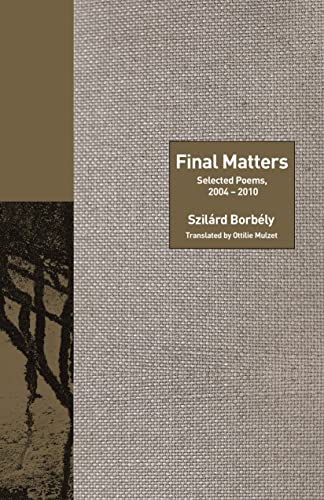
Inhaltsangabe
An award-winning translator presents selections from the haunting final volumes of a leading voice in contemporary Hungarian poetry
Szilárd Borbély, one of the most celebrated writers to emerge from post-Communist Hungary, received numerous literary awards in his native country. In this volume, acclaimed translator Ottilie Mulzet reveals the full range and force of Borbély’s verse by bringing together generous selections from his last two books, Final Matters and To the Body. The original Hungarian text is set on pages facing the English translations, and the book also features an afterword by Mulzet that places the poems in literary, historical, and biographical context.
Restless, curious, learned, and alert, Borbély weaves into his work an unlikely mix of Hungarian folk songs, Christian and Jewish hymns, classical myths, police reports, and unsettling accounts of abortions. In her afterword, Mulzet calls this collection “a blasphemous and fragmentary prayer book … that challenges us to rethink the boundaries of victimhood, culpability, and our own religious and cultural definitions.”
Die Inhaltsangabe kann sich auf eine andere Ausgabe dieses Titels beziehen.
Über die Autorin bzw. den Autor
Szilárd Borbély (1963–2014) wrote in a wide variety of genres. His books include the novel The Dispossessed and the poetry collection Berlin-Hamlet. Ottilie Mulzet is a literary critic and the translator of The Dispossessed and Berlin-Hamlet, among other books. Her translation of the novel Seiobo There Below by László Krasznahorkai won the 2014 Best Translated Book Award. She lives in Prague.
Auszug. © Genehmigter Nachdruck. Alle Rechte vorbehalten.
Final Matters
Selected Poems, 2004–2010
By Szilárd Borbély, Ottilie MulzetPRINCETON UNIVERSITY PRESS
Copyright © 2019 Princeton University Press
All rights reserved.
ISBN: 978-0-691-18242-1All rights reserved.
Contents
From Final Matters, Sequences, Book One: Sequences of Holy Week,
From Final Matters, Sequences, Book Two: Sequences of Amor and Psyche,
From Final Matters, Sequences, Book Three: Hasidic Sequences,
From To the Body: Odes and Legends,
Notes, 161,
Credits, 167,
Translator's Acknowledgments, 169,
Translator's Afterword, 171,
CHAPTER 1
ALLEGORY OF THE PELICAN
For as that Pelican yonder,
alighting on the Rosemary branch,
on the Rosemary bower,
gazes at the Sun descending,
eventide and day's ending,
light upon the Dead One falling
through the fissures of the shutter,
the sun's last ray across his face,
he awaits — the Resurrection.
And the Pelican bides its time,
when the Sun has already declined,
reckons the number of branches,
the branches of the Rosemary bush,
like the light of Faith itself,
murderous, it blinds:
"I ask of you, my Pilgrim Soul,
You, my Body, passed from this world,
in this grant me your accord.
The Pelican alights on the Rosemary's
bough, and its branches sway;
our wings at rest remain.
Christ counts the blows, five thousand
four hundred and two score, when
offense is given to Him,
and, within his Crown of Thorns,
thorns of seventy-two branches,
how great would be the torment,
were the Dead One to arise,
and walk here, like the Pelican,
its Allegory revived."
FINAL MATTERS: DEATH
There was nothing more than there should have been,
the common residue of the last few days,
gathered by the breeze into the courtyard nooks,
until Fanny the charwoman swept them away
and into the ground-floor flat called
"Good morning!" and "What's for lunch today?"
The sun shone down. Doves alighted on the eaves
and pockmarks on the cement were seen
each one by itself, for eternity. It was Spring.
The shutters were folded, the shades drawn.
The window opened just a crack, which was strange,
but maybe not so much. And then everyone
was seeking the cause of the peculiar smell. Evening
came, and morning again. The third day. No one
thought of the elderly couple in the ground-floor flat.
The detectives were bored. Nothing affects them
anymore. They were drunk when they got there and
guzzled even more at the drink-stand next door. The corpses
were buried quickly, because it was Easter. The case
was closed. And no one played the Dies irae.
AETERNITAS
(1)
The Eternal is
cold, like the chisel
used to carve
the face of our Jesus.
The Eternal is submerged,
like the pebble,
as you gaze at the river and see
the water again tranquil.
The Eternal leaps
away, like the flea
you clutch at in vain —
already the inferno.
The Eternal is profound,
like that awareness
in which resides
the mercy of our Christ.
The Eternal ticks
on, like the clock,
though maybe it misses
— at times — the dawn.
The Eternal is thin
as the blade of the knife
which Death then slips
into your heart.
The Eternal is,
like life itself, fleeting —
it comes to an end
while you're speaking.
ROSARY FOR THE NYMPHS
There is something in the soul. Perhaps a yearning for greatness
which never leaves one in peace. From memory, the time
of waiting falls away. Only circumstances remain,
the opened palm, the mouth askew, the cold
touch on the forehead. The eyelids bound
to the tear ducts with three or four stitches. Both
already closed, only a scalpel could open them
now. The umbilical cord, gnawed through with the teeth. The face
bloodied. The nymphs heard the grinding
of teeth. In the realms of poetry, all errant forms
followed the trace. The spilt milk left a stain
on the stone floor by the fridge. The shades thirstily
gathered round. For the entire day, they listened in silence.
Waiting by the edge of the opened eye. The flock of sheep
drifted down the white stony hillside. Like a grandmother's
hair at night, falling from its knot. Or like
teeth, which are whiter and more rigid
than bone. Like specters, jostling around the mouth.
THE SEQUENCE OF EMPTINESS
Ghastly the void at the page's edge,
where the sentence comes to an end
and floats across
to the next page, turning over
the leaves, yet nothing contains
within itself
the world, which, should you not
pay heed, is lost, for the Soul no longer
there resides,
only Malediction, as it watches
you in the Mirror, the pupil of its eye
observing
by the pages' end, where the void may arise,
the sentence penned may not remain
unfulfilled,
for that which is written must come to be,
He who is Sacred must appear:
Marana tha!
May grace upon us descend,
and may this world now reach its end!
Amen!
SEQUENCES OF CHRISTMAS
(1)
On Golgotha, by the crucifix,
our eyes are trained on sweet Jesus
who when he came into this world
for all our sakes was murdered
tiny being from his mother's womb
cast out upon this world
a naked life came all alone
and with it came a tiny soul
the infant has no swaddling clothes
only his father's watchful gaze
his tiny hand laid on the cross
and held in place with nails because
for all time now he must die
for our sakes he lies in agony
there the infant's tiny corpse
hovering above its soul there floats
on that night in Bethlehem
Pontius Pilate weeps alone
sees the one in the manger laid
the nails driven into his hands
the wide gash on his right side
crowned with thorns is the infant head
the manger's straw is slick with blood
tiny tiny Jesus brother
with his hands so very small
plays with the wounds in his tiny palms
turns them round, peering through:
the infant's face, dead, smiling.
FINAL MATTERS: HELL
He sat on the edge of the bed and waited for Him —
for years now. He said: I try to forget
in vain. That day was like any
other, like a confining husk —
he repeated this daily. And he couldn't
even die, that too was no use. He looked at the wall.
In his eyes there was no longer any light.
Only a few irrelevant thoughts flitted across
his brain. A hesitant smile. "Where am I? —"
he asked, but expected no answer.
As with all the other questions, he hardly
believed there could be answers. He perceived
that for the one who has fallen
there is no longer any reason to ascend. "Maybe
in another life ..." he said at times. In vain. "... For I
live here among assassins, which is how I betray Him."
AETERNITAS
(2)
The Eternal is what
I'd rather forget:
Like life itself,
unyielding, without end.
A man approaches from the south
bearing a cross upon his back,
people gather round and ask,
"Where did you find...
„Über diesen Titel“ kann sich auf eine andere Ausgabe dieses Titels beziehen.
Suchergebnisse für Final Matters: Selected Poems, 2004-2010 (The Lockert...

Beispielbild für diese ISBN
Final Matters: Selected Poems, 2004-2010
Verlag:
Princeton University Press, 2019
ISBN 10: 0691182426
ISBN 13: 9780691182421
Gebraucht
Hardcover
Anbieter: ThriftBooks-Dallas, Dallas, TX, USA
Verkäuferbewertung 5 von 5 Sternen

Hardcover. Zustand: As New. No Jacket. Pages are clean and are not marred by notes or folds of any kind. ~ ThriftBooks: Read More, Spend Less. Artikel-Nr. G0691182426I2N00
Gebraucht kaufen
EUR 40,85
Versand gratis
Versand innerhalb von USA
Versand innerhalb von USA
Anzahl: 1 verfügbar
Beispielbild für diese ISBN
Final Matters
Anbieter: PBShop.store US, Wood Dale, IL, USA
Verkäuferbewertung 5 von 5 Sternen
HRD. Zustand: New. New Book. Shipped from UK. Established seller since 2000. Artikel-Nr. WP-9780691182421
Beispielbild für diese ISBN
Final Matters
Anbieter: PBShop.store UK, Fairford, GLOS, Vereinigtes Königreich
Verkäuferbewertung 5 von 5 Sternen
HRD. Zustand: New. New Book. Shipped from UK. Established seller since 2000. Artikel-Nr. WP-9780691182421
Neu kaufen
EUR 56,74
EUR 4,92 Versand
Versand von Vereinigtes Königreich nach USA
Versand von Vereinigtes Königreich nach USA
Anzahl: 1 verfügbar
Beispielbild für diese ISBN
Final Matters Selected Poems, 20042010
Anbieter: Revaluation Books, Exeter, Vereinigtes Königreich
Verkäuferbewertung 5 von 5 Sternen
Hardcover. Zustand: Brand New. 176 pages. 8.50x5.75x0.75 inches. In Stock. Artikel-Nr. __0691182426
Neu kaufen
EUR 72,95
EUR 11,84 Versand
Versand von Vereinigtes Königreich nach USA
Versand von Vereinigtes Königreich nach USA
Anzahl: 1 verfügbar
Beispielbild für diese ISBN
Final Matters: Selected Poems, 2004-2010 (The Lockert Library of Poetry in Translation)
Anbieter: Ria Christie Collections, Uxbridge, Vereinigtes Königreich
Verkäuferbewertung 5 von 5 Sternen
Zustand: New. In English. Artikel-Nr. ria9780691182421_new
Neu kaufen
EUR 72,51
EUR 13,36 Versand
Versand von Vereinigtes Königreich nach USA
Versand von Vereinigtes Königreich nach USA
Anzahl: 1 verfügbar
Beispielbild für diese ISBN
Final Matters: Selected Poems, 2004-2010
Anbieter: Kennys Bookstore, Olney, MD, USA
Verkäuferbewertung 5 von 5 Sternen
Zustand: New. 2019. Hardcover. . . . . . Books ship from the US and Ireland. Artikel-Nr. V9780691182421
Neu kaufen
EUR 84,28
EUR 9,36 Versand
Versand innerhalb von USA
Versand innerhalb von USA
Anzahl: 1 verfügbar
Foto des Verkäufers
Final Matters: Selected Poems, 2004-2010
Anbieter: moluna, Greven, Deutschland
Verkäuferbewertung 5 von 5 Sternen
Zustand: New. KlappentextrnrnAn award-winning translator presents selections from the haunting final volumes of a leading voice in contemporary Hungarian poetrySzilard Borbely, one of the most celebrated writers to emerge from post-Communist Hungary, received. Artikel-Nr. 252454243
Neu kaufen
EUR 58,55
EUR 48,99 Versand
Versand von Deutschland nach USA
Versand von Deutschland nach USA
Anzahl: 1 verfügbar
Foto des Verkäufers
Final Matters : Selected Poems, 2004-2010
Verlag:
Princeton University Press Feb 2019, 2019
ISBN 10: 0691182426
ISBN 13: 9780691182421
Neu
Hardcover
Anbieter: AHA-BUCH GmbH, Einbeck, Deutschland
Verkäuferbewertung 5 von 5 Sternen
Buch. Zustand: Neu. Neuware - An award-winning translator presents selections from the haunting final volumes of a leading voice in contemporary Hungarian poetrySzilard Borbely, one of the most celebrated writers to emerge from post-Communist Hungary, received numerous literary awards in his native country. In this volume, acclaimed translator Ottilie Mulzet reveals the ful. Artikel-Nr. 9780691182421
Neu kaufen
EUR 79,87
EUR 35,00 Versand
Versand von Deutschland nach USA
Versand von Deutschland nach USA
Anzahl: 1 verfügbar