
Verwandte Artikel zu The New Science of Strong Materials: Or Why You Don't...
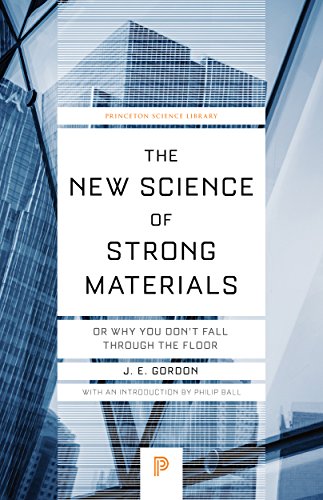
The New Science of Strong Materials: Or Why You Don't Fall Through the Floor (Princeton Science Library, Band 58) - Softcover
Inhaltsangabe
J. E. Gordon's classic introduction to the properties of materials used in engineering answers some fascinating and fundamental questions about how the structural world around us works. Gordon focuses on so-called strong materials--such as metals, wood, ceramics, glass, and bone--explaining in engaging and accessible terms the unique physical and chemical basis for their inherent structural qualities. He also shows how an in-depth understanding of these materials’ intrinsic strengths--and weaknesses--guides our engineering choices, allowing us to build the structures that support our society. This work is an enduring example of first-rate scientific communication. Philip Ball's introduction describes Gordon's career and the impact of his innovations in materials research, while also discussing how the field has evolved since Gordon wrote this enduring example of first-rate scientific communication.
Die Inhaltsangabe kann sich auf eine andere Ausgabe dieses Titels beziehen.
Über die Autorin bzw. den Autor
J. E. Gordon (1913–1998) was a founder of materials science and biomechanics. He was the author of Structures: Or Why Things Don't Fall Down and The Science of Structures and Materials. Philip Ball is a science writer whose work has appeared in Nature, New Scientist, the New York Times, and the Guardian, among others.
Von der hinteren Coverseite
"I found Gordon's writing style fascinating; his book reads like a novel, and the technical content is superb."--Enoch J. Durbin, Princeton University
„Über diesen Titel“ kann sich auf eine andere Ausgabe dieses Titels beziehen.
Suchergebnisse für The New Science of Strong Materials: Or Why You Don't...

Foto des Verkäufers
The New Science of Strong Materials
Verlag:
Princeton University Press, US, 2018
ISBN 10: 0691180989
ISBN 13: 9780691180984
Neu
Paperback
Anbieter: Rarewaves USA, HEBRON, KY, USA
Verkäuferbewertung 5 von 5 Sternen

Paperback. Zustand: New. J. E. Gordon's classic introduction to the properties of materials used in engineering answers some fascinating and fundamental questions about how the structural world around us works. Gordon focuses on so-called strong materials--such as metals, wood, ceramics, glass, and bone--explaining in engaging and accessible terms the unique physical and chemical basis for their inherent structural qualities. He also shows how an in-depth understanding of these materials' intrinsic strengths--and weaknesses--guides our engineering choices, allowing us to build the structures that support our society. This work is an enduring example of first-rate scientific communication. Philip Ball's introduction describes Gordon's career and the impact of his innovations in materials research, while also discussing how the field has evolved since Gordon wrote this enduring example of first-rate scientific communication. Artikel-Nr. LU-9780691180984
Neu kaufen
EUR 17,17
Versand gratis
Versand innerhalb von USA
Versand innerhalb von USA
Anzahl: Mehr als 20 verfügbar
Foto des Verkäufers
The New Science of Strong Materials
Verlag:
Princeton University Press, US, 2018
ISBN 10: 0691180989
ISBN 13: 9780691180984
Neu
Paperback
Anbieter: Rarewaves.com USA, London, LONDO, Vereinigtes Königreich
Verkäuferbewertung 5 von 5 Sternen
Paperback. Zustand: New. J. E. Gordon's classic introduction to the properties of materials used in engineering answers some fascinating and fundamental questions about how the structural world around us works. Gordon focuses on so-called strong materials--such as metals, wood, ceramics, glass, and bone--explaining in engaging and accessible terms the unique physical and chemical basis for their inherent structural qualities. He also shows how an in-depth understanding of these materials' intrinsic strengths--and weaknesses--guides our engineering choices, allowing us to build the structures that support our society. This work is an enduring example of first-rate scientific communication. Philip Ball's introduction describes Gordon's career and the impact of his innovations in materials research, while also discussing how the field has evolved since Gordon wrote this enduring example of first-rate scientific communication. Artikel-Nr. LU-9780691180984
Neu kaufen
EUR 20,75
Versand gratis
Versand von Vereinigtes Königreich nach USA
Versand von Vereinigtes Königreich nach USA
Anzahl: 3 verfügbar
Beispielbild für diese ISBN
The New Science of Strong Materials: Or Why You Don't Fall through the Floor (Princeton Science Library)
Anbieter: California Books, Miami, FL, USA
Verkäuferbewertung 5 von 5 Sternen
Zustand: New. Artikel-Nr. I-9780691180984
Neu kaufen
EUR 19,30
EUR 2,68 Versand
Versand innerhalb von USA
Versand innerhalb von USA
Anzahl: Mehr als 20 verfügbar
Beispielbild für diese ISBN
The New Science of Strong Materials (Princeton Science Library)
Anbieter: Chiron Media, Wallingford, Vereinigtes Königreich
Verkäuferbewertung 5 von 5 Sternen
Paperback. Zustand: New. Brand new book, sourced directly from publisher. Dispatch time is 9-10 days from our warehouse. Book will be sent in robust, secure packaging to ensure it reaches you securely. Artikel-Nr. 6666-BKZ-9780691180984
Neu kaufen
EUR 18,90
EUR 5,98 Versand
Versand von Vereinigtes Königreich nach USA
Versand von Vereinigtes Königreich nach USA
Anzahl: 5 verfügbar
Foto des Verkäufers
New Science of Strong Materials : Or Why You Don't Fall Through the Floor
Anbieter: GreatBookPricesUK, Woodford Green, Vereinigtes Königreich
Verkäuferbewertung 5 von 5 Sternen
Zustand: New. Artikel-Nr. 30615563-n
Neu kaufen
EUR 18,33
EUR 17,98 Versand
Versand von Vereinigtes Königreich nach USA
Versand von Vereinigtes Königreich nach USA
Anzahl: Mehr als 20 verfügbar
Beispielbild für diese ISBN
The New Science of Strong Materials: Or Why You Don t Fall through the Floor
Anbieter: Kennys Bookstore, Olney, MD, USA
Verkäuferbewertung 5 von 5 Sternen
Zustand: New. 2020. Revised edition. Paperback. . . . . . Books ship from the US and Ireland. Artikel-Nr. V9780691180984
Neu kaufen
EUR 27,00
EUR 9,37 Versand
Versand innerhalb von USA
Versand innerhalb von USA
Anzahl: 1 verfügbar
Beispielbild für diese ISBN
The New Science of Strong Materials or Why You Don't Fall Through the Floor: Or Why You Don't Fall Through the Floor
Anbieter: Revaluation Books, Exeter, Vereinigtes Königreich
Verkäuferbewertung 5 von 5 Sternen
Paperback. Zustand: Brand New. revised edition. 328 pages. 8.50x5.50x1.00 inches. In Stock. Artikel-Nr. x-0691180989
Neu kaufen
EUR 22,04
EUR 14,98 Versand
Versand von Vereinigtes Königreich nach USA
Versand von Vereinigtes Königreich nach USA
Anzahl: 2 verfügbar
Beispielbild für diese ISBN
The New Science of Strong Materials
Anbieter: Majestic Books, Hounslow, Vereinigtes Königreich
Verkäuferbewertung 4 von 5 Sternen

Zustand: New. pp. 328. Artikel-Nr. 370388642
Neu kaufen
EUR 30,74
EUR 7,79 Versand
Versand von Vereinigtes Königreich nach USA
Versand von Vereinigtes Königreich nach USA
Anzahl: 1 verfügbar
Foto des Verkäufers
New Science of Strong Materials : Or Why You Don't Fall Through the Floor
Verlag:
Princeton University Press, 2018
ISBN 10: 0691180989
ISBN 13: 9780691180984
Gebraucht
Softcover
Anbieter: GreatBookPricesUK, Woodford Green, Vereinigtes Königreich
Verkäuferbewertung 5 von 5 Sternen
Zustand: As New. Unread book in perfect condition. Artikel-Nr. 30615563
Gebraucht kaufen
EUR 21,95
EUR 17,98 Versand
Versand von Vereinigtes Königreich nach USA
Versand von Vereinigtes Königreich nach USA
Anzahl: Mehr als 20 verfügbar
Foto des Verkäufers
The New Science of Strong Materials
Verlag:
Princeton University Press, US, 2018
ISBN 10: 0691180989
ISBN 13: 9780691180984
Neu
Paperback
Anbieter: Rarewaves USA United, HEBRON, KY, USA
Verkäuferbewertung 5 von 5 Sternen
Paperback. Zustand: New. J. E. Gordon's classic introduction to the properties of materials used in engineering answers some fascinating and fundamental questions about how the structural world around us works. Gordon focuses on so-called strong materials--such as metals, wood, ceramics, glass, and bone--explaining in engaging and accessible terms the unique physical and chemical basis for their inherent structural qualities. He also shows how an in-depth understanding of these materials' intrinsic strengths--and weaknesses--guides our engineering choices, allowing us to build the structures that support our society. This work is an enduring example of first-rate scientific communication. Philip Ball's introduction describes Gordon's career and the impact of his innovations in materials research, while also discussing how the field has evolved since Gordon wrote this enduring example of first-rate scientific communication. Artikel-Nr. LU-9780691180984
Neu kaufen
EUR 18,34
EUR 44,62 Versand
Versand innerhalb von USA
Versand innerhalb von USA
Anzahl: Mehr als 20 verfügbar