
Verwandte Artikel zu Holy Roman Empire: A Short History
Inhaltsangabe
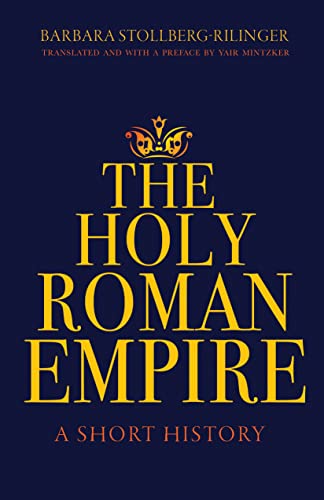
The Holy Roman Empire emerged in the Middle Ages as a loosely integrated union of German states and city-states under the supreme rule of an emperor. Around 1500, it took on a more formal structure with the establishment of powerful institutions--such as the Reichstag and Imperial Chamber Court- that would endure more or less intact until the empire's dissolution by Napoleon in 1806. Barbara Stollberg-Rilinger provides a concise history of the Holy Roman Empire, presenting an entirely new interpretation of the empire's political culture and remarkably durable institutions. In a narrative spanning three turbulent centuries, she takes readers from the reform era at the dawn of the sixteenth century to the crisis of the Reformation, from the consolidation of the Peace of Augsburg to the destructive fury of the Thirty Years' War, from the conflict between Austria and Prussia to the empire's downfall in the age of the French Revolution
Die Inhaltsangabe kann sich auf eine andere Ausgabe dieses Titels beziehen.
Über die Autorin bzw. den Autor
Barbara Stollberg-Rilinger is professor and chair of early modern history at the University of Münster in Germany. Her many books include her acclaimed biography of Maria Theresa, which won Germany's prestigious Leipzig Book Fair Prize in 2017, and The Emperor's Old Clothes: Constitutional History and the Symbolic Language of the Holy Roman Empire. Yair Mintzker is professor of history at Princeton University. His books include The Many Deaths of Jew Süss: The Notorious Trial and Execution of an Eighteenth-Century Court Jew (Princeton).
Von der hinteren Coverseite
"Barbara Stollberg-Rilinger, one of Germany’s leading historians, provides an elegant, succinct, and thought-provoking account of that most baffling of states, the Holy Roman Empire. Her distinctive and novel approach balances the recent, more positive assessment of the empire as a functioning political structure with an innovative interpretation of its conservative political culture. Readers are given a clear explanation of why it overcame some problems and not others, and why it ended in 1806."--Peter H. Wilson, author of Heart of Europe: A History of the Holy Roman Empire
"This important book advances a new interpretation of the Holy Roman Empire that promises to free analyses of the empire's inner workings from the burdens of contemporary political memory. Stollberg-Rilinger makes the imperial political system, endlessly complex though it was, accessible and comprehensible to a wider audience."--David M. Luebke, author of Hometown Religion: Regimes of Coexistence in Early Modern Westphalia
Auszug. © Genehmigter Nachdruck. Alle Rechte vorbehalten.
The Holy Roman Empire
A Short History
By Barbara Stollberg-Rilinger, Yair MintzkerPRINCETON UNIVERSITY PRESS
Copyright © 2018 Princeton University Press
All rights reserved.
ISBN: 978-0-691-17911-7All rights reserved.
Contents
Translator's Preface to the English Edition, vii,
A Note on the Translation, xiii,
Introduction, 1,
1. What Was the Holy Roman Empire of the German Nation?, 10,
2. A Body Made of Head and Limbs, 17,
3. Institutional Consolidation, 1495-1521, 43,
4. The Challenge of the Reformation, 1521-1555, 60,
5. From the Consolidation to the Crisis of the Imperial Institutions, 1555-1618, 76,
6. The Thirty Years' War and the Peace of Westphalia, 88,
7. The Westphalian Order and the Renewed Rise of the Emperor, 106,
8. Political Polarization, 1740-1790, 120,
9. The Dissolution of the Empire, 1790-1806, 132,
10. Once Again: What Was the Holy Roman Empire?, 140,
The Roman-German Emperors of the Early Modern Period, 147,
Select Bibliography, 149,
Index, 157,
CHAPTER 1
WHAT WAS THE HOLY ROMAN EMPIRE OF THE GERMAN NATION?
The very name "Holy Roman Empire of the German Nation" hints at this polity's ambiguous, perhaps even peculiar, character. It was "Roman" but also "German"; it was an empire, but it also belonged to a specific "nation"; and somehow it was supposed to be "holy." What was it, then?
As a polity, the Empire largely escapes modern constitutional categories, and so it is far easier to say what it wasn't than to determine what it actually was. The Holy Roman Empire was neither a state nor a confederation of states. It had no systematic written constitution, it acknowledged no equality before the law — not even as an ideal — and it did not impart Imperial citizenship on its inhabitants. The Empire furthermore did not encompass a territory with clearly defined boundaries, and it possessed no sovereign, supreme authority, no central executive, no bureaucracy, and no standing army. In short, the Holy Roman Empire lacked almost all those characteristics that define modern states as such. Using modern constitutional categories to define it might consequently lead to a negative evaluation of its history almost by default. To understand what the Empire actually was, we must describe it on its own terms and refrain from using modern concepts that, throughout its long history, had always remained foreign to it.
While it existed, the Empire was most commonly imagined as a loose political body. It contained very different members, or "limbs," that formed individual ties to a common overlord, or "head" (the emperor), through oaths of personal fealty. Generally speaking, the cohesiveness of this body politic declined over the course of the Middle Ages, but around the year 1500 the Empire evolved along new lines and took more solid institutional forms. Despite rising political tensions and even outright open conflicts, the Empire lasted for another three hundred years. It ceased to exist only under the impact of the French Revolution and the Napoleonic Wars.
In contrast to the relative independence of the political realm in modern systems of government, the political system of the Holy Roman Empire was still tightly connected to the social and religious structures of its day. Its constitution resembled less a systematic modern legal code and much more a colorful fabric woven out of both new and old threads. These threads included symbolic and ceremonial practices, formal and informal rules, some occasionally negotiated consensual decisions and contracts, a few fixed, written fundamental laws (leges fundamentales), many traditional forms of legitimacy, and a multitude of incompatible and indeed conflicting legal-political claims. Within this complex system, every rule had its exceptions and every abstract definition was restricted in practice. Moreover, different Imperial members perceived the Empire's basic structure differently, depending on their particular point of view, and these perceptions constantly changed and evolved over time. All of this makes it close to impossible to muster a clear-cut definition of the Empire. If I nevertheless attempt to do so here, the reader should take it with a grain of salt. In reality, things were always much more complicated.
A good starting point for our discussion is the Empire's very title. The complete name "The Holy Roman Empire of the German Nation" appeared for the first time only at the end of the fifteenth century, and it would never be the sole — let alone the official — title of the Empire. According to an often-quoted quip by the eighteenth-century French philosopher Voltaire, the Holy Roman Empire was neither holy nor Roman, nor indeed an empire at all. This witticism aside, a close investigation of the individual elements in the Empire's title does reveal important clues about its composite — part medieval, part early modern — character.
Here, first of all, is the term "empire," imperium in Latin, which denotes a supreme overlordship, namely that of the emperor. During the Middle Ages, "imperium" was a common synonym for the office of the emperor himself. Its primary meaning was not a specific territory in which the emperor ruled supreme, but a universal, transpersonal authority that was not bound to a specific region or people.
The term "Roman" placed the Empire within the ancient European imperial tradition. As the first medieval ruler of the West, Charlemagne had himself crowned emperor by the pope in the year 800, thus transforming himself from a king of one Germanic tribe (the Franks) into a ruler with universal aspirations and a sacred aura. Charlemagne's empire disintegrated not long after his death. But Otto the Great, Charlemagne's distant descendant, revived the same idea in 962 when he related his east Frankish (later German) kingship to the imperial traditions of ancient Rome. From that point on, almost all German kings also possessed the title of "Roman emperor." The idea of translatio imperii — the uninterrupted passing, or "translation," of rulership from the ancient Romans to the Franks and then further down to the great medieval German dynasties — was obviously a fiction. At the same time, it was based on the symbolic act of coronation by the pope, who was the supreme head of the Roman Church. This symbolic act allowed German emperors to claim political authority over all Christians and precedence over all other European rulers. By invoking the idea of translatio imperii, medieval emperors placed themselves within the divine history of the ancient Roman empire, the political entity in which Jesus Christ lived and died and which eventually allowed for the spread of the Gospel over the entire known world. Common late antique interpretations of the Book of Daniel also viewed the Roman empire as the last of the four worldly empires, at the fall of which the Antichrist would appear and the Last Judgment take place. These biblical interpretations bolstered the idea of translatio imperii. If the world had yet to come to an end, the Roman empire must have continued to exist one way or another.
The ancient Roman empire was not called "holy" (sacrum in Latin). Only since the time of Emperor Frederick Barbarossa in the twelfth century does one find this adjective attached to the Empire's title. It was introduced in the context of the hugely contested issue of the supposed subordination of the emperor to the pope, an argument first espoused by Pope Gregory VII in the...
„Über diesen Titel“ kann sich auf eine andere Ausgabe dieses Titels beziehen.
Suchergebnisse für Holy Roman Empire: A Short History

Beispielbild für diese ISBN
The Holy Roman Empire: A Short History
Verlag:
Princeton University Press, 2018
ISBN 10: 0691179115
ISBN 13: 9780691179117
Gebraucht
Paperback
Anbieter: WorldofBooks, Goring-By-Sea, WS, Vereinigtes Königreich
Verkäuferbewertung 5 von 5 Sternen

Paperback. Zustand: Very Good. The book has been read, but is in excellent condition. Pages are intact and not marred by notes or highlighting. The spine remains undamaged. Artikel-Nr. GOR009948260
Gebraucht kaufen
EUR 19,36
EUR 6,53 Versand
Versand von Vereinigtes Königreich nach USA
Versand von Vereinigtes Königreich nach USA
Anzahl: 1 verfügbar
Beispielbild für diese ISBN
The Holy Roman Empire
Anbieter: PBShop.store US, Wood Dale, IL, USA
Verkäuferbewertung 5 von 5 Sternen
HRD. Zustand: New. New Book. Shipped from UK. Established seller since 2000. Artikel-Nr. WP-9780691179117
Beispielbild für diese ISBN
The Holy Roman Empire: A Short History: 4
Verlag:
Princeton University Press, 2018
ISBN 10: 0691179115
ISBN 13: 9780691179117
Gebraucht
Hardcover
Anbieter: HALCYON BOOKS, LONDON, Vereinigtes Königreich
Verkäuferbewertung 5 von 5 Sternen
Hardcover. Zustand: Very Good. Zustand des Schutzumschlags: Very Good. NEW EU 3 EURO CHARGE FOR IMPORTS IS INCLUDED IN OUR SHIPPING PRICE. ALL ITEMS ARE DISPATCHED FROM THE UK, ALL OVERSEAS ORDERS SENT BY TRACKABLE AIR MAIL. IF YOU ARE LOCATED OUTSIDE THE UK PLEASE ASK US FOR A POSTAGE QUOTE FOR MULTI VOLUME SETS BEFORE ORDERING. Artikel-Nr. mon0000987579
Gebraucht kaufen
EUR 14,69
EUR 20,99 Versand
Versand von Vereinigtes Königreich nach USA
Versand von Vereinigtes Königreich nach USA
Anzahl: 1 verfügbar
Foto des Verkäufers
The Holy Roman Empire: A Short History
Verlag:
Princeton University Press, Princeton, NJ, USA, 2018
ISBN 10: 0691179115
ISBN 13: 9780691179117
Gebraucht
Hardcover
Erstausgabe
Anbieter: BookAddiction (IOBA, IBooknet), Canterbury, Vereinigtes Königreich
Verkäuferbewertung 5 von 5 Sternen
Hardcover. Zustand: Near Fine. Zustand des Schutzumschlags: Very Good. 1st Edition. First English language edition, first printing (previously published in the original German). xii, 164pp, with black and white illustrations in text. Black cloth-covered boards with gilt titles on the spine. Yellow endpapers. 8vo. Volume is neat, clean, bright and tight throughout. In its original illustrated dust jacket, not price clipped, very slightly rubbed on extreme edges, slight shelf wear visible on verso. Artikel-Nr. 041601
Gebraucht kaufen
EUR 30,03
EUR 8,16 Versand
Versand von Vereinigtes Königreich nach USA
Versand von Vereinigtes Königreich nach USA
Anzahl: 1 verfügbar
Beispielbild für diese ISBN
The Holy Roman Empire
Anbieter: PBShop.store UK, Fairford, GLOS, Vereinigtes Königreich
Verkäuferbewertung 5 von 5 Sternen
HRD. Zustand: New. New Book. Shipped from UK. Established seller since 2000. Artikel-Nr. WP-9780691179117
Neu kaufen
EUR 33,82
EUR 4,85 Versand
Versand von Vereinigtes Königreich nach USA
Versand von Vereinigtes Königreich nach USA
Anzahl: 4 verfügbar
Beispielbild für diese ISBN
The Holy Roman Empire: A Short History
Anbieter: Majestic Books, Hounslow, Vereinigtes Königreich
Verkäuferbewertung 4 von 5 Sternen

Zustand: New. Artikel-Nr. 384187661
Neu kaufen
EUR 41,25
EUR 7,58 Versand
Versand von Vereinigtes Königreich nach USA
Versand von Vereinigtes Königreich nach USA
Anzahl: 3 verfügbar
Beispielbild für diese ISBN
The Holy Roman Empire: A Short History
Anbieter: Kennys Bookstore, Olney, MD, USA
Verkäuferbewertung 5 von 5 Sternen
Zustand: New. 2018. Hardcover. . . . . . Books ship from the US and Ireland. Artikel-Nr. V9780691179117
Neu kaufen
EUR 40,89
EUR 9,14 Versand
Versand innerhalb von USA
Versand innerhalb von USA
Anzahl: 1 verfügbar
Beispielbild für diese ISBN
The Holy Roman Empire: A Short History
Anbieter: Ria Christie Collections, Uxbridge, Vereinigtes Königreich
Verkäuferbewertung 5 von 5 Sternen
Zustand: New. In English. Artikel-Nr. ria9780691179117_new
Neu kaufen
EUR 40,12
EUR 10,93 Versand
Versand von Vereinigtes Königreich nach USA
Versand von Vereinigtes Königreich nach USA
Anzahl: 4 verfügbar
Beispielbild für diese ISBN
The Holy Roman Empire, Volume IV, parts 1 and 2 A Short History
Anbieter: Revaluation Books, Exeter, Vereinigtes Königreich
Verkäuferbewertung 5 von 5 Sternen
Hardcover. Zustand: Brand New. 164 pages. 8.75x5.50x0.75 inches. In Stock. Artikel-Nr. __0691179115
Neu kaufen
EUR 41,55
EUR 11,66 Versand
Versand von Vereinigtes Königreich nach USA
Versand von Vereinigtes Königreich nach USA
Anzahl: 2 verfügbar
Beispielbild für diese ISBN
The Holy Roman Empire, Volume IV, parts 1 and 2 A Short History
Anbieter: Revaluation Books, Exeter, Vereinigtes Königreich
Verkäuferbewertung 5 von 5 Sternen
Hardcover. Zustand: Brand New. 164 pages. 8.75x5.50x0.75 inches. In Stock. Artikel-Nr. x-0691179115
Neu kaufen
EUR 63,40
EUR 11,66 Versand
Versand von Vereinigtes Königreich nach USA
Versand von Vereinigtes Königreich nach USA
Anzahl: 2 verfügbar