
Verwandte Artikel zu Dining Posture in Ancient Rome: Bodies, Values, and...
Inhaltsangabe
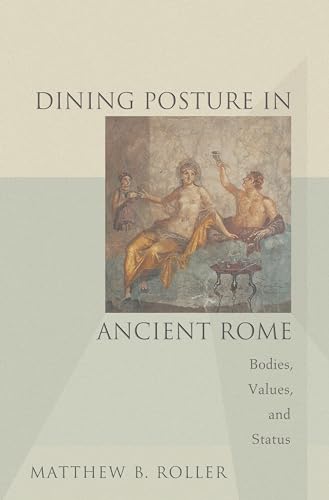
What was really going on at Roman banquets? In this lively new book, veteran Romanist Matthew Roller looks at a little-explored feature of Roman culture: dining posture. In ancient Rome, where dining was an indicator of social position as well as an extended social occasion, dining posture offered a telling window into the day-to-day lives of the city's inhabitants. This book investigates the meaning and importance of the three principal dining postures--reclining, sitting, and standing--in the period 200 B.C.-200 A.D. It explores the social values and distinctions associated with each of the postures and with the diners who assumed them. Roller shows that dining posture was entangled with a variety of pressing social issues, such as gender roles and relations, sexual values, rites of passage, and distinctions among the slave, freed, and freeborn conditions. Timely in light of the recent upsurge of interest in Roman dining, this book is equally concerned with the history of the body and of bodily practices in social contexts. Roller gathers evidence for these practices and their associated values not only from elite literary texts, but also from subelite visual representations--specifically, funerary monuments from the city of Rome and wall paintings of dining scenes from Pompeii. Engagingly written, Dining Posture in Ancient Rome will appeal not only to the classics scholar, but also to anyone interested in how life was lived in the Eternal City.
Die Inhaltsangabe kann sich auf eine andere Ausgabe dieses Titels beziehen.
Über die Autorin bzw. den Autor
Matthew B. Roller is Professor of Classics at Johns Hopkins University. He is the author of Constructing Autocracy: Aristocrats and Emperors in Julio-Claudian Rome (Princeton).
Von der hinteren Coverseite
"A scholarly and significant book on an important aspect of Roman conviviality, written with clarity and elegance."--Oswyn Murray, University of Oxford
"Matthew Roller is refreshingly challenging in his unwillingness to accept the communis opinio of scholarship while candid about the speculative character of many of his own conclusions. The book engages consistently and persuasively with past and current work on Roman dining and the topic is timely and sure to be of interest."--Anthony Corbeill, University of Kansas
Auszug. © Genehmigter Nachdruck. Alle Rechte vorbehalten.
Dining Posture in Ancient Rome
Bodies, Values, and Status
By Matthew B. RollerPRINCETON UNIVERSITY PRESS
Copyright © 2006 Princeton University Press
All rights reserved.
ISBN: 978-0-691-17800-4All rights reserved.
Contents
List of Illustrations, ix,
Acknowledgments, xi,
Abbreviations, xiii,
Introduction, 1,
Chapter One Dining Men: Posture, Leisure, and Privilege, 15,
Chapter Two Dining Women: Posture, Sex, and Status, 96,
Chapter Three Dining Children: Posture, Pedagogy, and Coming-of-Age, 157,
Appendix: Convivial Wine Drinking and Comissationes, 181,
Catalogue of Funerary Monuments and Wall Paintings, 189,
Bibliography, 197,
Index Locorum, 209,
General Index, 215,
CHAPTER 1
Dining Men: Posture, Leisure, and Privilege
1. Overview
THROUGHOUT THE PERIOD OF INTEREST to this study, in all the media under examination, free adult males are represented as reclining to dine at convivia in the normal course of events. As noted in the introduction, the practice of reclining was transmitted from the Near East through the Greek world into central Italy by the late archaic period. In all these cultures, reclining marked a greater degree of social privilege and autonomy than was associated with the other possible dining postures, namely, sitting and standing. In each culture that appropriated the reclining posture, however, that privilege and autonomy was articulated through locally distinctive social forms; the posture was always embedded in, and in turn helped to construct and sustain, a culturally unique regime of social values and symbols. In the Roman case, in our period, the reclining dining posture is associated with one social value in particular: otium (leisure) and the various pleasures and luxuries that Roman otium comprises. In this chapter, I examine the link between reclining dining and otium in the three media defined in the introduction: literary texts in section 2, funerary monuments in section 3, and wall paintings in section 4. I treat these media separately not only because they emerge from and address themselves to different social strata but also because each medium has a distinctive place in the spaces and rhythms of everyday Roman life. Thus, to discuss representations of reclining dining in the different media is also to discuss different producers, consumers, settings, and meanings for these representations, even though the activity represented in each case is broadly the same. These representations do allow for synthesis and cross-illumination, but only after the fundamental differences are carefully accounted for. The concluding sections of the chapter (5 and 6) discuss circumstances under which free adult males reject the reclining dining posture and its associated otium.
2. Reclining and Elite Otium: Some Literary Evidence
The association of the reclining dining posture with otium is articulated most clearly in literary texts. Being produced largely by and for a Rome-oriented elite, these texts tend to articulate elite urban values, anxieties, and practices. In such texts, conviviality is often categorized under the rubric of otium, and is implicitly or explicitly contrasted with the various negotia — the occupations or duties — by which elite Roman males occupied themselves much of the time, and indeed defined themselves as elite Roman males: their own private social and economic affairs; legal advocacy on behalf of their clients or friends; discharging magistracies or other military and administrative posts associated with government. More generally still, conviviality in these texts may symbolize or instantiate something "pleasant," in contrast to "unpleasant" alternatives. While the association of elite conviviality with otium should come as no surprise, it seems worthwhile to cite a handful of literary passages, scattered across various genres and ranging throughout the period under discussion, that illustrate this association, and that show how the reclining posture is implicated in this schema.
To begin with the earliest Roman literary texts, several Plautine dramas contain convivial scenes in which high-status males dine and drink while reclining in one another's company and alongside courtesans. The convivium is thus a place where such males enjoy a nexus of pleasures: wine, food, companionship, and the prospect (at least) of sex. Meanwhile, a fragment of the historian Calpurnius Piso, dating to the late second century B.C., relates that King Romulus drank wine sparingly when invited to dinner, on the ground that he had serious work to do the next day (eundem Romulum dicunt ad cenam vocatum ibi non multum bibisse, quia postridie negotium haberet). Thus the sharp distinction between elite negotium and the activities of the convivium — along with a moral hierarchy privileging the former over the latter — is attributed to the city's founder, and so receives strong ideological sanction. Moving into the late Republic, Catullus, in poem 50, declares that he and his friend Licinius Calvus are "at leisure" (otiosi, v. 1), playfully composing spontaneous verses and drinking wine in an atmosphere filled with eroticism. Meanwhile, Cicero, early in his treatise on the ideal orator (De Or. 1.27), contrasts convivial pleasures with more "serious" activities and concerns. He relates that, when he was a young man, the senior senator and orator Cotta regaled him with a story dating from Cotta's own youth. Cotta said that he himself had participated one day in a gloomy and difficult discussion with certain éminences grises regarding the condition of the state. Following this discussion, however, when the party repaired to the dining couches, the host Crassus dispelled the prevailing gloom with his humanity, urbanity, and pleasantness. Cotta contrasts these differing moods as follows: "In the company of these men the day seemed to have been spent in the senate-house, but the dinner party in a villa in Tusculum." That is, the grave affairs of state (negotia), which filled the day's conversation, stereotypically occupied the curia at the political heart of the Roman Republican forum, while the pleasurable, cheerful reclining fellowship of the evening convivium (otium) better suited a country villa. Cicero himself, according to his biographer Plutarch (Cic. 8.4), almost never reclined for dinner before sundown, citing a bad stomach and also his ?s????a (i.e., negotia) as keeping him away.
Moving into the Augustan and Imperial ages, Horace contrasts otium and negotium, though not necessarily in these terms, in some of his dinner-invitation odes (e.g., Carm. 2.11, 3.8, 3.29). Here he dangles before his addressee — in each case, a magistrate busy with public affairs — the enticements of companionship, sex, and especially wine, requesting that he embrace these pleasures and abandon for the evening his anxious cares on behalf of the state. In a more mythical vein the wretched Phineus, in Valerius Flaccus's Argonautica, is finally delivered from the plague of Harpies; at last he can recline on a dining couch and consume food and drink, joyful at the forgotten pleasures of the table; he now enjoys tranquillity and indeed "drinks down forgetfulness of his long punishment" (4.529–37). Meanwhile, a declamation in the elder Seneca's collection (Cont. 9.2) posits that a provincial governor, L. Quinctius Flamininus, executed a criminal in the midst of...
„Über diesen Titel“ kann sich auf eine andere Ausgabe dieses Titels beziehen.
Suchergebnisse für Dining Posture in Ancient Rome: Bodies, Values, and...

Beispielbild für diese ISBN
Dining Posture in Ancient Rome Bodies, Values, and Status
Anbieter: Revaluation Books, Exeter, Vereinigtes Königreich
Verkäuferbewertung 5 von 5 Sternen

Paperback. Zustand: Brand New. reprint edition. 219 pages. 9.50x6.25x0.75 inches. In Stock. Artikel-Nr. x-0691178003
Neu kaufen
EUR 61,75
EUR 11,80 Versand
Versand von Vereinigtes Königreich nach USA
Versand von Vereinigtes Königreich nach USA
Anzahl: 2 verfügbar