
Verwandte Artikel zu What the Victorians Made of Romanticism: Material Artifacts,...
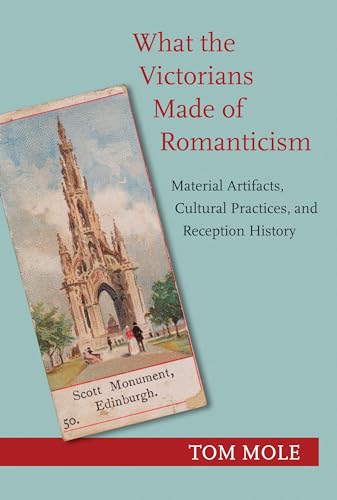
What the Victorians Made of Romanticism: Material Artifacts, Cultural Practices, and Reception History - Hardcover
Inhaltsangabe
This insightful and elegantly written book examines how the popular media of the Victorian era sustained and transformed the reputations of Romantic writers. Tom Mole provides a new reception history of Lord Byron, Felicia Hemans, Sir Walter Scott, Percy Bysshe Shelley, and William Wordsworth—one that moves beyond the punctual historicism of much recent criticism and the narrow horizons of previous reception histories. He attends instead to the material artifacts and cultural practices that remediated Romantic writers and their works amid shifting understandings of history, memory, and media.
Mole scrutinizes Victorian efforts to canonize and commodify Romantic writers in a changed media ecology. He shows how illustrated books renovated Romantic writing, how preachers incorporated irreligious Romantics into their sermons, how new statues and memorials integrated Romantic writers into an emerging national pantheon, and how anthologies mediated their works to new generations. This ambitious study investigates a wide range of material objects Victorians made in response to Romantic writing—such as photographs, postcards, books, and collectibles—that in turn remade the public’s understanding of Romantic writers.
Shedding new light on how Romantic authors were posthumously recruited to address later cultural concerns, What the Victorians Made of Romanticism reveals new histories of appropriation, remediation, and renewal that resonate in our own moment of media change, when once again the cultural products of the past seem in danger of being forgotten if they are not reimagined for new audiences.
Die Inhaltsangabe kann sich auf eine andere Ausgabe dieses Titels beziehen.
Über die Autorin bzw. den Autor
Tom Mole is Reader in English Literature and Director of the Centre for the History of the Book at the University of Edinburgh. He is the author of Byron’s Romantic Celebrity, the editor of Romanticism and Celebrity Culture, the coeditor of The Broadview Reader in Book History, and the coauthor of The Broadview Introduction to Book History.
Von der hinteren Coverseite
"This ambitious book is a major contribution to our understanding of Romanticism, not only what it was but also what it became. It will be an essential guide to the web of reception and remaking for period specialists, while also posing urgent questions—and answers—for our own moment of hypermediation."--Clifford Siskin, New York University
"What have Victorian temperance lectures to do with Shelley, retrofitted illustrations to say about Wordsworth, or snuffboxes and postcards to tell us about Scott? In fascinating case studies, Tom Mole traces the unexpected shapes that literature is requisitioned to fill in the interests of its own survival. Mole writes with relish and flair, and with a canny awareness that these are the stories of what happens as texts and reputations are remade and reused for more purposes than those of the professional critic."--Kathryn Sutherland, University of Oxford
"Original and compelling. What the Victorians Made of Romanticism presents a number of valuable insights and perspectives on its topic."--Antony H. Harrison, author of Victorian Poets and Romantic Poems: Intertextuality and Ideology
"Convincing and nuanced. Mole extends existing knowledge of the Victorian reshaping of Romanticism by tracing the cultural transmission of selected Romantic poets through often overlooked reception practices such as sermons, illustrations, anthologies, and statues."--Kim Wheatley, author of Romantic Feuds: Transcending the "Age of Personality"
"A splendid book. Mole provides a much needed perspective on how the broader culture of the Victorian age responded to a highly selective and heavily mediated and remediated version of Romanticism."--David G. Riede, author of Matthew Arnold and the Betrayal of Language
Auszug. © Genehmigter Nachdruck. Alle Rechte vorbehalten.
What the Victorians Made of Romanticism
Material Artifacts, Cultural Practices, and Reception History
By Tom MolePRINCETON UNIVERSITY PRESS
Copyright © 2017 Princeton University Press
All rights reserved.
ISBN: 978-0-691-17536-2All rights reserved.
Contents
List of Illustrations and Tables, ix,
Acknowledgments, xi,
Introduction Don Juan in the Pub, 1,
PART I. THE WEB OF RECEPTION, 7,
1 Romantic Writers in the Victorian Media Ecology, 9,
2 Reception Traditions and Punctual Historicism, 21,
3 Minding the Generation Gap, 31,
PART II. ILLUSTRATIONS, 43,
4 Illustration as Renovation, 45,
5 Renovating Romantic Poetry: Retrofitted Illustrations, 55,
6 Turning the Page: Illustrated Frontmatter, 72,
PART III. SERMONS, 87,
7 A Religious Reception Tradition, 89,
8 Converting Shelley, 100,
9 Spurgeon, Byron, and the Contingencies of Mediation, 117,
PART IV. STATUES, 131,
10 Secular Pantheons for the Reformed Nation: Byron in Cambridge, 133,
11 The Distributed Pantheon: Scott in Edinburgh, 145,
12 The Networked Pantheon: Byron in London, 164,
PART V. ANTHOLOGIES, 183,
13 Scattered Odes in Shattered Books: Quantifying Victorian Anthologies, 185,
14 Romantic Short Poems in Victorian Anthologies, 195,
15 Romantic Long Poems in Victorian Anthologies, 211,
Coda Ozymandias at the Olympics; or, She Walks in Brixton, 225,
Notes, 233,
Bibliography, 283,
Index, 307,
CHAPTER 1
Romantic Writers in the Victorian Media Ecology
FOR A WHILE, it seemed that the Romantics would not be remembered at all. Many early-Victorian commentators worried that the writing of the recent past no longer compelled readers' interest, and that it would soon be forgotten. The predictions began polemically. Blackwood's Magazine claimed in 1820 that John Keats had ruined his talent by imitating Leigh Hunt, that "he must be content to share his fate, and be like him forgotten," and Coleridge wrote in 1825 that he "dare[d] predict, that in less than a century" Byron's and Scott's poems would "lie on the same Shelf of Oblivion." John Todd felt sure in 1835 that Byron would "quickly pass from notice." Predictions soon became warnings. The Quarterly Review asserted that Scott was "in danger of passing — we cannot conceive why — out of the knowledge of the rising generation," and Thomas Carlyle cautioned in 1829 that "Byron [...] with all his wild siren charming, already begins to be disregarded and forgotten." And the warnings became simple statements of fact. Orestes Brownson asserted in 1841 that Shelley was "seldom spoken of and much more seldom read." The Graphic cattily remarked in 1873 that Hemans was "almost as much neglected now, as she was overrated formerly," while another journalist in 1886 thought that she was "a writer too little read by our young people of the present day." Stopford Brooke declared simply in 1893 that Byron was "not much read now."
If anyone read the Romantics, some claimed, it was only those people who scarcely counted, like adolescents or the uneducated. Selections of Wordsworth's poetry "chiefly for the use of schools and young persons" appeared from as early as 1831, while in 1848 Readings for the Young, from the Works of Sir Walter Scott inaugurated a tradition of excerpting or retelling Scott's works for children. Walter Bagehot wrote that "a stray schoolboy may still be detected in a wild admiration for The Giaour or The Corsair [...], but the real posterity — the quiet students of past literature — never read them or think of them." T. S. Eliot followed this line when he recalled taking "the usual adolescent course with Byron, Shelley, [and] Keats," dismissed enthusiasm for Shelley as "an affair of adolescence," and described some of Byron's Don Juan as "not too good for the school magazine."
This chapter explains why so many Victorians thought that Romantic writing was starting to seem irrelevant and in danger of being forgotten. The underlying causes, I argue, lay in shifting concepts of history, new anxieties about cultural memory, and a rapidly changing media ecology. When these elements came together, sometime between roughly 1750 and 1850, they created the cultural conditions of modernity, which defined itself as distinctly and self-consciously different from what had gone before. When self-consciously modern people looked back from the nineteenth century to the poets and novelists of their parents' generation, those writers seemed unfitted for addressing modern concerns. The Romantics began to look perilously outdated and uninteresting to new readers. They were liable to gather dust on the "Shelf of Oblivion" if no one took pains to make their works relevant once again. But if the modern nexus of history, memory, and media that I trace here made the Romantics seem old-fashioned, it also created the conditions in which they could be fashioned anew. Changing configurations of history, memory, and media produced the problem and the materials for solving it. Even as they made literature from the recent past seem obsolescent, they created new possibilities for renovating, memorializing, and remediating it. The web of reception would be woven on the conceptual frames that modern understandings of history, memory, and media constructed.
Concerns about who would be remembered and by whom especially clustered around those writers who had been celebrities in their lifetimes. As I have argued elsewhere, a distinctly modern culture of celebrity took shape at the end of the eighteenth century. It emerged in response to the industrialization of print culture and the growth of an audience that was large, anonymous, socially diverse and geographically distributed, and it was bound up with shifting conceptions of subjectivity. In these conditions, celebrity emerged as a cultural apparatus with both material and discursive aspects. Celebrity was often understood, then as now, to be an inferior kind of recognition, opposed to true, worthwhile, and lasting fame. Celebrity was thought of as something ascribed rather than earned, here today and gone tomorrow, a meteor that burned itself out too soon. True fame, in contrast, was slow to arrive and usually posthumous, but it lasted forever because it was deserved. Celebrity and true fame each operated in its own timeframe, and they seldom overlapped. Once celebrity and true fame had come to be understood as mutually exclusive, it became easy to assume that those like Byron and Scott who had been celebrities in their lifetimes would soon be forgotten after their deaths. For some individuals, that proved to be the case. Mary Robinson's celebrity was already deserting her by the end of her life (only two people came to her funeral), and after her memoirs and an edition of her works were published posthumously she disappeared from view almost entirely for the rest of the century. When celebrated authors were not in fact forgotten, we can usually discern a variety of efforts that helped to move them across the bar from lifetime celebrity to posthumous fame. This book, then, is partly a sequel to my earlier work; in it, I pursue the story of celebrity beyond the grave to discover what happens to celebrity authors after their deaths. But celebrity is not the whole story here: the web of reception weaves in some other threads as well.
Predictions that Romantic authors would be forgotten were part of a wider set of complaints about the ignorance and presentism of the "rising...
„Über diesen Titel“ kann sich auf eine andere Ausgabe dieses Titels beziehen.
Suchergebnisse für What the Victorians Made of Romanticism: Material Artifacts,...

Beispielbild für diese ISBN
What the Victorians Made of Romanticism: Material Artifacts, Cultural Practices, and Reception History
Anbieter: Labyrinth Books, Princeton, NJ, USA
Verkäuferbewertung 5 von 5 Sternen

Zustand: New. Artikel-Nr. 226534
Neu kaufen
EUR 32,98
EUR 4,00 Versand
Versand innerhalb von USA
Versand innerhalb von USA
Anzahl: 1 verfügbar
Beispielbild für diese ISBN
What the Victorians Made of Romanticism: Material Artifacts, Cultural Practices, and Reception History
Verlag:
Princeton University Press, 2017
ISBN 10: 0691175365
ISBN 13: 9780691175362
Gebraucht
Hardcover
Anbieter: Anybook.com, Lincoln, Vereinigtes Königreich
Verkäuferbewertung 5 von 5 Sternen
Zustand: Good. This is an ex-library book and may have the usual library/used-book markings inside.This book has hardback covers. In good all round condition. Dust jacket in good condition. Please note the Image in this listing is a stock photo and may not match the covers of the actual item,700grams, ISBN:9780691175362. Artikel-Nr. 4144671
Gebraucht kaufen
EUR 23,20
EUR 15,47 Versand
Versand von Vereinigtes Königreich nach USA
Versand von Vereinigtes Königreich nach USA
Anzahl: 1 verfügbar
Foto des Verkäufers
WHAT THE VICTORIANS MADE OF ROMANTICISM
Verlag:
Princeton University Press, Princeton, NJ, 2017
ISBN 10: 0691175365
ISBN 13: 9780691175362
Gebraucht
Hardcover
Erstausgabe
Anbieter: Type Punch Matrix, Silver Spring, MD, USA
Verkäuferbewertung 5 von 5 Sternen
Zustand: Fine in fine jacket. First edition. First printing of this study of the Victorian reception of Romantic writers, with a warm note from the author to contemporary poet and Keats biographer Stanley Plumly. 9'' x 6''. Original dark grey cloth. In original dust jacket. Note in pen from Mole laid in: "Dear Prof. Plumly - Having greatly admired your work on Romantic poetry, I'd be delighted if you'd accept this book as a gift. All good wishes, Tom Mole.". Artikel-Nr. 47239
Gebraucht kaufen
EUR 45,82
Versand gratis
Versand innerhalb von USA
Versand innerhalb von USA
Anzahl: 1 verfügbar
Beispielbild für diese ISBN
What the Victorians Made of Romanticism
Anbieter: PBShop.store US, Wood Dale, IL, USA
Verkäuferbewertung 5 von 5 Sternen
HRD. Zustand: New. New Book. Shipped from UK. Established seller since 2000. Artikel-Nr. WP-9780691175362
Beispielbild für diese ISBN
What the Victorians Made of Romanticism
Anbieter: PBShop.store UK, Fairford, GLOS, Vereinigtes Königreich
Verkäuferbewertung 5 von 5 Sternen
HRD. Zustand: New. New Book. Shipped from UK. Established seller since 2000. Artikel-Nr. WP-9780691175362
Neu kaufen
EUR 51,72
EUR 5,95 Versand
Versand von Vereinigtes Königreich nach USA
Versand von Vereinigtes Königreich nach USA
Anzahl: 2 verfügbar
Beispielbild für diese ISBN
What the Victorians Made of Romanticism
Anbieter: Majestic Books, Hounslow, Vereinigtes Königreich
Verkäuferbewertung 4 von 5 Sternen

Zustand: New. pp. 336. Artikel-Nr. 409317451
Neu kaufen
EUR 61,76
EUR 7,71 Versand
Versand von Vereinigtes Königreich nach USA
Versand von Vereinigtes Königreich nach USA
Anzahl: 3 verfügbar
Beispielbild für diese ISBN
What the Victorians Made of Romanticism: Material Artifacts, Cultural Practices, and Reception History
Anbieter: Kennys Bookstore, Olney, MD, USA
Verkäuferbewertung 5 von 5 Sternen
Zustand: New. 2017. Hardcover. . . . . . Books ship from the US and Ireland. Artikel-Nr. V9780691175362
Neu kaufen
EUR 63,72
EUR 9,34 Versand
Versand innerhalb von USA
Versand innerhalb von USA
Anzahl: 1 verfügbar
Beispielbild für diese ISBN
What the Victorians Made of Romanticism: Material Artifacts, Cultural Practices, and Reception History
Anbieter: Ria Christie Collections, Uxbridge, Vereinigtes Königreich
Verkäuferbewertung 5 von 5 Sternen
Zustand: New. In English. Artikel-Nr. ria9780691175362_new
Neu kaufen
EUR 66,64
EUR 13,39 Versand
Versand von Vereinigtes Königreich nach USA
Versand von Vereinigtes Königreich nach USA
Anzahl: 2 verfügbar
Beispielbild für diese ISBN
What the Victorians Made of Romanticism Material Artifacts, Cultural Practices, and Reception History
Anbieter: Revaluation Books, Exeter, Vereinigtes Königreich
Verkäuferbewertung 5 von 5 Sternen
Hardcover. Zustand: Brand New. 317 pages. 10.00x7.00x1.00 inches. In Stock. Artikel-Nr. __0691175365
Neu kaufen
EUR 67,19
EUR 14,82 Versand
Versand von Vereinigtes Königreich nach USA
Versand von Vereinigtes Königreich nach USA
Anzahl: 2 verfügbar
Foto des Verkäufers
Mole, T: What the Victorians Made of Romanticism
Anbieter: moluna, Greven, Deutschland
Verkäuferbewertung 5 von 5 Sternen
Gebunden. Zustand: New. KlappentextrnrnThis insightful and elegantly written book examines how the popular media of the Victorian era sustained and transformed the reputations of Romantic writers. Tom Mole provides a new reception history of Lord Byron, Felicia Hemans,. Artikel-Nr. 594886406
Neu kaufen
EUR 54,09
EUR 48,99 Versand
Versand von Deutschland nach USA
Versand von Deutschland nach USA
Anzahl: 2 verfügbar