
The Extravagant Universe: Exploding Stars, Dark Energy, and the Accelerating Cosmos: Explding Stars, Dark Energy, andf the Accelerating Cosmos (Princeton Science Library) - Softcover
Buch 25 von 61: Princeton Science Library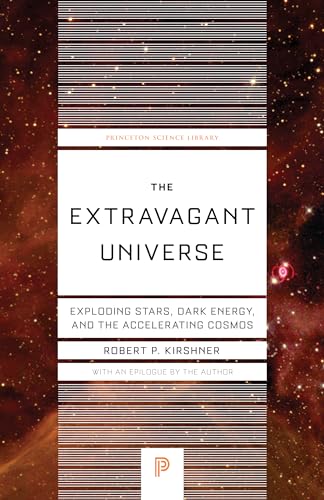
Inhaltsangabe
The Extravagant Universe tells the story of a remarkable adventure of scientific discovery. One of the world's leading astronomers, Robert Kirshner, takes readers inside a lively research team on the quest that led them to an extraordinary cosmological discovery: the expansion of the universe is accelerating under the influence of a dark energy that makes space itself expand. In addition to sharing the story of this exciting discovery, Kirshner also brings the science up-to-date in a new epilogue. He explains how the idea of an accelerating universe--once a daring interpretation of sketchy data--is now the standard assumption in cosmology today.
Die Inhaltsangabe kann sich auf eine andere Ausgabe dieses Titels beziehen.
Über die Autorin bzw. den Autor
Robert P. Kirshner is the Clowes Professor of Science at Harvard University.
Von der hinteren Coverseite
'"This book describes a remarkable era in cosmology. Over the last three years several lines of evidence have gelled into a consistent but--to most of us--unexpected picture of what our universe consists of and how it is expanding. Told by a key participant, the story will be enjoyed by anyone with an interest in astronomy or cosmology, or even merely a general curiosity about science."--Martin Rees, author of Our Cosmic Habitat
"This is a wonderful book on one of the hottest topics in science, written by one of the main contributors to the breakthrough. It presents a history of modern cosmology written in a very lively style with amusing personal stories that make the reading easy and entertaining."--Bohdan Paczynski, Princeton University
Auszug. © Genehmigter Nachdruck. Alle Rechte vorbehalten.
The Extravagant Universe
Exploding Stars Dark Energy and the Accelerating Cosmos
By Robert P. KirshnerPRINCETON UNIVERSITY PRESS
Copyright © 2002 Robert P. Kirshner
All rights reserved.
ISBN: 978-0-691-17318-4All rights reserved.
Contents
PREFACE, ix,
CHAPTER 1 The Big Picture, 1,
CHAPTER 2 Violent Agents of Cosmic Change, 15,
CHAPTER 3 Another Way to Explode, 34,
CHAPTER 4 Einstein Adds a Constant, 49,
CHAPTER 5 Cosmic Expansion, 60,
CHAPTER 6 What Time Is It?, 83,
CHAPTER 7 A Hot Day in Holmdel, 114,
CHAPTER 8 Learning to Swim, 136,
CHAPTER 9 Getting It First, 158,
CHAPTER 10 Getting It Right, 194,
CHAPTER 11 The Smoking Gun?, 234,
EPILOGUE, 262,
NOTES, 271,
ACKNOWLEDGMENTS, 283,
INDEX, 285,
CHAPTER 1
the big picture
At first, the idea of understanding the universe seems preposterous, presumptuous, or in any case, out of reach, precisely because the universe is not built on a human scale of time or size. But we now have a physical picture of the history and evolution of the universe. How have we overcome the limitations of our small brains, our short lives, and our absurdly small stature to understand an ancient and immense universe?
We're so brief. The stars seem permanent, but that's only because we're just passing through. If you live for 100 years that's only one part in 100 million of the age of the universe. How can you expect to see the flow of cosmic change? Comparing your lifetime to the age of the universe is like comparing the longest time you can hold your breath to your lifetime. That's it. One breath is to one lifetime as one lifetime is to the age of universe. Inhale deeply!
Cosmic time numbs our sense of history. All of recorded human history reaches back only 10,000 years: 100 generations for 100 years each. Deep cosmic time stretches back a million times farther than the first glimmer of civilization when dogs decided to join humans in their caves. With a few spectacular exceptions, as when stars destroy themselves in supernova explosions, we have no chance to see the universe change during one lifetime, even though we know processes of change must be at work. But by learning what supernovae are, how they work, and how to use them, we can trace the history of cosmic expansion deep into the distant past.
And we're short. So short that we can't see the curve of the spherical Earth, which is 10 million times bigger than a person. Our common sense view of a flat Earth is wrong because the Earth, to say nothing of larger astronomical objects, is not built to our scale. We usually learn our planet's shape by meekly accepting dogma from third-grade teachers teaching the Columbus Day curriculum. A better way is to launch people off Earth's surface to take a look. Astronauts travel for us and bring back pictures that illuminate the true spherical geometry of the Earth. Even though we knew what these pictures would show, images of a round planet conquer our common sense and move a spherical Earth into our intuition.
Stepping back to get perspective doesn't work so well for learning the shape of larger astronomical objects. Just as a slice of pepperoni sizzling amid the mozzarella has a hard time seeing the whole pizza, we have a hard time seeing the flattened disk of the galaxy in which the sun is located. We have no perspective on the shape of our Milky Way galaxy and there's no stepping back. Our difficulty in imagining the shape of the universe in which the Milky Way and 100 billion equivalent systems reside is even more acute: there is no way to get outside for some perspective.
How do we overcome these limitations to gain a picture of the universe? Although we have small brains, brief lives, and a common sense that seems certain to lead us astray, the case is not altogether desperate. The problem isn't the size of our brains, it's having the right ideas. Over the past 500 years we have begun to puzzle out where we are and how things work.
Human imagination can begin to explore the possibilities. The old German 10- mark note, now displaced by the Euro, depicted Karl Friedrich Gauss, prince of mathematicians. His civil service job was to direct the astronomical observatory at Göttingen. Astronomers invoke his name daily, using his bell-shaped curve to evaluate the effects of chance on every type of astronomical evidence from motions in the solar system all the way out to tracing the bubbling variations in the glow from the hot Big Bang.
Ideas of curved space were worked out by Gauss in the 1820s and advanced in the 1850s by his brilliant student and colleague at Göttingen, Bernhard Riemann. Being a mathematician, Riemann was not constricted to thinking about two-dimensional spaces like the surface of a beach ball, but thought through general properties of curvature for mathematical spaces with three or four or many more dimensions.
In 1915, Albert Einstein needed those ideas of curved space to construct a new theory of gravity. In Einstein's general relativity, the presence of matter and energy warps a four-dimensional space–time and affects the way light travels through the universe. Mathematics developed by mathematicians for their own reasons turned out to be just the tool that Einstein needed to describe the physical world. Gravity is weak here and the solar system is very small, so curved space makes only subtle differences in the solar system, just as the curvature of the Earth makes only subtle differences in laying out a baseball diamond. But over cosmic distances the curvature of space matters. Einstein's general theory of relativity describes the way matter and energy curve the universe and how the contents of the universe make it expand or contract on the biggest imaginable scale. Using exploding stars, the heat left over from the Big Bang, and a strong web of physical understanding developed over centuries, we now have our first real glimpse of cosmic history and cosmic geometry.
No person has to construct our picture of the universe single-handedly: science lets us accumulate the understanding of very fine brains of the past such as those of Gauss and Einstein, cooperate and compete with other people today, and harness rapidly improving technology to sift vast haystacks of data. Other aspects of culture may or may not have improved from the time of Shakespeare or Mozart or Rembrandt, but science today is most definitely better than the science of past centuries, or even the past decade. We get to use every good idea and measurement from the past because scientists publish their findings in carefully screened journals. We get to use sharp new tools like the Hubble Space Telescope (HST), giant electronic cameras, and powerful computers for present-day exploration. In this way, more-or-less ordinary people today can make far better measurements than Galileo or Newton or Hubble ever could. Since we get to peek at Einstein's homework and have new and powerful tools of observation, we would be dull astronomers indeed if we couldn't make some progress in learning the history of the universe.
We can decode the universe because the laws of physics discovered on Earth also work in distant places. Gravity accelerating a roller coaster (and its thrilled riders) on the Boardwalk at Santa Cruz is just the local form of universal gravitation that keeps planets and asteroids in their orbits, steers stars around in clusters and galaxies, and determines whether the universe will expand forever. Atoms of calcium, whether in your femur, the sun's...
„Über diesen Titel“ kann sich auf eine andere Ausgabe dieses Titels beziehen.
Weitere beliebte Ausgaben desselben Titels

Suchergebnisse für The Extravagant Universe: Exploding Stars, Dark Energy,...

Beispielbild für diese ISBN
The Extravagant Universe: Exploding Stars, Dark Energy, and the Accelerating Cosmos (Princeton Science Library): 45
Verlag:
Princeton University Press, 2016
ISBN 10: 0691173184
ISBN 13: 9780691173184
Gebraucht
Paperback
Anbieter: WorldofBooks, Goring-By-Sea, WS, Vereinigtes Königreich
Verkäuferbewertung 5 von 5 Sternen

Paperback. Zustand: Very Good. The book has been read, but is in excellent condition. Pages are intact and not marred by notes or highlighting. The spine remains undamaged. Artikel-Nr. GOR012669644
Gebraucht kaufen
EUR 12,35
EUR 6,57 Versand
Versand von Vereinigtes Königreich nach USA
Versand von Vereinigtes Königreich nach USA
Anzahl: 2 verfügbar
Beispielbild für diese ISBN
The Extravagant Universe
Anbieter: PBShop.store US, Wood Dale, IL, USA
Verkäuferbewertung 5 von 5 Sternen
PAP. Zustand: New. New Book. Shipped from UK. Established seller since 2000. Artikel-Nr. WP-9780691173184
Beispielbild für diese ISBN
The Extravagant Universe
Anbieter: PBShop.store UK, Fairford, GLOS, Vereinigtes Königreich
Verkäuferbewertung 5 von 5 Sternen
PAP. Zustand: New. New Book. Shipped from UK. Established seller since 2000. Artikel-Nr. WP-9780691173184
Neu kaufen
EUR 22,00
EUR 4,88 Versand
Versand von Vereinigtes Königreich nach USA
Versand von Vereinigtes Königreich nach USA
Anzahl: 4 verfügbar
Beispielbild für diese ISBN
The Extravagant Universe: Exploding Stars, Dark Energy, and the Accelerating Cosmos (Princeton Science Library)
Anbieter: Majestic Books, Hounslow, Vereinigtes Königreich
Verkäuferbewertung 4 von 5 Sternen

Zustand: New. pp. 304. Artikel-Nr. 371481201
Neu kaufen
EUR 27,09
EUR 7,62 Versand
Versand von Vereinigtes Königreich nach USA
Versand von Vereinigtes Königreich nach USA
Anzahl: 3 verfügbar
Beispielbild für diese ISBN
The Extravagant Universe: Exploding Stars, Dark Energy, and the Accelerating Cosmos
Anbieter: Kennys Bookstore, Olney, MD, USA
Verkäuferbewertung 5 von 5 Sternen
Zustand: New. Series: Princeton Science Library. Num Pages: 304 pages, 11 color illus. 29 halftones. 12 line illus. BIC Classification: PDZ; PGK. Category: (G) General (US: Trade); (U) Tertiary Education (US: College). Dimension: 142 x 216 x 22. Weight in Grams: 326. . 2016. Reprint. Paperback. . . . . Books ship from the US and Ireland. Artikel-Nr. V9780691173184
Neu kaufen
EUR 28,08
EUR 9,22 Versand
Versand innerhalb von USA
Versand innerhalb von USA
Anzahl: 1 verfügbar
Beispielbild für diese ISBN
The Extravagant Universe Exploding Stars, Dark Energy, and the Accelerating Cosmos
Anbieter: Revaluation Books, Exeter, Vereinigtes Königreich
Verkäuferbewertung 5 von 5 Sternen
Paperback. Zustand: Brand New. reprint edition. 304 pages. 8.75x5.50x1.00 inches. In Stock. Artikel-Nr. __0691173184
Neu kaufen
EUR 25,86
EUR 11,73 Versand
Versand von Vereinigtes Königreich nach USA
Versand von Vereinigtes Königreich nach USA
Anzahl: 2 verfügbar