
Verwandte Artikel zu Big Mind: How Collective Intelligence Can Change Our...
Inhaltsangabe
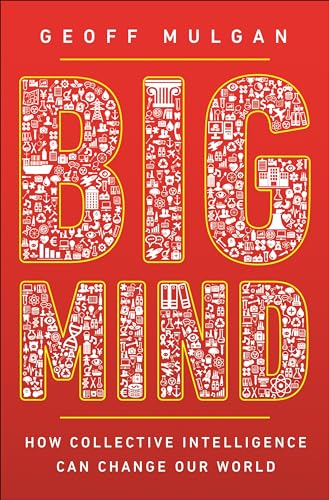
A new field of collective intelligence has emerged in the last few years, prompted by a wave of digital technologies that make it possible for organizations and societies to think at large scale. This "bigger mind"-human and machine capabilities working together-has the potential to solve the great challenges of our time. So why do smart technologies not automatically lead to smart results? Gathering insights from diverse fields, including philosophy, computer science, and biology, Big Mind reveals how collective intelligence can guide corporations, governments, universities, and societies to make the most of human brains and digital technologies. Geoff Mulgan explores how collective intelligence has to be consciously organized and orchestrated in order to harness its powers. He looks at recent experiments mobilizing millions of people to solve problems, and at groundbreaking technology like Google Maps and Dove satellites. He also considers why organizations full of smart people and machines can make foolish mistakes-from investment banks losing billions to intelligence agencies misjudging geopolitical events-and shows how to avoid them. Highlighting differences between environments that stimulate intelligence and those that blunt it, Mulgan shows how human and machine intelligence could solve challenges in business, climate change, democracy, and public health. But for that to happen we'll need radically new professions, institutions, and ways of thinking. Informed by the latest work on data, web platforms, and artificial intelligence, Big Mind shows how collective intelligence could help us survive and thrive.
Die Inhaltsangabe kann sich auf eine andere Ausgabe dieses Titels beziehen.
Über die Autorin bzw. den Autor
Geoff Mulgan is chief executive of Nesta, the UK's National Endowment for Science, Technology and the Arts, and a senior visiting scholar at Harvard University's Ash Center. He was the founder of the think tank Demos and director of the Prime Minister's Strategy Unit and head of policy under Tony Blair. His books include The Locust and the Bee (Princeton) and Good and Bad Power (Penguin).
Von der hinteren Coverseite
"This important work provides a sophisticated analysis of the various human and computational forms of collective intelligence. Mulgan demonstrates in a powerful way how such collective intelligence can be mobilized to deal effectively and wisely with the most urgent problems on the planet."--Howard Gardner, author of Multiple Intelligences
"In Big Mind, Mulgan nails it yet again. How collective intelligence can stay ahead of artificial intelligence is the big question of the day and Mulgan has answers. This is a smart, lucid, and compelling book."--Julia Hobsbawm, author of Fully Connected
"This insightful and broad-ranging book will appeal to business leaders at all levels, from tech giants to start-ups."--Martha Lane Fox, executive chair of Doteveryone
"Mulgan combines distinguished academic expertise with extensive real-world policy experience. In this important, wide-ranging book, he shows how decision making can be hugely improved in our increasingly networked world. To those of us dismayed by how ineffectually democracy now operates, Big Mind offers a dose of optimism and many concrete proposals. It's enlightening--indeed inspiring--and should be read by all citizens, especially those aspiring to improve all levels of governance."--Martin Rees, Astronomer Royal and former president of the Royal Society
"Big Mind is a book the world needs. At a time of intense pessimism about our capacity to reimagine society's systems, and amid rising populism, Mulgan offers a balanced and highly sophisticated approach to revamping democracy and our institutions. Rather than providing technocratic solutions, he lays out intelligent ways to more deeply involve individuals. Through smartly designed systems that structure for participation, a better world is possible--Mulgan’s magnificent book shows us how."--Jeremy Heimans, cofounder of Purpose, GetUp!, and Avaaz
"This book presents a novel way of seeing the world that places collective intelligence center stage. It assesses the practice and evidence on how we might achieve more intelligent institutions and systems, by making the most use of emerging technologies, and by applying more systematic methods to amplifying intelligence in everyday tools for shaping and making decisions."--Stefaan G. Verhulst, GovLab, New York University
"Big Mind brims with pragmatic, unexpected insights. Mulgan filters his awe-inspiring breadth of academic knowledge through the lens of decades of practical experience."--Scott Page, University of Michigan
Auszug. © Genehmigter Nachdruck. Alle Rechte vorbehalten.
Big Mind
How Collective Intelligence Can Change Our World
By Geoff MulganPRINCETON UNIVERSITY PRESS
Copyright © 2018 Princeton University Press
All rights reserved.
ISBN: 978-0-691-17079-4All rights reserved.
Contents
Preface, vii,
Introduction Collective Intelligence as a Grand Challenge, 1,
Part I What Is Collective Intelligence?, 9,
1 The Paradox of a Smart World, 11,
2 The Nature of Collective Intelligence in Theory and Practice, 14,
Part II Making Sense of Collective Intelligence as Choice, 33,
3 The Functional Elements of Collective Intelligence, 35,
4 The Infrastructures That Support Collective Intelligence, 48,
5 The Organizing Principles of Collective Intelligence, 60,
6 Learning Loops, 70,
7 Cognitive Economics and Triggered Hierarchies, 76,
8 The Autonomy of Intelligence, 90,
9 The Collective in Collective Intelligence, 99,
10 Self-Suspicion and Fighting the Enemies of Collective Intelligence, 119,
Part III Collective Intelligence in Everyday Life, 129,
11 Mind-Enhancing Meetings and Environments, 131,
12 Problem Solving: How Cities and Governments Think, 145,
13 Visible and Invisible Hands: Economies and Firms as Collective Intelligence, 161,
14 The University as Collective Intelligence, 174,
15 Democratic Assembly, 181,
16 How Does a Society Think and Create as a System?, 193,
17 The Rise of Knowledge Commons: It's for Everyone, 200,
Part IV Collective Intelligence as Expanded Possibility, 215,
18 Collective Wisdom and Progress in Consciousness, 217,
Afterword: The Past and Future of Collective Intelligence as a Discipline, 229,
Summary of the Argument, 237,
Notes, 239,
Index, 263,
CHAPTER 1
The Paradox of a Smart World
We live surrounded by new ways of thinking, understanding, and measuring that simultaneously point to a new step in human evolution and an evolution beyond humans.
Some of the new ways of thinking involve data — mapping, matching, and searching for patterns far beyond the capacity of the human eye or ear. Some involve analysis — supercomputers able to model the weather, play chess, or diagnose diseases (for example, using the technologies of firms like Google's DeepMind or IBM's Watson). Some pull us ever further into what the novelist William Gibson described as the "consensual hallucination" of cyberspace.
These all show promise. But there is a striking imbalance between the smartness of the tools we have around us and the more limited smartness of the results. The Internet, World Wide Web, and Internet of things are major steps forward in the orchestration of information and knowledge.
Yet it doesn't often feel as if the world is all that clever. Technologies can dumb down as well as smarten up. Many institutions and systems act much more stupidly than the people within them, including many that have access to the most sophisticated technologies. Martin Luther King Jr. spoke of "guided missiles but misguided men," and institutions packed with individual intelligence can often display collective stupidity or the distorted worldview of "idiots savants" in machine form. New technologies bring with them new catastrophes partly because they so frequently outstrip our wisdom (no one has found a way to create code without also creating bugs, and as the French philosopher Paul Virilio put it, the aircraft inevitably produces the air disaster).
In the 1980s, the economist Robert Solow commented, "You can see the computer age everywhere but in the productivity statistics." Today we might say again that data and intelligence are everywhere — except in the productivity statistics, and in many of the things that matter most. The financial crash of the late 2000s was a particularly striking example. Financial institutions that had spent vast sums on information technologies failed to understand what was happening to them, or understood the data but not what lay behind the data, and so brought the world to the brink of economic disaster. In the 1960s and 1970s, the Soviet government had at its disposal brilliant minds and computers, but couldn't think its way out of stagnation. During the same period, the US military had more computing power at its disposition than any other organization in history, but failed to understand the true dynamics of the war it was fighting in Vietnam. A generation later the same happened in Iraq, when a war was fought based on a profound error of intelligence launched by the US and UK governments with more invested than any other countries in the most advanced intelligence tools imaginable. Many other examples confirm that having smart tools does not automatically lead to more intelligent results.
Health is perhaps the most striking example of the paradoxical combination of smart elements and often-stupid results. We now benefit from vastly more access to information on diseases, diagnoses, and treatments on the Internet. There are global databases of which treatments work; detailed guidance for doctors on symptoms, diagnoses, and prescriptions; and colossal funds devoted to pushing the frontiers of cancer, surgery, or pharmaceuticals.
But this is far from a golden age of healthy activity or intelligence about health. The information available through networks is frequently misleading (according to some research, more so than face-to-face advice). There are well over 150,000 health apps, yet only a tiny fraction can point to any evidence that they improve their users' health. The dominant media propagate half-truths and sometimes even lies as well as useful truths. And millions of people make choices every day that clearly threaten their own health. The world's health systems are in many ways pioneers of collective intelligence, as I will show later, but much doesn't work well. It's estimated that some 30 to 50 percent of antibiotic prescriptions are unnecessary, 25 percent of medicines in circulation are counterfeit, somewhere between 10 and 20 percent of diagnoses are incorrect, and each year 250,000 die in the United States alone because of medical error (the third leading cause of death there). In short, the world has made great strides in improving health and has accumulated an extraordinary amount of knowledge about it, yet still has a long way to go in orchestrating that knowledge to best effect.
Similar patterns can be found in many fields, from politics and business to personal life: unprecedented access to data, information, and opinions, but less obvious progress in using this information to guide better decisions. We benefit from a cornucopia of goods unimaginable to past generations, yet still too often spend money we haven't earned to buy things we don't need to impress people we don't like.
We have extraordinary intelligence in pockets, for specific, defined tasks. Yet there has been glacial, if any, progress in handling more complex, interconnected problems, and paradoxically the excitement surrounding new capacities to sense, process, or analyze may distract attention from the more fundamental challenges.
In later chapters, I address what true collective intelligence would look like in some of the most important fields. How could democracy be organized differently if it wanted to make the most of the ideas, expertise, and needs of citizens? Various experiments around the world suggest what the answers might be, but they baffle most of the professionals brought up in traditional politics. How could universities become better at creating, orchestrating,...
„Über diesen Titel“ kann sich auf eine andere Ausgabe dieses Titels beziehen.
Suchergebnisse für Big Mind: How Collective Intelligence Can Change Our...

Beispielbild für diese ISBN
Big Mind : How Collective Intelligence Can Change Our World
Verlag:
Princeton University Press, 2017
ISBN 10: 0691170797
ISBN 13: 9780691170794
Gebraucht
Hardcover
Anbieter: Better World Books, Mishawaka, IN, USA
Verkäuferbewertung 5 von 5 Sternen

Zustand: Very Good. Former library copy. Pages intact with possible writing/highlighting. Binding strong with minor wear. Dust jackets/supplements may not be included. Includes library markings. Stock photo provided. Product includes identifying sticker. Better World Books: Buy Books. Do Good. Artikel-Nr. 16092031-6
Gebraucht kaufen
EUR 6,35
Versand gratis
Versand innerhalb von USA
Versand innerhalb von USA
Anzahl: 2 verfügbar
Beispielbild für diese ISBN
Big Mind : How Collective Intelligence Can Change Our World
Verlag:
Princeton University Press, 2017
ISBN 10: 0691170797
ISBN 13: 9780691170794
Gebraucht
Hardcover
Anbieter: Better World Books, Mishawaka, IN, USA
Verkäuferbewertung 5 von 5 Sternen
Zustand: Good. Pages intact with minimal writing/highlighting. The binding may be loose and creased. Dust jackets/supplements are not included. Stock photo provided. Product includes identifying sticker. Better World Books: Buy Books. Do Good. Artikel-Nr. 38214977-6
Gebraucht kaufen
EUR 6,35
Versand gratis
Versand innerhalb von USA
Versand innerhalb von USA
Anzahl: 1 verfügbar
Beispielbild für diese ISBN
Big Mind: How Collective Intelligence Can Change Our World
Verlag:
Princeton University Press, 2017
ISBN 10: 0691170797
ISBN 13: 9780691170794
Gebraucht
Hardcover
Anbieter: ThriftBooks-Atlanta, AUSTELL, GA, USA
Verkäuferbewertung 5 von 5 Sternen
Hardcover. Zustand: Very Good. No Jacket. Former library book; May have limited writing in cover pages. Pages are unmarked. ~ ThriftBooks: Read More, Spend Less. Artikel-Nr. G0691170797I4N10
Gebraucht kaufen
EUR 7,01
Versand gratis
Versand innerhalb von USA
Versand innerhalb von USA
Anzahl: 1 verfügbar
Beispielbild für diese ISBN
Big Mind: How Collective Intelligence Can Change Our World
Verlag:
Princeton University Press, 2017
ISBN 10: 0691170797
ISBN 13: 9780691170794
Gebraucht
Paperback
Anbieter: WorldofBooks, Goring-By-Sea, WS, Vereinigtes Königreich
Verkäuferbewertung 5 von 5 Sternen
Paperback. Zustand: Very Good. The book has been read, but is in excellent condition. Pages are intact and not marred by notes or highlighting. The spine remains undamaged. Artikel-Nr. GOR008792854
Gebraucht kaufen
EUR 3,32
EUR 6,68 Versand
Versand von Vereinigtes Königreich nach USA
Versand von Vereinigtes Königreich nach USA
Anzahl: 4 verfügbar
Beispielbild für diese ISBN
Big Mind: How Collective Intelligence Can Change Our World
Anbieter: AwesomeBooks, Wallingford, Vereinigtes Königreich
Verkäuferbewertung 5 von 5 Sternen
hardcover. Zustand: Very Good. Big Mind: How Collective Intelligence Can Change Our World This book is in very good condition and will be shipped within 24 hours of ordering. The cover may have some limited signs of wear but the pages are clean, intact and the spine remains undamaged. This book has clearly been well maintained and looked after thus far. Money back guarantee if you are not satisfied. See all our books here, order more than 1 book and get discounted shipping. Artikel-Nr. 7719-9780691170794
Gebraucht kaufen
EUR 5,37
EUR 4,91 Versand
Versand von Vereinigtes Königreich nach USA
Versand von Vereinigtes Königreich nach USA
Anzahl: 2 verfügbar
Beispielbild für diese ISBN
Big Mind: How Collective Intelligence Can Change Our World
Anbieter: Bahamut Media, Reading, Vereinigtes Königreich
Verkäuferbewertung 4 von 5 Sternen

hardcover. Zustand: Very Good. This book is in very good condition and will be shipped within 24 hours of ordering. The cover may have some limited signs of wear but the pages are clean, intact and the spine remains undamaged. This book has clearly been well maintained and looked after thus far. Money back guarantee if you are not satisfied. See all our books here, order more than 1 book and get discounted shipping. Artikel-Nr. 6545-9780691170794
Gebraucht kaufen
EUR 5,69
EUR 8,32 Versand
Versand von Vereinigtes Königreich nach USA
Versand von Vereinigtes Königreich nach USA
Anzahl: 2 verfügbar
Beispielbild für diese ISBN
Big Mind: How Collective Intelligence Can Change Our World
Verlag:
Princeton University Press, 2018
ISBN 10: 0691170797
ISBN 13: 9780691170794
Gebraucht
Hardcover
Anbieter: Anybook.com, Lincoln, Vereinigtes Königreich
Verkäuferbewertung 5 von 5 Sternen
Zustand: Good. This is an ex-library book and may have the usual library/used-book markings inside.This book has hardback covers. In good all round condition. No dust jacket. Please note the Image in this listing is a stock photo and may not match the covers of the actual item,600grams, ISBN:9780691170794. Artikel-Nr. 2331752
Gebraucht kaufen
EUR 3,42
EUR 15,55 Versand
Versand von Vereinigtes Königreich nach USA
Versand von Vereinigtes Königreich nach USA
Anzahl: 1 verfügbar
Foto des Verkäufers
Big Mind: How Collective Intelligence Can Change Our World
Verlag:
Princeton University Press, Princeton, NJ, 2018
ISBN 10: 0691170797
ISBN 13: 9780691170794
Gebraucht
Hardcover
Erstausgabe
Anbieter: Sekkes Consultants, North Dighton, MA, USA
Verkäuferbewertung 5 von 5 Sternen
Hardcover. Zustand: Near fine. Zustand des Schutzumschlags: Near fine. First edition. Princeton University Press first edition on collective intelligence by policy thinker Geoff Mulgan. Condition: Hardcover; dust jacket present with a shallow crease bottom front corner, like new otherwise. 6½" - 9½". book. Artikel-Nr. 278250
Gebraucht kaufen
EUR 25,71
Versand gratis
Versand innerhalb von USA
Versand innerhalb von USA
Anzahl: 1 verfügbar
Beispielbild für diese ISBN
Big Mind: How Collective Intelligence Can Change Our World
Verlag:
Princeton University Press, 2017
ISBN 10: 0691170797
ISBN 13: 9780691170794
Gebraucht
Hardcover
Anbieter: medimops, Berlin, Deutschland
Verkäuferbewertung 5 von 5 Sternen
Zustand: very good. Gut/Very good: Buch bzw. Schutzumschlag mit wenigen Gebrauchsspuren an Einband, Schutzumschlag oder Seiten. / Describes a book or dust jacket that does show some signs of wear on either the binding, dust jacket or pages. Artikel-Nr. M00691170797-V
Gebraucht kaufen
EUR 16,75
EUR 10,00 Versand
Versand von Deutschland nach USA
Versand von Deutschland nach USA
Anzahl: 1 verfügbar
Beispielbild für diese ISBN
Big Mind: How Collective Intelligence Can Change Our World
Verlag:
Princeton University Press, 2017
ISBN 10: 0691170797
ISBN 13: 9780691170794
Gebraucht
Hardcover
Anbieter: medimops, Berlin, Deutschland
Verkäuferbewertung 5 von 5 Sternen
Zustand: as new. Wie neu/Like new. Artikel-Nr. M00691170797-N
Gebraucht kaufen
EUR 17,25
EUR 10,00 Versand
Versand von Deutschland nach USA
Versand von Deutschland nach USA
Anzahl: 1 verfügbar