
Verwandte Artikel zu Design with Climate - Bioclimatic Approach to Architectural...
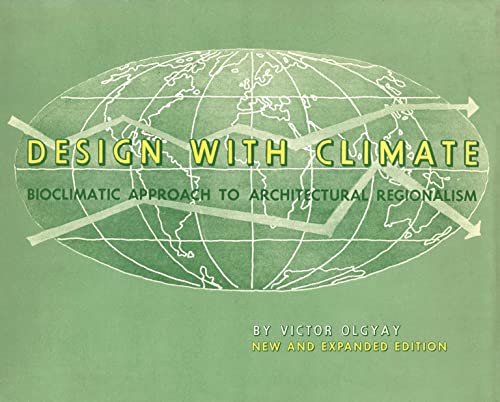
Design with Climate - Bioclimatic Approach to Architectural Regionalism - New and expanded Edition - Softcover
Inhaltsangabe
First published in 1963, Design with Climate was one of the most pioneering books in the field and remains an important reference for practitioners, teachers, and students, over fifty years later. In this book, Victor Olgyay explores the impact of climate on shelter design, identifying four distinct climatic regions and explaining the effect of each on orientation, air movement, site, and materials. He derives principles from biology, engineering, meteorology, and physics, and demonstrates how an analytical approach to climate management can merge into a harmonious and aesthetically sound design concept. rst published in 1963, Design with Climate was one of the most pioneering books in the field and remains an important reference for practitioners, teachers, and students, over fifty years later. In this book, Victor Olgyay explores the impact of climate on shelter design, identifying four distinct climatic regions and explaining the effect of each on orientation, air movement, site, and materials. He derives principles from biology, engineering, meteorology, and physics, and demonstrates how an analytical approach to climate management can merge into a harmonious and aesthetically sound design concept. This updated edition contains four new essays that provide unique insights on issues of climate design, showing how Olgyays concepts work in contemporary practice.
Die Inhaltsangabe kann sich auf eine andere Ausgabe dieses Titels beziehen.
Über die Autorin bzw. den Autor
Victor Olgyay (1910-70) was associate professor in the School of Architecture and Urban Planning at Princeton University. He was a leading researcher on the relationship between architecture, climate, and energy.
Von der hinteren Coverseite
"Design with Climate has had an extremely important impact on the practice of sustainable design, and is perhaps even more relevant today than when it was when originally published in 1963. In many ways the book was ahead of its time."--Peter Anderson, author of Prefab Prototypes: Site-specific Design for Offsite Construction
"Design with Climate is a seminal work of continued relevance, and is especially needed as architects relearn the basics of climatic design in order to right the causes and effects of global warming."--Bruce Haglund, University of Idaho
Auszug. © Genehmigter Nachdruck. Alle Rechte vorbehalten.
Design With Climate
Bioclimatic Approach to Architectural Regionalism
By Victor OlgyayPRINCETON UNIVERSITY PRESS
Copyright © 2015 Princeton University Press
All rights reserved.
ISBN: 978-0-691-16973-6All rights reserved.
Contents
PART 1. CLIMATIC APPROACH,
I. GENERAL INTRODUCTION, 1,
II. THE BIOCLIMATIC APPROACH, 14,
III. REGIONAL EVALUATION, 24,
IV. CLIMATIC ELEMENTS, 32,
PART 2. INTERPRETATION IN ARCHITECTURAL PRINCIPLES,
V. SITE SELECTION, 44,
VI. SOL-AIR ORIENTATION, 53,
VII. SOLAR CONTROL, 63,
VIII. ENVIRONMENT AND BUILDING FORMS, 84,
IX. WIND EFFECTS AND AIR FLOW PATTERNS, 94,
X. THERMAL EFFECTS OF MATERIALS, 113,
PART 3. APPLICATION,
XI. HELIOTHERMIC PLANNING, 126,
XII. EXAMPLES IN FOUR REGIONS, 153,
APPENDIX A. Technical Notes, 178,
APPENDIX B. The Thermoheliodon, 180,
BIBLIOGRAPHY AND REFERENCES, 186,
INDEX, 189,
CHAPTER 1
GENERAL INTRODUCTION
THE EARTH AND LIFE
The full spectrum of earth's arena ranges from the rigor of the cold blues to the oppression of the torrid reds, and only the restful hues near green are associated with life. The bluish-white of icecaps in the polar regions blends into a brownish-green where vegetation makes its first stand in the tundra. This gives way to the dark green coniferous belt of the cold zone, which merges southward with the broadleaved deciduous trees of the fertile temperate region. Further down, the warm middle latitudes are marked with the sparsely inhabited yellowish-reds of the desert areas, and the tones finally deepen into the lush green of the permanent verdure around the equatorial belt.
Surrounded by oceans, the great land masses are relieved by heights and depths of mountains, plains, and plateaus, and enlivened by veins of rivers and networks of streams and lakes. On and beneath the surface lie the meager or abundant soils and minerals which make life prosperous or infertile.
There is a discipline, however, imposed on this complexity. The revolution of the globe gives the heartbeat of day and night which regulates the activities and reposes of natural life. The tilted rotation of the earth around the sun sets the rhythm of the seasons, which call to life the dormant vegetation and donate the bounty of harvests. Whether each locale is cool or warm is largely determined by its relative distance from the equator; but the imperative regularity of the sun also sets the pace for the patterns of humidity and wind that sweep across the earth.
The features of the physical environment are blanketed by a vast ocean of air, whose tides carry climatic elements to all parts of the earth and are in turn modulated by them. Climate not only plays a great part in the composition of soils, but strongly affects the character of plants and animals in different regions and — most important from our point of view — man's energy.
As life has arisen through the hidden aspects of natural laws, so for better or worse the rules of nature command that life make a close adjustment to natural background. The setting is impartial; it can be kind or cruel, but all living species must either adapt their physiology, through selection or mutation, or find other defenses against the impacts of environment.
ANIMAL LIFE AND SHELTER
Mankind's physical flexibility and capacity for adaptation are relatively feeble compared to those of many animals, who possess natural defenses against a large range of unfavorable climates. Against the danger of dryness animals have a number of weapons, and to relive the impacts of excessive heat they use heightened transpiration. The bear, in cold weather, can reduce his metabolism through slumber. The bat can survive a change of its body temperature of 60 degrees. The elephant can cool its blood by moving its honeycombed ear. As cold arrives the mink grows a new fur coat. In the hostile territory of the desert many animals reverse their life rhythm, live by night, and tuck away underground at dawn. Some rabbit breeds place their burrows with efficient foresight in relation to water and wind.
Birds can regulate their body insulation by trapping minute air bubbles with their adjustable feathers. When hardship becomes excessive, they seek to change to an environment where food and warmth are more favorable for existence. Birds during their stay do not rely entirely on their ability to adapt, but enlarge this ability with their building habits, with an innate instinct to cope with their environment. The varied forms and delicate patterns thus produced provide enlightening examples of the intuitive reconciliation of natural forces.
The open nest secures insulating qualities; the hanging nest utilizes the tensile strength of fibers, or grasses, and, pendulum-like, avoids the wind forces. The nest which is massively built from clay and straw prevents the intrusion of the direct sun and rain by its steep entrance. The vertical mud and straw nest is similar to apartment dwellings, where each opening is an individual nest comprised of two chambers. The first serves as an entrance foyer, the second an egg laying and hatching area. This very special form successfully avoids the nearly vertical sun rays, and minimizes the effect of precipitation. The mass of the earth can effectively relieve extreme temperature differences and secures more stable heat conditions. Each solution is an effort, with a different approach, to cope with some main element of the climatic surroundings.
These individual efforts for shelter are surpassed by the collective building of the insect world. Anthills vary with their surroundings; in temperate regions they are often found on southeast slopes, and elongated on a northeast-southwest axis to catch early morning warmth. But in the tropics, the immense buildings of Hamitermes meridionalis ("compass termites") are blade-shaped and point due north. The east and west exposures help to secure an equable temperature; but, as with most mound-buildings, the large mass of earth stabilizes the caloric range. Their towers are immense, reaching 400 times their body-length (10 mm), which translated into human terms would equal 2400 feet.
HUMAN LIFE AND SHELTER
Mankind in the same environments encounters the same stresses as other fauna. From Aristotle to Montesquieu, many scholars believed that climate had pronounced effects on human physiology and temperament. More recently interest has centered on human energy in relation to environment. Ellsworth Huntington has hypothesized that climate ranks with racial inheritance and cultural development as one of the three great factors in determining the conditions of civilization. According to him, man, who can apparently live in any region where he can obtain food, has strictly limited conditions under which his physical and mental energy (and even his moral character) can reach their highest development. He postulates optimum climate conditions for human progress:
1. average temperature ranges from somewhat below 40° F in the coldest months to nearly 70° F in the warmest months;
2. frequent storms or winds, to keep the relative humidity quite high except in hot weather, and provide rain at all seasons;
3. a constant succession of cyclonic storms which bring frequent moderate changes in temperature but are not severe enough to be harmful.
Another contemporary, Julian Huxley, relates human history to climate by comparing the incidence of early civilizations with that of dry and wet epochs. He...
„Über diesen Titel“ kann sich auf eine andere Ausgabe dieses Titels beziehen.
Suchergebnisse für Design with Climate - Bioclimatic Approach to Architectural...

Beispielbild für diese ISBN
Design with Climate: Bioclimatic Approach to Architectural Regionalism - New and expanded Edition
Verlag:
Princeton University Press, 2015
ISBN 10: 069116973X
ISBN 13: 9780691169736
Gebraucht
Softcover
Anbieter: World of Books (was SecondSale), Montgomery, IL, USA
Verkäuferbewertung 5 von 5 Sternen

Zustand: Very Good. Item in very good condition! Textbooks may not include supplemental items i.e. CDs, access codes etc. Artikel-Nr. 00109983188
Gebraucht kaufen
EUR 21,46
Versand gratis
Versand innerhalb von USA
Versand innerhalb von USA
Anzahl: 1 verfügbar
Beispielbild für diese ISBN
Design with Climate: Bioclimatic Approach to Architectural Regionalism - New and expanded Edition
Verlag:
Princeton University Press, 2015
ISBN 10: 069116973X
ISBN 13: 9780691169736
Gebraucht
Softcover
Anbieter: World of Books (was SecondSale), Montgomery, IL, USA
Verkäuferbewertung 5 von 5 Sternen
Zustand: Good. Item in good condition. Textbooks may not include supplemental items i.e. CDs, access codes etc. Artikel-Nr. 00109878220
Gebraucht kaufen
EUR 21,46
Versand gratis
Versand innerhalb von USA
Versand innerhalb von USA
Anzahl: 1 verfügbar
Beispielbild für diese ISBN
Design with Climate: Bioclimatic Approach to Architectural Regionalism - New and Expanded Edition
Verlag:
Princeton University Press, 2015
ISBN 10: 069116973X
ISBN 13: 9780691169736
Gebraucht
Paperback
Anbieter: ThriftBooks-Dallas, Dallas, TX, USA
Verkäuferbewertung 5 von 5 Sternen
Paperback. Zustand: Fair. No Jacket. Readable copy. Pages may have considerable notes/highlighting. ~ ThriftBooks: Read More, Spend Less. Artikel-Nr. G069116973XI5N00
Gebraucht kaufen
EUR 21,47
Versand gratis
Versand innerhalb von USA
Versand innerhalb von USA
Anzahl: 1 verfügbar
Beispielbild für diese ISBN
Design with Climate
Anbieter: PBShop.store US, Wood Dale, IL, USA
Verkäuferbewertung 5 von 5 Sternen
PAP. Zustand: New. New Book. Shipped from UK. Established seller since 2000. Artikel-Nr. WP-9780691169736
Beispielbild für diese ISBN
Design with Climate
Anbieter: PBShop.store UK, Fairford, GLOS, Vereinigtes Königreich
Verkäuferbewertung 5 von 5 Sternen
PAP. Zustand: New. New Book. Shipped from UK. Established seller since 2000. Artikel-Nr. WP-9780691169736
Neu kaufen
EUR 29,70
EUR 5,85 Versand
Versand von Vereinigtes Königreich nach USA
Versand von Vereinigtes Königreich nach USA
Anzahl: 4 verfügbar
Beispielbild für diese ISBN
Design with Climate: Bioclimatic Approach to Architectural Regionalism - New and expanded Edition
Anbieter: Kennys Bookstore, Olney, MD, USA
Verkäuferbewertung 5 von 5 Sternen
Zustand: New. Num Pages: 224 pages, 183 halftones. 173 line illus. 24 tables. BIC Classification: AMCR. Category: (P) Professional & Vocational; (U) Tertiary Education (US: College). Dimension: 212 x 261 x 18. Weight in Grams: 512. . 2015. paperback. . . . . Books ship from the US and Ireland. Artikel-Nr. 9780691169736
Neu kaufen
EUR 33,42
EUR 9,14 Versand
Versand innerhalb von USA
Versand innerhalb von USA
Anzahl: 1 verfügbar
Beispielbild für diese ISBN
Design with Climate: Bioclimatic Approach to Architectural Regionalism - New and expanded Edition
Anbieter: Ria Christie Collections, Uxbridge, Vereinigtes Königreich
Verkäuferbewertung 5 von 5 Sternen
Zustand: New. In English. Artikel-Nr. ria9780691169736_new
Neu kaufen
EUR 37,05
EUR 13,17 Versand
Versand von Vereinigtes Königreich nach USA
Versand von Vereinigtes Königreich nach USA
Anzahl: 4 verfügbar
Beispielbild für diese ISBN
Design with Climate Bioclimatic Approach to Architectural Regionalism New and expanded Edition
Anbieter: Revaluation Books, Exeter, Vereinigtes Königreich
Verkäuferbewertung 5 von 5 Sternen
Paperback. Zustand: Brand New. expanded edition. 190 pages. 8.50x10.25x1.00 inches. In Stock. Artikel-Nr. __069116973X
Neu kaufen
EUR 39,04
EUR 14,58 Versand
Versand von Vereinigtes Königreich nach USA
Versand von Vereinigtes Königreich nach USA
Anzahl: 2 verfügbar
Beispielbild für diese ISBN
Design with Climate Bioclimatic Approach to Architectural Regionalism New and expanded Edition
Anbieter: Revaluation Books, Exeter, Vereinigtes Königreich
Verkäuferbewertung 5 von 5 Sternen
Paperback. Zustand: Brand New. expanded edition. 190 pages. 8.50x10.25x1.00 inches. In Stock. Artikel-Nr. xr069116973X
Neu kaufen
EUR 48,43
EUR 14,58 Versand
Versand von Vereinigtes Königreich nach USA
Versand von Vereinigtes Königreich nach USA
Anzahl: 2 verfügbar
Beispielbild für diese ISBN
DESIGN WITH CLIMATE
Anbieter: Speedyhen, Hertfordshire, Vereinigtes Königreich
Verkäuferbewertung 5 von 5 Sternen
Zustand: NEW. Artikel-Nr. NW9780691169736
Neu kaufen
EUR 29,73
EUR 47,81 Versand
Versand von Vereinigtes Königreich nach USA
Versand von Vereinigtes Königreich nach USA
Anzahl: 2 verfügbar