
Verwandte Artikel zu One Nation Undecided: Clear Thinking about Five Hard...
Inhaltsangabe
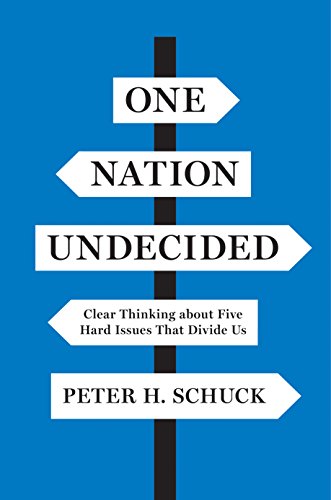
A unique primer on how to think intelligently about the thorniest public issues confronting us today
Let's be honest, we've all expressed opinions about difficult hot-button issues without always thinking them through. With so much media spin, political polarization, and mistrust of institutions, it's hard to know how to think about these tough challenges, much less what to do about them. One Nation Undecided takes on some of today's thorniest issues and walks you through each one step-by-step, explaining what makes it so difficult to grapple with and enabling you to think smartly about it.
In this unique what-to-do book, Peter Schuck tackles poverty, immigration, affirmative action, campaign finance, and religious objections to gay marriage and transgender rights. For each issue, he provides essential context; defines key concepts and values; presents the relevant empirical evidence; describes and assesses the programs that now seek to address it; and considers many plausible solutions. Schuck looks at all sides with scrupulous fairness while analyzing them rigorously and factually. Each chapter is self-contained so that readers may pick and choose among the issues that interest and concern them most. His objective is to educate rather than proselytize you—the very nature of these five issues is that they resist clear answers; reasonable people can differ about where they come out on them.
No other book provides such a comprehensive, balanced, and accessible analysis of these urgent social controversies. One Nation Undecided gives you the facts and competing values, makes your thinking about them more sophisticated, and encourages you to draw your own conclusions.
Die Inhaltsangabe kann sich auf eine andere Ausgabe dieses Titels beziehen.
Über die Autorin bzw. den Autor
Peter H. Schuck is the Simeon E. Baldwin Professor Emeritus of Law at Yale University. His many books include Why Government Fails So Often (Princeton), Meditations of a Militant Moderate, Diversity in America, and Agent Orange on Trial. He lives in New York City.
Von der hinteren Coverseite
"At a time of deep social and political division, along comes a much-needed book to steer us toward solutions to five very difficult national problems. There could be no better guide for this endeavor than Peter Schuck, one of the clearest and most thoughtful legal and policy scholars of this or any generation. Every policymaker at every level of government, and ideally every citizen, should read this book."--Robert E. Litan, author of Trillion Dollar Economists
"This is scholarship as performance art: Peter Schuck challenges our polarized era's life inside self-contained ideological silos by demonstrating what an evidence-based approach to policy, which sympathetically engages with competing positions, can teach us about many of our most hotly contested issues."--Richard H. Pildes, New York University School of Law
"Bringing together legal, political, empirical, and normative analysis, Peter Schuck trains his immense critical faculties and deep learning on five knotty public problems. The result is bracing. No policy wonk is likely to agree with all of the conclusions offered by this self-described ‘militant moderate.' But all who care about the commonweal will come away thinking more clearly and more wisely."--Kay Lehman Schlozman, Boston College
"In this nuanced, intellectually eclectic, and scrupulously honest engagement with five ‘hard problems’ facing America, Peter Schuck sets for himself one supremely hard problem: How can evidence and analysis be made to prevail over passion and spin in our increasingly polarized, diminishingly reality-based republic? If anyone can pull off a plausible pep talk for reasoned debate on contentious public choices these days, Schuck can."--John D. Donahue, Harvard Kennedy School
"Quite good. One Nation Undecided gives detailed background on the facts and analysis of five controversial U.S. issues: poverty, immigration, campaign finance, affirmative action, and religious exemptions from government policies. Whatever your views on these issues, it’s important to know the facts. Reading this book carefully made me, a policy wonk, realize how little I knew about four of those issues and that I didn’t know quite as much as I thought I knew about the fifth, immigration."--David Henderson, Regulation
"Remarkable. Schuck covers a number of especially hard issues with unusual sophistication, care, and balance."--R. Shep Melnick, author of Between the Lines: Interpreting Welfare Rights
"Schuck's in-depth chapters illustrate what high-quality public debate looks like."--Mary Jo Bane, Harvard Kennedy School
Auszug. © Genehmigter Nachdruck. Alle Rechte vorbehalten.
One Nation Undecided
Clear Thinking About Five Hard Issues That Divide Us
By PETER H. SCHUCKPRINCETON UNIVERSITY PRESS
Copyright © 2017 Princeton University Press
All rights reserved.
ISBN: 978-0-691-16743-5All rights reserved.
Contents
Acknowledgments, ix,
1 INTRODUCTION, 1,
2 POVERTY, 23,
3 IMMIGRATION, 115,
4 CAMPAIGN FINANCE, 192,
5 AFFIRMATIVE ACTION, 273,
6 RELIGIOUS EXEMPTIONS FROM SECULAR PUBLIC POLICIES, 316,
7 CONCLUSION, 364,
Notes, 373,
Index, 419,
CHAPTER 1
INTRODUCTION
YOU ARE A SERIOUS, well-educated voter. You read print and online media, listen to the views of opinion leaders and organizations that you trust, discuss current events informally with interested friends, and generally try to keep up with current events. You want to participate responsibly in the democratic process through which the policies that govern us are formed, but you find this difficult. Busy with your family, work, and other private commitments, you don't have much spare time to navigate the daunting complexity of the substantive policy issues. Social groups and peer pressure urge you to take clear positions on these issues. You might feel more comfortable if you could conscientiously do so. But you feel uneasy in taking firm positions on these important issues because, in all honesty, you know that you haven't given them all that much thought or done your homework. So what is a conscientious but understandably distracted citizen like you to do?
I wrote this book for you. It is about hard public issues and how Americans should think about them before deciding where they stand. The success of our deliberative democracy — in which We the People and our representatives really do decide how such issues are resolved — depends on citizens' knowing what they are talking and voting about.
What makes an issue hard? Why are some issues getting even harder, while others seem to become easier?* Is more public debate on hard issues needed? What do I mean by clear thinking about issues? What is the quality of today's debates? How much must citizens know about the issues in order to think clearly about them, and how realistic is this? What can this book hope to contribute to these debates?
This chapter answers these questions in general, and the chapters that follow get down to specifics. But which ones? The list of domestic policy decisions on which Americans sharply disagree with one another — in the voting booth and in conversations — is very long. No single person could explicate most of them. To do so would require far more knowledge, technical skill, time, and patience than any individual (certainly this one) possesses.
The reader's patience is short, so I focus my analysis on five domestic policy issues: poverty; immigration; campaign finance; affirmative action; and conflicts between religious and secular values. Why these? Reasonable people will disagree about the most important issues facing the nation. The first — poverty — is an enduring challenge to the American dream. The next two — immigration and campaign finance — are perennially controversial, especially during election campaigns. The debate over affirmative action remains as robust as ever, even after the U.S. Supreme Court upheld its constitutionality in 2016. (The Court did not endorse its policy merits and the decision was a narrow one, limited — as the majority emphasized — to Texas's "sui generis" plan.) The final issue, which I shall call "religious accommodation" as a shorthand, has always been controversial in our public life, and its prominence today is especially high in light of two recent Supreme Court decisions, discussed in chapter 6.
Each of the five is a very hard issue according to the criteria I present immediately below — although some of them are more hotly debated, affect more people, are more politically sensitive, and raise more basic constitutional issues than others. And some issues that I do not analyze here are even harder and arguably more consequential — for example, climate change and the financing and delivery of health care — are more complicated. But trying to compare the hardness of different public issues (rather than of, say, different minerals) is a fool's errand. Each of the five vitally affects our democracy and society. We have argued about all of them for so long that their contours are relatively well defined and thus amenable to the kind of close analysis presented in this book. And the analytical structure that I use to dissect each of them invites the reader to apply it to other issues not considered here.
WHAT MAKES AN ISSUE HARD?
In my usage, an issue is hard to the extent that the following characteristics are inherent to it: Hard issues also have external or contingent aspects (e.g., political conditions, timing, leadership, unexpected events, international developments).
• It is a public and federal issue. Government institutions, especially at the federal level, play an important role in resolving it through the political process and in embodying it in public law. In contrast, most issues never make it on to the public agenda at all.
• It is highly salient to a large number of people. This means that they care deeply, passionately, and perhaps even militantly about it. People tend to have at least provisional opinions or intuitions about where they stand on it when it enters their world.
• It constitutes an ensemble of interrelated disputed questions. We may try to treat the issue as if it were analytically discrete or self-contained, but in reality its knot of questions interact in complicated, opaque, and hard-to-disentangle ways.
• It is historically inflected, bearing the strong imprint of earlier struggles that continue to haunt current debates, affect the terms of discussion, and perhaps limit the menu of future options.
• It consists in part of complex empirical disputes that our existing knowledge cannot authoritatively resolve and on which even the experts are usually divided. Hard issues, moreover, often are subject to a "meta" empirical issue — i.e., whether the empirical disputes have in fact been settled or are instead still open to dispute. Efforts to persuade the public that a given issue is or is not still open to serious, responsible debate is a high-stakes game played by competing interests. Climate change is probably the clearest current example. Reformers typically cite a looming crisis that must be addressed immediately, while those who favor the status quo or emphasize our ignorance or uncertainty usually favor delay, urging more deliberation, better information, and thus a more durable public consensus.
• It is embedded in normative disputes. The contested values are usually widely held and deeply felt by their proponents. Depending on the nature and content of these values, they may be more or less sensitive or tractable to empirical facts that might (or might not) seem relevant to them. Thus, people who employ a utilitarian framework that values a particular policy according to its consequences (often measured by its costs and benefits) will want to know which conditions cause which effects (among other empirical facts) before they choose a preferred policy or action. In contrast, others may assess the desirability of a policy or action deontologically — i.e., in light of whether it conforms to...
„Über diesen Titel“ kann sich auf eine andere Ausgabe dieses Titels beziehen.
Suchergebnisse für One Nation Undecided: Clear Thinking about Five Hard...

Beispielbild für diese ISBN
One Nation Undecided: Clear Thinking about Five Hard Issues That Divide Us
Verlag:
Princeton University Press, 2017
ISBN 10: 0691167435
ISBN 13: 9780691167435
Gebraucht
Hardcover
Anbieter: World of Books (was SecondSale), Montgomery, IL, USA
Verkäuferbewertung 5 von 5 Sternen

Hardback. Zustand: Very Good. A unique primer on how to think intelligently about the thorniest public issues confronting us today Let's be honest, we've all expressed opinions about difficult hot-button issues without always thinking them through. With so much media spin, political polarization, and mistrust of institutions, it's hard to know how to think about these tough ch. Artikel-Nr. 00110484587
Gebraucht kaufen
EUR 6,32
Versand gratis
Versand innerhalb von USA
Versand innerhalb von USA
Anzahl: 1 verfügbar
Beispielbild für diese ISBN
One Nation Undecided: Clear Thinking about Five Hard Issues That Divide Us
Verlag:
Princeton University Press, 2017
ISBN 10: 0691167435
ISBN 13: 9780691167435
Gebraucht
Hardcover
Anbieter: World of Books (was SecondSale), Montgomery, IL, USA
Verkäuferbewertung 5 von 5 Sternen
Hardback. Zustand: Good. A unique primer on how to think intelligently about the thorniest public issues confronting us today Let's be honest, we've all expressed opinions about difficult hot-button issues without always thinking them through. With so much media spin, political polarization, and mistrust of institutions, it's hard to know how to think about these tough ch. Artikel-Nr. 00095863410
Gebraucht kaufen
EUR 6,32
Versand gratis
Versand innerhalb von USA
Versand innerhalb von USA
Anzahl: 1 verfügbar
Beispielbild für diese ISBN
One Nation Undecided: Clear Thinking about Five Hard Issues That Divide Us
Verlag:
Princeton University Press, 2017
ISBN 10: 0691167435
ISBN 13: 9780691167435
Gebraucht
Hardcover
Anbieter: ThriftBooks-Dallas, Dallas, TX, USA
Verkäuferbewertung 5 von 5 Sternen
Hardcover. Zustand: Very Good. No Jacket. Missing dust jacket; May have limited writing in cover pages. Pages are unmarked. ~ ThriftBooks: Read More, Spend Less. Artikel-Nr. G0691167435I4N01
Gebraucht kaufen
EUR 6,33
Versand gratis
Versand innerhalb von USA
Versand innerhalb von USA
Anzahl: 1 verfügbar
Beispielbild für diese ISBN
One Nation Undecided : Clear Thinking about Five Hard Issues That Divide Us
Verlag:
Princeton University Press, 2017
ISBN 10: 0691167435
ISBN 13: 9780691167435
Gebraucht
Hardcover
Anbieter: Better World Books, Mishawaka, IN, USA
Verkäuferbewertung 5 von 5 Sternen
Zustand: Very Good. Former library copy. Pages intact with possible writing/highlighting. Binding strong with minor wear. Dust jackets/supplements may not be included. Includes library markings. Stock photo provided. Product includes identifying sticker. Better World Books: Buy Books. Do Good. Artikel-Nr. 16466846-6
Gebraucht kaufen
EUR 6,52
Versand gratis
Versand innerhalb von USA
Versand innerhalb von USA
Anzahl: 1 verfügbar
Beispielbild für diese ISBN
One Nation Undecided : Clear Thinking about Five Hard Issues That Divide Us
Verlag:
Princeton University Press, 2017
ISBN 10: 0691167435
ISBN 13: 9780691167435
Gebraucht
Hardcover
Anbieter: Better World Books: West, Reno, NV, USA
Verkäuferbewertung 5 von 5 Sternen
Zustand: Fine. Used book that is in almost brand-new condition. May contain a remainder mark. Better World Books: Buy Books. Do Good. Artikel-Nr. 50590427-75
Gebraucht kaufen
EUR 6,52
Versand gratis
Versand innerhalb von USA
Versand innerhalb von USA
Anzahl: 1 verfügbar
Beispielbild für diese ISBN
One Nation Undecided : Clear Thinking about Five Hard Issues That Divide Us
Verlag:
Princeton University Press, 2017
ISBN 10: 0691167435
ISBN 13: 9780691167435
Gebraucht
Hardcover
Anbieter: Better World Books, Mishawaka, IN, USA
Verkäuferbewertung 5 von 5 Sternen
Zustand: Good. Pages intact with minimal writing/highlighting. The binding may be loose and creased. Dust jackets/supplements are not included. Stock photo provided. Product includes identifying sticker. Better World Books: Buy Books. Do Good. Artikel-Nr. 11765869-6
Gebraucht kaufen
EUR 6,52
Versand gratis
Versand innerhalb von USA
Versand innerhalb von USA
Anzahl: 1 verfügbar
Beispielbild für diese ISBN
One Nation Undecided
Anbieter: PBShop.store UK, Fairford, GLOS, Vereinigtes Königreich
Verkäuferbewertung 5 von 5 Sternen
HRD. Zustand: New. New Book. Shipped from UK. Established seller since 2000. Artikel-Nr. WP-9780691167435
Neu kaufen
EUR 35,18
EUR 7,01 Versand
Versand von Vereinigtes Königreich nach USA
Versand von Vereinigtes Königreich nach USA
Anzahl: 1 verfügbar
Beispielbild für diese ISBN
One Nation Undecided: Clear Thinking about Five Hard Issues That Divide Us
Anbieter: Kennys Bookstore, Olney, MD, USA
Verkäuferbewertung 5 von 5 Sternen
Zustand: New. Num Pages: 440 pages. BIC Classification: JPA. Category: (G) General (US: Trade); (U) Tertiary Education (US: College). Dimension: 229 x 152. Weight in Grams: 485. . 2017. Hardcover. . . . . Books ship from the US and Ireland. Artikel-Nr. V9780691167435
Neu kaufen
EUR 48,24
EUR 9,40 Versand
Versand innerhalb von USA
Versand innerhalb von USA
Anzahl: 1 verfügbar
Beispielbild für diese ISBN
One Nation Undecided: Clear Thinking about Five Hard Issues That Divide Us
Anbieter: Ria Christie Collections, Uxbridge, Vereinigtes Königreich
Verkäuferbewertung 5 von 5 Sternen
Zustand: New. In English. Artikel-Nr. ria9780691167435_new
Neu kaufen
EUR 48,89
EUR 13,48 Versand
Versand von Vereinigtes Königreich nach USA
Versand von Vereinigtes Königreich nach USA
Anzahl: 1 verfügbar
Foto des Verkäufers
One Nation Undecided : Clear Thinking about Five Hard Issues That Divide Us
Verlag:
Princeton University Press Mär 2017, 2017
ISBN 10: 0691167435
ISBN 13: 9780691167435
Neu
Hardcover
Anbieter: AHA-BUCH GmbH, Einbeck, Deutschland
Verkäuferbewertung 5 von 5 Sternen
Buch. Zustand: Neu. Neuware. Artikel-Nr. 9780691167435
Neu kaufen
EUR 54,34
EUR 35,00 Versand
Versand von Deutschland nach USA
Versand von Deutschland nach USA
Anzahl: 1 verfügbar