Quantitative Risk Management: Concepts, Techniques and Tools (Princeton Series in Finance) - Hardcover
Buch 5 von 5: Princeton Series in Finance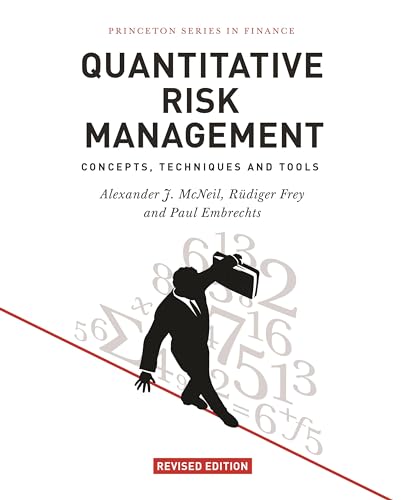
Inhaltsangabe
This book provides the most comprehensive treatment of the theoretical concepts and modelling techniques of quantitative risk management. Whether you are a financial risk analyst, actuary, regulator or student of quantitative finance, Quantitative Risk Management gives you the practical tools you need to solve real-world problems.
Describing the latest advances in the field, Quantitative Risk Management covers the methods for market, credit and operational risk modelling. It places standard industry approaches on a more formal footing and explores key concepts such as loss distributions, risk measures and risk aggregation and allocation principles. The book's methodology draws on diverse quantitative disciplines, from mathematical finance and statistics to econometrics and actuarial mathematics. A primary theme throughout is the need to satisfactorily address extreme outcomes and the dependence of key risk drivers. Proven in the classroom, the book also covers advanced topics like credit derivatives.
- Fully revised and expanded to reflect developments in the field since the financial crisis
- Features shorter chapters to facilitate teaching and learning
- Provides enhanced coverage of Solvency II and insurance risk management and extended treatment of credit risk, including counterparty credit risk and CDO pricing
- Includes a new chapter on market risk and new material on risk measures and risk aggregation
Die Inhaltsangabe kann sich auf eine andere Ausgabe dieses Titels beziehen.
Über die Autorin bzw. den Autor
Alexander J. McNeil is professor of actuarial mathematics and statistics at Heriot-Watt University in Edinburgh. Rüdiger Frey is professor of mathematics and finance at the Vienna University of Economics and Business. Paul Embrechts is professor of mathematics at the Swiss Federal Institute of Technology in Zurich.
Von der hinteren Coverseite
Praise for the previous edition: "McNeil, Frey, and Embrechts present a wide-ranging yet remarkably clear and coherent introduction to the modelling of financial risk. Unlike most finance texts, where the focus is on pricing individual instruments, the primary focus in this book is the statistical behavior of portfolios of risky instruments, which is, after all, the primary concern of risk management. This ought to be a core text in every risk manager's training, and a useful reference for experienced professionals."--Michael Gordy
Praise for the previous edition: "There is no book that provides the type of rigorous and detailed coverage of risk management topics that this book does. This could become the book on quantitative risk management."--Riccardo Rebonato, Royal Bank of Scotland, author of Modern Pricing of Interest-Rate Derivatives
Auszug. © Genehmigter Nachdruck. Alle Rechte vorbehalten.
Quantitative Risk Management
Concepts, Techniques and Tools
By Alexander J. McNeil, Rüdiger Frey, Paul EmbrechtsPRINCETON UNIVERSITY PRESS
Copyright © 2015 Princeton University Press
All rights reserved.
ISBN: 978-0-691-16627-8All rights reserved.
Contents
Preface, xv,
I An Introduction to Quantitative Risk Management, 1,
1 Risk in Perspective, 3,
2 Basic Concepts in Risk Management, 42,
3 Empirical Properties of Financial Data, 79,
II Methodology, 95,
4 Financial Time Series, 97,
5 Extreme Value Theory, 135,
6 Multivariate Models, 173,
7 Copulas and Dependence, 220,
8 Aggregate Risk, 275,
III Applications, 323,
9 Market Risk, 325,
10 Credit Risk, 366,
11 Portfolio Credit Risk Management, 425,
12 Portfolio Credit Derivatives, 476,
13 Operational Risk and Insurance Analytics, 503,
IV Special Topics, 537,
14 Multivariate Time Series, 539,
15 Advanced Topics in Multivariate Modelling, 559,
16 Advanced Topics in Extreme Value Theory, 572,
17 Dynamic Portfolio Credit Risk Models and Counterparty Risk, 599,
Appendix, 641,
References, 652,
Index, 687,
CHAPTER 1
Risk in Perspective
In this chapter we provide a non-mathematical discussion of various issues that form the background to the rest of the book. In Section 1.1 we begin with the nature of risk itself and discuss how risk relates to randomness; in the financial context (which includes insurance) we summarize the main kinds of risks encountered and explain what it means to measure and manage such risks.
A brief history of financial risk management and the development of financial regulation is given in Section 1.2, while Section 1.3 contains a summary of the regulatory framework in the financial and insurance industries.
In Section 1.4 we take a step back and attempt to address the fundamental question of why we might want to measure and manage risk at all. Finally, in Section 1.5 we turn to quantitative risk management (QRM) explicitly and set out our own views concerning the nature of this discipline and the challenge it poses. This section in particular should give more insight into our choice of methodological topics in the rest of the book.
1.1 Risk
The Concise Oxford English Dictionary defines risk as "hazard, a chance of bad consequences, loss or exposure to mischance". In a discussion with students taking a course on financial risk management, ingredients that are typically discussed are events, decisions, consequences and uncertainty. It is mostly only the downside of risk that is mentioned, rarely a possible upside, i.e. the potential for a gain. While for many people risk has largely negative connotations, it may also represent an opportunity. Much of the financial industry would not exist were it not for the presence of financial risk and the opportunities afforded to companies that are able to create products and services that offer more financial certainty to their clients.
For financial risks no single one-sentence definition of risk is entirely satisfactory. Depending on context, one might arrive at notions such as "any event or action that may adversely affect an organization's ability to achieve its objectives and execute its strategies" or, alternatively, "the quantifiable likelihood of loss or less-than-expected returns".
1.1.1 Risk and Randomness
Regardless of context, risk strongly relates to uncertainty, and hence to the notion of randomness. Randomness has eluded a clear, workable definition for many centuries; it was not until 1933 that the Russian mathematician A. N. Kolmogorov gave an axiomatic definition of randomness and probability (see Kolmogorov 1933). This definition and its accompanying theory provide the language for the majority of the literature on risk, including this book.
Our reliance on probability may seem unsatisfactorily narrow to some. It bypasses several of the current debates on risk and uncertainty (Frank Knight), the writings on probabilistic thinking within economics (John Maynard Keynes), the unpredictability of unprecedented financial shocks, often referred to as Black Swans (Nassim Taleb), or even the more political expression of the known, the unknown and the unknowable (Donald Rumsfeld); see the Notes and Comments section for more explanation. Although these debates are interesting and important, at some point clear definitions and arguments are called for and this is where mathematics as a language enters. The formalism of Kolmogorov, while not the only possible approach, is a tried-and-tested framework for mathematical reasoning about risk.
In Kolmogorov's language a probabilistic model is described by a triplet (Ω, F, P). An element ω of Ω represents a realization of an experiment, in economics often referred to as a state of nature. The statement "the probability that an event A occurs" is denoted (and in Kolmogorov's axiomatic system defined) as P(A), where A is an element of F, the set of all events. P denotes the probability measure. For the less mathematically trained reader it suffices to accept that Kolmogorov's system translates our intuition about randomness into a concise, axiomatic language and clear rules.
Consider the following examples: an investor who holds stock in a particular company; an insurance company that has sold an insurance policy; an individual who decides to convert a fixed-rate mortgage into a variable one. All of these situations have something important in common: the investor holds today an asset with an uncertain future value. This is very clear in the case of the stock. For the insurance company, the policy sold may or may not be triggered by the underlying event covered. In the case of a mortgage, our decision today to enter into this refinancing agreement will change (for better or for worse) the future repayments. So randomness plays a crucial role in the valuation of current products held by the investor, the insurance company and the home owner.
To model these situations a mathematician would now define the value of a risky position X to be a function on the probability space Ω, F, P; this function is called a random variable. We leave for the moment the range of X (i.e. its possible values) unspecified. Most of the modelling of a risky position X concerns its distribution function FX(x) = P(X ≤ x): the probability that by the end of the period under consideration the value of the risk X is less than or equal to a given number x. Several risky positions would then be denoted by a random vector (X1, ..., Xd), also written in bold face as X; time can be introduced, leading to the notion of random (or so-called stochastic) processes, usually written (Xt). Throughout this book we will encounter many such processes, which serve as essential building blocks in the mathematical description of risk.
1.1. Risk
We therefore expect the reader to be at ease with basic notation, terminology and results from elementary probability and statistics, the branch of mathematics dealing with stochastic models and their application to the real world. The word "stochastic" is derived from the Greek "stochazesthai", the art of guessing, or "stochastikos", meaning skilled at aiming ("stochos" being a target). In discussing stochastic methods for risk management we hope to emphasize the skill aspect rather...
„Über diesen Titel“ kann sich auf eine andere Ausgabe dieses Titels beziehen.
Suchergebnisse für Quantitative Risk Management: Concepts, Techniques...

Beispielbild für diese ISBN
Quantitative Risk Management: Concepts, Techniques and Tools - Revised Edition (Princeton Series in Finance)
Verlag:
Princeton University Press (edition Revised), 2015
ISBN 10: 0691166277
ISBN 13: 9780691166278
Gebraucht
Hardcover
Anbieter: BooksRun, Philadelphia, PA, USA
Verkäuferbewertung 5 von 5 Sternen

Hardcover. Zustand: Good. Revised. It's a preowned item in good condition and includes all the pages. It may have some general signs of wear and tear, such as markings, highlighting, slight damage to the cover, minimal wear to the binding, etc., but they will not affect the overall reading experience. Artikel-Nr. 0691166277-11-1
Gebraucht kaufen
EUR 41,58
Versand gratis
Versand innerhalb von USA
Versand innerhalb von USA
Anzahl: 1 verfügbar
Beispielbild für diese ISBN
Quantitative Risk Management (Princeton Series in Finance)
Verlag:
Princeton University Press, 2015
ISBN 10: 0691166277
ISBN 13: 9780691166278
Gebraucht
Hardcover
Anbieter: medimops, Berlin, Deutschland
Verkäuferbewertung 5 von 5 Sternen
Zustand: good. Befriedigend/Good: Durchschnittlich erhaltenes Buch bzw. Schutzumschlag mit Gebrauchsspuren, aber vollständigen Seiten. / Describes the average WORN book or dust jacket that has all the pages present. Artikel-Nr. M00691166277-G
Gebraucht kaufen
EUR 66,76
EUR 15,00 Versand
Versand von Deutschland nach USA
Versand von Deutschland nach USA
Anzahl: 1 verfügbar
Beispielbild für diese ISBN
Quantitative Risk Management - Concepts, Techniques and Tools - Revised Edition
Anbieter: PBShop.store UK, Fairford, GLOS, Vereinigtes Königreich
Verkäuferbewertung 4 von 5 Sternen

HRD. Zustand: New. New Book. Shipped from UK. Established seller since 2000. Artikel-Nr. WP-9780691166278
Neu kaufen
EUR 88,07
EUR 9,78 Versand
Versand von Vereinigtes Königreich nach USA
Versand von Vereinigtes Königreich nach USA
Anzahl: 15 verfügbar
Beispielbild für diese ISBN
Quantitative Risk Management - Concepts, Techniques and Tools - Revised Edition
Anbieter: PBShop.store US, Wood Dale, IL, USA
Verkäuferbewertung 5 von 5 Sternen
HRD. Zustand: New. New Book. Shipped from UK. Established seller since 2000. Artikel-Nr. GB-9780691166278
Beispielbild für diese ISBN
Quantitative Risk Management: Concepts, Techniques and Tools (Princeton Series in Finance)
Anbieter: Majestic Books, Hounslow, Vereinigtes Königreich
Verkäuferbewertung 4 von 5 Sternen
Zustand: New. Artikel-Nr. 373735734
Neu kaufen
EUR 119,95
EUR 7,49 Versand
Versand von Vereinigtes Königreich nach USA
Versand von Vereinigtes Königreich nach USA
Anzahl: 3 verfügbar
Beispielbild für diese ISBN
Quantitative Risk Management Concepts, Techniques and Tools (Revised Edition)
Anbieter: Revaluation Books, Exeter, Vereinigtes Königreich
Verkäuferbewertung 5 von 5 Sternen
Hardcover. Zustand: Brand New. revised edition. 648 pages. 10.50x7.50x2.00 inches. In Stock. Artikel-Nr. __0691166277
Neu kaufen
EUR 112,74
EUR 17,28 Versand
Versand von Vereinigtes Königreich nach USA
Versand von Vereinigtes Königreich nach USA
Anzahl: 1 verfügbar
Beispielbild für diese ISBN
QUANTITATIVE RISK MANAGEMENT
Anbieter: Speedyhen, Hertfordshire, Vereinigtes Königreich
Verkäuferbewertung 5 von 5 Sternen
Zustand: NEW. Artikel-Nr. NW9780691166278
Neu kaufen
EUR 88,08
EUR 47,24 Versand
Versand von Vereinigtes Königreich nach USA
Versand von Vereinigtes Königreich nach USA
Anzahl: 2 verfügbar
Beispielbild für diese ISBN
Quantitative Risk Management: Concepts, Techniques and Tools - Revised Edition
Anbieter: Kennys Bookstore, Olney, MD, USA
Verkäuferbewertung 4 von 5 Sternen
Zustand: New. This book provides a comprehensive treatment of the theoretical concepts and modelling techniques of quantitative risk management and equips readers - whether financial risk analysts, actuaries, regulators, or students of quantitative finance - with practical tools to solve real-world problems. Series: Princeton Series in Finance. Num Pages: 720 pages, illustrations. BIC Classification: KFF; KJMV1. Category: (P) Professional & Vocational; (U) Tertiary Education (US: College). Dimension: 188 x 262 x 46. Weight in Grams: 1654. . 2015. Revised. Hardcover. . . . . Books ship from the US and Ireland. Artikel-Nr. V9780691166278
Neu kaufen
EUR 146,74
EUR 8,85 Versand
Versand innerhalb von USA
Versand innerhalb von USA
Anzahl: Mehr als 20 verfügbar
Foto des Verkäufers
Quantitative Risk Management: Concepts, Techniques and Tools
Anbieter: moluna, Greven, Deutschland
Verkäuferbewertung 4 von 5 Sternen
Zustand: New. Über den AutorAlexander J. McNeil, Ruediger Frey & Paul EmbrechtsKlappentextrnrnThis book provides a comprehensive treatment of the theoretical concepts and modelling techniques of quantitative risk management and. Artikel-Nr. 31722689
Neu kaufen
EUR 114,13
EUR 48,99 Versand
Versand von Deutschland nach USA
Versand von Deutschland nach USA
Anzahl: 3 verfügbar
Beispielbild für diese ISBN
Quantitative Risk Management Concepts, Techniques and Tools (Revised Edition)
Anbieter: Revaluation Books, Exeter, Vereinigtes Königreich
Verkäuferbewertung 5 von 5 Sternen
Hardcover. Zustand: Brand New. revised edition. 648 pages. 10.50x7.50x2.00 inches. In Stock. Artikel-Nr. zk0691166277
Neu kaufen
EUR 153,17
EUR 17,28 Versand
Versand von Vereinigtes Königreich nach USA
Versand von Vereinigtes Königreich nach USA
Anzahl: 1 verfügbar