
Offshore Sea Life ID Guide: East Coast (Princeton Field Guides) - Softcover
Buch 47 von 80: Princeton Field Guides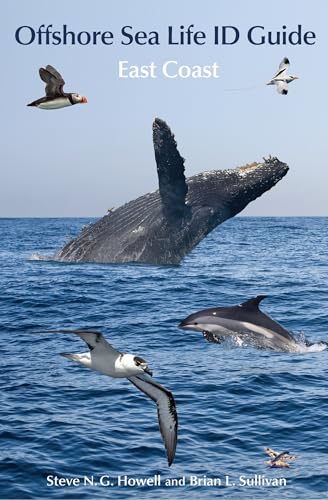
Inhaltsangabe
The first compact field guide to offshore sea life of the East Coast
Two-thirds of our planet lies out of sight of land, just offshore beyond the horizon. What wildlife might you see out there? This handy guide, designed for quick use on day trips off the East Coast, helps you put a name to what you find, from whales and dolphins to shearwaters, turtles, and even flying fish. Carefully crafted color plates show species as they typically appear at sea, and expert text highlights identification features. Essential for anyone heading out on a whale-watching or birding trip, this guidebook provides a handy gateway to the wonders of the ocean.
- Over 100 color photos and composite plates
- Includes whales, dolphins, birds, sharks, turtles, flying fish, and more
- Accessible and informative text reveals what to look for
- Great for beginners and experts alike
Die Inhaltsangabe kann sich auf eine andere Ausgabe dieses Titels beziehen.
Über die Autorin bzw. den Autor
Steve N.G. Howell is an international bird tour leader with WINGS and a research associate at the California Academy of Sciences. His other books include Petrels, Albatrosses, and Storm-Petrels of North America and The Amazing World of Flyingfish (both Princeton). Brian L. Sullivan is eBird program codirector and photographic editor for Birds of North America Online at the Cornell Lab of Ornithology, and a coauthor of The Crossley ID Guide: Raptors (Princeton). Howell and Sullivan are the coauthors of Offshore Sea Life ID Guide: West Coast (Princeton).
Von der hinteren Coverseite
"Filled with concise information and accurate illustrations, this terrific field guide will be a handy, quick reference for the layperson and serious naturalist on boat trips off the West Coast of the United States. No other useful guides for this region deal with both marine mammals and seabirds in the same book."--Sophie Webb, coauthor ofField Guide to Marine Mammals of the Pacific Coast
"Intended for beginner- and moderate-level naturalists as well as tourists on whale-watching and birding trips, this field guide presents a fresh, new format. Images are nicely formatted and the text is clear, light, and humorous while being informative and scientifically accurate."--Peter Pyle, author of Identification Guide to North American Birds
Auszug. © Genehmigter Nachdruck. Alle Rechte vorbehalten.
Offshore Sea Life ID Guide East Coast
By STEVE N. G. HOWELL, Brian L. SullivanPRINCETON UNIVERSITY PRESS
Copyright © 2016 Steve N. G. Howell, Brian L. Sullivan
All rights reserved.
ISBN: 978-0-691-16621-6All rights reserved.
Contents
Introduction, 5,
Acknowledgments, 11,
Some Words Explained, 11,
Marine Mammals, 12,
Whales, 12,
Pilot Whales and Beaked Whales, 16,
Dolphins, 18,
Rarer Whales and Dolphins, 22,
Seabirds, 26,
Gulls, 26,
Shearwaters and Petrels, 28,
Storm-Petrels, 32,
Alcids, 34,
Phalaropes, 39,
Terns, 40,
Jaegers, 42,
Skuas, 44,
Tropicbirds, 45,
Gannet and Boobies, 46,
Frigatebird, 47,
Rarer Seabirds, 48,
Sea Turtles, 50,
Flyingfish and Flying Squid, 52,
Other Fish, 55,
Billfish and Sharks, 56,
Other Big Fish, 58,
Rarer Big Fish, 59,
Seaweeds, 60,
Jellyfish and Cousins, 61,
Landbirds, 62,
Species Codes, Scientific Names, and Index, 63,
CHAPTER 1
Marine Mammals
Unlike seabirds, marine mammals spend most of their time underwater, coming to the surface to breathe, and rarely do you see the whole animal. Views can be brief, and we provide the clues needed to identify species based on what you are likely to see — a fin, a blow, a tail going down.
As with 'seabirds,' some 'marine mammals' live along the coast, such as Harbor Seals and Gray Seals (see p. 5). We do not treat these species because they're not really offshore creatures; they can be seen more easily from land. Other marine mammals can be seen from shore on occasion, although to see them up close you'll still want to go out on a boat.
Things to look for with whales and dolphins are group size, general behavior, dorsal fin size and shape, any patterns or markings, and, for the larger whales, shape and size of the blow and how soon the dorsal fin appears relative to when you see the blow.
Whales: Very large swimming creatures 12
Beaked Whales and Pilot Whales: Medium-sized, often in groups 16 Dolphins: Smaller and faster swimming creatures, often in groups 18
Rarer Whales and Dolphins 22
Humpback Whale (HUWH)
The staple of many whale-watching businesses. Fairly common off the Northeast May–Sep, migrating s. to breed in the Caribbean; found off the Southeast mainly in winter. Well-known for active displays at the surface, including tail- and flipper-slapping, breaching, and lunge-feeding. Often seen simply blowing, swimming, and diving (arching its back high but not fluking). With luck or patience, can be seen fluking before deeper dives. Blow bushy, but fairly high. Dorsal fin distinctive but variable, lumpy and fairly low; very long narrow flippers mostly white. Underside of tail varies from white to black; many individuals can be identified by tail pattern.
Whales
Fin (Finback) Whale (FIWH)
Fairly common off the Northeast spring–fall, with a few present in winter; ranges s. to Mid-Atlantic states in late fall–spring; very rarely seen s. of Cape Hatteras. Singly or in small groups; may associate with HUWH in rich feeding areas. Very large and often fast-swimming, with sloping fin typically wider at base than tall, slightly falcate (individually quite variable; cf. much smaller MIWH). Fin appears after blow and after a stretch of back rolls by. Blow taller and stronger than bushier blow of HUWH. Rarely flukes or breaches.
Northern Minke Whale (MIWH)
The Minke (pronounced 'minky') is fairly common off New England spring–fall; very rarely seen to the s. Usually seen singly. Fast-swimming; resembles a mini FIWH but dorsal fin typically taller than wide, often more falcate. Blow low and bushy, usually not striking; fin appears simultaneously with blow, not after a length of back has appeared. Often rolls fairly high but rarely flukes, and after a few blows tends to disappear. Infrequent breaches can be clear out of the water.
North Atlantic Right Whale (RIWH)
Total population only 500 or so animals. Rare to locally uncommon off the Northeast in spring–fall, mainly Apr–early May and late Sep–Nov. Moves s. to winter and calve off the Southeast, Dec–Mar. Found singly or in loose groups, mainly in nearshore waters. Blow bushy and, seen at the right angle, distinctly V-shaped. Large, blackish, and broad-bodied, without dorsal fin; flippers short and broad. Large head has variable whitish patches (callosities). Broad flukes often raised high when sounding.
Sperm Whale, Pilot Whales, and Beaked Whales
Sperm Whale (SPWH)
Uncommon in deeper offshore waters, usually just beyond the shelf break or over submarine canyons; singly or in loose groups. Off New England found mainly late summer–fall, but present year-round to the s. Bushy blow angled forward, not vertical. Dorsal fin low and triangular; massive head apparent at closer range; rear of body wrinkled. Rests at the surface (looks like a giant turd), blowing steadily before sounding for a deep dive, when usually shows its broad, triangular flukes. Feeds on squid in deep water, and dives can last 1–2 hours.
Pilot Whales (PIWH)
2 very similar species of large dolphins, smaller than true whales: Long-finned Pilot Whale and Short-finned Pilot Whale ('long' and 'short' refer to the pectoral flippers, rarely visible). Uncommon to fairly common in deep waters beyond the shelf break. Species identity usually presumed by location and temperature: Long-finned occurs in cooler waters off the Northeast, ranging s. to Mid-Atlantic states in winter; Short-finned in warmer waters off the Southeast, ranging n. to Mid-Atlantic states in summer–fall. Usually in groups of 5–50, often logging at the surface; rarely breach or show flukes. Blackish overall with blunt head. Dorsal fin low and wide-based, lobed at tip on adult male.
Beaked Whales occur in deep waters beyond the shelf break. Found as singles or small groups; often indifferent to boats but at times curious. Surfacing animals show beak first and then a low triangular dorsal fin (similar in all species), but do not fluke; rarely breach. Many sightings are noted simply as 'beaked whale sp.' (= species unidentified).
Cuvier's Beaked Whale (Goosebeak) (CUBW)
Uncommon from Mid-Atlantic states s., very rare n. to Cape Cod. Larger than dolphins, clearly smaller than typical whales. Low bushy blow inconspicuous. Color variable; adults have whitish head, and adult male is marked with whitish scratches. Surfacing animals often show distinctive short 'goosebeak' and roll fairly high, especially before sounding.
Mesoplodon Beaked Whales (MBWH)
The genus Mesoplodon contains numerous similar-looking species worldwide, all slightly smaller than CUBW; 4 occur off the East Coast but are seen infrequently. Usually surface and blow a few times before deep feeding dives. Gervais's Beaked Whale (GEBW) is regular off Cape Hatteras in spring–summer; status and distribution of other species not well known. Photos showing male teeth needed for species identification.
Dolphins
Risso's Dolphin (Grampus) (RIDO)
Uncommon to fairly common from Mid-Atlantic states s., mainly in deeper waters offshore from the shelf break; small numbers range n. to Gulf of Maine in summer–fall. This large dolphin is usually...
„Über diesen Titel“ kann sich auf eine andere Ausgabe dieses Titels beziehen.
Suchergebnisse für Offshore Sea Life ID Guide: East Coast (Princeton Field...

Beispielbild für diese ISBN
Offshore Sea Life ID Guide
Anbieter: PBShop.store US, Wood Dale, IL, USA
Verkäuferbewertung 5 von 5 Sternen

PAP. Zustand: New. New Book. Shipped from UK. Established seller since 2000. Artikel-Nr. WP-9780691166216
Beispielbild für diese ISBN
Offshore Sea Life ID Guide
Anbieter: PBShop.store UK, Fairford, GLOS, Vereinigtes Königreich
Verkäuferbewertung 5 von 5 Sternen
PAP. Zustand: New. New Book. Shipped from UK. Established seller since 2000. Artikel-Nr. WP-9780691166216
Neu kaufen
EUR 17,82
EUR 3,81 Versand
Versand von Vereinigtes Königreich nach USA
Versand von Vereinigtes Königreich nach USA
Anzahl: 3 verfügbar
Beispielbild für diese ISBN
Offshore Sea Life ID Guide: East Coast
Anbieter: Majestic Books, Hounslow, Vereinigtes Königreich
Verkäuferbewertung 4 von 5 Sternen

Zustand: New. pp. 64. Artikel-Nr. 373701741
Neu kaufen
EUR 20,75
EUR 7,53 Versand
Versand von Vereinigtes Königreich nach USA
Versand von Vereinigtes Königreich nach USA
Anzahl: 3 verfügbar
Beispielbild für diese ISBN
Offshore Sea Life I.D. Guide: East Coast
Anbieter: Revaluation Books, Exeter, Vereinigtes Königreich
Verkäuferbewertung 5 von 5 Sternen
Paperback. Zustand: Brand New. 64 pages. 8.25x5.25x0.50 inches. In Stock. Artikel-Nr. __0691166218
Neu kaufen
EUR 18,43
EUR 11,58 Versand
Versand von Vereinigtes Königreich nach USA
Versand von Vereinigtes Königreich nach USA
Anzahl: 2 verfügbar
Beispielbild für diese ISBN
Offshore Sea Life ID Guide: East Coast
Anbieter: Kennys Bookstore, Olney, MD, USA
Verkäuferbewertung 5 von 5 Sternen
Zustand: New. Series: Princeton Field Guides. Num Pages: 64 pages, 120 color photos. BIC Classification: 1QSPN; WNCS. Category: (G) General (US: Trade); (U) Tertiary Education (US: College). Dimension: 203 x 127. Weight in Grams: 114. . 2015. Paperback. . . . . Books ship from the US and Ireland. Artikel-Nr. V9780691166216
Neu kaufen
EUR 22,89
EUR 9,10 Versand
Versand innerhalb von USA
Versand innerhalb von USA
Anzahl: 1 verfügbar