Inhaltsangabe
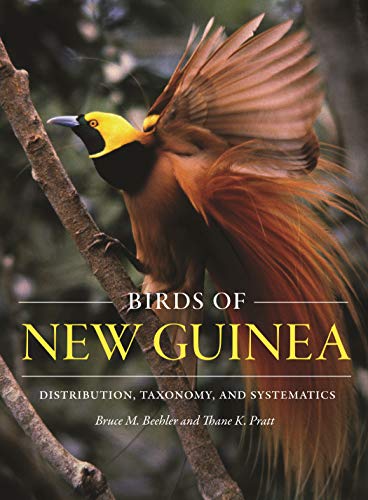
New Guinea, the largest tropical island, supports a spectacular bird fauna characterized by cassowaries, megapodes, pigeons, parrots, kingfishers, and owlet-nightjars, as well as the iconic birds of paradise and bowerbirds. Of the nearly 800 species of birds recorded from New Guinea, more than 350 are found nowhere else on Earth. This comprehensive annotated checklist of distribution, taxonomy, and systematics of the birds of New Guinea is the first formal review of this avifauna since Ernst Mayr's Checklist, published in 1941. This new book brings together all the systematic, taxonomic, and distributional research conducted on the region's bird families over the last 70 years.
Bruce Beehler and Thane Pratt provide the scientific foundation for the names, geographic distributions, and systematic arrangement of New Guinea's bird fauna. All technical information is annotated and a geographic gazetteer and bibliography are included. This book is an ideal complement to the Birds of New Guinea field guide also published by Princeton, and is an essential technical reference for all scientific libraries, ornithologists, and those interested in bird classification.
- The first complete revision of the New Guinea bird fauna since 1941
- Accounts for 75 bird species new to the region
- Includes a geographic gazetteer, bibliography, and explanations of taxonomic and systematic classifications
Die Inhaltsangabe kann sich auf eine andere Ausgabe dieses Titels beziehen.
Über die Autorin bzw. den Autor
Bruce M. Beehler is a research associate of the Division of Birds at the Smithsonian's National Museum of Natural History and a naturalist with interests in birds and forests. Thane K. Pratt is a research associate at the B. P. Bishop Museum in Honolulu, Hawaii and a bird conservationist with a focus on the tropical Pacific. Pratt and Beehler are the coauthors of the field guide Birds of New Guinea, Second Edition (Princeton).
Von der hinteren Coverseite
"This extraordinary and long-awaited work combines deep authority and scholarship with the authors' extensive field experience and museum expertise. The book increases our knowledge of New Guinea's obscure avifauna and offers a superior modern perspective."--Frank B. Gill, author of Ornithology
"This is an essential reference for anyone interested in the birds of New Guinea, natural resource policy, and conservation practices."--Christopher Filardi, American Museum of Natural History
Auszug. © Genehmigter Nachdruck. Alle Rechte vorbehalten.
Birds of New Guinea
Distribution, Taxonomy, and Systematics
By Bruce M. Beehler, Thane K. Pratt, Amy Hughes, Bruce Beehler, John AndertonPRINCETON UNIVERSITY PRESS
Copyright © 2016 Princeton University Press
All rights reserved.
ISBN: 978-0-691-16424-3All rights reserved.
Contents
Preface, 8,
PART ONE,
Introduction, 11,
Layout of the Accounts, 28,
Figures, 37,
PART TWO,
Casuariiformes, 40,
Galliformes, 44,
Anseriformes, 53,
Phoenicopteriformes, 61,
Columbiformes, 63,
Phaethontiformes, 92,
Procellariiformes, 93,
Ciconiiformes, 103,
Otidiformes, 123,
Gruiformes, 123,
Cuculiformes, 136,
Caprimulgiformes, 148,
Charadriiformes, 163,
Accipitriformes, 198,
Strigiformes, 213,
Bucerotiformes, 219,
Coraciiformes, 220,
Falconiformes, 235,
Psittaciformes, 238,
Passeriformes, 271,
PART THREE,
Bibliography, 525,
Geographic Gazetteer J. L. Mandeville and W. S. Peckover, 560,
Index of English Bird Names and Topics, 633,
Index of Scientific Names, 647,
CHAPTER 1
Introduction
The New Guinea Region
Our region of coverage follows Mayr (1941: vi), who defined the natural region that encompasses the avifauna of New Guinea, naming it the "New Guinea Region." It comprises the great tropical island of New Guinea as well as an array of islands lying on its continental shelf or immediately offshore. This region extends from the equator to latitude 12° south and from longitude 129° east to 155° east; it is 2,800 km long by 750 km wide and supports the largest remaining contiguous tract of old-growth humid tropical forest in the Asia-Pacific (Beehler 1993a). The Region includes the Northwestern Islands (Raja Ampat group) of the far west — Waigeo, Batanta, Salawati, Misool, Kofiau, Gam, Gebe, and Gag; the Aru Islands of the southwest — Wokam, Kobroor, Trangan, and others; the Bay Islands of Geelvink/Cenderawasih Bay — Biak-Supiori, Numfor, Mios Num, and Yapen; Dolak Island of south-central New Guinea (also known as Dolok, Kimaam, Kolepom, Yos Sudarso, or Frederik Hendrik); Daru and Kiwai Islands of eastern south- central New Guinea; islands of the north coast of Papua New Guinea (PNG) — Kairiru, Muschu, Manam, Bagabag, and Karkar; and the Southeastern (Milne Bay) Islands of the far southeast — Goodenough, Fergusson, Normanby, Kiriwina, Kaileuna, Woodlark, Misima, Tagula/Sudest, and Rossel, plus many groups of smaller islands (see the endpapers for a graphic delimitation of the Region).
Politically, the island of New Guinea is bisected at longitude 141° east. To the west is Indonesian New Guinea (comprising Papua and Papua Barat Provinces). To the east of the line is the mainland portion of Papua New Guinea. Although this abrupt north-south boundary line is an artificial product of colonial-era claims, today this line, in effect, separates Asia (to the west) from the Pacific (to the east).
Indonesian New Guinea includes the western half of mainland New Guinea plus the islands of Geelvink (Cenderawasih) Bay, the Aru Islands, and the Raja Ampat Islands — all territory covered in this book. Papua New Guinea encompasses territory in the New Guinea region — the eastern half of the island of New Guinea and the islands of Milne Bay Province, as well as territory outside the Region and not covered in this book — the Bismarck and Admiralty Islands and the northernmost of the Solomon Islands. Thus, much of insular Papua New Guinea is not included in this treatment.
The New Guinea region does not include Seram, the Southeast Islands of Indonesia, the Kai Islands, the Torres Strait Islands, Long and Umboi Islands, New Britain, New Ireland, Manus, or the Solomon Islands. The northern Melanesian avifauna inhabiting these last six entities is admirably treated in Mayr & Diamond (2001) and Dutson (2011).
The postmodern political side of geographic names is problematic — is it Maluku or Moluccas? Nusa Tenggara or Lesser Sundas? Tagula or Sudest? Rossel or Yela? We have tended toward conservatism here (particularly because the main users of this type of work are people interested in the history of ornithology), as the older names have received more use in the literature and are, quite simply, better known and more widely used in the science. Our geographic gazetteer in the back of the book (Appendix) makes an initial attempt to present all the geographic names, so one can locate and identify both the new and old name here, even if only the "old" name appears in the text accounts. Some of the more prominent choices appear in our usage chart at the end of this introductory section.
With regard to seabirds, our treatment includes records within ca. 50 km of the Mainland coastline and ca. 25 km of any fringing New Guinea island. Also included are waters encompassed by embayments (the limit is a straight line between major projecting points on the Mainland). That said, we do not include any territorial waters of Australia (which in the Torres Strait approaches northward to the shores of the New Guinea mainland) or the Solomon Islands. We strongly encourage much additional seabird-watching in New Guinea's waters. These efforts should be timed to coincide with the annual spring and fall movements of these long-distance migrants and mainly should focus on the western and eastern extremities of the Region, where north-south water passages encourage concentrations of the birds where they can bypass the substantial east-west land barrier posed by mountainous mainland New Guinea.
New Guinea in Context
Aside from continental Australia, the only island larger than New Guinea is ice-capped Greenland. Among tropical islands, New Guinea is the largest and highest (it is larger and substantially higher than either Madagascar or Borneo) and still supports tropical glaciers in the far west of its high Central Ranges.
New Guinea is the geographic hub of the southwest Pacific — situated at the heart of an array of tropical island arcs that are home to a wonderful assemblage of bird species featured in this book. Australia lies just to the south. New Guinea and Australia share the Australian plate and thus the same tectonic history — New Guinea is the high, wet, and equatorial sector, whereas continental Australia is the low, dry, and temperate sector. To the west lie the Moluccas (Maluku) and Lesser Sundas (Nusa Tenggara) of Indonesia. To the north and northwest lie the Philippines, Palau, and the Mariana Islands. The Bismarck, Admiralty, Caroline, Marshall, and Gilbert Islands lie to the northeast and east, and the Solomons, Vanuatu, New Caledonia, and Fiji to the southeast.
New Guinea supports the Pacific's richest humid-forest avifauna. By contrast, Australia hosts the Pacific's richest savanna and dry-zone avifauna. Both rest atop the Australian continental craton, isolated by deepwater barriers from Sundaland to the west and from the Melanesian islands to the northeast and southeast. Whereas the differences between the avifaunas of New Guinea and Australia are mainly products of their distinct environments, the differences distinguishing New Guinea's avifauna from that of southeast Asia are biogeographic in origin. Wallace's Line, an ancient deepwater barrier, marks the eastern limit of many continental Asian bird lineages, separating the continental avifaunas of southeast Asia from those of Australia–New Guinea. In a similar manner,...
„Über diesen Titel“ kann sich auf eine andere Ausgabe dieses Titels beziehen.
Weitere beliebte Ausgaben desselben Titels

Suchergebnisse für Birds of New Guinea: Distribution, Taxonomy, and Systematics

Foto des Verkäufers
Birds of New Guinea: Distribution, Taxonomy, and Systematics
Anbieter: COLLINS BOOKS, Seattle, WA, USA
Verkäuferbewertung 5 von 5 Sternen

HARDCOVER. Zustand: Very Good. Zustand des Schutzumschlags: Very Good. 1st edition. 668pp, large octavo, hc w/jacket, tight binding, clean throughout, clean black cloth boards with sharp corners, light soiling to the page edges, jacket is clean and colorful with mild wear, owner's stamp. From the library of Dale W. Rice, famed writer/researcher/collector of natural history, and founder of the Dale W. Rice Memorial Library in Seattle, WA. Artikel-Nr. 137474
Gebraucht kaufen
EUR 43,96
EUR 5,97 shipping
Versand innerhalb von USA
Versand innerhalb von USA
Anzahl: 1 verfügbar
Foto des Verkäufers
Birds of New Guinea: Distribution, Taxonomy, and Systematics
Verlag:
Princeton University Press, 2016
ISBN 10: 069116424X
ISBN 13: 9780691164243
Gebraucht
Hardcover
Erstausgabe
Anbieter: Milbury Books, New Romney, Vereinigtes Königreich
Verkäuferbewertung 5 von 5 Sternen
Hardcover. Zustand: Very Good. Zustand des Schutzumschlags: Very Good. 1st Edition. A Very Good+ 1st Impression copy of this 688pp technical study of New Guinea's bird fauna. The text is pristine, there are no inscriptions, the binding remains tight and there is very little wear to black cloth boards. There is some discolouration to bottom edge of text block only. The dust wrapper displays only light hints of use to surfaces/edges and remains Very Good+. Please see five pictures attached. Note: Owing to 1.7kg weight an adjustment to shipping charge may be requested for some International destinations. Artikel-Nr. ABE-1738944386861
Gebraucht kaufen
EUR 46,35
EUR 24,84 shipping
Versand von Vereinigtes Königreich nach USA
Versand von Vereinigtes Königreich nach USA
Anzahl: 1 verfügbar
Beispielbild für diese ISBN
Birds of New Guinea
Anbieter: PBShop.store US, Wood Dale, IL, USA
Verkäuferbewertung 5 von 5 Sternen
HRD. Zustand: New. New Book. Shipped from UK. Established seller since 2000. Artikel-Nr. WP-9780691164243
Beispielbild für diese ISBN
Birds of New Guinea
Anbieter: PBShop.store UK, Fairford, GLOS, Vereinigtes Königreich
Verkäuferbewertung 5 von 5 Sternen
HRD. Zustand: New. New Book. Shipped from UK. Established seller since 2000. Artikel-Nr. WP-9780691164243
Neu kaufen
EUR 83,00
EUR 9,81 shipping
Versand von Vereinigtes Königreich nach USA
Versand von Vereinigtes Königreich nach USA
Anzahl: 3 verfügbar
Beispielbild für diese ISBN
Birds of New Guinea - Distribution, Taxonomy, and Systematics
Anbieter: Majestic Books, Hounslow, Vereinigtes Königreich
Verkäuferbewertung 4 von 5 Sternen

Zustand: New. pp. 672. Artikel-Nr. 373295406
Neu kaufen
EUR 91,21
EUR 7,51 shipping
Versand von Vereinigtes Königreich nach USA
Versand von Vereinigtes Königreich nach USA
Anzahl: 3 verfügbar
Beispielbild für diese ISBN
Birds of New Guinea: Distribution, Taxonomy, and Systematics
Anbieter: Kennys Bookstore, Olney, MD, USA
Verkäuferbewertung 4 von 5 Sternen
Zustand: New. Num Pages: 672 pages, 14 color illus. 2 maps. BIC Classification: 1MKLP; PSVW6. Category: (P) Professional & Vocational; (U) Tertiary Education (US: College). Dimension: 241 x 178. . . 2016. Revised ed. Hardcover. . . . . Books ship from the US and Ireland. Artikel-Nr. V9780691164243
Neu kaufen
EUR 92,35
EUR 8,96 shipping
Versand innerhalb von USA
Versand innerhalb von USA
Anzahl: 1 verfügbar
Foto des Verkäufers
Birds of New Guinea
Anbieter: moluna, Greven, Deutschland
Verkäuferbewertung 4 von 5 Sternen
Zustand: New. Gazetteer of New Guinea ornithology [by] Jennifer L. Mandeville and William S. Peckover : pages 560-632.Über den AutorrnrnBruce M. Beehler is a research associate of the Division of Birds at the Smithsonian s National Museum of Natural. Artikel-Nr. 109500729
Neu kaufen
EUR 72,67
EUR 48,99 shipping
Versand von Deutschland nach USA
Versand von Deutschland nach USA
Anzahl: 3 verfügbar
Beispielbild für diese ISBN
Birds of New Guinea Distribution, Taxonomy, and Systematics
Anbieter: Revaluation Books, Exeter, Vereinigtes Königreich
Verkäuferbewertung 5 von 5 Sternen
Hardcover. Zustand: Brand New. revised ed. edition. 672 pages. 10.00x7.25x2.00 inches. In Stock. Artikel-Nr. __069116424X
Neu kaufen
EUR 101,07
EUR 23,10 shipping
Versand von Vereinigtes Königreich nach USA
Versand von Vereinigtes Königreich nach USA
Anzahl: 2 verfügbar
Foto des Verkäufers
Birds of New Guinea : Distribution, Taxonomy, and Systematics
Verlag:
Princeton University Press Mär 2016, 2016
ISBN 10: 069116424X
ISBN 13: 9780691164243
Neu
Hardcover
Anbieter: AHA-BUCH GmbH, Einbeck, Deutschland
Verkäuferbewertung 5 von 5 Sternen
Buch. Zustand: Neu. Neuware - New Guinea, the largest tropical island, supports a spectacular bird fauna characterized by cassowaries, megapodes, pigeons, parrots, kingfishers, and owlet-nightjars, as well as the iconic birds of paradise and bowerbirds. Of the nearly 800 species of birds recorded from New Guinea, more than 350 are found nowhere else on Earth. This comprehensive annotated checklist of distribution, taxonomy, and systematics of the birds of New Guinea is the first formal review of this avifauna since Ernst Mayr's Checklist, published in 1941. This new book brings together all the systematic, taxonomic, and distributional research conducted on the region's bird families over the last 70 years. Artikel-Nr. 9780691164243
Neu kaufen
EUR 91,81
EUR 67,61 shipping
Versand von Deutschland nach USA
Versand von Deutschland nach USA
Anzahl: 2 verfügbar
Beispielbild für diese ISBN
Birds of New Guinea Distribution, Taxonomy, and Systematics
Anbieter: Revaluation Books, Exeter, Vereinigtes Königreich
Verkäuferbewertung 5 von 5 Sternen
Hardcover. Zustand: Brand New. revised ed. edition. 672 pages. 10.00x7.25x2.00 inches. In Stock. Artikel-Nr. x-069116424X
Neu kaufen
EUR 150,72
EUR 23,10 shipping
Versand von Vereinigtes Königreich nach USA
Versand von Vereinigtes Königreich nach USA
Anzahl: 1 verfügbar