
Verwandte Artikel zu Faust I & II: Goethe's Collected Works - Updated...
Faust I & II: Goethe's Collected Works - Updated Edition (Goethe's Collected Works: Princeton Classics, 2, Band 2) - Softcover
Buch 1 von 89: Princeton Legacy Library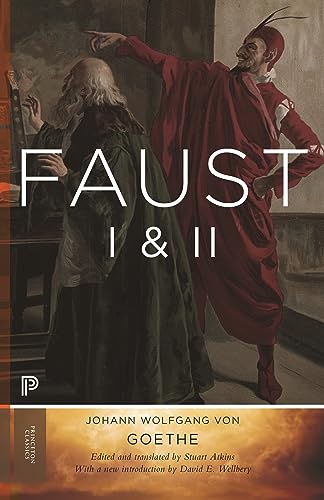
Inhaltsangabe
One of the great classics of European literature, Faust is Goethe's most complex and profound work. To tell the dramatic and tragic story of one man's pact with the Devil in exchange for knowledge and power, Goethe drew from an immense variety of cultural and historical material, and a wealth of poetic and theatrical traditions. What results is a tour de force illustrating Goethe's own moral and artistic development, and a symbolic, cautionary tale of Western humanity striving restlessly and ruthlessly for progress. Capturing the sense, poetic variety, and tonal range of the German original in present-day English, Stuart Atkins's translation presents the formal and rhythmic dexterity of Faust in all its richness and beauty, without recourse to archaisms or interpretive elaborations. Featuring a new introduction by David Wellbery, this Princeton Classics edition of Faust is the definitive English version of a timeless masterpiece.
Die Inhaltsangabe kann sich auf eine andere Ausgabe dieses Titels beziehen.
Über die Autorin bzw. den Autor
Johann Wolfgang von Goethe (1749-1832) was one of the greatest artists of the German Romantic period. He was a poet, playwright, novelist, and natural philosopher. David E. Wellbery is the LeRoy T. and Margaret Deffenbaugh Carlson University Professor in the Department of Germanic Studies and Comparative Literature at the University of Chicago.
Auszug. © Genehmigter Nachdruck. Alle Rechte vorbehalten.
Faust I & II
By Johann Wolfgang von GOETHE, Stuart AtkinsPRINCETON UNIVERSITY PRESS
Copyright © 2014 Princeton University Press
All rights reserved.
ISBN: 978-0-691-16229-4All rights reserved.
Contents
INTRODUCTION, xi,
FAUST: A Tragedy,
PART ONE,
PART TWO, in Five Acts,
Act I,
Act II,
Act III (Helen: Classico-Romantic Phantasmagoria. An Intermezzo),
Act IV,
Act V,
Chronology of the Composition of Faust, 306,
Goethe's Faust and the Present Translation, 307,
Bibliographical Note, 314,
Explanatory Notes, 315,
INTRODUCTION
Due to its range and complexity, Goethe's Faust invites metaphors of all-inclusiveness. A vast continent, one is tempted to say, a world unto itself, a cosmos. World literature (a concept invented by Goethe) knows several encompassing works, but their formal principles typically make for easy survey. Homer's Iliad and Odyssey are epics in twenty-four books, a pattern mimicked in Vergil's Aeneid, in which, of course, the number of books is halved. Dante's Divine Comedy unfolds in three parts, the cantos of each arranged according to theologically inspired symmetries. Milton's comparable world-historical poems yield cognate results. Moreover, all the mentioned works are cast in metrical patterns sustained from beginning to end. For Faust, a metrical jungle, no transparent principle of organization is available, and, for this reason, the reader engaging with the work for the first time (and the experienced reader, too) will do well to consult a map. Bare summary has its benefits. That's where we shall start.
Faust consists of two large, but asymmetrical parts. The first divides into what has come to be known as the "scholar's tragedy"—Faust's despair at attaining genuine knowledge, his near suicide, the formation of his alliance with the devil Mephistopheles—and the "Gretchen tragedy"—Faust's illicit and disastrous love affair with Margarete, called Gretchen. Between these two segments are wedged two transitional scenes, the zany "Witches Kitchen," in which the elderly Faust is rejuvenated by a magical potion, and the rowdy "Auerbach's Wine Cellar in Leipzig," a drinking bout that spills into violence. These two scenes anticipate the Satanic festival of "Walpurgis Night" that provides the Gretchen tragedy with its sexual subtext while delaying, in good Shakespearean fashion, the onset of the final catastrophe. The scholar's tragedy derives its internal coherence from Faust's mood swings, which find a kind of precarious stabilization in the agreement achieved between Faust and Mephistopheles. The Gretchen tragedy, by contrast, conducts the humble, inexperienced girl at its center to extremes of tragic experience worthy of an Oedipus or Lear.
Part Two of Faust is internally even more heterogeneous, consisting of five loosely connected acts, each of which takes place in a different sphere of experience. It opens with a scene titled "A Pleasant Landscape" that, although included within Act I, is clearly something like a metaphysical prelude to the entire second part. Faust, awakening from a healing sleep following the trauma of the Gretchen tragedy, attempts to look directly at the rising sun, the very source of life, but must turn away, temporarily blinded. This supplies the play with the central figure (blindness) of its tragic conclusion. Act I proper shows Faust at the Imperial Court, where, aided as always by Mephistopheles, he orchestrates entertainments, draws the shade of Helen of Troy from the abyss of the past, and pulls off a bit of financial wizardry (the invention of paper money).
Act II returns to Faust's Gothic study where the play began. Wagner, Faust's amanuensis and pedantic counterpart from Part One, has succeeded in creating a homunculus, a pure spirit whose only "body" is the test tube or "vial" he hops about in. We may take Homunculus, who becomes the leading character of Act II, as paradigmatic of the imaginary extravagance Goethe allows himself—and succeeds in making artistically necessary—throughout Part Two. As pure mind, Homunculus has telepathic talents and he puts them to use interpreting for us the dream unfolding in the mind of the sleeping Faust. No latency here: Faust's oneiric vision pictures the conception of Helen in the coital embrace of the swan-disguised Zeus and the bathing Leda. That dream gives the dramatic action its direction. Act II concludes with an elaborate "Classical Walpurgis Night" in which Faust, Mephistopheles, and Homunculus make their way across a series of encounters with somewhat obscure mythical figures. Mephistopheles finds his ancient counterpart among the one-eyed, one-toothed Phorcides. Homunculus, rejecting his purely mental existence, smashes his vial on the mollusk shell that transports the lovely Galatea over the waves. Absent from the stage, Faust sets off in search of Helen.
In Act III of Part Two, Faust finds himself in ancient Greece, where, in the guise of a late-medieval lord, he is joined in love with the beautiful but ghostly Helen only to see their offspring, Euphorion, fall from the cliffs to his death, at which point Helen too disappears. The act begins in the mode of Attic tragedy, transitions to Renaissance pastoral, and concludes as opera. The aesthetic theories of Goethe's time all revolved around the distinction between Classical (ancient) and Romantic (Christian, modern) forms of art and life. Viewed as a whole, Act III stages the momentary, but finally ill-fated synthesis of these historical-artistic worldviews. Act IV turns to the material forces that drive the modern world. Its subject is warfare and its dramatic action has Faust and Mephistopheles supply the technological and strategic innovations that secure victory for the emperor's forces. Faust's reward for this service is a swath of land at sea's edge, a province onto which he can impress his political will.
Consequently, in Act V Faust appears as a colonial lord who undertakes a vast project of engineering, both civil—building dikes to hold back the seas—and social—a utopian community of "autonomous" individuals. But Mephistophelian forces are at work here as well: piracy, slave labor, infernal flames. All of this ends with the murder of the ancient couple Philemon and Baucis, for which Faust bears responsibility, and then Faust's own death, when, blinded by Care, he mistakes the sound of the gravediggers' grim labor for the realization of his engineering enterprise. There follows a coda of sorts in which Faust's "immortal part" is snatched from Mephistopheles' grasp and borne upward through a medieval hierarchy of souls toward what appears to be a guiding feminine principle. Margarete makes her return as a penitent Beatrice serving as Faust's heavenly advocate and guide.
Our map must not neglect the fact that the entire work is introduced and framed by three extra-dramatic segments. The first is a poetic "Dedication," a puzzling designation since there is no dedicatee, no rhetoric of admiration and gratitude, nor plea for acceptance of the modest gift of the poetic work to follow. In fact, the dedicatory poem is inwardly directed, a meditation on the self-driven and ghostly nature of poetic creation. This is followed by a "Prelude on the Stage," a meta-theatrical episode that juxtaposes the views of Poet, Manager, and Player, the last mentioned clearly being a clown or fool. The operative fiction is that the play to follow is not yet complete, and the verbal exchanges among the three role-bearers bring out the clash of their...
„Über diesen Titel“ kann sich auf eine andere Ausgabe dieses Titels beziehen.
Suchergebnisse für Faust I & II: Goethe's Collected Works - Updated...

Beispielbild für diese ISBN
Faust I & II (Princeton Classics)
Verlag:
Princeton University Press (edition Updated), 2014
ISBN 10: 0691162298
ISBN 13: 9780691162294
Gebraucht
Paperback
Anbieter: BooksRun, Philadelphia, PA, USA
Verkäuferbewertung 5 von 5 Sternen

Paperback. Zustand: Very Good. Updated. It's a well-cared-for item that has seen limited use. The item may show minor signs of wear. All the text is legible, with all pages included. It may have slight markings and/or highlighting. Artikel-Nr. 0691162298-11-1
Gebraucht kaufen
EUR 9,45
Versand gratis
Versand innerhalb von USA
Versand innerhalb von USA
Anzahl: 1 verfügbar
Beispielbild für diese ISBN
Faust I & II (Princeton Classics)
Verlag:
Princeton University Press (edition Updated), 2014
ISBN 10: 0691162298
ISBN 13: 9780691162294
Gebraucht
Paperback
Anbieter: BooksRun, Philadelphia, PA, USA
Verkäuferbewertung 5 von 5 Sternen
Paperback. Zustand: Very Good. Updated. It's a well-cared-for item that has seen limited use. The item may show minor signs of wear. All the text is legible, with all pages included. It may have slight markings and/or highlighting. Artikel-Nr. 0691162298-8-1
Gebraucht kaufen
EUR 10,40
Versand gratis
Versand innerhalb von USA
Versand innerhalb von USA
Anzahl: 2 verfügbar
Beispielbild für diese ISBN
Faust I & II, Volume 2: Goethe's Collected Works (Princeton Classics)
Verlag:
Princeton University Press, 2014
ISBN 10: 0691162298
ISBN 13: 9780691162294
Gebraucht
Paperback
Anbieter: Books From California, Simi Valley, CA, USA
Verkäuferbewertung 4 von 5 Sternen

Paperback. Zustand: Good. Artikel-Nr. mon0004151254
Gebraucht kaufen
EUR 7,19
EUR 4,36 Versand
Versand innerhalb von USA
Versand innerhalb von USA
Anzahl: 7 verfügbar
Beispielbild für diese ISBN
Faust I and II
Anbieter: PBShop.store US, Wood Dale, IL, USA
Verkäuferbewertung 5 von 5 Sternen
PAP. Zustand: New. New Book. Shipped from UK. Established seller since 2000. Artikel-Nr. WP-9780691162294
Beispielbild für diese ISBN
Faust I and II
Anbieter: PBShop.store UK, Fairford, GLOS, Vereinigtes Königreich
Verkäuferbewertung 5 von 5 Sternen
PAP. Zustand: New. New Book. Shipped from UK. Established seller since 2000. Artikel-Nr. WP-9780691162294
Neu kaufen
EUR 18,84
EUR 4,85 Versand
Versand von Vereinigtes Königreich nach USA
Versand von Vereinigtes Königreich nach USA
Anzahl: 15 verfügbar
Beispielbild für diese ISBN
Faust I & II
Anbieter: Majestic Books, Hounslow, Vereinigtes Königreich
Verkäuferbewertung 4 von 5 Sternen
Zustand: New. pp. 360. Artikel-Nr. 95997899
Neu kaufen
EUR 23,31
EUR 7,58 Versand
Versand von Vereinigtes Königreich nach USA
Versand von Vereinigtes Königreich nach USA
Anzahl: 3 verfügbar
Beispielbild für diese ISBN
Faust I & II, Volume 2: Goethe s Collected Works - Updated Edition
Anbieter: Kennys Bookstore, Olney, MD, USA
Verkäuferbewertung 5 von 5 Sternen
Zustand: New. One of the great classics of European literature, Faust is Goethe's most complex and profound work. This title tells the story of one man's pact with the Devil in exchange for knowledge and power. Series: Princeton Classics. Num Pages: 360 pages. BIC Classification: DD. Category: (G) General (US: Trade); (U) Tertiary Education (US: College). Dimension: 229 x 152 x 25. Weight in Grams: 336. . 2014. Updated edition with a New Foreword. Paperback. . . . . Books ship from the US and Ireland. Artikel-Nr. V9780691162294
Neu kaufen
EUR 24,18
EUR 9,17 Versand
Versand innerhalb von USA
Versand innerhalb von USA
Anzahl: 1 verfügbar
Beispielbild für diese ISBN
Faust I & II, Volume 2 Goethe`s Collected Works Updated Edition
Anbieter: Revaluation Books, Exeter, Vereinigtes Königreich
Verkäuferbewertung 5 von 5 Sternen
Paperback. Zustand: Brand New. new foreword edition. 360 pages. 8.50x5.50x1.00 inches. In Stock. Artikel-Nr. x-0691162298
Neu kaufen
EUR 22,34
EUR 11,66 Versand
Versand von Vereinigtes Königreich nach USA
Versand von Vereinigtes Königreich nach USA
Anzahl: 2 verfügbar
Beispielbild für diese ISBN
Faust I & II (Princeton Classics)
Anbieter: Ria Christie Collections, Uxbridge, Vereinigtes Königreich
Verkäuferbewertung 5 von 5 Sternen
Zustand: New. In English. Artikel-Nr. ria9780691162294_new
Neu kaufen
EUR 25,74
EUR 13,16 Versand
Versand von Vereinigtes Königreich nach USA
Versand von Vereinigtes Königreich nach USA
Anzahl: Mehr als 20 verfügbar
Beispielbild für diese ISBN
FAUST I II VOLUME 2 GOETHE S COLLECTE
Anbieter: Speedyhen, Hertfordshire, Vereinigtes Königreich
Verkäuferbewertung 5 von 5 Sternen
Zustand: NEW. Artikel-Nr. NW9780691162294
Neu kaufen
EUR 18,65
EUR 47,79 Versand
Versand von Vereinigtes Königreich nach USA
Versand von Vereinigtes Königreich nach USA
Anzahl: 2 verfügbar