
Verwandte Artikel zu Rethinking Language, Mind, and Meaning (Carl G. Hempel...
Inhaltsangabe
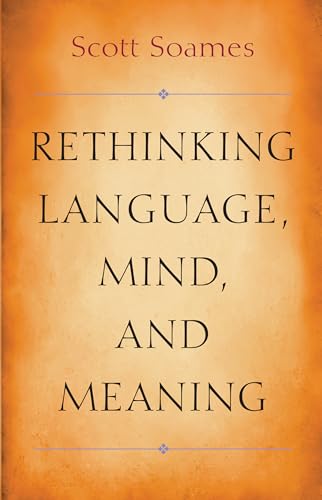
In this book, Scott Soames argues that the revolution in the study of language and mind that has taken place since the late nineteenth century must be rethought.
Die Inhaltsangabe kann sich auf eine andere Ausgabe dieses Titels beziehen.
Über die Autorin bzw. den Autor
Scott Soames is Distinguished Professor of Philosophy and director of the School of Philosophy at the University of Southern California. He is the author of many books, including The Analytic Tradition in Philosophy, Volume 1; Analytic Philosophy in America; Philosophy of Language; Philosophical Essays; and Philosophical Analysis in the Twentieth Century (all Princeton).
Von der hinteren Coverseite
"This is a very significant and original contribution to the philosophy of language, centering on a new way of thinking about propositions. Previous authors have treated propositions as abstract entities that speakers and hearers are aware of and that constitute the meanings or contents of sentences. But Soames argues persuasively that propositions are best thought of as things people do. In developing this idea, he shows how his proposal solves significant difficulties in the philosophy of language. This book will make a huge impact on the subject."--Gilbert Harman, Princeton University
"This is a brilliant book and it will be extremely influential. It lays out Soames’s important theory of propositions, and significantly extends that theory to solve central problems in the foundations of the study of mind and language. Soames has gone further than anyone else in trying to use a theory of the metaphysics of propositions to illuminate issues in the theory of content."--Jeff Speaks, University of Notre Dame
Aus dem Klappentext
"This is a very significant and original contribution to the philosophy of language, centering on a new way of thinking about propositions. Previous authors have treated propositions as abstract entities that speakers and hearers are aware of and that constitute the meanings or contents of sentences. But Soames argues persuasively that propositions are best thought of as things people do. In developing this idea, he shows how his proposal solves significant difficulties in the philosophy of language. This book will make a huge impact on the subject."--Gilbert Harman, Princeton University
"This is a brilliant book and it will be extremely influential. It lays out Soames s important theory of propositions, and significantly extends that theory to solve central problems in the foundations of the study of mind and language. Soames has gone further than anyone else in trying to use a theory of the metaphysics of propositions to illuminate issues in the theory of content."--Jeff Speaks, University of Notre Dame
Auszug. © Genehmigter Nachdruck. Alle Rechte vorbehalten.
Rethinking Language, Mind, and Meaning
By SCOTT SOAMESPRINCETON UNIVERSITY PRESS
Copyright © 2015 Princeton University Press
All rights reserved.
ISBN: 978-0-691-16045-0All rights reserved.
Contents
Acknowledgments, ix,
Chapter 1 The Need for New Foundations, 1,
Chapter 2 The Metaphysics and Epistemology of Information, 15,
Chapter 3 Thinking of Oneself, the Present Moment, and the Actual World-State, 46,
Chapter 4 Linguistic Cognition, Understanding, and Millian Modes of Presentation, 67,
Chapter 5 Perceptual and Demonstrative Modes of Presentation, 96,
Chapter 6 Recognition of Recurrence, 117,
Chapter 7 Believing, Asserting, and Communicating Propositions of Limited Accessibility, 143,
Chapter 8 Recognition of Recurrence Revisited, 156,
Chapter 9 Situating Cognitive Propositions in a Broader Context, 164,
Chapter 10 Overcoming Objections, 208,
Chapter 11 Worries, Opportunities, and Unsolved Problems, 225,
References, 235,
Index, 239,
CHAPTER 1
The Need for New Foundations
In this book, I will argue that the revolution in the study of language, mind, and meaning led by advances in philosophical logic from Frege through Tarski, Kripke, Montague, and Kaplan must be reconceptualized. Although much progress has been made by adapting intensional logic to the study of natural language, the resulting theoretical framework has limitations that require rethinking much of what has guided us up to now. I will begin by sketching where we are in the study of linguistic meaning and how we got there, after which I will identify three main ways in which I believe the current theoretical framework must change.
The story begins with the development of symbolic logic by Gottlob Frege and Bertrand Russell at the end of the nineteenth and beginning of the twentieth centuries. Initially, their goal was to answer two questions in the philosophy of mathematics: What is the source of mathematical knowledge? and What are numbers? They answered (roughly) that logic is the source of mathematical knowledge, that zero is the set of concepts true of nothing, that one is the set of concepts true something, and only that thing, that two is the set of concepts true of some distinct x and y, and nothing else, and so on. Since the concept being non-self-identical is true of nothing, it is a member of zero; since the concept being the Hempel lecturer in 2013 is true of me and only me, it is a member of the number one; since the concept being my son is true of Greg and Brian Soames, and only them, it is a member of the number two. Other integers follow in train. Since numbers are sets of concepts, the successor of a number n is the set of concepts F such that for some x of which F is true, the concept being an F which is not identical to x is a member of n. Natural numbers are defined as those things that are members of every set that contains zero, and that, whenever it contains something, always contains its successor. Multiplication is defined as repeated addition, while addition is defined as repeated application of the successor function. In this way arithmetic was derived from what Frege and Russell took to be pure logic. When, in similar fashion, classical results of higher mathematics were derived from arithmetic, it was thought that all classical mathematics could be so generated. So, logic was seen the foundation of all mathematical knowledge.
That, at any rate, was the breathtaking dream of Frege and Russell. The reality was more complicated. Their first step was the development of the predicate calculus (of first and higher orders), which combined truth-functional logic, familiar from the Stoics onward, with a powerful new account of generality supplanting the more limited syllogistic logic dating back to Aristotle. The key move was to trade the subject/predicate distinction of syllogistic logic for an expanded version of the function/argument distinction from mathematics. Applied to quantification, this meant treating the claim that something is F as predicating being true of something of the property being F or, in Russell's convenient formulation, of the function that maps an object onto the proposition that it is F, while treating the claim that everything is F as predicating being true of each object of that property or function. The crucial point, resulting in a vast increase in expressive power, is the analysis of all and some as expressing higher-order properties of properties or propositional functions expressed by formulas of arbitrary complexity.
Although the first-order fragment of Frege's system was sound and complete—in the sense of proving all and only genuine logical truths—the concepts needed to define and prove this (while also proving that the higher-order system was sound but, like all such systems, incomplete) were still fifty years away. In itself, this didn't defeat the reduction of mathematics to logic. More serious was the intertwining of this early stage of modern logic with what we now call "naïve set theory"—according to which for every stateable condition on objects there is a set (perhaps empty, perhaps not) of all and only the things satisfying it. To think of this as a principle of logic is to think that talk of something's being so-and-so is interchangeable with talk of its being in the set of so-and-so's.
When Russell's paradox demonstrated the contradiction at the heart of this system, it quickly became clear that the principles required to generate sets without falling into contradiction are less obvious, and open to greater doubt, than the arithmetical principles that Frege and Russell hoped to derive from them. This undercut the initial epistemological motivation for reducing mathematics to logic. Partly for this reason, the subsequent boundary that grew up between logic and set theory was one in which the latter came to be viewed as itself an elementary mathematical theory, rather than a part of logic. Reductions of mathematical theories to set theory could still be done, with illuminating results for the foundations of mathematics, but the philosophical payoff was not what Frege and Russell initially hoped for.
This philosophical shortcoming was compensated by the birth of new deductive disciplines—proof theory and model theory—to study the powerful new logical systems that had been developed. A modern system of logic consists of a formally defined language, plus a proof procedure, often in the form of a set of axioms and rules of inference. A proof is a finite sequence of lines each of which is an axiom or a formula obtainable from earlier lines by inference rules. Whether or not something counts as a proof is decidable merely by inspecting the formula on each line, and determining whether it is an axiom, and, if it isn't, whether it bears the structural relation to earlier lines required by the rules. Since these are trivially decidable questions, it can always be decided whether something counts as a proof, thus forestalling the need to prove that something is a proof. In a purely logical (first-order) system, the aim is to prove all and only the logical truths, and to be able to derive from any statement all and only its logical consequences.
These notions are defined semantically. To think of them in this way is to think of them as having something to do with meaning. Although this wasn't exactly how the founder of model theory, Alfred Tarski,...
„Über diesen Titel“ kann sich auf eine andere Ausgabe dieses Titels beziehen.
Suchergebnisse für Rethinking Language, Mind, and Meaning (Carl G. Hempel...

Beispielbild für diese ISBN
Rethinking Language, Mind, and Meaning
Verlag:
Princeton University Press, 2015
ISBN 10: 0691160457
ISBN 13: 9780691160450
Gebraucht
Hardcover
Anbieter: ThriftBooks-Atlanta, AUSTELL, GA, USA
Verkäuferbewertung 5 von 5 Sternen

Hardcover. Zustand: Very Good. No Jacket. May have limited writing in cover pages. Pages are unmarked. ~ ThriftBooks: Read More, Spend Less. Artikel-Nr. G0691160457I4N00
Gebraucht kaufen
EUR 20,99
Versand gratis
Versand innerhalb von USA
Versand innerhalb von USA
Anzahl: 1 verfügbar
Beispielbild für diese ISBN
Rethinking Language, Mind, and Meaning
Anbieter: PBShop.store US, Wood Dale, IL, USA
Verkäuferbewertung 5 von 5 Sternen
HRD. Zustand: New. New Book. Shipped from UK. Established seller since 2000. Artikel-Nr. WP-9780691160450
Beispielbild für diese ISBN
Rethinking Language, Mind, and Meaning
Anbieter: PBShop.store UK, Fairford, GLOS, Vereinigtes Königreich
Verkäuferbewertung 5 von 5 Sternen
HRD. Zustand: New. New Book. Shipped from UK. Established seller since 2000. Artikel-Nr. WP-9780691160450
Neu kaufen
EUR 40,20
EUR 5,86 Versand
Versand von Vereinigtes Königreich nach USA
Versand von Vereinigtes Königreich nach USA
Anzahl: 2 verfügbar
Beispielbild für diese ISBN
Rethinking Language, Mind, and Meaning
Anbieter: Kennys Bookstore, Olney, MD, USA
Verkäuferbewertung 5 von 5 Sternen
Zustand: New. Series: Carl G. Hempel Lecture Series. Num Pages: 256 pages. BIC Classification: CFA; HPM. Category: (P) Professional & Vocational; (U) Tertiary Education (US: College). Dimension: 150 x 223 x 28. Weight in Grams: 452. . 2015. Hardcover. . . . . Books ship from the US and Ireland. Artikel-Nr. V9780691160450
Neu kaufen
EUR 53,00
EUR 9,16 Versand
Versand innerhalb von USA
Versand innerhalb von USA
Anzahl: 1 verfügbar
Beispielbild für diese ISBN
Rethinking Language, Mind, and Meaning (Carl G. Hempel Lecture Series)
Anbieter: Ria Christie Collections, Uxbridge, Vereinigtes Königreich
Verkäuferbewertung 5 von 5 Sternen
Zustand: New. In English. Artikel-Nr. ria9780691160450_new
Neu kaufen
EUR 50,91
EUR 13,17 Versand
Versand von Vereinigtes Königreich nach USA
Versand von Vereinigtes Königreich nach USA
Anzahl: 2 verfügbar
Beispielbild für diese ISBN
Rethinking Language, Mind, and Meaning
Anbieter: Revaluation Books, Exeter, Vereinigtes Königreich
Verkäuferbewertung 5 von 5 Sternen
Hardcover. Zustand: Brand New. 256 pages. 8.75x5.75x1.00 inches. In Stock. Artikel-Nr. __0691160457
Neu kaufen
EUR 54,77
EUR 11,67 Versand
Versand von Vereinigtes Königreich nach USA
Versand von Vereinigtes Königreich nach USA
Anzahl: 2 verfügbar