Foragers, Farmers, and Fossil Fuels: How Human Values Evolve (University Center for Human Values) - Hardcover
Buch 10 von 16: University Center for Human Values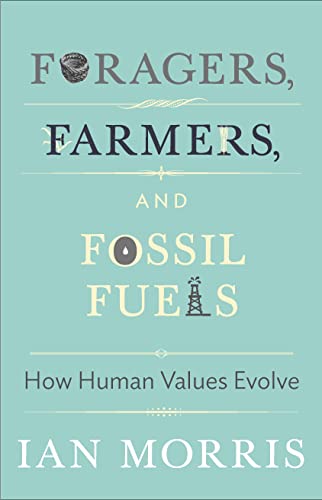
Inhaltsangabe
Most people in the world today think democracy and gender equality are good, and that violence and wealth inequality are bad. But most people who lived during the 10,000 years before the nineteenth century thought just the opposite. Drawing on archaeology, anthropology, biology, and history, Ian Morris, author of the best-selling Why the West Rules - for Now, explains why. The result is a compelling new argument about the evolution of human values, one that has far-reaching implications for how we understand the past - and for what might happen next.
Die Inhaltsangabe kann sich auf eine andere Ausgabe dieses Titels beziehen.
Über die Autorin bzw. den Autor
Ian Morris is professor of classics and a fellow of the Stanford Archaeology Center at Stanford University.
Von der hinteren Coverseite
"Ian Morris has thrown another curveball for social science. In this disarmingly readable book, which takes us from prehistory to the present, he offers a new theory of human culture, linking it firmly to economic fundamentals and how humans obtained their energy and resources from nature. This is bold, erudite, and provocative."--Daron Acemoglu, coauthor ofHow Nations Fail: The Origins of Power, Prosperity, and Poverty
"Ian Morris has emerged in recent years as one of the great big thinkers in history, archaeology, and anthropology, writing books that set people talking and thinking. I found delightful things in every chapter ofForagers, Farmers, and Fossil Fuels, interesting enough that I found myself sharing them with family over dinner. The breadth of reading and the command of the subject are just dazzling. His major argument—that value systems adapt themselves to ambient energy structures, in the same way that an organism adapts to its niche—is fascinating."--Daniel Lord Smail, author ofOn Deep History and the Brain
"This is an important and stylistically excellent book written from a sophisticated materialist perspective. It is eminently readable, lively, and with clearly stated arguments explored in a systematic fashion. In a sense, it follows up on Jared Diamond’s work on agricultural origins, and it parallels Steven Pinker’s book on warfare in depicting a world that is culturally evolving in a certain direction.Foragers, Farmers, and Fossil Fuels should have a serious impact."--Chris Boehm, author ofMoral Origins: The Evolution of Altruism, Virtue, and Shame
Aus dem Klappentext
"Ian Morris has thrown another curveball for social science. In this disarmingly readable book, which takes us from prehistory to the present, he offers a new theory of human culture, linking it firmly to economic fundamentals and how humans obtained their energy and resources from nature. This is bold, erudite, and provocative."--Daron Acemoglu, coauthor ofHow Nations Fail: The Origins of Power, Prosperity, and Poverty
"Ian Morris has emerged in recent years as one of the great big thinkers in history, archaeology, and anthropology, writing books that set people talking and thinking. I found delightful things in every chapter ofForagers, Farmers, and Fossil Fuels, interesting enough that I found myself sharing them with family over dinner. The breadth of reading and the command of the subject are just dazzling. His major argument that value systems adapt themselves to ambient energy structures, in the same way that an organism adapts to its niche is fascinating."--Daniel Lord Smail, author ofOn Deep History and the Brain
"This is an important and stylistically excellent book written from a sophisticated materialist perspective. It is eminently readable, lively, and with clearly stated arguments explored in a systematic fashion. In a sense, it follows up on Jared Diamond s work on agricultural origins, and it parallels Steven Pinker s book on warfare in depicting a world that is culturally evolving in a certain direction.Foragers, Farmers, and Fossil Fuels should have a serious impact."--Chris Boehm, author ofMoral Origins: The Evolution of Altruism, Virtue, and Shame
Auszug. © Genehmigter Nachdruck. Alle Rechte vorbehalten.
Foragers, Farmers, and Fossil Fuels
How Human Values Evolve
By Ian Morris, Stephen MacedoPRINCETON UNIVERSITY PRESS
Copyright © 2015 Ian Morris
All rights reserved.
ISBN: 978-0-691-16039-9All rights reserved.
Contents
List of Figures and Tables, ix,
Acknowledgments, xi,
Introduction by Stephen Macedo, xiii,
Chapter 1 Each Age Gets the Thought It Needs, 1,
Chapter 2 Foragers, 25,
Chapter 3 Farmers, 44,
Chapter 4 Fossil Fuels, 93,
Chapter 5 The Evolution of Values: Biology, Culture, and the Shape of Things to Come, 139,
COMMENTS,
Chapter 6 On the Ideology of Imagining That "Each Age Gets the Thought It Needs" Richard Seaford, 172,
Chapter 7 But What Was It Really Like? The Limitations of Measuring Historical Values Jonathan D. Spence, 180,
Chapter 8 Eternal Values, Evolving Values, and the Value of the Self Christine M. Korsgaard, 184,
Chapter 9 When the Lights Go Out: Human Values after the Collapse of Civilization Margaret Atwood, 202,
RESPONSE,
Chapter 10 My Correct Views on Everything Ian Morris, 208,
Notes, 267,
References, 305,
Contributors, 341,
Index, 343,
CHAPTER 1
EACH AGE GETS THE THOUGHT IT NEEDS
Mr. George
In 1982, I went on my first archaeological excavation in Greece. I was thrilled: I had dug a lot in Britain, but this was something else entirely. An ancient Land Rover took me from Birmingham as far as Thessaloniki, where I caught an even more ancient bus to Assiros, the farming village where we would be working (figure 1.1). There I settled into the project's routine. All day long we would count, weigh, and catalogue fragments of prehistoric pottery, and as the sun went down, we would revive ourselves with a glass or two of ouzo in the dig house's dusty front yard.
One evening, an old man came down the dirt road past the house, riding sidesaddle on a donkey, tapping the animal with a stick. Next to him was an old woman, on foot, bent under the weight of a bulging sack. As they passed, one of my fellow students greeted them in broken Greek.
The old man stopped, all smiles. He exchanged a few sentences with our spokesman, and then the little party trudged on.
"That was Mr. George," our interpreter explained.
"What did you ask him?" one of us said.
"How he's doing. And why his wife isn't riding the donkey."
There was a pause. "And?"
"He says she doesn't have one."
It was my first taste of the classic anthropological experience of culture shock. Back in Birmingham, a man who rode a donkey while his wife struggled with a huge sack would have seemed selfish (or worse). Here in Assiros, however, the arrangement was clearly so natural, and the reasons for it so self-evident, that our question apparently struck Mr. George as simpleminded.
A third of a century later, this book is an attempt to explain what I saw in Assiros. It is based on the two Tanner Lectures in Human Values that I delivered at Princeton University in October 2012. Being asked to give the Tanners is one of the highest honors in academic life, but I was especially delighted by the invitation because I am, frankly, such an unlikely person to receive it. In the thirty years since I met Mr. George, I had never written a single word about moral philosophy. Needless to say, that detail gave me pause, but on reflection, I convinced myself that Princeton's Center for Human Values was actually the perfect setting for me to hold forth on the events in Assiros, because explaining Mr. George's comment and my own reaction to it requires nothing less than a general theory of the cultural evolution of human values across the last twenty thousand years. For that task, a background in history and archaeology rather than in moral philosophy struck me as just the right skillset, and, I told myself, such a general theory of the cultural evolution of human values might be of some interest to moral philosophers too.
Whether I am right or wrong is for you to decide, with some input from the experts. After five chapters in which I set out my theory, in chapters 6 to 9 the four respondents to the original lectures—the classicist Richard Seaford, the Sinologist Jonathan D. Spence, the philosopher Christine M. Korsgaard, and the novelist Margaret Atwood—will have their say. But I get the last word, responding to the responses in chapter 10.
The Argument
In the last forty or fifty years, academics have written hundreds of books and thousands of articles about culture shocks similar to (and often much odder than) my encounter with Mr. George, his donkey, and his wife. What I offer here, though, is rather different from most of these studies. When we look at the entire planet across the last twenty thousand years, I argue, we see three broadly successive systems of human values. Each is associated with a particular way of organizing society, and each form of organization is dictated by a particular way of capturing energy from the world around us. Energy capture ultimately explains not only what Mr. George said but also why it surprised me so much.
Immediately, though, I must make a caveat: because value systems—or cultures, or whatever we want to call them—are such shapeless entities, the only way to present this argument in the space of a hundred or so pages is by focusing on specific subsets of the broader systems. In my comparisons here, I therefore limit myself to ideas about equality and hierarchy (including politics, economics, and gender) and attitudes toward violence. I pick these topics partly because I am interested in them and partly because they seem to be important. However, I also suspect that most subsets of values would reveal similar patterns; and if they do not, comparisons between different subsets of values will be one obvious way that critics might falsify my argument.
I will spend chapters 2 to 4 trying to demonstrate the reality of these three broadly successive systems of human values. I call the first of them "foraging values," because it is associated with societies that support themselves primarily by gathering wild plants and hunting wild animals. Foragers tend to value equality over most kinds of hierarchy and are quite tolerant of violence. The second system I call "farming values," because it is associated with societies that support themselves primarily off domesticated plants and animals. Farmers tend to value hierarchy over equality and are less tolerant of violence. The third system, which I call "fossil-fuel values," is associated with societies that augment the energy of living plants and animals by tapping into the energy of fossilized plants that have turned into coal, gas, and oil. Fossil-fuel users tend to value equality of most kinds over hierarchy and to be very intolerant of violence.
This framework not only explains why Mr. George's comment seemed so odd to me in 1982 (his values were largely those of the farming phase, while mine belonged to the fossil- fuel phase) but also seems to have two broader implications for the study of human values. If I am right that energy capture determines values, it perhaps follows (1) that those moral philosophers who try to identify a one-size-fits-all, perfect system of human values are wasting their time, and (2) that the values that we (whoever "we" happen to be) hold dearest today are very likely to turn out—at some point fairly soon—not to be helpful any more. At that point (again, if I am right), we will abandon these values and will move on to a fourth, post-fossil-fuel,...
„Über diesen Titel“ kann sich auf eine andere Ausgabe dieses Titels beziehen.
Weitere beliebte Ausgaben desselben Titels

Suchergebnisse für Foragers, Farmers, and Fossil Fuels: How Human Values...

Beispielbild für diese ISBN
Foragers, Farmers, and Fossil Fuels: How Human Values Evolve
Verlag:
Princeton University Press, 2015
ISBN 10: 0691160392
ISBN 13: 9780691160399
Gebraucht
Hardcover
Anbieter: ThriftBooks-Dallas, Dallas, TX, USA
Verkäuferbewertung 5 von 5 Sternen

Hardcover. Zustand: Very Good. No Jacket. Former library book; May have limited writing in cover pages. Pages are unmarked. ~ ThriftBooks: Read More, Spend Less. Artikel-Nr. G0691160392I4N10
Beispielbild für diese ISBN
Foragers, Farmers, and Fossil Fuels: How Human Values Evolve
Verlag:
Princeton University Press, 2015
ISBN 10: 0691160392
ISBN 13: 9780691160399
Gebraucht
Hardcover
Anbieter: ThriftBooks-Atlanta, AUSTELL, GA, USA
Verkäuferbewertung 5 von 5 Sternen
Hardcover. Zustand: Good. No Jacket. Missing dust jacket; Pages can have notes/highlighting. Spine may show signs of wear. ~ ThriftBooks: Read More, Spend Less. Artikel-Nr. G0691160392I3N01
Beispielbild für diese ISBN
Foragers, Farmers, and Fossil Fuels: How Human Values Evolve
Verlag:
Princeton University Press, 2015
ISBN 10: 0691160392
ISBN 13: 9780691160399
Gebraucht
Hardcover
Anbieter: ThriftBooks-Dallas, Dallas, TX, USA
Verkäuferbewertung 5 von 5 Sternen
Hardcover. Zustand: Good. No Jacket. Former library book; Pages can have notes/highlighting. Spine may show signs of wear. ~ ThriftBooks: Read More, Spend Less. Artikel-Nr. G0691160392I3N10
Beispielbild für diese ISBN
Foragers, Farmers, and Fossil Fuels: How Human Values Evolve
Verlag:
Princeton University Press, 2015
ISBN 10: 0691160392
ISBN 13: 9780691160399
Gebraucht
Hardcover
Anbieter: ThriftBooks-Atlanta, AUSTELL, GA, USA
Verkäuferbewertung 5 von 5 Sternen
Hardcover. Zustand: Good. No Jacket. Pages can have notes/highlighting. Spine may show signs of wear. ~ ThriftBooks: Read More, Spend Less. Artikel-Nr. G0691160392I3N00
Beispielbild für diese ISBN
Foragers, Farmers, and Fossil Fuels : How Human Values Evolve
Verlag:
Princeton University Press, 2015
ISBN 10: 0691160392
ISBN 13: 9780691160399
Gebraucht
Hardcover
Anbieter: Better World Books, Mishawaka, IN, USA
Verkäuferbewertung 5 von 5 Sternen
Zustand: Very Good. Updated ed. Former library book; may include library markings. Used book that is in excellent condition. May show signs of wear or have minor defects. Artikel-Nr. 13623076-75
Beispielbild für diese ISBN
Foragers, Farmers, and Fossil Fuels
Anbieter: PBShop.store US, Wood Dale, IL, USA
Verkäuferbewertung 5 von 5 Sternen
HRD. Zustand: New. New Book. Shipped from UK. Established seller since 2000. Artikel-Nr. WP-9780691160399
Foto des Verkäufers
FORAGERS FARMERS AND FOSSIL FUELS How Human Values Evolve
Verlag:
Princeton University Press, 2015. 9780691160399, 2015
ISBN 10: 0691160392
ISBN 13: 9780691160399
Gebraucht
Hardcover
Erstausgabe
Anbieter: Rothwell & Dunworth (ABA, ILAB), Dulverton, Vereinigtes Königreich
Verkäuferbewertung 5 von 5 Sternen
1st edn 1st printing. 8vo. Original silver lettered black cloth (page edges a little tanned - otherwise near Fine), dustwrapper (VG, not clipped). Pp. xxii + 369, illus with b&w photos in text, maps, graphs and figures (no inscriptions). Artikel-Nr. 186322
Gebraucht kaufen
EUR 17,69
Versand:
EUR 11,45
Von Vereinigtes Königreich nach USA
Anzahl: 1 verfügbar
Beispielbild für diese ISBN
Foragers, Farmers, and Fossil Fuels
Anbieter: PBShop.store UK, Fairford, GLOS, Vereinigtes Königreich
Verkäuferbewertung 5 von 5 Sternen
HRD. Zustand: New. New Book. Shipped from UK. Established seller since 2000. Artikel-Nr. WP-9780691160399
Neu kaufen
EUR 26,24
Versand:
EUR 5,75
Von Vereinigtes Königreich nach USA
Anzahl: 15 verfügbar
Beispielbild für diese ISBN
Foragers, Farmers and Fossil Fuels
Anbieter: Majestic Books, Hounslow, Vereinigtes Königreich
Verkäuferbewertung 4 von 5 Sternen

Zustand: New. pp. 360 4 Maps. Artikel-Nr. 322534802
Neu kaufen
EUR 28,77
Versand:
EUR 7,44
Von Vereinigtes Königreich nach USA
Anzahl: 1 verfügbar
Beispielbild für diese ISBN
Foragers, Farmers, and Fossil Fuels How Human Values Evolve
Anbieter: Revaluation Books, Exeter, Vereinigtes Königreich
Verkäuferbewertung 5 von 5 Sternen
Hardcover. Zustand: Brand New. revised updated edition. 400 pages. 8.00x5.00x1.00 inches. In Stock. Artikel-Nr. __0691160392
Neu kaufen
EUR 32,49
Versand:
EUR 14,31
Von Vereinigtes Königreich nach USA
Anzahl: 2 verfügbar