
Verwandte Artikel zu The Passions and the Interests: Political Arguments...
The Passions and the Interests: Political Arguments for Capitalism before Its Triumph (Princeton Classics) - Softcover
Buch 2 von 49: Princeton Classics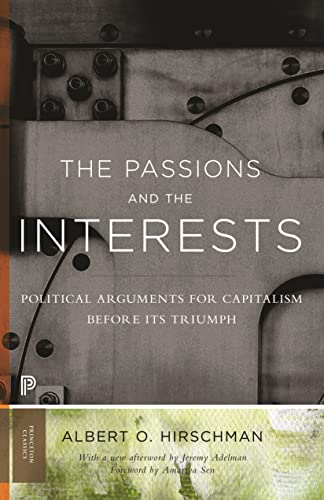
Inhaltsangabe
In this volume, Albert Hirschman reconstructs the intellectual climate of the seventeenth and eighteenth centuries to illuminate the intricate ideological transformation that occurred, wherein the pursuit of material interests--so long condemned as the deadly sin of avarice--was assigned the role of containing the unruly and destructive passions of man. Hirschman here offers a new interpretation for the rise of capitalism, one that emphasizes the continuities between old and new, in contrast to the assumption of a sharp break that is a common feature of both Marxian and Weberian thinking. Among the insights presented here is the ironical finding that capitalism was originally supposed to accomplish exactly what was soon denounced as its worst feature: the repression of the passions in favor of the "harmless," if one-dimensional, interests of commercial life. To portray this lengthy ideological change as an endogenous process, Hirschman draws on the writings of a large number of thinkers, including Montesquieu, Sir James Steuart, and Adam Smith. Featuring a new afterword by Jeremy Adelman and a foreword by Amartya Sen, this Princeton Classics edition of The Passions and the Interests sheds light on the intricate ideological transformation from which capitalism emerged triumphant, and reaffirms Hirschman's stature as one of our most influential and provocative thinkers.
Die Inhaltsangabe kann sich auf eine andere Ausgabe dieses Titels beziehen.
Über die Autorin bzw. den Autor
Albert O. Hirschman With a foreword by Amartya Sen and a new afterword by Jeremy Adelman
Auszug. © Genehmigter Nachdruck. Alle Rechte vorbehalten.
THE PASSIONS AND THE INTERESTS
Political Arguments for Capitalism before Its Triumph
By Albert O. HirschmanPRINCETON UNIVERSITY PRESS
Copyright © 2013 Princeton University Press
All rights reserved.
ISBN: 978-0-691-16025-2All rights reserved.
Contents
| Foreword, by Amartya Sen................................................... | ix |
| Preface to the Twentieth Anniversary Edition............................... | xxi |
| Acknowledgments............................................................ | xxv |
| Introduction............................................................... | 3 |
| PART ONE. How the Interests were Called Upon to Counteract the Passions.... | 7 |
| The Idea of Glory and Its Downfall......................................... | 9 |
| Man "as he really is"...................................................... | 12 |
| Repressing and Harnessing the Passions..................................... | 14 |
| The Principle of the Countervailing Passion................................ | 20 |
| "Interest" and "Interests" as Tamers of the Passions....................... | 31 |
| Interest as a New Paradigm................................................. | 42 |
| Assets of an Interest-Governed World: Predictability and Constancy......... | 48 |
| Money-Making and Commerce as Innocent and Doux............................. | 56 |
| Money-Making as a Calm Passion............................................. | 63 |
| PART TWO. How Economic Expansion was Expected to Improve the Political Order...................................................................... | 67 |
| Elements of a Doctrine..................................................... | 70 |
| Related yet Discordant Views............................................... | 93 |
| PART THREE. Reflections on an Episode in Intellectual History.............. | 115 |
| Where the Montesquieu-Steuart Vision Went Wrong............................ | 117 |
| The Promise of an Interest-Governed World versus the Protestant Ethic...... | 128 |
| Contemporary Notes......................................................... | 132 |
| Afterword by Jeremy Adelman................................................ | 137 |
| Notes...................................................................... | 145 |
| Index...................................................................... | 155 |
CHAPTER 1
The Idea of Glory and Its Downfall
At the beginning of the principal section of his famousessay, Max Weber asked: "Now, how could anactivity, which was at best ethically tolerated, turn intoa calling in the sense of Benjamin Franklin?" Inother words: How did commercial, banking, and similarmoney-making pursuits become honorable at some pointin the modern age after having stood condemned ordespised as greed, love of lucre, and avarice for centuriespast?
The enormous critical literature on The ProtestantEthic has found fault even with this point of departureof Weber's inquiry. The "spirit of capitalism," it hasbeen alleged, was extant among merchants as far backas the fourteenth and fifteenth centuries, and a positiveattitude toward certain categories of business pursuitscould be discovered in the writings of the Scholastics.
Weber's question is nevertheless justified if it isasked in a comparative vein. No matter how muchapproval was bestowed on commerce and other formsof money-making, they certainly stood lower in thescale of medieval values than a number of other activities,in particular the striving for glory. It is indeedthrough a brief sketch of the idea of glory in the MiddleAges and the Renaissance that I shall now attempt torenew the sense of wonder about the genesis of the"spirit of capitalism."
At the beginning of the Christian era St. Augustine!lad supplied basic guidelines to medieval thinking bydenouncing lust for money and possessions as one of thethree principal sins of fallen man, lust for power (libidodominandi) and sexual lust being the other two. Onthe whole Augustine is perfectly even-handed in hiscondemnation of these three human drives or passions.If he does admit of attenuating circumstances for anyof them, it is for libido dominandi when combined witha strong desire for praise and glory. Thus Augustinespeaks of the "civil virtue" characterizing the earlyRomans "who have shown a Babylonian love for theirearthly fatherland," and who were "suppressing the desireof wealth and many other vices for their one vice,namely, the love of praise."
For the later argument of this essay it is of considerableinterest that St. Augustine conceives here of thepossibility that one vice may check another. In anyevent, his limited endorsement of glory-seeking left anopening that was broadened far beyond his teachingsby the spokesmen for the chivalric, aristocratic idealwho made the striving for honor and glory into thetouchstone of a man's virtue and greatness. WhatAugustine had expressed most cautiously and reluctantlywas later triumphantly proclaimed: love of glory,in contrast with the purely private pursuit of riches,can have "redeeming social value." In fact, the idea ofan "Invisible Hand"—of a force that makes men pursuingtheir private passions conspire unknowingly to·ward the public good-was formulated in connectionwith the search for glory, rather than with the desire formoney, by Montesquieu. The pursuit of honor in amonarchy, so he says, "brings life to all the parts of thebody politic"; as a result, "it turns out that everyonecontributes to the general welfare while thinking thathe works for his own interests."
With or without such sophisticated justification, strivingfor honor and glory was exalted by the medievalchivalric ethos even though it stood at odds with thecentral teachings, not only of St. Augustine, but of along line of religious writers, from St. Thomas Aquinasto Dante, who attacked glory-seeking as both vain(inanis) and sinful. Then, during the Renaissance, thestriving for honor achieved the status of a dominantideology as the influence of the Church receded and theadvocates of the aristocratic ideal were able to draw onthe plentiful Greek and Roman texts celebrating thepursuit of glory. This powerful intellectual currentcarried over into the seventeenth century: perhaps thepurest conception of glory-seeking as the only justificationof life is to be found in the tragedies of Corneille.At the same time, Corneille's formulations were so extremethat they may have contributed to the spectaculardownfall of the aristocratic ideal that was to be stagedby some of his contemporaries.
Writers from a number of Western European countriescooperated in this "demolition of the hero," withthose from France—the country that had perhaps gonefarthest in the cult of the heroic ideal-playing themajor part. All the heroic virtues were shown to beforms of mere self-preservation by Hobbes, of self-loveby La Rochefoucauld, of vanity and of frantic escapefrom real self-knowledge by Pascal. The heroic passionswere portrayed as demeaning by Racine after havingbeen denounced as foolish, if not demented, by Cervantes.
This astounding transformation of the moral andideological...
„Über diesen Titel“ kann sich auf eine andere Ausgabe dieses Titels beziehen.
Suchergebnisse für The Passions and the Interests: Political Arguments...

Beispielbild für diese ISBN
The Passions and the Interests: Political Arguments for Capitalism before Its Triumph
Verlag:
Princeton University Press, 2013
ISBN 10: 0691160252
ISBN 13: 9780691160252
Gebraucht
Paperback
Anbieter: World of Books (was SecondSale), Montgomery, IL, USA
Verkäuferbewertung 5 von 5 Sternen

Paperback. Zustand: Fair. Reconstructs the intellectual climate of the seventeenth and eighteenth centuries to illuminate the intricate ideological transformation that occurred, wherein the pursuit of material interests - so long condemned as the deadly sin of avarice - was assigned the role of containing the unruly and destructive passions of man. Artikel-Nr. 00110070141
Gebraucht kaufen
EUR 7,94
Versand gratis
Versand innerhalb von USA
Versand innerhalb von USA
Anzahl: 1 verfügbar
Beispielbild für diese ISBN
The Passions and the Interests: Political Arguments for Capitalism before Its Triumph (Princeton Classics)
Verlag:
Princeton University Press, 2013
ISBN 10: 0691160252
ISBN 13: 9780691160252
Gebraucht
Paperback
Anbieter: Books Do Furnish A Room, Durham, NC, USA
Verkäuferbewertung 4 von 5 Sternen

Paperback. Zustand: Very Good. Pages unmarked. Covers glossy. Covers curl a bit at outer edges. Book. Artikel-Nr. 120157
Gebraucht kaufen
EUR 5,01
EUR 4,77 Versand
Versand innerhalb von USA
Versand innerhalb von USA
Anzahl: 1 verfügbar
Beispielbild für diese ISBN
The Passions and the Interests: Political Arguments for Capitalism before Its Triumph (Princeton Classics)
Verlag:
Princeton University Press, 2013
ISBN 10: 0691160252
ISBN 13: 9780691160252
Gebraucht
Softcover
Anbieter: Wonder Book, Frederick, MD, USA
Verkäuferbewertung 5 von 5 Sternen
Zustand: Good. Good condition. A copy that has been read but remains intact. May contain markings such as bookplates, stamps, limited notes and highlighting, or a few light stains. Artikel-Nr. O06I-01489
Gebraucht kaufen
EUR 10,89
Versand gratis
Versand innerhalb von USA
Versand innerhalb von USA
Anzahl: 1 verfügbar
Beispielbild für diese ISBN
The Passions and the Interests: Political Arguments for Capitalism before Its Triumph (Princeton Classics)
Verlag:
Princeton University Press, 2013
ISBN 10: 0691160252
ISBN 13: 9780691160252
Gebraucht
Softcover
Anbieter: Wonder Book, Frederick, MD, USA
Verkäuferbewertung 5 von 5 Sternen
Zustand: As New. Like New condition. A near perfect copy that may have very minor cosmetic defects. Artikel-Nr. SB14OS-01928
Gebraucht kaufen
EUR 18,14
Versand gratis
Versand innerhalb von USA
Versand innerhalb von USA
Anzahl: 1 verfügbar
Beispielbild für diese ISBN
The Passions and the Interests
Anbieter: PBShop.store US, Wood Dale, IL, USA
Verkäuferbewertung 5 von 5 Sternen
PAP. Zustand: New. New Book. Shipped from UK. Established seller since 2000. Artikel-Nr. WP-9780691160252
Beispielbild für diese ISBN
The Passions and the Interests
Anbieter: PBShop.store UK, Fairford, GLOS, Vereinigtes Königreich
Verkäuferbewertung 5 von 5 Sternen
PAP. Zustand: New. New Book. Shipped from UK. Established seller since 2000. Artikel-Nr. WP-9780691160252
Neu kaufen
EUR 21,44
EUR 3,85 Versand
Versand von Vereinigtes Königreich nach USA
Versand von Vereinigtes Königreich nach USA
Anzahl: 15 verfügbar
Beispielbild für diese ISBN
The Passions and the Interests: Political Arguments for Capitalism before Its Triumph (Princeton Classics)
Anbieter: Majestic Books, Hounslow, Vereinigtes Königreich
Verkäuferbewertung 4 von 5 Sternen
Zustand: New. pp. 192. Artikel-Nr. 56772216
Neu kaufen
EUR 20,15
EUR 7,61 Versand
Versand von Vereinigtes Königreich nach USA
Versand von Vereinigtes Königreich nach USA
Anzahl: 1 verfügbar
Beispielbild für diese ISBN
The Passions and the Interests Political Arguments for Capitalism before Its Triumph
Anbieter: Revaluation Books, Exeter, Vereinigtes Königreich
Verkäuferbewertung 5 von 5 Sternen
Paperback. Zustand: Brand New. reprint edition. 161 pages. 8.50x5.50x0.75 inches. In Stock. Artikel-Nr. x-0691160252
Neu kaufen
EUR 23,21
EUR 11,71 Versand
Versand von Vereinigtes Königreich nach USA
Versand von Vereinigtes Königreich nach USA
Anzahl: 2 verfügbar
Beispielbild für diese ISBN
The Passions and the Interests: Political Arguments for Capitalism before Its Triumph
Anbieter: Kennys Bookstore, Olney, MD, USA
Verkäuferbewertung 5 von 5 Sternen
Zustand: New. Reconstructs the intellectual climate of the seventeenth and eighteenth centuries to illuminate the intricate ideological transformation that occurred, wherein the pursuit of material interests - so long condemned as the deadly sin of avarice - was assigned the role of containing the unruly and destructive passions of man. Series: Princeton Classics. Num Pages: 192 pages. BIC Classification: KCM; KCZ. Category: (G) General (US: Trade); (U) Tertiary Education (US: College). Dimension: 215 x 142 x 13. Weight in Grams: 198. . 2013. With a New afterword by Jeremy Adelman. Paperback. . . . . Books ship from the US and Ireland. Artikel-Nr. V9780691160252
Neu kaufen
EUR 28,14
EUR 9,27 Versand
Versand innerhalb von USA
Versand innerhalb von USA
Anzahl: Mehr als 20 verfügbar
Beispielbild für diese ISBN
The Passions and the Interests: Political Arguments for Capitalism before Its Triumph (Princeton Classics)
Anbieter: Ria Christie Collections, Uxbridge, Vereinigtes Königreich
Verkäuferbewertung 5 von 5 Sternen
Zustand: New. In English. Artikel-Nr. ria9780691160252_new
Neu kaufen
EUR 29,35
EUR 10,97 Versand
Versand von Vereinigtes Königreich nach USA
Versand von Vereinigtes Königreich nach USA
Anzahl: Mehr als 20 verfügbar