
Verwandte Artikel zu Strategic Reassurance and Resolve: U.S.- China Relations...
Inhaltsangabe
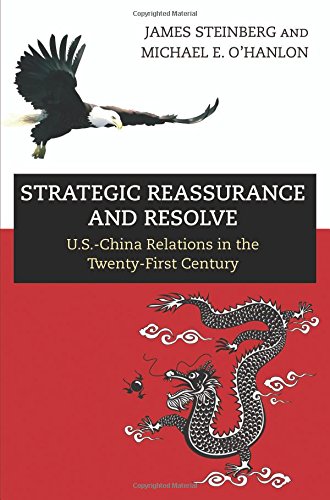
After forty years of largely cooperative Sino-U.S. relations, policymakers, politicians, and pundits on both sides of the Pacific see growing tensions between the United States and China. Some go so far as to predict a future of conflict, driven by the inevitable rivalry between an established and a rising power, and urge their leaders to prepare now for a future showdown. Others argue that the deep economic interdependence between the two countries and the many areas of shared interests will lead to more collaborative relations in the coming decades. In this book, James Steinberg and Michael O'Hanlon stake out a third, less deterministic position. They argue that there are powerful domestic and international factors, especially in the military and security realms, that could well push the bilateral relationship toward an arms race and confrontation, even though both sides will be far worse off if such a future comes to pass. They contend that this pessimistic scenario can be confidently avoided only if China and the United States adopt deliberate policies designed to address the security dilemma that besets the relationship between a rising and an established power
Die Inhaltsangabe kann sich auf eine andere Ausgabe dieses Titels beziehen.
Über die Autorin bzw. den Autor
James Steinberg is dean of the Maxwell School of Citizenship and Public Affairs and professor of social science, international affairs, and law at Syracuse University, and former deputy secretary of state in the Obama administration. His books include An Ever Closer Union. Michael E. O'Hanlon is a senior fellow at the Brookings Institution who specializes in national security policy. His books include The Science of War (Princeton). Steinberg and O'Hanlon are the authors of Protecting the American Homeland.
Von der hinteren Coverseite
"The United States and China are locked in an increasingly intense strategic rivalry. In their thought-provoking new book, Steinberg and O'Hanlon seek ways to prevent this competition from spiraling out of control. While acknowledging the obstacles and potential risks, the authors offer concrete proposals aimed at promoting transparency, restraint, and stability. Their ideas deserve to be discussed and debated, in Beijing as well as Washington."--Aaron L. Friedberg, Princeton University
"A highly informed and realistic analysis of U.S.-China relations that avoids premature fatalism and Pollyannish optimism. It offers a bold strategy based on developing a common framework of cooperation benefiting both countries while still standing up for American interests and allies. The authors further undertake the hard work of offering concrete examples of where such cooperative opportunities might be found. A must-read for anyone interested in the future of U.S.-China relations."--Stephen J. Hadley, former national security advisor to President George W. Bush
"This excellent book makes an elegant statement on the stakes involved in achieving strategic coexistence between the established power, the United States, and the rising power, China. The authors provide a specific set of guidelines for avoiding unnecessary competition."--Patrick M. Cronin, Center for a New American Security
"Strategic Reassurance and Resolve argues that major armed conflict between the United States and China is far from inevitable and moreover, that concrete steps can be taken to avoid such an outcome. Offering numerous recommendations and proposals, this effectively organized and well-written book offers an important contribution to the debate on China's rise and U.S. policy."--M. Taylor Fravel, author ofStrong Borders, Secure Nation
Aus dem Klappentext
"The United States and China are locked in an increasingly intense strategic rivalry. In their thought-provoking new book, Steinberg and O'Hanlon seek ways to prevent this competition from spiraling out of control. While acknowledging the obstacles and potential risks, the authors offer concrete proposals aimed at promoting transparency, restraint, and stability. Their ideas deserve to be discussed and debated, in Beijing as well as Washington."--Aaron L. Friedberg, Princeton University
"A highly informed and realistic analysis of U.S.-China relations that avoids premature fatalism and Pollyannish optimism. It offers a bold strategy based on developing a common framework of cooperation benefiting both countries while still standing up for American interests and allies. The authors further undertake the hard work of offering concrete examples of where such cooperative opportunities might be found. A must-read for anyone interested in the future of U.S.-China relations."--Stephen J. Hadley, former national security advisor to President George W. Bush
"This excellent book makes an elegant statement on the stakes involved in achieving strategic coexistence between the established power, the United States, and the rising power, China. The authors provide a specific set of guidelines for avoiding unnecessary competition."--Patrick M. Cronin, Center for a New American Security
"Strategic Reassurance and Resolve argues that major armed conflict between the United States and China is far from inevitable and moreover, that concrete steps can be taken to avoid such an outcome. Offering numerous recommendations and proposals, this effectively organized and well-written book offers an important contribution to the debate on China's rise and U.S. policy."--M. Taylor Fravel, author ofStrong Borders, Secure Nation
Auszug. © Genehmigter Nachdruck. Alle Rechte vorbehalten.
Strategic Reassurance and Resolve
U.S.-China Relations in the Twenty-First Century
By James Steinberg, Michael E. O'HanlonPRINCETON UNIVERSITY PRESS
Copyright © 2014 Princeton University Press
All rights reserved.
ISBN: 978-0-691-15951-5All rights reserved.
Contents
Acknowledgments, ix,
Chapter 1. Introduction, 1,
PART I: The Cause for Concern,
Chapter 2. The Sources of Conflict, 17,
Chapter 3. The Determinants of Chinese Strategy, 29,
Chapter 4. The Determinants of American Strategy, 48,
PART II: Strategic Reassurance in Practice,
Chapter 5. Military Spending and Military Modernization, 77,
Chapter 6. Military Contingencies: Enhancing Crisis Stability, 120,
Chapter 7. The Strategic Domain: Nuclear, Space, and Cyber, 150,
Chapter 8. Bases, Deployments, and Operations, 182,
Chapter 9. Conclusion, 203,
Appendix A. Summary of Specific Recommendations, 209,
Appendix B. Naval Vessels of the United States and China, 213,
Notes, 215,
Index, 257,
CHAPTER 1
Introduction
On March 7, 2012, in a speech to mark the fortieth anniversary of President Nixon's historic trip to China, Secretary of State Hillary Clinton observed that "the U.S.-China project of 2012 ... is unprecedented in the history of nations. The United States is attempting to work with a rising power to foster its rise as an active contributor to global security, stability and prosperity while also sustaining and securing American leadership in a changing world. And we are trying to do this without entering into unhealthy competition, rivalry, or conflict."
With these sentences, she encapsulated what may be the most consequential foreign policy challenge of the twenty-first century. While there is a wide range of views in both the United States and China on how to manage bilateral relations, few dispute the assertion of leaders on both sides that the U.S.-China relationship is the most consequential bilateral relationship of our time, as China's spectacular economic growth, its military modernization, and its increasingly active role on the regional and global stages have focused attention on the prospects for cooperation or conflict between the United States and China in the coming decades.
China's leaders have responded to the challenge with a formulation of their own: the call for a "new great power relationship," implicitly endorsing Secretary Clinton's argument that China and the United States must chart a novel approach in order to avoid the dangers of conflict that have characterized relations between established and emerging powers so often in the past.
Both are responding to commonly held views among both policymakers and many academic international relations theorists that China, as a rising power, is bound to challenge America's regional and global hegemony and that America, the dominant power, is destined to resist. Although the outcome of the contest is not foreordained, in this view the inevitability of it is. The immutable structure of the international system is based on states pursuing their national interest by seeking absolute or relative power dominance. For the proponents of this view, the coming contest is largely independent of the character and history of the two countries in question and of the choices made by their leaders.
Their views find inspiration in Thucydides' explanation of the cause of the Peloponnesian War: "What made the war inevitable was the growth of Athenian power and the fear which this caused Sparta." The United States may not be fearful of China, per se, but its leaders certainly recognize the tectonic implications of the rise of the People's Republic China (PRC) for international relations in the Asia-Pacific region and beyond. In any event, the tragic record of conflict over the centuries between rising and established powers has only reinforced Thucydides' argument since then.
For those who embrace this view, the policy implications are clear. On the U.S. side, proponents argue that the core goal of U.S. foreign policy should be to sustain American dominance to ward off the inevitable challenge of emerging powers. It was embodied in the U.S. National Security Strategy of 2002: "Our forces will be strong enough to dissuade potential adversaries from pursuing a military build-up in hopes of surpassing or equaling the power of the United States." The concept has been further underscored by leading academic strategists.
Their views are mirrored on the China side by academics and former officials (primarily from the People's Liberation Army [PLA]) who share the view that conflict is inevitable and that China should not shirk from the challenge of taking on American interests.
Others are less deterministic, but not much less pessimistic. Although conflict between China and the United States is not inevitable, they argue, it is highly likely. These analysts draw their pessimistic forecasts from a number of factors. Some point to the difficulty of achieving cooperation and avoiding conflict under uncertainty. Drawing on insights from game theory, they note that rational actors often compete even when they would be better off cooperating because they cannot "trust" the other side to keep any bargain between them rather than defect, as the game theory lexicon would phrase it. Others point to the problems of misperception—what appears to one side as a legitimate strategy of self-defense may look to the other as preparations for offensive actions (the so-called security dilemma). A third group focuses more on the specific traditions and cultures of the two countries themselves, each of which has a strong sense of unique mission and superior values. In the case of the United States and China, this can be depicted as the City on the Hill versus the Middle Kingdom. These self-images give each a legitimate claim, at least in its own eyes, to act as the dominant power—not only for its own narrow self-interest but for the greater good.
Of course, these are not the only views. Practitioners tend to reject deterministic accounts, not least because adopting such a view implies that the choices made by individual leaders are irrelevant to the future course of events. They are supported by historians who look at periods where power shifts have not been accompanied by war. They are further buttressed by theorists who argue that the so-called iron laws of state-to-state relations are really context dependent (with contemporary factors such as nuclear deterrence clearly being relevant) and finally by those who argue that in the globalized world of increasing interdependence, power shifts need not lead to zero-sum competition.
This book proceeds from the premise that the future is not fully determined by factors beyond the control of policymakers in both countries; otherwise there would be little point in considering policy options at all. This is a modest assumption; our analysis does not depend on adherence to a particular school of international relations theory. As a number of academics have noted, even adherents of the so-called realist school have argued in favor of an optimistic view of the future of U.S.-China relations, while some liberal internationalists find a potential cause for pessimism from the application of their theory to the Sino-American case.
Our core contention is that the outcome is contingent. It is contingent on a variety of both external developments and domestic factors in both countries—and in other places, particularly those in the Asia-Pacific region. To a large degree, the...
„Über diesen Titel“ kann sich auf eine andere Ausgabe dieses Titels beziehen.
Suchergebnisse für Strategic Reassurance and Resolve: U.S.- China Relations...

Beispielbild für diese ISBN
Strategic Reassurance and Resolve: U.S.-China Relations in the Twenty-First Century
Verlag:
Princeton University Press (edition ), 2014
ISBN 10: 0691159513
ISBN 13: 9780691159515
Gebraucht
Hardcover
Anbieter: BooksRun, Philadelphia, PA, USA
Verkäuferbewertung 5 von 5 Sternen

Hardcover. Zustand: Very Good. It's a well-cared-for item that has seen limited use. The item may show minor signs of wear. All the text is legible, with all pages included. It may have slight markings and/or highlighting. Artikel-Nr. 0691159513-11-1
Gebraucht kaufen
EUR 5,73
Versand gratis
Versand innerhalb von USA
Versand innerhalb von USA
Anzahl: 1 verfügbar
Beispielbild für diese ISBN
Strategic Reassurance and Resolve: U.S.-China Relations in the Twenty-First Century
Verlag:
Princeton University Press, 2014
ISBN 10: 0691159513
ISBN 13: 9780691159515
Gebraucht
Hardcover
Anbieter: Wonder Book, Frederick, MD, USA
Verkäuferbewertung 5 von 5 Sternen
Zustand: Very Good. Very Good condition. Very Good dust jacket. A copy that may have a few cosmetic defects. May also contain light spine creasing or a few markings such as an owner's name, short gifter's inscription or light stamp. Artikel-Nr. X06D-01164
Gebraucht kaufen
EUR 6,73
Versand gratis
Versand innerhalb von USA
Versand innerhalb von USA
Anzahl: 1 verfügbar
Beispielbild für diese ISBN
Strategic Reassurance and Resolve: U.S.-China Relations in the Twenty-First Century
Verlag:
Princeton University Press, 2014
ISBN 10: 0691159513
ISBN 13: 9780691159515
Gebraucht
Hardcover
Signiert
Anbieter: Wonder Book, Frederick, MD, USA
Verkäuferbewertung 5 von 5 Sternen
Zustand: Good. Signed Copy . Very Good dust jacket. Inscribed by author Michael O'Hanlon on title page. Writing inside. Artikel-Nr. SB03H-01538
Gebraucht kaufen
EUR 6,73
Versand gratis
Versand innerhalb von USA
Versand innerhalb von USA
Anzahl: 1 verfügbar
Beispielbild für diese ISBN
Strategic Reassurance and Resolve : U. S. -China Relations in the Twenty-First Century
Verlag:
Princeton University Press, 2014
ISBN 10: 0691159513
ISBN 13: 9780691159515
Gebraucht
Hardcover
Anbieter: Better World Books: West, Reno, NV, USA
Verkäuferbewertung 5 von 5 Sternen
Zustand: Good. Pages intact with minimal writing/highlighting. The binding may be loose and creased. Dust jackets/supplements are not included. Stock photo provided. Product includes identifying sticker. Better World Books: Buy Books. Do Good. Artikel-Nr. 16466075-6
Gebraucht kaufen
EUR 10,45
Versand gratis
Versand innerhalb von USA
Versand innerhalb von USA
Anzahl: 1 verfügbar
Beispielbild für diese ISBN
Strategic Reassurance and Resolve - U.S.-China Relations in the Twenty-First Century.
Verlag:
University Press Group Ltd, 2014
ISBN 10: 0691159513
ISBN 13: 9780691159515
Gebraucht
Hardcover
Anbieter: Mooney's bookstore, Den Helder, Niederlande
Verkäuferbewertung 4 von 5 Sternen

Zustand: As New. Artikel-Nr. EB43A49318DD38F
Gebraucht kaufen
EUR 31,30
EUR 14,95 Versand
Versand von Niederlande nach USA
Versand von Niederlande nach USA
Anzahl: 1 verfügbar
Beispielbild für diese ISBN
Strategic Reassurance and Resolve
Anbieter: PBShop.store UK, Fairford, GLOS, Vereinigtes Königreich
Verkäuferbewertung 5 von 5 Sternen
HRD. Zustand: New. New Book. Shipped from UK. Established seller since 2000. Artikel-Nr. WP-9780691159515
Neu kaufen
EUR 45,26
EUR 6,00 Versand
Versand von Vereinigtes Königreich nach USA
Versand von Vereinigtes Königreich nach USA
Anzahl: 1 verfügbar
Beispielbild für diese ISBN
Strategic Reassurance and Resolve: U.S.-China Relations in the Twenty-First Century
Anbieter: Kennys Bookstore, Olney, MD, USA
Verkäuferbewertung 5 von 5 Sternen
Zustand: New. 2014. Hardcover. . . . . . Books ship from the US and Ireland. Artikel-Nr. V9780691159515
Neu kaufen
EUR 49,43
EUR 9,44 Versand
Versand innerhalb von USA
Versand innerhalb von USA
Anzahl: 1 verfügbar
Beispielbild für diese ISBN
Strategic Reassurance and Resolve; U.S.-China Relations in the Twenty-First Century
Verlag:
Princeton University Press, Princeton, 2014
ISBN 10: 0691159513
ISBN 13: 9780691159515
Gebraucht
Hardcover
Erstausgabe
Anbieter: Ground Zero Books, Ltd., Silver Spring, MD, USA
Verkäuferbewertung 5 von 5 Sternen
Hardcover. Zustand: Very good. Zustand des Schutzumschlags: Very good. First Printing [Stated]. ix, [3], 260 pages. Figures. Tables. Appendix A. Summary of Specific Recommendations. Appendix B. Naval Vessels of the United States and China. Notes. Index. James Braidy Steinberg (born May 7, 1953) is an American academic and political advisor, and former United States Deputy Secretary of State. He has served as the dean of the Paul H. Nitze School of Advanced International Studies (SAIS) at Johns Hopkins University since November 1, 2021. Prior to his deanship, he was a professor at the Maxwell School of Citizenship and Public Affairs at Syracuse University. As Deputy Secretary of State and principal Deputy to US Secretary of State Hillary Clinton, Steinberg notably coined the phrase "strategic reassurance" to describe China-United States relations suggestive of the idea that the United States should reassure China about welcoming China's rise while China would reassure the US and its neighbors that it would not conflict with their interests. Michael Edward O'Hanlon (born May 16, 1961) is a senior fellow at The Brookings Institution, specializing in defense and foreign policy issues. He began his career as a budget analyst in the defense field. O'Hanlon's main areas of work over the years include studies on defense technology issues, such as missile defense and space weaponry and the future of nuclear weapons policy, and on defense strategy and budget issues that follow a long Brookings tradition. The analytical approaches that O'Hanlon employs were explained in his 2009 Princeton University Press book, The Science of War, which discusses methods of defense analysis. After forty years of largely cooperative Sino-U.S. relations, policymakers, politicians, and pundits on both sides of the Pacific see growing tensions between the United States and China. Some go so far as to predict a future of conflict, driven by the inevitable rivalry between an established and a rising power, and urge their leaders to prepare now for a future showdown. Others argue that the deep economic interdependence between the two countries and the many areas of shared interests will lead to more collaborative relations in the coming decades. In this book, James Steinberg and Michael O'Hanlon stake out a third, less deterministic position. They argue that there are powerful domestic and international factors, especially in the military and security realms, that could well push the bilateral relationship toward an arms race and confrontation, even though both sides will be far worse off if such a future comes to pass. They contend that this pessimistic scenario can be confidently avoided only if China and the United States adopt deliberate policies designed to address the security dilemma that besets the relationship between a rising and an established power. The authors propose a set of policy proposals to achieve a sustainable, relatively cooperative relationship between the two nations, based on the concept of providing mutual strategic reassurance in such key areas as nuclear weapons and missile defense, space and cyber operations, and military basing and deployments, while also demonstrating strategic resolve to protect vital national interests, including, in the case of the United States, its commitments to regional allies. Artikel-Nr. 85764
Gebraucht kaufen
EUR 60,17
EUR 4,49 Versand
Versand innerhalb von USA
Versand innerhalb von USA
Anzahl: 1 verfügbar
Beispielbild für diese ISBN
Strategic Reassurance and Resolve: U.S.-China Relations in the Twenty-First Century
Anbieter: Ria Christie Collections, Uxbridge, Vereinigtes Königreich
Verkäuferbewertung 5 von 5 Sternen
Zustand: New. In English. Artikel-Nr. ria9780691159515_new
Neu kaufen
EUR 52,60
EUR 13,50 Versand
Versand von Vereinigtes Königreich nach USA
Versand von Vereinigtes Königreich nach USA
Anzahl: 1 verfügbar
Beispielbild für diese ISBN
Strategic Reassurance and Resolve Us Chi: U.S.-China Relations in the Twenty-First Century
Anbieter: Revaluation Books, Exeter, Vereinigtes Königreich
Verkäuferbewertung 5 von 5 Sternen
Hardcover. Zustand: Brand New. 320 pages. 9.50x6.50x1.00 inches. In Stock. Artikel-Nr. __0691159513
Neu kaufen
EUR 51,52
EUR 14,95 Versand
Versand von Vereinigtes Königreich nach USA
Versand von Vereinigtes Königreich nach USA
Anzahl: 1 verfügbar