
Verwandte Artikel zu Finding Equilibrium: Arrow, Debreu, McKenzie and the...
Inhaltsangabe
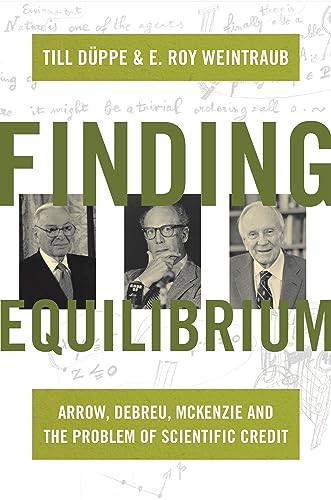
Finding Equilibrium explores the post-World War II transformation of economics by constructing a history of the proof of its central dogma--that a competitive market economy may possess a set of equilibrium prices. The model economy for which the theorem could be proved was mapped out in 1954 by Kenneth Arrow and Gerard Debreu collaboratively, and by Lionel McKenzie separately, and would become widely known as the "Arrow-Debreu Model." While Arrow and Debreu would later go on to win separate Nobel prizes in economics, McKenzie would never receive it. Till Düppe and E. Roy Weintraub explore the lives and work of these economists and the issues of scientific credit against the extraordinary backdrop of overlapping research communities and an economics discipline that was shifting dramatically to mathematical modes of expression.
Die Inhaltsangabe kann sich auf eine andere Ausgabe dieses Titels beziehen.
Über die Autorin bzw. den Autor
Till Düppe is assistant professor of economics at the Université du Québec à Montréal. He is the author of The Making of the Economy. E. Roy Weintraub is professor of economics at Duke University. He is the author of How Economics Became a Mathematical Science.
Von der hinteren Coverseite
"Düppe and Weintraub have written a powerful book that is both a marvelous introduction to modern economics for all who want to know what mathematical economists are up to, and a deep, textured account of the paths Arrow, Debreu, and McKenzie followed on their way to general equilibrium theory. A thoughtful mix of biography, intellectual history, and mathematical expertise,Finding Equilibrium invites us into the moments that proved decisive for economics as it exists today."--Peter Galison, author ofEinstein's Clocks, Poincaré's Maps
"A fascinating account of one of the central quests of modern economics--finding general conditions under which the existence of a competitive equilibrium is assured. Offering remarkable insights into the workings of the economics profession, this book illuminates the interplay between the personalities of the researchers, the structure of their ideas, and the historical events of their time."--Jerry R. Green, Harvard University
"Lakatos used history to show us the informality of mathematics. Düppe and Weintraub use history to show us how personal mathematics is: how the commitments of economists, and their personalities, are expressed in their mathematical accounts. Three different economists, three different mathematics of general equilibria--this narrative brilliantly destabilizes any linear story about a central motif in the creation of modern economics."--Mary S. Morgan, London School of Economics and University of Amsterdam
"'Unputdownable' is a word more often used of novels than of books on general equilibrium theory, but it describes this book. Written in a style accessible to nonmathematicians,Finding Equilibrium makes fascinating reading for anyone interested in the rise of mathematical economics after the Second World War."--Roger Backhouse, author ofThe Ordinary Business of Life: A History of Economics from the Ancient World to the Twenty-First Century
"By focusing on what became one of the central theoretical endeavors in postwar economics--proving the existence of general market equilibrium--this important book investigates not just the transformation of economic theory, but also changes in the discipline of economics, the blurring of disciplinary boundaries, and the evolution of the economist's scientific persona."--Harro Maas, Utrecht University
Aus dem Klappentext
"Düppe and Weintraub have written a powerful book that is both a marvelous introduction to modern economics for all who want to know what mathematical economists are up to, and a deep, textured account of the paths Arrow, Debreu, and McKenzie followed on their way to general equilibrium theory. A thoughtful mix of biography, intellectual history, and mathematical expertise,Finding Equilibrium invites us into the moments that proved decisive for economics as it exists today."--Peter Galison, author ofEinstein's Clocks, Poincaré's Maps
"A fascinating account of one of the central quests of modern economics--finding general conditions under which the existence of a competitive equilibrium is assured. Offering remarkable insights into the workings of the economics profession, this book illuminates the interplay between the personalities of the researchers, the structure of their ideas, and the historical events of their time."--Jerry R. Green, Harvard University
"Lakatos used history to show us the informality of mathematics. Düppe and Weintraub use history to show us how personal mathematics is: how the commitments of economists, and their personalities, are expressed in their mathematical accounts. Three different economists, three different mathematics of general equilibria--this narrative brilliantly destabilizes any linear story about a central motif in the creation of modern economics."--Mary S. Morgan, London School of Economics and University of Amsterdam
"'Unputdownable' is a word more often used of novels than of books on general equilibrium theory, but it describes this book. Written in a style accessible to nonmathematicians,Finding Equilibrium makes fascinating reading for anyone interested in the rise of mathematical economics after the Second World War."--Roger Backhouse, author ofThe Ordinary Business of Life: A History of Economics from the Ancient World to the Twenty-First Century
"By focusing on what became one of the central theoretical endeavors in postwar economics--proving the existence of general market equilibrium--this important book investigates not just the transformation of economic theory, but also changes in the discipline of economics, the blurring of disciplinary boundaries, and the evolution of the economist's scientific persona."--Harro Maas, Utrecht University
Auszug. © Genehmigter Nachdruck. Alle Rechte vorbehalten.
Finding Equilibrium
Arrow, Debreu, Mckenzie and the Problem of Scientific Credit
By Till Düppe, E. Roy WeintraubPRINCETON UNIVERSITY PRESS
Copyright © 2014 Princeton University Press
All rights reserved.
ISBN: 978-0-691-15664-4All rights reserved.
Contents
Preface, ix,
Chronology, xxiii,
Part I People, 1,
Chapter 1 Arrow's Ambitions, 3,
Chapter 2 McKenzie's Frustrations, 24,
Chapter 3 Debreu's Silence, 47,
Part II Context, 65,
Chapter 4 Sites, 67,
Chapter 5 Community, 98,
Part III Credit, 129,
Chapter 6 Three Proofs, 131,
Chapter 7 Aftermath, 172,
Chapter 8 The Proofs Become History, 204,
Conclusion, 231,
Coda, 245,
Acknowledgments, 249,
References, 251,
Index of Names, 267,
Index of Subjects, 273,
CHAPTER 1
ARROW'S AMBITIONS
Kenneth Arrow was never shy about engaging his past. In contrast to our other two protagonists, he gave a large number of interviews and on various occasions written sketches of different portions of his life and the development of his interests. Likely his openness to interviewers and biographers is the result of his ebullience and his lifelong interest in thinking about how ideas develop and how individuals' natures are formed. At the same time Arrow was hesitant about claiming the last word about his past. When asked to write about his "life philosophy" he began, "it is part of my life philosophy that no life can ever be examined fully and that attempts to do so are never free of self-deception.... Like the state in which I live, we plan and build on ground that may open beneath us" (1992, 42). Accordingly, the historian who undertakes to add another account to Arrow's self-accounts will wish neither to repeat them nor to reconstruct a self that is hidden by these self-deceptions. Thus we ask: Where did Arrow's intellectual ambitions come from?
A Precocious Boyhood in New York (1921–40)
The first ground that opened beneath Arrow during his childhood was the Great Depression. He was born on August 23, 1921. Both of his parents had been born overseas and came to the United States as infants. They were both successful academically, as his mother graduated from high school and his father from college, not a usual event for immigrants in the 1900–1914 period. His father Harry's "family was very poor, [his] mother's hardworking and moderately successful shopkeepers" (Arrow, in Breit and Spencer 1995, 44). Arrow recalled that his father had some business successes fairly young and earned a law degree; he worked for a bank and as a result the family was fairly prosperous through the 1920s. With the Depression, his father lost his regular job and the family often had to sell household belongings in order to have money for food and rent and clothes. His father managed to do contract work for various legal firms from time to time in those years, but it wasn't until the end of the 1930s that the family began to reestablish itself economically.
Arrow was precocious. It was not simply that his school academic record was very strong, but he read extensively and deeply outside the school curriculum. He recalled that he read Bertrand Russell's Introduction to Mathematical Philosophy (1919) and other demanding books in philosophy, literature, and the sciences unrelated to his high school programs. On graduation he applied to Columbia University even though he was quite young (fifteen) compared to those who might have been his classmates. In an admission interview he asked the counselor about meeting the deadlines for financial aid decisions since he needed a scholarship in order to attend. The interviewer replied by telling him that he needn't bother about financial aid since he was not going to be admitted. In fact he was admitted, but the interviewer's comment had the effect of delaying the family's completing the scholarship application until after they heard about admission. By the time they realized what had happened it was too late for Arrow to apply for a scholarship. Many decades later Arrow discovered that his interviewer had been described by an historian as one of the most egregious anti-Semites in all of Ivy League education. Columbia, while not nearly as exclusionary with respect to Jews as were Harvard, Yale, and Princeton, had a numerus clausus (i.e., quota) arrangement to limit admissions of children of immigrant Jews living in the New York metropolitan region.
Without financial aid and with his family's own finances limited, Arrow applied to, and was accepted into, the City College of New York (CCNY). At that time, City College had free tuition for residents of the city, the result of earlier agreements and understandings that the prosperity of the city depended upon the education of its youth independent of their financial means. Admission was strictly by merit and Arrow was certainly meritorious. Moreover, CCNY was a commuter school so Arrow could live at home. CCNY was also, for the students especially, a particularly political cauldron. As the late Irving Kristol, the neoconservative editor and writer, recalled his student years at the City College:
Every alcove [of the City College lunchroom] had its own identity, there was the jock alcove ... there were alcoves for ROTC people—I don't think I ever met one—and then there was the Catholic alcove, the Newman Club. There was even, I am told, a Young Republican Club, but I don't think I ever met anyone who belonged to that club and maybe they didn't exist. But pretty much our life in City College was concentrated between alcove one and alcove two, the anti-Stalinist left and the Stalinist left. And that was our world, at least our intellectual universe. (Kristol, in Dorman 1998, 46–47)
Arrow was not so politically engaged as a student but was interested in many different subjects, and early on he decided that he would major in mathematics with the long-term objective of becoming a high school mathematics teacher: "I was concerned about getting a job. I didn't look beyond college very much at that point. All I wanted was security" (Arrow, in Horn 2009, 63). In that Depression period, secure civil service employment in the New York City public schools seemed reasonable to both him and his family. As a result, in his undergraduate program he took not only a lot of mathematics courses but also courses in education, and he did student intern teaching as well. In Arrow's case, that teaching consisted of conducting preparation classes for high school students who wished to overcome their initial failure on the New York State Regents exam through a retest process. He recalled that his students were the most motivated he had ever come across: "It was the biggest teaching success of my entire life" (ibid., 64). He loved teaching but a difficulty emerged: in 1932 the education administrators had constructed a list of qualified teachers from whom future recruits to the teaching profession would be drawn. The idea was that as teachers left the schools, those at the top of the list would be hired. But during the Depression teachers were not resigning to take other jobs. No new names, like that of Kenneth Arrow, could be added to the list until that preexisting pool of candidates had been drawn down. At least a year before his graduation, Arrow realized that he would not be able to find a job teaching high school mathematics. What was he to do?
In the summer after his junior year Arrow found work as an actuarial intern, even though he realized that if he wished to pursue this...
„Über diesen Titel“ kann sich auf eine andere Ausgabe dieses Titels beziehen.
Suchergebnisse für Finding Equilibrium: Arrow, Debreu, McKenzie and the...

Beispielbild für diese ISBN
Finding Equilibrium: Arrow, Debreu, McKenzie and the Problem of Scientific Credit
Verlag:
Princeton University Press, 2014
ISBN 10: 0691156646
ISBN 13: 9780691156644
Gebraucht
Hardcover
Anbieter: World of Books (was SecondSale), Montgomery, IL, USA
Verkäuferbewertung 5 von 5 Sternen

Zustand: Very Good. Item in very good condition! Textbooks may not include supplemental items i.e. CDs, access codes etc. Artikel-Nr. 00107160937
Gebraucht kaufen
EUR 17,96
Versand gratis
Versand innerhalb von USA
Versand innerhalb von USA
Anzahl: 3 verfügbar
Beispielbild für diese ISBN
Finding Equilibrium
Anbieter: PBShop.store UK, Fairford, GLOS, Vereinigtes Königreich
Verkäuferbewertung 5 von 5 Sternen
HRD. Zustand: New. New Book. Shipped from UK. Established seller since 2000. Artikel-Nr. WP-9780691156644
Neu kaufen
EUR 48,18
EUR 5,86 Versand
Versand von Vereinigtes Königreich nach USA
Versand von Vereinigtes Königreich nach USA
Anzahl: 7 verfügbar
Beispielbild für diese ISBN
Finding Equilibrium
Anbieter: PBShop.store US, Wood Dale, IL, USA
Verkäuferbewertung 5 von 5 Sternen
HRD. Zustand: New. New Book. Shipped from UK. Established seller since 2000. Artikel-Nr. WP-9780691156644
Beispielbild für diese ISBN
Finding Equilibrium: Arrow, Debreu, McKenzie and the Problem of Scientific Credit
Anbieter: Kennys Bookstore, Olney, MD, USA
Verkäuferbewertung 5 von 5 Sternen
Zustand: New. Explores the post-World War II transformation of economics by constructing a history of the proof of its central dogma - that a competitive market economy may possess a set of equilibrium prices. Num Pages: 304 pages, 11 halftones. BIC Classification: KCA; KCZ; PDX. Category: (P) Professional & Vocational; (U) Tertiary Education (US: College). Dimension: 237 x 161 x 24. Weight in Grams: 560. . 2014. Hardcover. . . . . Books ship from the US and Ireland. Artikel-Nr. V9780691156644
Neu kaufen
EUR 55,23
EUR 9,15 Versand
Versand innerhalb von USA
Versand innerhalb von USA
Anzahl: 1 verfügbar
Beispielbild für diese ISBN
Finding Equilibrium: Arrow, Debreu, McKenzie and the Problem of Scientific Credit
Anbieter: Majestic Books, Hounslow, Vereinigtes Königreich
Verkäuferbewertung 4 von 5 Sternen

Zustand: New. pp. 312. Artikel-Nr. 95998530
Neu kaufen
EUR 56,87
EUR 7,58 Versand
Versand von Vereinigtes Königreich nach USA
Versand von Vereinigtes Königreich nach USA
Anzahl: 3 verfügbar
Beispielbild für diese ISBN
Finding Equilibrium: Arrow, Debreu, McKenzie and the Problem of Scientific Credit
Anbieter: Ria Christie Collections, Uxbridge, Vereinigtes Königreich
Verkäuferbewertung 5 von 5 Sternen
Zustand: New. In English. Artikel-Nr. ria9780691156644_new
Neu kaufen
EUR 54,12
EUR 13,17 Versand
Versand von Vereinigtes Königreich nach USA
Versand von Vereinigtes Königreich nach USA
Anzahl: 7 verfügbar
Beispielbild für diese ISBN
Finding Equilibrium Arrow, Debreu, McKenzie and the Problem of Scientific Credit
Anbieter: Revaluation Books, Exeter, Vereinigtes Königreich
Verkäuferbewertung 5 von 5 Sternen
Hardcover. Zustand: Brand New. 296 pages. 9.25x6.25x1.00 inches. In Stock. Artikel-Nr. __0691156646
Neu kaufen
EUR 59,49
EUR 14,58 Versand
Versand von Vereinigtes Königreich nach USA
Versand von Vereinigtes Königreich nach USA
Anzahl: 2 verfügbar
Beispielbild für diese ISBN
Finding Equilibrium Arrow, Debreu, McKenzie and the Problem of Scientific Credit
Anbieter: Revaluation Books, Exeter, Vereinigtes Königreich
Verkäuferbewertung 5 von 5 Sternen
Hardcover. Zustand: Brand New. 296 pages. 9.25x6.25x1.00 inches. In Stock. Artikel-Nr. x-0691156646
Neu kaufen
EUR 86,72
EUR 14,58 Versand
Versand von Vereinigtes Königreich nach USA
Versand von Vereinigtes Königreich nach USA
Anzahl: 2 verfügbar
Foto des Verkäufers
Finding Equilibrium
Anbieter: moluna, Greven, Deutschland
Verkäuferbewertung 5 von 5 Sternen
Zustand: New. Explores the post-World War II transformation of economics by constructing a history of the proof of its central dogma - that a competitive market economy may possess a set of equilibrium prices.Finding Equilibrium explores the post-World War II transfo. Artikel-Nr. 5948524
Neu kaufen
EUR 67,54
EUR 48,99 Versand
Versand von Deutschland nach USA
Versand von Deutschland nach USA
Anzahl: Mehr als 20 verfügbar
Foto des Verkäufers
Finding Equilibrium : Arrow, Debreu, McKenzie and the Prolem of Scientific Credit
Verlag:
Princeton University Press Jul 2014, 2014
ISBN 10: 0691156646
ISBN 13: 9780691156644
Neu
Hardcover
Anbieter: AHA-BUCH GmbH, Einbeck, Deutschland
Verkäuferbewertung 5 von 5 Sternen
Buch. Zustand: Neu. Neuware - Finding Equilibrium explores the post-World War II transformation of economics by constructing a history of the proof of its central dogma--that a competitive market economy may possess a set of equilibrium prices. The model economy for which the theorem could be proved was mapped out in 1954 by Kenneth Arrow and Gerard Debreu collaboratively, and by Lionel McKenzie separately, and would become widely known as the 'Arrow-Debreu Model.' While Arrow and Debreu would later go on to win separate Nobel prizes in economics, McKenzie would never receive it. Till Düppe and E. Roy Weintraub explore the lives and work of these economists and the issues of scientific credit against the extraordinary backdrop of overlapping research communities and an economics discipline that was shifting dramatically to mathematical modes of expression. Artikel-Nr. 9780691156644
Neu kaufen
EUR 127,19
EUR 30,50 Versand
Versand von Deutschland nach USA
Versand von Deutschland nach USA
Anzahl: 1 verfügbar