
Verwandte Artikel zu The Emperor Nero: A Guide to the Ancient Sources
Inhaltsangabe
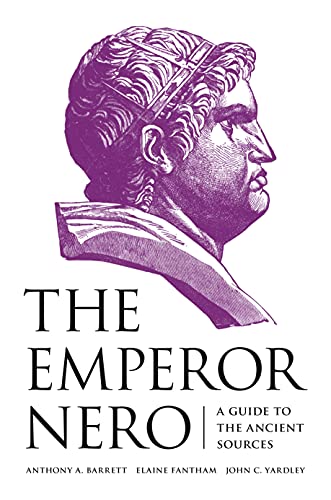
The Emperor Nero features clear, contemporary translations of key literary sources along with translations and explanations of representative inscriptions and coins issued under Nero. An informative introduction situates the emperor's reign within the history of the Roman Empire, and concise headnotes to chapters place the source material in historical and biographical context. Passages are accompanied by detailed notes and are organized around events, such as the Great Fire of Rome, or by topic, such as Nero's relationships with his wives. Complex events like the war with Parthia - split up among several chapters in Tacitus - are brought together in continuous narratives, making this the most comprehensible and user-friendly sourcebook on Nero available.
Die Inhaltsangabe kann sich auf eine andere Ausgabe dieses Titels beziehen.
Über die Autorin bzw. den Autor
Anthony A. Barrett is professor emeritus of classics at the University of British Columbia. His books include Livia: First Lady of Imperial Rome. Elaine Fantham is the Giger Professor of Latin, emerita, at Princeton University. Her books include Roman Literary Culture: From Plautus to Macrobius. John C. Yardley is professor emeritus of classics and religious studies at the University of Ottawa. His books include Alexander the Great: Historical Sources in Translation.
Von der hinteren Coverseite
"The most learned sourcebook I have ever seen."--Miriam T. Griffin, author of Nero: The End of a Dynasty
"This extremely well-informed and judicious sourcebook collates the most important evidence on the life and reign of the emperor Nero. No one has organized this material in this way before and provided such a rich and accessible commentary on these difficult sources."--T. Corey Brennan, author of The Praetorship in the Roman Republic
Auszug. © Genehmigter Nachdruck. Alle Rechte vorbehalten.
The Emperor Nero
A Guide to the Ancient Sources
By Anthony A. Barrett, Elaine Fantham, John C. YardleyPRINCETON UNIVERSITY PRESS
Copyright © 2016 Princeton University Press
All rights reserved.
ISBN: 978-0-691-15651-4All rights reserved.
Contents
Preface, vii,
Introduction, xi,
List of Major Events during Nero's Lifetime, xxvii,
I THE MAKING OF THE EMPEROR, 1,
II THE NEW EMPEROR, 22,
III ENEMIES WITHIN, 41,
IV PARTHIA, 77,
V BRITAIN AND GERMANY, 118,
VI THE GREAT FIRE, 149,
VII THE EMPEROR'S WIVES, 171,
VIII CONSPIRACIES, 190,
IX THE EMPEROR AS ARTIST AND SHOWMAN, 231,
X DEATH, 265,
Bibliography, 287,
Index, 295,
CHAPTER 1
THE MAKING OF THE EMPEROR
INTRODUCTION
It has often been observed that the primary weakness of the system established by Augustus was the absence of a clear formula for succession. It is certainly the case that after Julius Caesar every one of the Julio-Claudian emperors seemed at some early stage of his life to have been among the least likely candidates to become emperor. Augustus was an obscure student with a relatively modest family background when he learned that he had been adopted posthumously by Julius Caesar and made his subsequent bid for power. Tiberius enters the historical record as an infant when his parents were fleeing for their lives from Naples during the clashes between Antony and Octavian, and he almost betrayed their presence by crying. Even after his mother had married the future emperor, he spent a period of humiliating self-exile on the island of Rhodes, convinced that he was perpetually sidelined in the competition to succeed. Caligula might not even have escaped with his life had he been older. His two brothers were both put to death as a consequence of the bitter dynastic rivalries instigated largely by Sejanus. Caligula's successor, Claudius, who was neither a natural nor an adopted descendant of Augustus, had spent his youth hidden from public view and was so far from being a serious contender for the principate that he was considered an embarrassment to his family. By the end of Claudius's reign, Nero's father, a man noted for his mediocrity and laziness, was dead, and Nero's mother was in disgraced exile. Even after the succession of Claudius and the recall of Agrippina, Nero would spend his early youth in relative obscurity until the intrusion of his mother into the political scene in Rome.
Like Tiberius, Nero became emperor because of the single-minded and focused ambition of his mother (and, like Tiberius, he resented the idea that he owed his elevation to that agency). After her return from exile, Agrippina acquired a new husband, and presumably also acquired much of his considerable fortune upon his death. We cannot tell if she played any role in the downfall of Claudius's wife Messalina (whose behavior was so reckless that she in all likelihood brought about her own ruin, without any assistance from outside). But it is certainly the case that Agrippina saw the opportunity that the demise of Messalina offered, and exploited it relentlessly. She could provide Claudius with a much needed link to Augustus, since she was his granddaughter in a direct bloodline, and, with her son Nero, she enabled Claudius to take the wind out of the sails of any violent opposition to his reign by holding out the prospect of ultimately being succeeded by a direct Augustan descendant. Claudius was first and foremost a political animal, and if his political survival meant that his own natural son would be forced into a subordinate position, then that was a price he was willing to pay. Hence, after his marriage, which was technically illegal and required a special measure of the Senate because Agrippina was his brother's daughter, he agreed to adopt Nero. The adoption also necessitated a technical dispensation from the law, because Claudius already had a son. Claudius then agreed to his new son's marriage to his daughter Octavia, who was of course technically his sister and in yet another piece of legal legerdemain was adopted by another family to make the marriage legitimate. Claudius was prepared to overcome all of these formidable obstacles for his own self-preservation. Apparently, he did not stop to consider that these survival measures had the fatal flaw that while they made him more secure against external rivals, they generated a new rival in the form of the very individual meant to protect him, his adopted son Nero, and that once Claudius had, in the eyes of his wife, fulfilled his necessary role, she might be inclined, and the ancient sources generally agree that she was inclined, to play out her own role, that of a dynastic black widow spider.
Agrippina had in fact prepared the ground very skillfully. She removed the key supporters of Britannicus from his household staff, leaving him without close advisers and allies in any potential struggle for the succession that might ensue. Most importantly, she had, many years before the issue came to a head, ensured that her own man, Sextus Afranius Burrus, took command of the praetorian guard. Then, in an even more striking display of her capacity for carefully preparing the ground, over time she replaced the officers of the guard, the tribunes and centurions, with her own candidates, not by dismissing or demoting those not in her camp but more skillfully by bribing them with promotions to positions in the legions well away from Rome in the frontier regions. This meant that in December 54 the loyalty of the guard in Rome was a done deal. One can only speculate on how many of these same dislodged officers would still be serving, by then in senior positions, in AD 68, in legions that needed little urging to abandon Nero.
SOURCES
Suetonius provides information about Nero's general nature and appearance.
Suet. Ner. 51. Nero was of about average height, with a body that was blotchy and malodorous, hair that was almost blond, a face more agreeable than attractive, grey eyes that were rather weak, a thick neck, protruding stomach, spindly legs, and health that was robust. Indeed, despite his life of most decadent luxury, he was ill only three times during his fourteen-year reign, and even then not seriously enough to give up drinking or his other habits. In his personal grooming and dress, he was so outrageous as to have his hair always layered, and on his Achaean travels even let it grow long behind his head. He also frequently went out into the streets in dining attire, with a napkin tied around his neck and wearing no waistband or shoes.
52. When he was a boy, he engaged in practically all the liberal arts. His mother, however, turned him away from philosophy by warning him that it was not in a future emperor's interests, while his teacher Seneca, in order to prolong his student's admiration for him, steered him away from studying the orators of old.
Suetonius begins the Life of Nero with an account of the emperor's family background. Romans made much of the notion of inherited family traits and, by putting his focus on the shortcomings of Nero's ancestors, Suetonius seeks to suggest that his character failings were inherited. His narrative takes him down to the time of Nero's grandfather, Lucius Domitius Ahenobarbus, consul in 16 BC, whose marriage to Antonia the Elder, daughter of Mark Antony and Octavia, sister of Augustus, was a sure sign of the eminence that the family had acquired by the end of the Republic.
Suet. 5.1. By the elder Antonia, Domitius had as a son Nero's father, who was in...
„Über diesen Titel“ kann sich auf eine andere Ausgabe dieses Titels beziehen.
Suchergebnisse für The Emperor Nero: A Guide to the Ancient Sources

Beispielbild für diese ISBN
The Emperor Nero: A Guide to the Ancient Sources
Verlag:
Princeton University Press, 2016
ISBN 10: 0691156514
ISBN 13: 9780691156514
Gebraucht
Softcover
Anbieter: Phatpocket Limited, Waltham Abbey, HERTS, Vereinigtes Königreich
Verkäuferbewertung 5 von 5 Sternen

Zustand: Good. Your purchase helps support Sri Lankan Children's Charity 'The Rainbow Centre'. Ex-library, so some stamps and wear, but in good overall condition. Our donations to The Rainbow Centre have helped provide an education and a safe haven to hundreds of children who live in appalling conditions. Artikel-Nr. Z1-R-020-01898
Gebraucht kaufen
EUR 23,51
EUR 12,59 Versand
Versand von Vereinigtes Königreich nach USA
Versand von Vereinigtes Königreich nach USA
Anzahl: 1 verfügbar
Beispielbild für diese ISBN
The Emperor Nero
Anbieter: PBShop.store US, Wood Dale, IL, USA
Verkäuferbewertung 5 von 5 Sternen
PAP. Zustand: New. New Book. Shipped from UK. Established seller since 2000. Artikel-Nr. WP-9780691156514
Beispielbild für diese ISBN
The Emperor Nero
Anbieter: PBShop.store UK, Fairford, GLOS, Vereinigtes Königreich
Verkäuferbewertung 5 von 5 Sternen
PAP. Zustand: New. New Book. Shipped from UK. Established seller since 2000. Artikel-Nr. WP-9780691156514
Neu kaufen
EUR 35,12
EUR 5,94 Versand
Versand von Vereinigtes Königreich nach USA
Versand von Vereinigtes Königreich nach USA
Anzahl: 15 verfügbar
Beispielbild für diese ISBN
The Emperor Nero: A Guide to the Ancient Sources
Anbieter: Majestic Books, Hounslow, Vereinigtes Königreich
Verkäuferbewertung 4 von 5 Sternen

Zustand: New. pp. 280. Artikel-Nr. 373982404
Neu kaufen
EUR 45,94
EUR 7,69 Versand
Versand von Vereinigtes Königreich nach USA
Versand von Vereinigtes Königreich nach USA
Anzahl: 3 verfügbar
Beispielbild für diese ISBN
The Emperor Nero: A Guide to the Ancient Sources
Anbieter: Kennys Bookstore, Olney, MD, USA
Verkäuferbewertung 5 von 5 Sternen
Zustand: New. Editor(s): Barrett, Anthony A.; Fantham, Elaine; Yardley, John C. Num Pages: 280 pages, 11 halftones. 6 maps. BIC Classification: 1QDAR; 3D; BGH; GBC; HBJD; HBLA1. Category: (P) Professional & Vocational; (U) Tertiary Education (US: College). Dimension: 229 x 152. . . 2016. Paperback. . . . . Books ship from the US and Ireland. Artikel-Nr. V9780691156514
Neu kaufen
EUR 47,70
EUR 9,36 Versand
Versand innerhalb von USA
Versand innerhalb von USA
Anzahl: 20 verfügbar
Beispielbild für diese ISBN
The Emperor Nero: A Guide to the Ancient Sources
Anbieter: Ria Christie Collections, Uxbridge, Vereinigtes Königreich
Verkäuferbewertung 5 von 5 Sternen
Zustand: New. In English. Artikel-Nr. ria9780691156514_new
Neu kaufen
EUR 48,46
EUR 13,36 Versand
Versand von Vereinigtes Königreich nach USA
Versand von Vereinigtes Königreich nach USA
Anzahl: 20 verfügbar
Foto des Verkäufers
The Emperor Nero : A Guide to the Ancient Sources
Verlag:
Princeton University Press Jul 2016, 2016
ISBN 10: 0691156514
ISBN 13: 9780691156514
Neu
Taschenbuch
Anbieter: AHA-BUCH GmbH, Einbeck, Deutschland
Verkäuferbewertung 5 von 5 Sternen
Taschenbuch. Zustand: Neu. Neuware - The Emperor Nero features clear, contemporary translations of key literary sources along with translations and explanations of representative inscriptions and coins issued under Nero. An informative introduction situates the emperor's reign within the history of the Roman Empire, and concise headnotes to chapters place the source material in historical and biographical context. Passages are accompanied by detailed notes and are organized around events, such as the Great Fire of Rome, or by topic, such as Nero's relationships with his wives. Complex events like the war with Parthia - split up among several chapters in Tacitus - are brought together in continuous narratives, making this the most comprehensible and user-friendly sourcebook on Nero available. Artikel-Nr. 9780691156514
Neu kaufen
EUR 54,34
EUR 35,00 Versand
Versand von Deutschland nach USA
Versand von Deutschland nach USA
Anzahl: 2 verfügbar
Foto des Verkäufers
The Emperor Nero
Verlag:
Princeton University Press, 2016
ISBN 10: 0691156514
ISBN 13: 9780691156514
Neu
Kartoniert / Broschiert
Anbieter: moluna, Greven, Deutschland
Verkäuferbewertung 5 von 5 Sternen
Kartoniert / Broschiert. Zustand: New. The Emperor Nero features clear, contemporary translations of key literary sources along with translations and explanations of representative inscriptions and coins issued under Nero. An informative introduction situates the emperor s reign within the histo. Artikel-Nr. 128413758
Neu kaufen
EUR 40,72
EUR 48,99 Versand
Versand von Deutschland nach USA
Versand von Deutschland nach USA
Anzahl: Mehr als 20 verfügbar